Tag: virtual care

  • QI in Action eBulletin #100- Rx: Social Prescribing

    QI in Action eBulletin #100- Rx: Social Prescribing

    In collaboration with the Alliance for Healthier Communities

    In this Issue:

    • What is Social Prescribing?
    • What does Social Prescribing look like in practice?
    • Social prescribing: tools for equitable healthcare
    • Reminders
    • Upcoming Virtual Events

    What is Social Prescribing?

    Social prescribing is an evidence-based plan to address the social determinants of health, with focus on social isolation and loneliness. Importantly, social prescribing reduces reliance on expensive and inappropriate medical interventions and gives patients the confidence to manage their own health.

    Social Prescribing is:

    • A structured means of referring people who visit their doctor or nurse practitioner to a range of local, non-clinical services that seek to address people’s needs in a holistic way.
    • An asset-based approach that goes beyond treating illnesses, recognizing clients as people with a range of talents and non-medical needs.
    • A way to support individuals in taking greater control of their own health and enable them to engage with and contribute back to the community.
    A survey conducted with providers from the Alliance for Healthier Communities (n=31), identified 42% of participating providers report social prescribing has decreased the number of repeat visits by patients, and 84% of believe social prescriptions have improved their patient’s health.

    What does Social Prescribing look like in practice?

    Throughout the pandemic, many teams stayed open to meet the ongoing healthcare and social needs of their communities and clients. From your interviews and surveys (still open until Sept 18th!) we heard that the majority of teams reached out to vulnerable patients and made proactive check-in calls to screen for and support health and social needs. Humber River FHT conducted telephone outreach to assess social determinants of health and domestic safety. Central Lambton and Delhi FHTs worked directly with migrant workers to deliver trusted health and social care.
    Social prescribing is a way to capture, formalize and continue this work. It looks different in different communities, depending on local needs and capacity, but generally includes these 5 components:
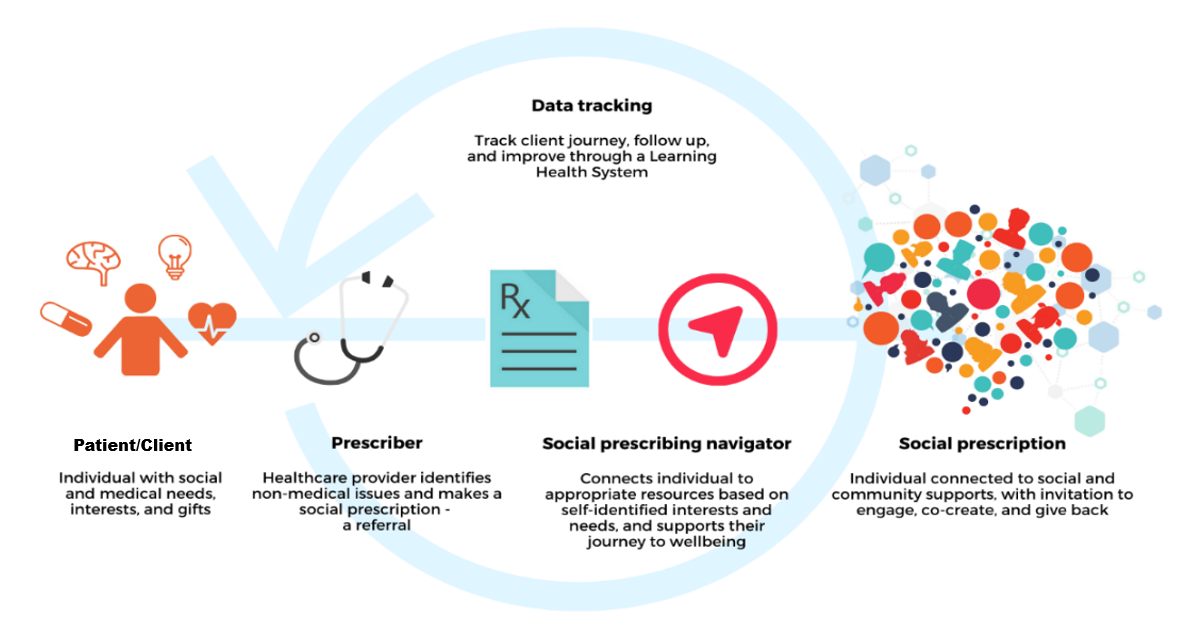
    Social prescribing components

    How are you using Social Prescribing in your team – let us know! Interested in learning more and implementing in your team? Join us at the AFHTO conference or drop us a line at improve@afhto.ca.

    Social prescribing: tools for equitable healthcare:

    Reminders:
    Responding to COVID-19: Understanding How Primary Care Teams Stepped up to Help Support Their Communities and Patients
    AFHTO in collaboration with Dr. Rachelle Ashcroft and Dr. Catherine Donnelly are conducting a research study to capture the efforts of all our members to ensure no story is left untold. This information will help influence and shape how teams will continue to adapt virtual care after the pandemic, as well as to meet patient needs.

    September 18th, 2020 is the last day to participate in a survey, don’t miss your chance to participate! Please click here to share your team’s story.

    Primary Care Patient/Client Virtual Care Experience Survey
    The Primary Care Patient/Client Virtual Care Experience Survey was created to help fill informational gaps to inform future planning and further support the implementation of virtual care in primary care. We also highly recommend you report back to AFHTO to support AFHTO’s Provincial Initiative. To further support practices in expanding and solidifying virtual care in primary health at a provincial-level, AFHTO will be collecting the practice-level aggregate responses to the survey.

    Upcoming Events

    Electronic Asthma Management System (eAMS) – Tool Demonstration Webinar
    Tuesday September 15, 2020 – 12:00 – 1:00 pm EDT
    The Electronic Asthma Management System (eAMS) is an evidence-based clinical decision support system developed to improve your ability to deliver best care for patients with asthma. Learn more about the tool by registering here.

    AFHTO 2020 Conference Tectonic shifts: rebuilding primary care in a new world
    Thursday, October 8, 2020 – Friday, October 9, 2020
    Before 2020, anyone with experience in Ontario’s healthcare system thought they knew what change meant. Now such changes seem almost a lifetime ago. COVID-19 has shifted our priorities with a focus on how to support our patients and our teams in new ways of delivering care. Primary care has risen to the challenge, but the ground is still shifting, and the future is uncertain. In short, we need to rebuild primary care for this new world.

    Register an individual or team for the conference here. Early-bird registration closes October 1, 2020.


    In Case You Missed It: Check out eBulletin #99 or other back issues here!
    Questions? Comments? Contact us at improve@afhto.ca.
     

  • Essex County NPLC receives COVID-19 grant to improve access to technology and enhanced digital services

    Essex County NPLC receives COVID-19 grant to improve access to technology and enhanced digital services

    The Essex County Nurse Practitioner-Led Clinic (ECNPLC) enhancing digital services to meet community needs.

    Essex County NPLC has received grant funding from the Canadian Red Cross, through the COVID-19 Emergency Support for Community Organizations Granting Program, to improve access to technology and enhanced digital services.

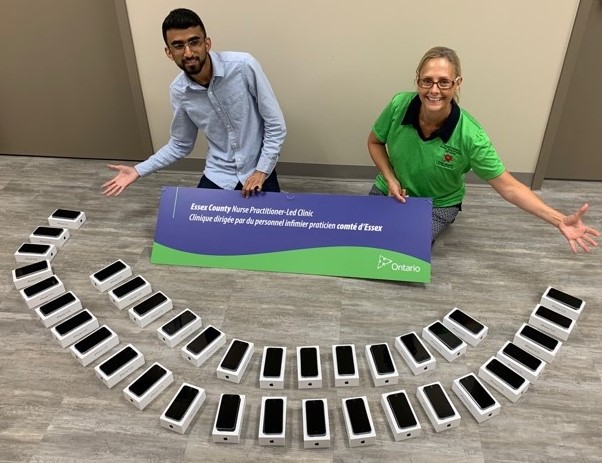
    Two Essex County NPLC staff show some of the devices to be used in the lending program

    The grant supports the Windsor Essex Health Program (WE Health). WE Health is a people first community-driven approach to addressing interruptions, reductions and the prevention of access and availability to primary and allied health services exacerbated by and resulting from the COVID-19 pandemic.

    The electronic device lending system (iPhone and tablet lending) and the creation of updated digital content, will allow people to access the live virtual appointments, one-on-one and group programming (substance use, physical, emotional and mental support programming), and pre-recorded digital material providing health information and helpful technique demonstrations.

    Digital service access supports the goal of accommodating services to meet community needs, while maintaining measures to prevent the spread of COVID-19. The program also bridges gaps between primary and allied health care providers transforming roadblocks into pathways that reduce systemic oppression.

    The inclusive multidisciplinary framework promotes unity, emphasizes the importance of commitment, shared responsibly for recognizing and addressing community needs, and identifies the people first approach as essential to overall community health. The grant will help with the purchase of 36 tablets, data services for the tablets, the production and distribution of up-to-date health videos. Please contact Elaine Coventry, MSW and Health Promoter, at 519-730-0446 for more information.

  • QI in Action eBulletin #99: Capturing Primary Care’s Response to COVID-19

    QI in Action eBulletin #99: Capturing Primary Care’s Response to COVID-19

    In this Issue:

    • Primary Care Patient/Client Experience Virtual Care Survey
    • Responding to COVID-19: Understanding How Primary Care Teams Stepped up to Help Support Their Communities and Patients
    • IHP Experience During the Early Phase of COVID-19
    • Upcoming Virtual Events

    Primary Care Patient/Client Virtual Care Experience Survey

    Primary Care Patient/Client Virtual Care Experience Survey


    The rapid adoption of virtual care during the pandemic not only addresses the current needs but it will most likely shape the future of primary care delivery, beyond the pandemic.

    As a result, the Association of Family Health Teams of Ontario (AFHTO) formed a working group with a number of primary care, health system and health research organizations to measure the patient/client experience with virtual care during the COVID-19 pandemic. These organizations included: Quality Improvement in Primary Care Council (QI in PC Council), Women’s College Hospital Institute for Health System Solutions and Virtual Care (WIHV), eHealth Centre of Excellence (eCE), Ontario Health (Quality) (OH(Q)), and Partnering for Quality.

    We created the Primary Care Patient/Client Virtual Care Experience Survey to help fill informational gaps to inform future planning and further support the implementation of virtual care in primary care. This survey can also be used for quality improvement purposes to allow providers to look at ways to improve their care delivery.

    For online surveys, a template survey for Microsoft Forms has been created that can be duplicated. If you will be using SurveyMonkey, please email Sandeep.gill@afhto.ca and a copy of the survey will be shared with you.

    Ocean (CognisantMD) is offering a free platform to patient experience data; however, please refer to this guide  to ensure that you have completed all the steps to qualify. For your convenience, eCE has created an Ocean eForm version of the survey, now available to be imported to your Ocean (CognisantMD) site. Instructions on how to import and configure the survey and data extraction can be found here.

    We also highly recommend you report back to AFHTO to support AFHTO’s Provincial Initiative. To further support practices in expanding and solidifying virtual care in primary health at a provincial-level, AFHTO will be collecting the practice-level aggregate responses to the survey. Please click here to find more information.

    Responding to COVID-19: Understanding How Primary Care Teams Stepped up to Help Support Their Communities and Patients
    Since the beginning of the COVID-19 pandemic, we’ve heard countless stories of our teams’ commitment, diligence and initiative to continue providing team-based primary care around the province. We’re here to ensure that your hard work gets noticed – but to do so, we need your help.

    AFHTO in collaboration with Dr. Rachelle Ashcroft and Dr. Catherine Donnelly are conducting a research study to capture the efforts of all our members to ensure no story is left untold. This information will help influence and shape how teams will continue to adapt virtual care after the pandemic, as well as to meet patient needs.

    Interviews end August 14- don’t miss your chance to participate! Please sign up for a 30-minute interview to share your team’s story.

    IHP Experience During the Early Phase of COVID-19
    At the beginning of pandemic Dr. Catherine Donnelly and Dr. Rachelle Ashcroft created a survey to capture the interprofessional health provider (IHP) experience as the transition to virtual care began. The objective of the study was to describe the state of IHP practice within primary care teams during the COVID-19 pandemic.

    Some of the preliminary findings of the study were that 48% of IHPs felt that teamwork collaboration increased during the pandemic, 18% of IHPs felt that it remained the same whereas 34% felt it decreased.

    Most of the IHPs delivered care to patients via phone. Before the pandemic this was the most popular mechanism of virtual care delivery. As the pandemic progressed and teams explored creative ways to outreach to patients, teams started to explore social media. The preliminary findings of this survey are that IHPs are the least confident with patient care delivery via social media compared to other virtual care options and in-person care.

    As the pandemic evolves so does the expertise of providers with virtual care. Dr. Catherine Donnelly and Dr. Rachelle Ashcroft will release another survey to capture the IHP experience at multiple time points. Stay tuned for the next survey!

    Upcoming Virtual Events
    211 Ontario – Connecting Patients to Community Programs and Services Webinar
    Thursday August 20, 2020 – 12:00 – 1:00 pm EDT
    A webinar about how 211 can assist Family Health Teams. 211 has been helping the people of Ontario navigate community, health, and social services for many years. Learn more about 211 Ontario by registering here.

    Electronic Asthma Management System (eAMS) – Tool Demonstration Webinar
    Tuesday September 15, 2020 – 12:00 – 1:00 pm EDT
    The Electronic Asthma Management System (eAMS) is an evidence-based clinical decision support system developed to improve your ability to deliver best care for patients with asthma. Learn more about the tool by registering here.

    AFHTO 2020 Conference Tectonic shifts: rebuilding primary care in a new world
    Thursday, October 8, 2020 – Friday, October 9, 2020
    Before 2020, anyone with experience in Ontario’s healthcare system thought they knew what change meant. Now such changes seem almost a lifetime ago. COVID-19 has shifted our priorities with a focus on how to support our patients and our teams in new ways of delivering care.

    Primary care has risen to the challenge, but the ground is still shifting, and the future is uncertain. In short, we need to rebuild primary care for this new world. Registration to open soon. Learn more here.


    In Case You Missed It: Check out eBulletin #98 or other back issues here!
    Questions? Comments? Contact us at improve@afhto.ca.
     

  • Update from the Primary Health Care Branch, transitions to a new normal, PPE, virtual care, and HR updates

    This email was sent to EDs/Administrative Leads, Board Chairs and Lead Clinicians of AFHTO member organizations.

    Dear triad members,

    To help us keep in touch this summer, we had a province-wide ED check-in call with ministry officials on July 22. Here is the follow-up information promised on the call. There were many questions and much discussion, so if you weren’t on the call, you can listen to the recording here.

    AFHTO maintains a strong relationship and works regularly with officials to ensure our members’ voices are heard, and we appreciate the time they give us to speak with you directly. Thank you to Allison Costello (Director, OHT Implementation and Supports Branch), Darlene Wong (A/Senior Manager, Interprofessional Programs Unit, PHCB), and Fernando Tavares (A/Program Manager, Interprofessional Programs Unit, PHCB) for being on the call.

    Update from the from the Ministry

    • The OHT Implementation and Supports Branch provided an update and said there would soon be more information on OHTs. The following day, on July 23, five new OHTs were announced and 17 were invited to full application. Congratulations to teams who are now an OHT candidate!
    • On July 23, the government also announced that they will be providing financial support to the 29 OHTs of up to $25.25 million. Of this funding, $9.5 million will be dedicated to virtual care; with the remaining $15.75 million, each OHT will receive up to $375,000. More information is here.
    • The Primary Health Care Branch (PHCB) confirmed there will be no additional operational funding available for FHT and NPLC budgets. However, it will be crucial for teams to report Q1 and Q2 accurately and to forecast for year-end to capture any COVID-related costs. The ministry will be using this data to understand the additional cost pressures facing teams, which will then be the basis used for additional funding requests. To help with forecasting the impact of the pandemic on your year-end budget, you can adapt and use the COVID-19 Expense Forecast Checklist.
    • A reminder that the 2020-21 Annual Operating Plan Submission package, released July 2, is due mid-September, although this due date is not firm. There is a webinar with the ministry on our site on how to complete AOP and Schedule A that may be helpful – please click here for the recording.

    Transitioning to a new normal

    PPE

      Virtual care

    Human Resources

    • AFHTO is arranging a webcast for late August that will provide guidance to boards on governance through COVID-19 and beyond. Stay tuned for registration details!
    • The ministry has rolled out pandemic pay to hospitals, long-term care homes, and retirements homes, and they are working on Ontario Health and municipalities. Teams that are leading FHT-run assessment centres should connect with their OH contact  at MOH.PPInquiries@ontario.ca to seek clarity on receiving their pandemic pay.
    • R&R funding was disbursed in April, and teams should be working on reallocating the increases. For guidance, please see the Recruitment and Retention Planning Document and the Compensation Guidance Document for more information. This is the last of the four-year commitment to R&R increases, and we will be looking at future compensation advocacy when the timing is right.

    Reminders!

    • HR webinar: The third webinar for executive directors on Managing HR through COVID-19 with Maria McDonald of McDonald HR Law is this Wednesday, July 29, at 11 AM. Registration will close end-of-day tomorrow, so please register now if you haven’t yet! This webinar’s for EDs only unless an ED requests otherwise.
    • Membership: The deadline for renewing AFHTO memberships is this Friday, July 31. Please contact Paula Myers with any questions. We hope we have proven of value to you this past year, and we will strive to continue to do so throughout the changes we are all experiencing.
    • ED interviews: AFHTO is working with our research partners to showcase how primary care has stepped up – and will continue to step up – to support Ontarians and to ensure a sustainable and equitable healthcare system. Thank you to all the EDs who have already had interviews with our researchers, and a reminder to other EDs to please schedule your interview


    As discussed on the call, here is a link to Shared Service Agreements that teams can use between organizations and with unaffiliated physicians. These are templates provided by Cottage Country FHT and would require legal review before finalisation for any teams.

    Keep checking out our COVID-19 section that we regularly update with news, tools, and resources, including the daily situation reports and regular memos from the ministry’s command table.

    We will be in touch late August or early September about resuming monthly regional ED calls in the fall if teams feel they would still be of value.

    Please contact us any time. We’re here to support you.

    Sincerely,

    Your AFHTO Team

  • Update from the Primary Health Care Branch, transitions to a new normal, PPE, virtual care, and HR updates

    This email was sent to EDs/Administrative Leads, Board Chairs and Lead Clinicians of AFHTO member organizations.

    Dear triad members,

    We held our fifth round of regional ED calls on June 29 and 30. We’ve been holding these calls since March, and we will be pausing them for the summer as people break and prepare for the fall. We will look at resuming regular calls in September. To ensure we keep in touch, we will be arranging a province-wide ED call with ministry officials for the end of July or early August. Stay tuned for details!

    A third webinar for executive directors on Managing HR through COVID-19 with Maria McDonald of McDonald HR Law has been confirmed for July 29. Please see the HR section of this communique for registration details.

    Below is information on the topics discussed on the recent calls and on supports that we heard would be helpful.

    Update from the Primary Health Care Branch

    • The 2020-21 Annual Operating Plan Submission package was released on July 2 with a due date of mid-September. In recognition of the challenges posed by the COVID-19 pandemic, the ministry is being flexible with the timeline and is not imposing a specific due date. A few years ago, AFHTO held a webinar with the ministry on how to complete AOP and Schedule A that newer EDs may find helpful – please click here for this archived recording.
    • It is going to be crucial for teams to report Q1 and Q2 accurately and to forecast for year-end as best they can to capture any COVID-related costs, such as PPE and IT. The ministry will be using this data to understand the additional cost pressures facing teams. This will be the basis used for additional funding requests. To help with forecasting the impact of the pandemic on your budget, you can adapt and use the COVID-19 Expense Forecast Checklist.
    • The FHT contract is set to expire in 2022. We hope to start work in the fall with the ministry to scope out opportunity for change and improvement through modifications to the contract.
    • AFHTO is also hoping to meet with the anti-racism directorate at the ministry to explore ways AFHTO and teams can help further address anti-racism and social determinants of health.

    Transitioning to a new normal

    PPE

    • PPE supply remains a concern. Many teams indicated they have a 1- to 3-month supply, but many others also indicated only a 1- to 3-week supply. Most teams expressed concern about PPE quantity for increasing in-person visits and a possible second wave in the fall.
    • Primary care is now included and recognized as a priority sector in the in OH’s ethical framework document used to guide distribution of the provincial PPE supply. However, the process for acquiring PPE through the regional tables appears to be inconsistent across the province, and even within regions. OH North has initiated a primary care PPE start-up allocation, and primary care entities in OH West have been successfully receiving PPE supplies regionally; however, access seems to vary across sub-regions.
    • Teams are encouraged to connect with their Regional Table Leads for PPE and Critical Supplies to access this inventory if regular supply chains are unavailable.  
    • AFHTO will continue to advocate for a consistent and sustainable long-term approach based on regional coordination.
    • We encourage teams to check out the resources posted on our site.

      Virtual care

    Human Resources

    • On June 24, AFHTO circulated a Temporary Pandemic Pay update and confirmed that eligibility of workers does include primary care team members who are redeployed to the COVID-19 assessment centres and other eligible workplaces (i.e. hospitals, long-term care homes, retirement homes).
    • The ministry will be rolling out pandemic pay funds through existing TPAs shortly. Teams that are leading FHT-run assessment centres should connect with their OH contact  at MOH.PPInquiries@ontario.ca to seek clarity on receiving their pandemic pay.
    • There will be two webcasts this summer:
      • There will be a webinar for EDs on Wednesday, July 29, at 11 AM with Maria McDonald, McDonald HR Law, to discuss ongoing topics of concern around employer obligations, including matters related to staff challenges with childcare and mental health. A portion of the webinar will be to address pre-submitted questions. You can register for the webinar and submit your questions here. Webinar registration will require approval, which EDs will receive from AFHTO within 24-48 hours of registration. Registration will close end of day Tuesday, July 28.
      • AFHTO is organising a webinar that will provide guidance to boards on governance throughout COVID-19 and beyond. This will include guidance on the role of the board in resumption of services, what governors should know about the direction of OHTs, and where to go from here. Stay tuned for details!
    • A reminder that R&R funding was disbursed in April, and teams should be working on reallocating the increases. For guidance, please see the Recruitment and Retention Planning Document and the Compensation Guidance Document.

    AFHTO is working with partners to showcase how primary care has stepped up – and will continue to step up – to support Ontarians and to ensure a sustainable and equitable healthcare system. We have received ethics approval from the Office of Research and Innovation at the University of Toronto to proceed with our research project entitled COVID-19: Understanding how primary care teams stepped up to help support their communities and patients.

    We ask all EDs to spare up to 30 minutes for an interview with one of the researchers who is working with us on this project. We will send a poll out shortly to schedule a time for a call. The calls will happen throughout July and August.

    Keep checking out our COVID-19 section that we regularly update with news, tools, and resources, including the daily situation reports and regular memos from the ministry’s command table.

    Please contact us any time. We’re here to support you.

    Sincerely,

    Your AFHTO Team

  • 2020 Conference Themes

    2020 Conference Themes

    Tectonic shifts: rebuilding primary care in a new world
    (more…)

  • Transitions to a new normal, PPE, virtual care, and HR updates

    This email was sent to EDs/Administrative Leads, Board Chairs and Lead Clinicians of AFHTO member organizations.

    Dear triad members,

    AFHTO’s Leadership Council met on June 3, and executive directors joined our fourth round of regional ED calls on June 1 and 2. This communique is in follow-up to those meetings.

    Below is information on the topics discussed on the calls, as well as other updates and supports that we heard would be helpful.

    Transitioning to a new normal

    PPE

      Virtual care

    • On May 20, AFHTO held a webinar on virtual visits with a panel of providers: “Virtual Visits: Beginning to End.” With close to 300 individuals participating in the webinar, we did not have a chance to answer all the questions, so a follow-up Q&A, along with the recording and the presentation, are posted online.
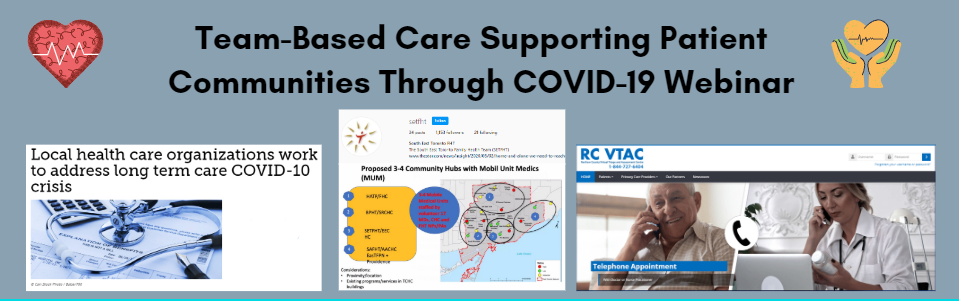
    • We are pleased to be hosting our next virtual care webinar this Thursday, June 11, at 12 PM. We’ll be hearing from teams across the province on innovative work they’re doing in the “Team-based Care Supporting Patient Communities through COVID-19” webinar. Register here!
    • For providers working remotely, more information can be found here to help with privacy and security concerns, as well as some of the VoIP options that teams are using.
    • Primary care teams have adapted to virtual care almost overnight and are leading patient-centric innovations in their community. Take a moment and learn more about what teams across the province are doing, and please share your initiatives with us at improve@afhto.ca.
    • Work is still underway with our primary care partners to roll out a provincial primary care patient survey and provider survey to measure the virtual care experience during the pandemic – stay tuned for more information on that!
    • The ministry is seeking feedback for its Digital health interoperability – proposed amendments to O. Reg. 329/04. The deadline for feedback is July 22, 2020.

    Human Resources

    • On May 25, AFHTO signed a joint letter to the premier regarding pandemic pay and the lack of clarification on how it would work and to whom it would apply. On May 29, the province released information on pandemic pay eligibility – the slide deck outlining this can be seen here. AFHTO can confirm the following:
      • Primary care team members (NPs, RNs, RPNs) that have been redeployed to work in the COVID-19 assessment centres, long-term care homes, retirement homes, and hospitals WILL be eligible for the pandemic pay.
      • Any other team members redeployed (administration, social workers, etc.), are not eligible for the pay. The eligible workers can be found on page 4 of the slide deck.
      • Page 9 outlines how the pay will be paid out:
        • Staff member redeployed from an ineligible employer to an eligible employer (e.g. private sector to hospital):
          • Will be paid by the home employer
          • Funds will be paid to receiving employer who will provide funds to home employer under agreement
      • Pandemic pay is an additional $4/hr from April 24 to August 13. An additional $250 monthly stipend applies to frontline staff working at least 40 hours a week in areas considered high risk.
      • The ministry is hoping to roll out the funds through already existing Transfer Payment Agreements in the next two weeks. They will be releasing a FAQs document Tuesday/Wednesday this week to address questions, including logistics for the payment.
    • Teams can also use the 10% exemption of payroll taxes to acknowledge staff efforts or recognize those whose responsibilities have increased. One-time bonuses or compensation increases are under the purview of each board, and COVID-specific policies would be needed.
    • A reminder to check out the presentation, recording, and documents provided by Maria McDonald, McDonald HR Law, during our recent webcast, “Managing HR and Supporting Staff through COVID-19.”
    • A reminder that R&R funding was disbursed in April, and teams should be working on reallocating the increases. For guidance, please see the Recruitment and Retention Planning Document and the Compensation Guidance Document.

    As re-opening gradually resumes and we reassess how health care is delivered – both from the impact of this pandemic and the ongoing development of Ontario Health Teams – it is critical to show how team-base primary care is a pillar in a strong healthcare system, and that it is the delivery of comprehensive care to individuals that contributes towards the best population health.

    In the midst of a pandemic, there is no better time to demonstrate this. AFHTO is working with our partners to showcase how primary care has stepped up – and will continue to step up – to support Ontarians and to ensure a sustainable and equitable health care system.

    As noted in the last communique, to capture the primary care experience, we will be reaching out to schedule interviews with executive directors. We have interviewed a researcher and we hope to start calls in late June. The research we are undertaking will provide a narrative of how essential team-based primary care was during the pandemic, and how critical it will continue to be moving forward.

    Keep checking out our COVID-19 section that we regularly update with news, tools, and resources, including the daily situation reports and regular memos from the ministry’s command table.

    We’ll continue to keep you updated, and we’ll arrange another round of check-in calls to happen in about 2-3 weeks’ time.

    Please contact us any time. We’re here to support you through this.

    Sincerely,

    Your AFHTO Team

  • QI in Action eBulletin #98: Team-Based Care Supporting Patient Communities Through COVID-19

    In this Issue:

    • Team Based Care Supporting Patient Communities Through COVID-19 Webinar

    • Virtual Visits: Beginning to End Q&A Document

    • QI Resources

    Team-Based Care Supporting Patient Communities Through COVID-19 Webinar

    Team-Based Care Supporting Patient Communities Through COVID-19 Webinar

    On June 11, 2020 (12-1pm EST) AFHTO, in collaboration with 3 primary care teams, will be hosting a webinar to share initiatives teams are currently doing to help support patients in their communities during COVID-19. Learn from these teams about how they created virtual care communities, helped long-term care homes, engaged with patients via social media and much more! Teams that will be presenting are South East Toronto FHT, Brockton Area and Kincardine FHTs, Arnprior & District FHT, North Renfrew FHT, West Champlain FHT, Madawaska Valley FHT and Petawawa Centennial Family Health Centre.

    COVID-19 Member initiatives table

    Register here for the webinar!


    We have also created a table highlighting the great work teams are doing! Help us grow this list by emailing improve@afhto.ca to share what your team is doing.

    Let’s make this into a webinar series! Email us at improve@afhto.ca to share what your team is doing. You may be featured in an upcoming webinar!


    Virtual Visits Q&A Document – One on One & Group Visits

    Virtual Visits Q&A Document

    On Wednesday, May 20 we held a discussion around virtual visits (one on one & group) with our expert panel. Panelists went through multiple components of how to conduct a virtual visit and a Q&A portion.

    The recording, slide deck and Q&A document for the webinar are available here. As a follow up AFHTO and the panelists have created a Q&A document for a few questions that were not covered such as:

    • How are providers conducting phone call visits remotely?
    • Is it necessary to repeat consent at every virtual visit?
    • How do you obtain consent for group programs?
    • What Mental Health Programs are being run virtually and open to the public?
    • What platforms are teams using for secure messaging?


    QI Resources
    Below are measurement and quality-related tools, resources, slides, and videos. You can flag these emails or bookmark the related posts, so they will be easy to find for future reference.


    In Case You Missed It: Check out eBulletin #97 or other back issues here!
    Questions? Comments? Contact us at improve@afhto.ca.

     

  • QI in Action eBulletin #98: Team-Based Care Supporting Patient Communities Through COVID-19

    QI in Action eBulletin #98: Team-Based Care Supporting Patient Communities Through COVID-19

    In this Issue:

    • Team Based Care Supporting Patient Communities Through COVID-19 Webinar

    • Virtual Visits: Beginning to End Q&A Document

    • QI Resources

    Team-Based Care Supporting Patient Communities Through COVID-19 Webinar

    Team-Based Care Supporting Patient Communities Through COVID-19 Webinar

    On June 11, 2020 (12-1pm EST) AFHTO, in collaboration with 3 primary care teams, will be hosting a webinar to share initiatives teams are currently doing to help support patients in their communities during COVID-19. Learn from these teams about how they created virtual care communities, helped long-term care homes, engaged with patients via social media and much more! Teams that will be presenting are South East Toronto FHT, Brockton Area and Kincardine FHTs, Arnprior & District FHT, North Renfrew FHT, West Champlain FHT, Madawaska Valley FHT and Petawawa Centennial Family Health Centre.

    COVID-19 Member initiatives table

    Register here for the webinar!


    We have also created a table highlighting the great work teams are doing! Help us grow this list by emailing improve@afhto.ca to share what your team is doing.

    Let’s make this into a webinar series! Email us at improve@afhto.ca to share what your team is doing. You may be featured in an upcoming webinar!


    Virtual Visits Q&A Document – One on One & Group Visits

    Virtual Visits Q&A Document

    On Wednesday, May 20 we held a discussion around virtual visits (one on one & group) with our expert panel. Panelists went through multiple components of how to conduct a virtual visit and a Q&A portion.

    The recording, slide deck and Q&A document for the webinar are available here. As a follow up AFHTO and the panelists have created a Q&A document for a few questions that were not covered such as:

    • How are providers conducting phone call visits remotely?
    • Is it necessary to repeat consent at every virtual visit?
    • How do you obtain consent for group programs?
    • What Mental Health Programs are being run virtually and open to the public?
    • What platforms are teams using for secure messaging?


    QI Resources
    Below are measurement and quality-related tools, resources, slides, and videos. You can flag these emails or bookmark the related posts, so they will be easy to find for future reference.


    In Case You Missed It: Check out eBulletin #97 or other back issues here!
    Questions? Comments? Contact us at improve@afhto.ca.
     

  • Bits & Pieces: virtual visits webinar materials, members’ stories & more

    Bits & Pieces: virtual visits webinar materials, members’ stories & more

    Your Weekly News & Updates


    In This Issue  
    • Virtual Visits: Beginning to End webinar materials now available
    • Members’ stories
    • Operational requirements for health sector restart and more
    • Questions Are the Answer- patient tips and tools
    • Educational supports for IPAC -Toronto region
    • Research participant recruitment – concussion telerehabilitation study
    • Upcoming events regarding mental health and more

    Virtual Visits: Beginning to End webinar materials now available

    On Wednesday, May 20 we held a discussion around virtual visits (one on one & group) with our expert panel. Panelists went through multiple components of how to conduct a virtual visit and a Q&A portion.

    The recording, slide deck and Q&A document for the webinar are available here. Please log into your AFHTO account first and then click again to access these resources. There were a few questions that were not covered so please find the Q&A document as a follow up in this link. All the resources mentioned within the webinar and in the document can also be found on the AFHTO website here.


    Members’ stories

    Oakridge Assessment Centre team, Thames Valley FHT

    Guelph FHT: Guelph FHT urges residents to not let pandemic stop them from seeking medical attention

    North Huron FHT: North Huron Family Health Team lays out guidelines for visiting local doctors

    North Simcoe FHT: North Simcoe FHT’s virtual-care clinic for orphan patients set to expand

    St. Michael’s Hospital Academic FHT: “It’s time we leveled the playing field”, Dr. Tara Kiran

    Promote your team: we regularly post about members on Twitter and Facebook, such as with the above picture from Thames Valley FHT. If you’re on either, please tag us if you’re promoting any programs, activities or good news. Otherwise, feel free to email us at info@afhto.ca with a picture and details if possible. We’re here to highlight how well you’re taking care of your communities right now.


    Operational requirements for health sector restart and more

    Last week the government released the following:

    We continue to update several pages on our site with resources and news:

    We’ll update these on a regular basis as we receive relevant resources, while trying to reduce duplication with other sources. We will continue to update the news page daily.


    Questions Are the Answer- patient tips and tools

    Questions Are the Answer helps patients effectively prepare for making decisions about medical treatment options by asking the right questions. It considers topics for before, during, and after appointments, using past, present, and future medicines, medical tests, and surgeries. You can share these tips and tools from the Canadian Patient Safety Institute with your patients.


    Educational supports for IPAC -Toronto region

    The Toronto region has a mental health and addictions working group, co-chaired by Catherine Zahn, CEO of CAMH, and Heather McDonald, CEO of LOFT Community Services. They have collaborated to develop a resource hub for high-value materials related to infection prevention and control in community settings. It is available on a public-facing website, EENet, so anyone can access.

    They have also created a webinar series hosted by the CAMH IPAC specialist for those in community settings to ask any IPAC-related questions. The webinars are held weekly on Mondays from 12:00 -12:30 pm and anyone can sign up to receive invites. You can sign up here.


    Research participant recruitment – concussion telerehabilitation study

    Researchers in the Department of Occupational Therapy at the University of Toronto are currently recruiting youth with concussion to participate in a study exploring the use of telerehabilitation for concussion management.

    Youth will participate in a 6-week rehabilitation program consisting of education, support and low-intensity exercise delivered by a kinesiologist or occupational therapist through weekly videoconferencing appointments.

    Who can participate?
    •    Youth (ages 13-18 years) experiencing concussion symptoms
    •    At least 2 weeks post-concussion

    For more information or to help with participant recruitment, please contact the research team at oaktelerehab@utoronto.ca or 416-946-3273.


    Ask Me Anything about Health Privacy, June 3, 2020

    Still have questions around Health privacy? Join Kate Dewhirst Law for another AMA. Register here.


    Overview of Managing Common COVID-19 Respiratory Symptoms in Palliative Care and End of Life – A Primer for Front Line Staff, June 4, 2020
    Familiarize yourself with respiratory symptom management in palliative care and end of life. Hosted by the HPCO and CHPCA. Learn more here.


    Re-opening, Warily: Re-Thinking Clinical Practice in a Time of Physical Distancing, June 3, 2020

    Choosing Wisely weekly virtual gatherings during COVID-19. Register in advance.


    Mental Health in the COVID-19 Pandemic (Psychiatric Dimensions of Disasters III), June 6, 2020

    Disaster Psychiatry Canada and University of Toronto Psychiatry are holding a free event for all healthcare professionals. Look forward to mental health discussions in 7 different sessions from morning to afternoon.
    Learn more here.


    Integrated Mental and Physical Health – ECHO Ontario Mental Health, June 5, 2020
    Join this 12-week program beginning on June 5 and ending August 28 to strengthen your capacity in integrated Mental and Physical Health. Learn more and register here.