Tag: Members Only

  • NEW privacy breach reporting rules effective Oct. 1 and NEW guidelines to support you in meeting them

    Effective October 1, 2017, health information custodians (HICs) will be required to report certain privacy breaches to the Information and Privacy Commissioner (IPC). The IPC has published new guidelines to support you in complying with these new rules. Please read them here and distribute them widely to all members of your team. The new guidelines outline the situations in which you must notify the commissioner of a privacy breach, including:

    • Use or disclosure of personal health information without authority
    • Stolen health information
    • Further unauthorized use or disclosure of health information after a breach
    • Pattern of similar breaches
    • Disciplinary action against an employee or agent of a custodian
    • Significant breaches that do not fall into one of the above categories

    Effective January 1, 2018, HICs will also be required to start tracking privacy breach statistics, and they will be required to provide the IPC with an annual report of the previous calendar year’s statistics beginning in March 2019. We will update you when the IPC releases detailed guidance on this statistical reporting requirement in the coming months. We are currently updating our privacy resources for AFHTO members, to further support you in complying with the new regulations. In the meantime, you may wish to review these two privacy tools developed for AFHTO members:

    For up-to-date privacy news and resources from Kate Dewhirst, check out the FHT category on her health privacy blog.

  • EMR queries for D2D – EMR Data Quality: Coded Diagnosis – Depression

    The EMR queries below were developed by QIDSS and the EMR Communities of Practice to help you extract data for submission to D2D.

    Telus PS Accuro Nightingale OSCAR P&P


    NOTE: All queries are tested and validated prior to release. However, changes that take place after the queries are released may affect how accurate they are.  Such changes could include EMR software updates, new medications, and changes to standard clinical definitions. They may result in false positives, that is, patients being flagged who do not have the specified condition. They may also result in false negatives, that is, patients not being flagged who do have the condition. Queries are also limited by the quality of your EMR data. 

    Telus PS

    The D2D EMR Data Quality Depression Coded v1 searches (.srx files) will extract data necessary to calculate the percent of patients with depression whose diagnosis is recorded with a code in the appropriate place in the EMR. Save these searches to your desktop and import into your EMR. You might need the help of your QIDSS, IT staff or other person who usually run queries in your EMR. This guide provides instructions on how to import the searches into your EMR. Screenshots of the query can be found here. Share you challenges and successes with improve@afhto.ca.

    Accuro 

    Please find the D2D EMR Data Quality Depression Coded v1 numerator and denominator queries on Publisher. You might need the help of your QIDSS, IT staff or any other person who usually run queries in your EMR. Share you challenges and successes with us.

    Nightingale 

    The D2D EMR Data Quality Depression Coded query has not been developed for Nightingale.

    OSCAR 

    Download the D2D EMR Data Quality DepressionCoded v2 queries to your computer and import into your EMR. You might need the help of your QIDSS, IT staff or any other person who usually run queries in your EMR. Share your challenges and successes with improve@afhto.ca.

    P&P 

    The D2D EMR Data Quality Depression Coded query has not been developed for P&P. Please contact improve@afhto.ca if you have a query for P&P that you’d like to share or if you have any suggestions for this work.

  • EMR queries for D2D – EMR Data Quality: Coded Diagnosis – COPD

    The EMR queries below were developed by QIDSS and the EMR Communities of Practice to help you extract data for submission to D2D.

    Telus PS Accuro Nightingale OSCAR P&P


    NOTE: All queries are tested and validated prior to release. However, changes that take place after the queries are released may affect how accurate they are.  Such changes could include EMR software updates, new medications, and changes to standard clinical definitions. They may result in false positives, that is, patients being flagged who do not have the specified condition. They may also result in false negatives, that is, patients not being flagged who do have the condition. Queries are also limited by the quality of your EMR data. 

    Telus PS 

    The D2D EMR Data Quality COPD Coded v1 searches (.srx files) will extract data neccessary to calculate the percent of patients with diabetes whose diagnosis is recorded with a code in the appropriate place in the EMR. Save these searches to your desktop and import into your EMR. You might need the help of your QIDSS, IT staff or other person who usually run queries in your EMR. This guide provides screenshots of the searches along with instructions on how to import the searches into your EMR. Share you challenges and successes with the Telus PS CoP or contact us.

    Accuro 

    Please find the D2D EMR Data Quality COPD Coded v1 numerator and denominator queries on Publisher. You might need the help of your QIDSS, IT staff or any other person who usually run queries in your EMR. Share you challenges and successes with the Accuro CoP or contact us.

    Nightingale 

    The D2D EMR Data Quality COPD has not been developed. Please contact us if you have a query for P&P that you’d like to share or if you have any suggestions for this work.

    OSCAR 

    Download the D2D EMR Data Quality COPD Coded v1 queries to your computer and import into your EMR. You might need the help of your QIDSS, IT staff or any other person who usually run queries in your EMR. Share your challenges and successes with the OSCAR CoP or contact us.

    P&P 

    The D2D EMR Data Quality COPD has not been developed. Please contact us if you have a query for P&P that you’d like to share or if you have any suggestions for this work.

  • EMR queries for D2D – EMR Data Quality: Coded Diagnosis – CHF

    The EMR queries below were developed by QIDSS and the EMR Communities of Practiceto help you extract data for submission to D2D.

    Telus PS Accuro Nightingale OSCAR P&P


    NOTE: All queries are tested and validated prior to release. However, changes that take place after the queries are released may affect how accurate they are.  Such changes could include EMR software updates, new medications, and changes to standard clinical definitions. They may result in false positives, that is, patients being flagged who do not have the specified condition. They may also result in false negatives, that is, patients not being flagged who do have the condition. Queries are also limited by the quality of your EMR data.

    Telus PS 

    The D2D EMR Data Quality CHF Coded v1 searches (.srx files) will extract data necessary to calculate the percent of patients with diabetes whose diagnosis is recorded with a code in the appropriate place in the EMR. Save these searches to your desktop and import into your EMR. You might need the help of your QIDSS, IT staff or other person who usually run queries in your EMR. This guide provides screenshots of the searches along with instructions on how to import the searches into your EMR. Share you challenges and successes with the Telus PS CoP or contact improve@afhto.ca.

    Accuro 

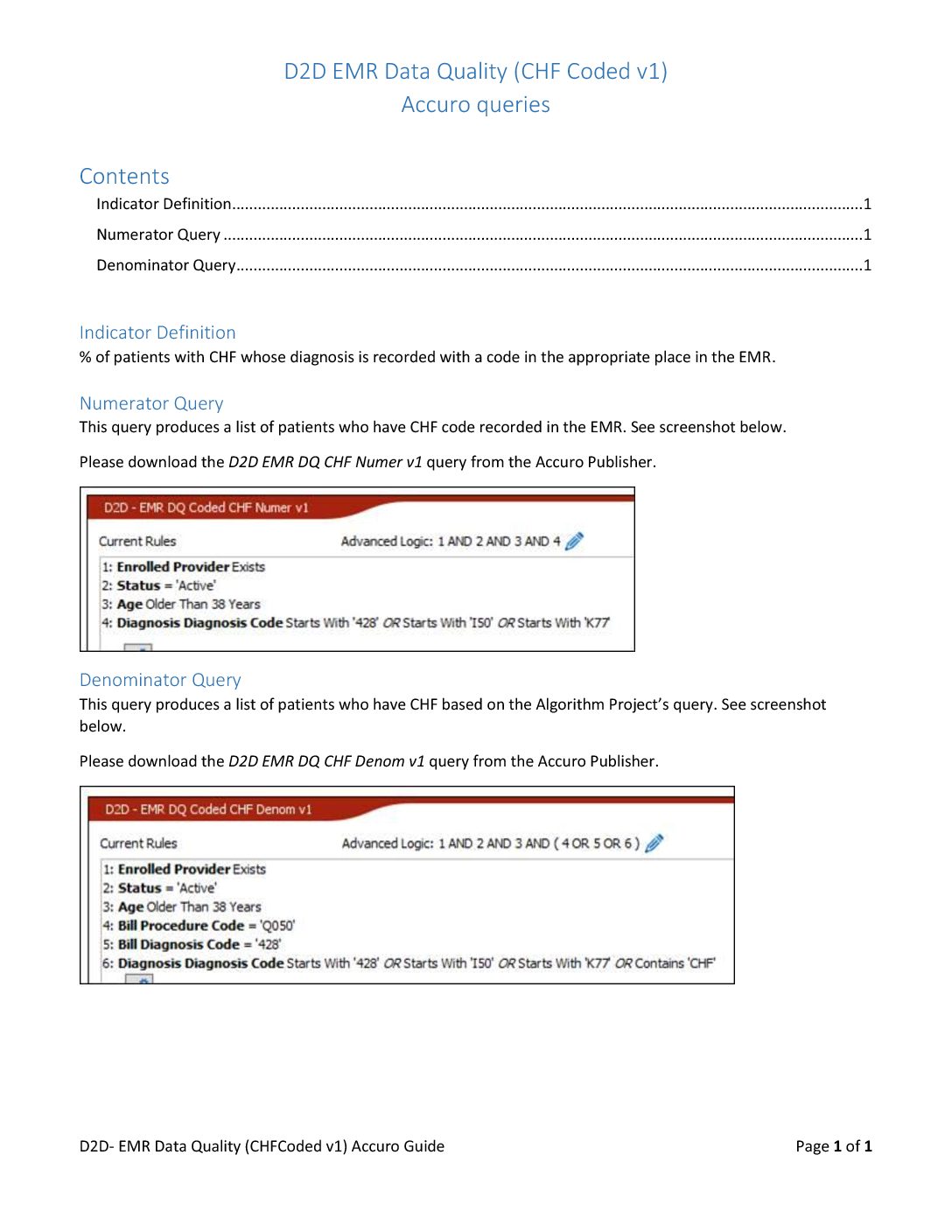
    Please find the D2D EMR Data Quality CHF Coded v1 numerator and denominator queries on Publisher. You might need the help of your QIDSS, IT staff or any other person who usually run queries in your EMR. Share you challenges and successes with the Accuro CoP or contact us.

    Nightingale 

    The D2D EMR data quality CHF coded denominator query has not been developed. Please contact us if you have a query for Nightingale that you’d like to share or if you have any suggestions for this work.

    OSCAR 

    Download the D2D EMR Data Quality CHF Coded v1 queries to your computer and import into your EMR. You might need the help of your QIDSS, IT staff or any other person who usually run queries in your EMR. Share your challenges and successes with the OSCAR CoP or contact improve@afhto.ca.

    P&P 

    The D2D EMR Data Quality Diabetes Coded query has not been developed. Please contact us if you have a query for P&P that you’d like to share or if you have any suggestions for this work.

  • Patient Oriented Discharge Summaries: Putting Patients at the Centre of Follow-Up Care

    Please consider sharing this with your Quality Committee, your clinical staff, site coordinators or anyone who is working in your team to make a difference with follow-up after hospitalization.  We understand that teams are sometimes frustrated in their efforts to provide meaningful follow-up for patients after they have been hospitalized.  AFHTO and research partners from the University Health Networks OpenLab are implementing a project that can help with that. The project is called Patient-Oriented Discharge Summaries (PODS) and is free to primary care providers. So far, it has been implemented across the province in 27 hospitals (and counting!).  It was funded by the Adopting Research to Improve Care (ARTIC) Program, which is run by the Council of Academic Hospitals of Ontario and Health Quality Ontario. ARTIC fast-tracks the adoption of proven health care interventions into broader clinical practice across the health system.

    What are PODS?

    Patient Oriented Discharge Summaries (PODS) are simple forms that ensure patients have the information they need before going home (see sample).  These forms were co-designed with patients and caregivers, and they are provided to patients when they are discharged from hospital. A PODS form contains five key pieces of information for the patient and their caregivers about what care the patient needs after they get home:

    • Signs and symptoms to watch out for
    • Medication instructions
    • Appointments
    • Routine and lifestyle changes
    • Telephone numbers and info to have handy

    PODS have already had positive results at hospitals where they have been implemented. Early results show that they have a positive impact on patient understanding and adherence to follow up appointments with primary care following discharge from hospital (read an article about it here).

    How can I get PODS for my patients?

    Primary care providers can get some of the benefits of PODS in a few different ways:

    1. Get in touch with your local participating hospital: see the list of hospitals who are already participating and contact the local lead to learn more about what they are doing.
    2. Get your hospital(s) on the project: If your local hospital is not participating in the project, perhaps you can persuade them to inquire. The PODS team would be happy to hear from them!
    3. Ask your patients if they received a PODS: If you know a patient has been in hospital, ask them if they have received a PODS and discuss it with them.
    4. Provide PODS handouts to your patients: If you are referring a patient for hospitalization, give them the PODS brochure so they can take action on their own behalf to get the information they need. You could do this even if your hospital is NOT participating in the project. Handouts will be ready in early fall and we welcome anyone who wants to design or co-brand them with us.
    5. Customize the PODS with your team/hospital logo: The PODS team will be happy to work with you to customize the form with your logo and local information.

    I need more information!

    Think you might be ready to get started, but want to know more? Check out the PODS Online Toolkit or email the research team. Want to learn more about how the PODS project is going? Check out their presentation at the AFHTO 2017 conference. Want to get better at tracking follow-up after hospitalization? Check out these ideas and resources from AFHTO.  

  • Paediatric Project ECHO: moving knowledge, not people

    The Hospital for Sick Children (SickKids) will be launching Paediatric Project ECHO (Extension for Community Healthcare Outcomes) in October 2017. Paediatric Project ECHO aims to connect community-based healthcare providers with specialists at SickKids, to build capacity in the community to care for paediatric patients. Paediatric Project ECHO expands the knowledge base of healthcare professionals through innovative virtual mentorship and collaboration. This model uses a combination of interactive videoconferencing, educational presentations, and hands-on boot-camps to enhance learning and build a supportive community of practice. Paediatric Project ECHO will concentrate on the following specialties: Pain, Bariatric Care, Complex Care and Palliative Care. All Ontario healthcare providers interested in any of these areas are invited to participate in the program at no cost. To help them meet your educational needs, please visit their site to complete the Needs Assessment. For more information or to register, please contact Sen Sivarajah at project.echo@sickkids.ca or call 416-813-7654 ext. 309664. To learn more about Project ECHO in Ontario visit www.echoontario.ca.

  • Participate in the QI Enablers Study

    Five iterations of D2D data show that some teams tend to improve more over time compared to others. AFHTO members want to know what some of the “tricks of the improvement trade” are so they can try them out in their own teams. This QI enablers study is aimed at learning more about what makes it easier or harder to improve so that all teams can take advantage of the wisdom from the field.

    What is the study about, and why? How will the study be done? When will the study happen?
    What we want to talk with teams about What we won’t ask teams about Frequently Asked Questions


    What is the study about and why?

    The QI Enablers study will be based on in-person interviews with teams. It will provide a snapshot of how teams think and work to get better at what they do. We will ask teams “what works and why” when they try to get better at what they do. Details on the interview process are outlined below. The study will describe what is happening with teams at a single point in time – ie it is not ongoing, the way that D2D is. The data from the interviews (which will mostly be in the form of stories) will be compared to D2D performance. This will point out any patterns between the stories of how teams work and their D2D scores which will provide hints regarding what works best to move beyond measurement to improvement. The key is to have teams from ALL stages of the QI journey so we can compare and contrast. We will share the stories first with the participating teams to confirm that we have heard them right. Then we will be sharing the collective wisdom from the stories with all members and also with external partners, so that everyone (AFHTO members and beyond) can learn together. The stories will be shared anonymously – unless a team is keen to see their name in lights, in which case we would happily oblige!

    How will the study be done?

    The team visits and interviews will be done by Carol Mulder, Provincial Lead for Quality Improvement and Decision Support and Laura Belsito, Clinical Knowledge Translation and Exchange Specialist, supported by any graduate students we are able to recruit and the QIDS program staff at AFHTO. We will spend about 4 hours at each team site, talking to whoever the team wants us to talk to.  We have put together a “straw dog” schedule to give teams a sense of who might be included. However, it is totally up to the team to decide who will meet with us to tell their story.  In addition, the conversations can take place in any order the team wants – ie Hour 1 doesn’t have to be the first hour if that doesn’t work for the team.

    • Hour 1: ED, Medical Lead and Board Chair
    • Hour 2 (2 groups): Separate conversations with QI staff (QIDSS and others?) and patients
    • Hour 3: IHPs and physicians together
    • Hour 4 (2 groups): Separate conversations with clerical staff (including physician staff, if different from FHT clerical staff) and possibly LHIN performance staff

    When will the study happen?

    Visits to teams will be scheduled starting September 2017. See below for draft timeline.  Note that this study will be taking place at the same time as patient focus groups to learn more about patient priorities for primary care measurement (see the patient priorities survey information on the AFHTO web site for more information). Interested teams may choose to volunteer for both the QI enablers visits and a patient focus group if they choose.

    Activity Start End
    Invite teams to participate NOW! July 31, 2017
    Schedule interviews August 4, 2017 September 26, 2017
    Conduct interviews September 27, 2017 ongoing
    Summarize input October 30, 2017 January 31, 2018
    Reflection with participants and QSC February 15, 2018 February 22, 2018
    Take action NOW!  April 30, 2018

    What we want to talk with teams about

    We will visit teams and ask them “what works and why” when they try to get better at what they do. This approach is loosely grounded in theories of “appreciative inquiry”, “solutions focus” and “positive deviance.” In keeping with these theories, the interview questions will follow the stories of the people we are talking to. That means the questions won’t be the same for each person or team we talk to.  However, the stories we are looking for are the same for all teams. They include:

    • Stories about your attempts to get better at something: How did you know you needed to get better? Who decided? What happened when you tried to change things? Who worked on it? How do you know if it worked or not? Who was happy about it? Who wasn’t? Why?
    • Stories about learning from what you tried in the past: How do you feel now about being able to make something else better? What makes you feel that way?
    • Stories about the “perfect storm” for improvement: When did it last happen for you? What does it look like? Who is there? What made the storm? Who likes the storm?
    • Stories about your special skills/people/processes (ie superpowers) for improvement or good primary care: What are they? How did you get them? What do you use them for?

    When we are hearing the stories, we will be looking for some particular ideas in the data (see below). Even if they are not there, that might mean something. For example, if nobody talks about how many people need to be on board for improvement to work, that might be as interesting as finding out that teams agree on a certain minimum number.

    • Drivers for quality improvement
    • Triggers for improvement
    • Confidence and appetite for change in the team (improvement = change)
    • Culture of innovation/tendency to try new things FIRST vs wait for tried/tested solutions
    • Minimum critical mass of staff to enable improvement (if any)
    • Role of leadership and/or intentional planning in successful improvement
    • Absolute requirements for successful improvement (if any)
    • Role of EMR functionality and data
    • QI as an approach to work vs a separate project
    • Significant team events (eg Change in ED) that might affect QI activity

    What we won’t ask teams about

    Teams will not be asked why they are doing better (or worse) than others in making things better over time. This is partly because they might not know – and partly because it doesn’t matter that much. For example, maybe all (or no?) teams feel they have superpowers. Yet some teams may find it easier to get better than other teams, even if they all have the same superpower.  This might mean that superpowers matter for other reasons but might not be the answer we thought they were in terms of making things better.

    Frequently Asked Questions


    Is this a formal research study? Yes. This is an observational, qualitative cross-sectional study. AFHTO will be getting approval from the Research Ethics Board for it. Why do this as a formal research study? AFHTO Board has recently affirmed its commitment to playing a leadership role in primary care and, more broadly, in the Ontario healthcare sector. AFHTO needs to be able to tell the story of its leadership in a wide variety of forums to demonstrate that leadership. A formal research study (with formal ethical approval) makes it possible to share the collective wisdom of AFHTO members in credible and high profile way to support leadership activity. Do members HAVE to participate? Practically everything AFHTO does is voluntary and intended to serve the members. Members can choose not to be interviewed simply by not volunteering. Nobody but they themselves will ever know that. Can I tell my story to AFHTO but not be in the research study? We will only include the stories of teams who agree to be part of the published study but we will listen to and share ALL the stories among the members for their own use. And all the stories will be anonymous unless a team is keen to have their name in lights, in which case we would happily oblige! What if our team is really struggling to improve? You are so not alone! And your story is really important. You may be doing everything “right” and still be in the place you are. That is the kind of story that will help us all see what actually is important on the ground (vs in theory). If we only talk to teams who are making good progress, we will not get useful information for those who are in the trenches, pulling out all the stops and still frustrated. You (all of you!) really are the answer! Who should be part of the interviews? Bring whoever you want to the table. We have a hunch about some roles that tend to be important in a team’s efforts to get better – see our list above. You may have different ideas. It is your call. What is the risk for our team? All of your stories will be masked (i.e., “Team X”) unless you want to see your team’s name in lights. No team’s story will be shared without their consent with any external group (Eg MOHLTC) except in an anonymous way as part of the collected stories from the study. Why don’t we just go to the literature to find out what the enablers of Quality improvement are? We would love to. If you have suggestions of studies we should look at, please tell us! So far, most studies about “high performing teams” describe the way teams work but don’t compare that to a measure of performance. Teams are identified as high performers mostly by self-report or nomination by peers. Teams that self-report as high performers may or may not be the same as those with high performance on measures of quality such as those in D2D. Other studies identify high performers on the basis of administrative data (eg cancer screening rates, readmissions etc). These indicators do not reflect the overall quality of care provided nor the contribution of the team, which is problematic, given the interest in high performing teams. This study addresses those gaps by comparing team characteristics (such as those examined in other studies) with demonstrated ability to improve over several iterations of D2D (which we define as “high performance”). What is a “high performing” team? This study focuses on enablers for improvement. That means high performance is defined as “demonstrated improvement in D2D indicators over time”. D2D indicators reflect the patient perspective (patient experience survey indicators), the provider perspective (eg cancer screening etc) and the system perspective (e.g., readmissions). This is not a perfect definition of performance. It is, however, the most broad, current and ongoing source of primary care performance data available to describe the performance of primary care teams.  
  • FREE Governance Webinar July 11: Strategies for Building and Maintaining an Effective Board in Primary Care

    AFHTO has recently partnered with the Governance Centre of Excellence, to offer our members a series of webcast and online learning modules to better serve your governance needs and empower board leadership. Please join us for the first webcast on Tuesday, July 11th from 12:00-1:30pm: Strategies for Building and Maintaining an Effective Board in Primary Care (see brochure for agenda overview). This interactive discussion will focus on strategies for building a skills-based board, governance insights from the Ministry of Health and Long-Term Care, and examples from the field on strengthening governance practices.

    Topics to be covered:

    • An overview of a board skills matrix
    • How a skills matrix is used and why it is effective
    • Board orientation best practices
    • Elements to successful succession planning

    Presenters:

    • Richard Powers, National Academic Director, Directors Education Program and Governance Essentials Program, Rotman School of Management, University of Toronto
    • Fernando Tavares, Program Manager, Ministry of Health and Long-Term Care
    • Lori Richey, Executive Director, Peterborough Family Health Team
    • Thomas Richard, Board Member, Peterborough Family Health Team
    • Chair – Marg Alfieri, AFHTO Board President & Chair; Centre for Family Medicine FHT

    To register, please use the link below. After registering, you will receive instructions for joining the webcast on July 11th. Please note – you will have to create a free account with the OHA to register for the webcast. Register Now For more information, please see the webinar brochure or contact Bryn Hamilton, AFHTO Provincial Lead for Governance & Leadership. Thanks to the over 80 members who attended! The webinar is available to view here, for those who were unable to attend and those who wish to review it or share it with a colleague.