Tag: Effective Use of EMRs

  • QI in Action eBulletin #98: Team-Based Care Supporting Patient Communities Through COVID-19

    QI in Action eBulletin #98: Team-Based Care Supporting Patient Communities Through COVID-19

    In this Issue:

    • Team Based Care Supporting Patient Communities Through COVID-19 Webinar
    • Virtual Visits: Beginning to End Q&A Document

    • QI Resources

    Team-Based Care Supporting Patient Communities Through COVID-19 Webinar

    Team-Based Care Supporting Patient Communities Through COVID-19 Webinar

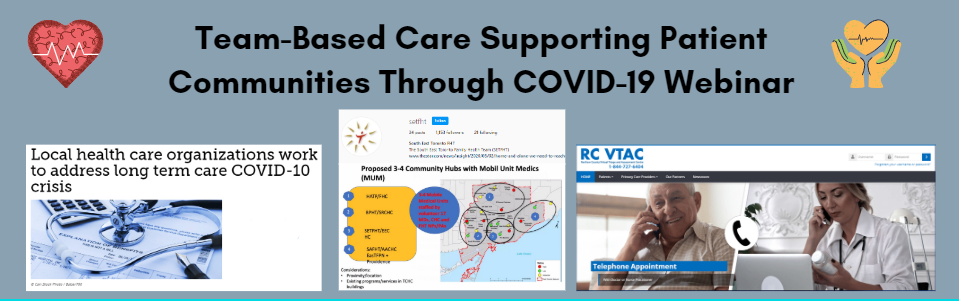
    On June 11, 2020 (12-1pm EST) AFHTO, in collaboration with 3 primary care teams, will be hosting a webinar to share initiatives teams are currently doing to help support patients in their communities during COVID-19. Learn from these teams about how they created virtual care communities, helped long-term care homes, engaged with patients via social media and much more! Teams that will be presenting are South East Toronto FHT, Brockton Area and Kincardine FHTs, Arnprior & District FHT, North Renfrew FHT, West Champlain FHT, Madawaska Valley FHT and Petawawa Centennial Family Health Centre.
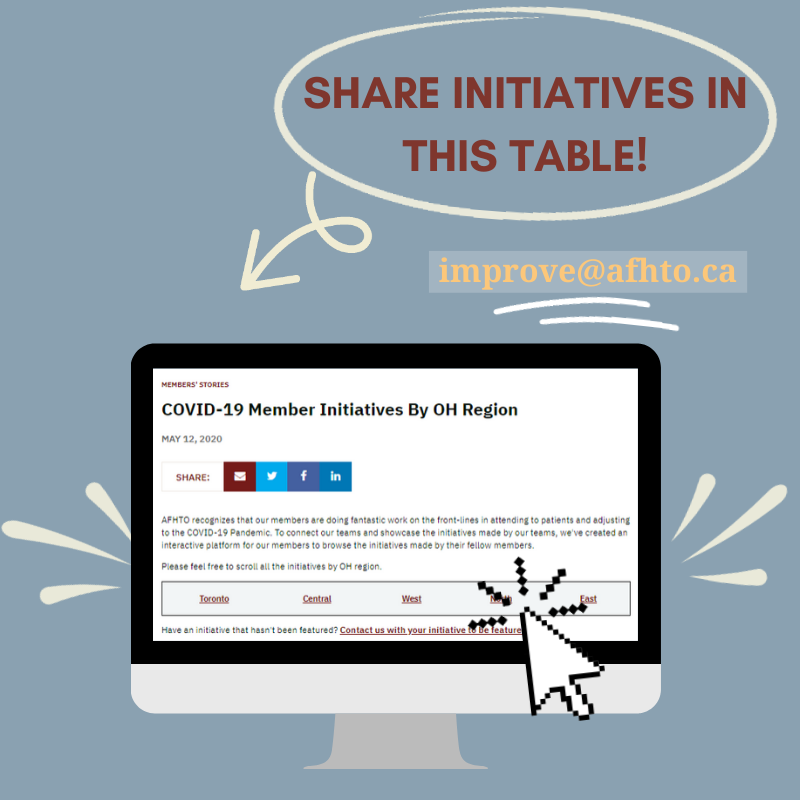
    COVID-19 Member initiatives table

    Register here for the webinar!


    We have also created a table highlighting the great work teams are doing! Help us grow this list by emailing improve@afhto.ca to share what your team is doing.

    Let’s make this into a webinar series! Email us at improve@afhto.ca to share what your team is doing. You may be featured in an upcoming webinar!


    Virtual Visits Q&A Document – One on One & Group Visits

    Virtual Visits Q&A Document

    On Wednesday, May 20 we held a discussion around virtual visits (one on one & group) with our expert panel. Panelists went through multiple components of how to conduct a virtual visit and a Q&A portion.

    The recording, slide deck and Q&A document for the webinar are available here. As a follow up AFHTO and the panelists have created a Q&A document for a few questions that were not covered such as:

    • How are providers conducting phone call visits remotely?
    • Is it necessary to repeat consent at every virtual visit?
    • How do you obtain consent for group programs?
    • What Mental Health Programs are being run virtually and open to the public?
    • What platforms are teams using for secure messaging?


    QI Resources
    Below are measurement and quality-related tools, resources, slides, and videos. You can flag these emails or bookmark the related posts, so they will be easy to find for future reference.


    In Case You Missed It: Check out eBulletin #97 or other back issues here!
    Questions? Comments? Contact us at improve@afhto.ca.

     

  • Bits & Pieces: members’ COVID-19 initiatives, updated case definition & more

    Bits & Pieces: members’ COVID-19 initiatives, updated case definition & more

    Your Weekly News & Updates


    In This Issue  
    • ICYMI- members’ COVID-19 initiatives and vulnerable patient outreach queries
    • World Family Doctor Day
    • Videos for the pandemic from Niagara North FHT for patients and providers
    • Members’ stories
    • Updated case definition, symptom, and screening documents for COVID-19
    • Call for abstracts- Virtual ADHD Research Day
    • Upcoming events including Virtual Visits- Beginning to End and more

    ICYMI- members’ COVID-19 initiatives and vulnerable patient outreach queries

    Last week we released a table highlighting members’ innovations in care in response to the current pandemic, organized by Ontario Health regions. If your team isn’t there, please email improve@afhto.ca to share your work.

    We also published QIDSS and QIDSS-like folks’ queries and scripts to help identify vulnerable, isolated, and high-risk patients, and virtual care resources. Read the QI in Action eBulletin here.


    World Family Doctor Day

    Today’s World Family Doctor Day so we celebrate all family physicians and residents affiliated with primary care teams. Thank you for your leadership, dedication, and resilience especially as we face this once-in-a-lifetime pandemic.


    Videos for the pandemic from Niagara North FHT for patients and providers

    Videos for the pandemic from Niagara North FHT for patients and providers

    Niagara North FHT’s registered dietitian Melissa Dunlop and Dr. Brian Kerley teamed up to produce several YouTube videos that may prove useful for your patients:


    Windsor Team Care Centre’s substance abuse services

    Members’ stories

    Brockton and Kincardine Area, Hanover FHTs: Local health care organizations work to address long term care COVID-10 crisis
     

    Georgian Bay FHT: COVID-19 testing complete at three local nursing homes
     

    Powassan & Area FHT: COVID-19 outreach team finishes Long Term Health Care Home testing
     

    Windsor FHT: New virtual substance abuse program launched in Windsor-Essex


    Updated case definition, symptom, and screening documents for COVID-19

    Last week the government released an updated case definition and reference document for symptoms. They also provided the following:

    We continue to update several pages on our site with resources and news:

    We’ll update these on a regular basis as we receive relevant resources, while trying to reduce duplication with other sources. We will continue to update the news page daily.


    Call for abstracts- Virtual ADHD Research Day

    Submit your abstract to present at Canadian ADHD Resource Alliance’s Virtual ADHD Research Day on October 23. The deadline is June 8th.

    Student/trainee awards available:

    • Kids Brain Health Network (KBHN) Junior Researcher Awards of $300 each (10 available)
    • KBHN/CADDRA ADHD Research Day Registration Awards (complimentary registration will be presented to the 40 top ranked student oral/poster submissions)
    • CADDRA Poster Awards of $150 each (two available, junior presenters only)

    Click here for submission guidelines.

    Submit your abstract here: caddra.societyconference.com


    Virtual Visits- Beginning to End, May 20, 2020

    Join AFHTO for our highly anticipated webinar on virtual visits. Panelists from Scarborough, East Wellington, Hamilton and West Carleton FHTs share their virtual visit tips- from start to finish. Register today!


    Choosing Wisely – Canada’s National Meeting, May 26, 2020
    The Virtual National Meeting will bring together health professionals, patients, system leaders, and researchers from across the country to discuss and engage in topics related to overuse in health care. Learn more here.


    Meeting Social Needs in an Integrated Health System: Social Prescribing During COVID-19 and Beyond, May 27, 2020

    The Alliance for Healthier Communities has made their social prescribing meeting virtual. Join the conversation around integrating healthcare and social supports. Learn more here.


    Asthma Action Plans: Keeping Asthma Under Control (Especially In The Virtual World), May 27, 2020
    Join this talk held by Dr. Gupta on asthma action plans in a virtual environment. Learn more here.


    ECHO Evening Series on Cannabis and Pain, June 8-22, 2020

    Free online sessions open to all healthcare providers:

    Session Times and Topics
    All sessions are 6:30-8:00PM

    • June 8, 2020 -Cannabis: Working & Driving  
    • June 15, 2020 – Trends in Cannabis Research
    • June 22, 2020- Cannabis Use Disorder: Signs & Symptoms  

    Find out more.

  • QI in Action eBulletin #97: Quality Improvement on the Go

    QI in Action eBulletin #97: Quality Improvement on the Go

    In this Issue:

    • Team Based Care Supporting Patient Communities Through COVID-19

    • Quality Improvement in Primary Care Council Updates

    • Primary Care Practice Reports

    • Upcoming Webinars

    COVID-19 Member initiatives table


    Team-Based Care Supporting Patient Communities Through COVID-19
    Primary care continues to step up and ensure our patients get the care they need. From the beginning of this pandemic to now as the province transitions to re-opening services, teams have rapidly been adapting to change. It is important that teams’ innovative initiatives are shared as they continue to do quality improvement initiatives on the go. To facilitate this sharing, we have created a table highlighting the great work teams are doing!

    Email us at improve@afhto.ca to share what your team is doing. You may be featured in an upcoming webinar!


    Quality Improvement in Primary Care Council Updates

    With rapid change comes QI on the go. QI in PC Council members are helping teams adapt to these rapid changes. With an increased urgency to connect with vulnerable, isolated, and high-risk patients during this challenging time, QIDSS and QIDSS-like folks have created queries to help identify who these patients are.

    • Barrie and Community FHT has created a script that teams can use to reach out to their patients.
    • Sudbury District NPLCs has created a script and documentation for Accuro which can be found here.
    • City of Lakes FHT has created a Telus PS Encounter Assist, Screen Tool and Script that can be found here.

    QI in PC Council members have also started two working groups to address important areas during COVID-19:

    • Let’s Measure the Impact of Primary Care during COVID-19 Working Group will be specifically focusing on standardizing patient and provider experience survey questions for primary care.
    • Standardized Queries for Chronic Diseases & High-Risk Patients Working Group will help identify standardized queries to identify patients with chronic diseases and at a high-risk.

    QI in PC Council members continue to support teams with the rapid transition to virtual care. Some of the resources council members and AFHTO have created are:

    Primary Care Practice Reports

    The MyPractice: Primary Care Family Health Team report is typically released bi-annually with the next report release scheduled for May 2020. Due to COVID-19, the next release will be postponed.
    Ontario Health Quality will notify you by email once your report is refreshed and include it as an attachment. It will also be made available in the MyPractice web portal. In the meantime, you can still access your previous reports by logging in here: www.hqontario.ca/pcreport.

    Upcoming Webinars:

    Virtual Visits: Beginning to End Webinar– May 20, 2020 (12:00-1:00 pm EDT)
    Please join us for a discussion around virtual visits (one on one & group) with our expert panel. During this IHP-focused webinar, panelists will go through multiple components of how to conduct a virtual visit and a Q&A portion. Click here to register!

    In Case You Missed It: Check out eBulletin #96 or other back issues here!
    Questions? Comments? Contact us at improve@afhto.ca.
  • EMR Communities of Practice Transition to OntarioMD

    Originally posted March 31, 2020, updated on April 3, 2020.

    Dear AFHTO EMR CoP Members, 

    As many of you are aware the EMR communities of practice (CoP) will be transitioning from AFHTO to OntarioMD effective March 31, 2020. AFHTO would like to thank all members for their continuous support and participation. We would also like to sincerely thank CoP leads for their dedication to these groups! We look forward to a smooth transition. 

    OntarioMD is in the process of updating membership lists for existing CoPs. Please take a few minutes to fill in this form through which contact info is being collected. OntarioMD will use this information to send all meeting invitations and updates regarding the CoPs after March 31, 2020. Moving forward, the central contact email will be communities@ontariomd.com

    Listserv emails have been updated to: 

    • For OSCAR users: oscaromdcop@emaildodo.com
    • For Accuro users: accuroomdcop@emaildodo.com
    • For Telus PS users: telusomdcop@emaildodo.com
    • For P&P users: p-pomdcop@emaildodo.com


    If you have any comments, questions or concerns about this transition, please take a few minutes to fill out the following surveys: 

    Thank you for your continued support and participation in these important meetings!
     

  • Getting started on a COPD registry (Archived)

    This page has been archived. For the most recent version of this page, please click here.


    This document explains how to use standardized queries in your EMR to start building chronic disease registries.  The instructions below focus on COPD. The COPD query is intended for teams that do not yet have a reliable list of COPD patients and don’t have the time or resources to start from scratch in reviewing all their patients to generate such a list.  Right now, it is also only for teams with PSS or Accuro although work is continuing to expand the standardized query to OSCAR and Nightingale. The following steps will help your team use the query to generate a list of COPD patients, starting from your EMR.

    Step 1. Estimate how many patients you think this will affect.  Multiply the number of patients your team serves by 0.12 (the average rate of COPD in Ontario) to get a rough idea of how many of your patients likely have COPD.  If you still think this is a big enough group of patients for you to generate a registry for, carry on to step 2.

    Step 2. Import the query into your EMR.  Right now, you can only do this if have either Telus PSS,  QHR Technologies Accuro or OSCAR EMRs.  You will likely need the help of your QIDSS, IT staff or other person who usually works with your EMR to do this.

    • For PSS, click here to import the PSS SRX file into your EMR.
    • For Accuro, download the query “AFHTO COPD Frontend Search” from their publisher.
      • Click here for instructions on how to download the query
    • For Nightingale EMR queries cannot be exported and shared so please access the “how to” instructions on Trello – they explain the process to create a COPD registry.
    • For OSCAR copy the query text into a Notepad file and save locally to your computer.  Instructions on how to import the query into your OSCAR EMR can be found here.

    Step 3.  Run the query in your EMR. Again, you might need the help of your QIDSS, IT staff or other person who usually runs queries in your EMR.  Running the query will produce a list of patients with COPD.  The list will not be perfect – probably 15% of the patients identified by the query will NOT have COPD.  The query gets you STARTED in building the COPD registry but doesn’t do the whole job for you.

    Step 4. Find the patients who might not have COPD. Review the list of patients generated by the query to separate out those patients that are clearly already coded as having COPD.  What’s left will the list of patients who MIGHT have COPD based on other data in the EMR besides formal coding.

    Step 5. Prepare your physicians to review the list  Subdivide the list of possible COPD patients into separate, shorter lists for each physician.  Work with your physicians to find out if they would prefer a list on paper or electronically and how they might like it sorted (ie by name or most recent visit or some other parameter).

    Step 6Invite each physician to review their list of patients.  They know their patients best and can likely quickly confirm which ones do or do not have COPD, even though that information might not be easy for others to find in the EMR.

    Step 7Clean up your EMR data.  Add COPD codes to the EMR for each patient that the physician confirms as having COPD.  This so-called “data cleaning” work is a great job for a student.  AFHTO has created a toolkit to assist members in recruiting and using students for data clean-up. Click here for the toolkit.

    Step 8Re-run the query .  After you have corrected the EMR, re-run the query to generate a list of patients with COPD.  This is your new COPD patient registry.  Going forward, you can run the query anytime you need to generate a list of COPD patients.  You can use the list to invite patients to a lung health program, track progress with outcomes on these patients once you have started such a program or any other purpose. This query was produced by and for QIDSS in support of all AFHTO members. 

    If you have any questions please contact improve@afhto.ca.

     
  • QI in Action eBulletin #96: Lung Health in Primary Care

    In this Issue:


    • Primary Care Lung Health Programs
    • Electronic Asthma Management System Tool for Oscar Users
    • Understanding Bronchiectasis
    • Vaping
    • Upcoming Webinars

    Primary Care Lung Health Programs
    In 2015, there were 60, 530 new Chronic Obstructive Pulmonary Disease (COPD) diagnoses for people in Ontario ages 35 and older and 883,400 Ontarians were living with a COPD diagnosis . 61, 580 Ontarians ages 1 and older were newly diagnosed with asthma in 2015, with 1.9 million living with an asthma diagnosis1. COPD and asthma are only 2 of the 5 major chronic respiratory diseases also including lung cancer, tuberculosis (TB) and cystic fibrosis. Primary care provides care for these lung health conditions and many more in team-based care settings; this document highlights some of the lung health programs within primary care.

    eAMS Tool for OSCAR Users – Webinar
    The Electronic Asthma Management System (eAMS) is an evidence-based clinical decision support system developed to improve your ability to deliver best care for patients with asthma.

    WHAT DOES THE eAMS DO?

    The eAMS was designed to help providers to bridge the main evidence-to-practice gaps that have been identified across care settings and are believed to be the major cause of poor disease control and healthcare utilization in patients with asthma.

    WHO IS THE eAMS FOR?

    The eAMS was designed by primary care providers, for primary care providers. The tool was designed to assist clinicians in busy real-world primary care settings. The system can be used by any health care provider but because the system makes prescription recommendations, the most common users are physicians, nurse practitioners, and physician assistants. Other team members could also use the system and receive signoff from a prescriber for any required medication changes. The system is available for all asthma patients aged 16 years and older.

    Join the OSCAR CoP Webinar and Dr. Samir Gupta, to learn more about this tool!

    Understanding Bronchiectasis

    Bronchiectasis is not rare, but it is currently a neglected pulmonary disease which poses a significant burden to the health care system. Learning how to counsel patients regarding the modifiable factors can affect prognosis and improve the patients’ quality of life. Self-management support plays an important role in the patient’s ability to make lifestyle changes to reduce symptoms, prevent recurrent lung infections, prevent emergency department visits, hospital admission and decrease mortality.

    We’re pleased to be hosting a webinar with Bruyère Academic FHT, so that our teams can learn more about bronchiectasis. At the end of this webinar, participants will be able to:

    • Verbalize their understanding of bronchiectasis and how to help patients self-manage this disease  
    • Learn how to avoid the acquisition of nontuberculosis mycobacteria.
    • Understand the bronchiectasis self-management plan

    Learn more at an upcoming webinar- sign up here!

    Vaping
    The Heart & Stroke Foundation, in collaboration with Dr. Andrew Pipe, hosted a webinar on the impact of vaping on the health of Canadians. The youth vaping trend and the concept of nicotine as a gateway along with challenges of vaping for cardiovascular disease prevention were discussed within this webinar.

    To address some of the dangers of vaping in youth, on Feb. 28 Minister Elliott announced proposed regulatory changes that, if approved, would limit where flavoured and high nicotine vapour products are sold at retail. At the same time, the province intends to expand prevention initiatives and services to quit vaping.

    To better understand the impact of vaping, please listen to the webinar by Dr. Pipe with learning objectives that included:

    1. Examine and explain the controversies surrounding vaping and the importance of influencing healthy public policy.
    2. Describe the risks associated with vaping and the impact on cardiovascular disease prevention.
    3. Discuss how to engage in meaningful discussion about vaping and smoking cessation with individuals.
    4. Recognize the advantages and shortcomings of nicotine replacement therapy.

    Listen to this webinar here.

    Upcoming Webinars:

    In Case You Missed It: Check out eBulletin #95 or other back issues here!
    Questions? Comments? Contact us at improve@afhto.ca.
  • Bits & Pieces: meeting the Minister, working together for change tools & resources & more

    Bits & Pieces: meeting the Minister, working together for change tools & resources & more

    Your Weekly News & Updates


    In This Issue  
    • Meeting the Minister to discuss pre budget recommendations
    • Working together for change
    • Members’ stories
    • Managing urinary incontinence in women: clinical tool
    • Novel coronavirus updates
    • Northern opioid learning community webinars, Mar. 5 & 26
    • Seeking volunteers for Early Chronic Kidney Disease priority panel
    • OASW call for proposals
    • Upcoming events including improving cancer screening and more

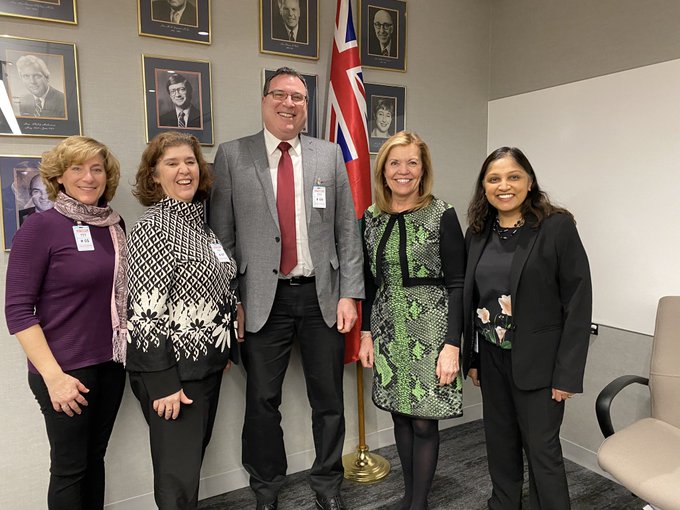
    AFHTO Board Executive Committee and CEO met with Minister Elliott on Feb. 13
    AFHTO Board Executive Committee and CEO met with Minister Elliott on Feb. 13


    Meeting the Minister to discuss pre budget recommendations

    On Feb. 13, our Board executive committee and CEO met with the Deputy Premier and Minister of Health, the Hon. Christine Elliott, to talk about our pre budget recommendations with a focus on integrated care foundationally based in team based primary care and the importance of clinical leadership.


    Working together for change
    Connecting physicians regionally is a powerful way to spark change, to improve the delivery of comprehensive patient services, and to influence health service decision making. For those who wish to consider how they might best work together to strengthen the primary care sector – or for those who have already started! – check out Primary Care Physicians: Working Together For Change, Primary Care: Local Change Ideas, and other tools and resources on our website. This repository will be updated regularly!


    Members’ stories
    Elliott Lake FHTbudget committee approves funding for video medical clinic which was set up on a trial basis last year


    Managing urinary incontinence in women: clinical tool

    The Centre for Effective Practice has launched a new clinical tool: Managing Urinary Incontinence in Women.

    Many women feel ashamed when they experience urinary incontinence, which may prevent them from speaking to their doctors about it. If left untreated, the condition can lead more needed care later. This tool is designed to help primary care providers manage care for adult women (18+) who experience involuntary loss of urine.


    Novel coronavirus (COVID-19) updates

    We continue to update the relevant page on the Novel Coronavirus. “Health care providers facing immediate challenges with their personal protective equipment supply levels can email the ministry at EOCLogistics.MOH@ontario.ca.”

    If you have any questions, you can also email EOCOperations.moh@ontario.ca.


    Northern opioid learning community webinars, Mar. 5 & 26
    Join the Ontario Pain Management Resources Partners as they explore how to optimize your EMR to support safer pain management and opioid prescribing. Including Sandeep Gill, AFHTO Clinical KTE Specialist and members, Drs. Sarah Newbery and Ryan Patchett-Marble, Marathon FHT, and Dr.Kevin Samson, East Wellington FHT.

    Target audience: Family physicians and nurse practitioners in northern Ontario who endeavour to access relevant data to support safer opioid prescribing and pain management, including primary care clinicians and support staff

    Register for:


    Seeking volunteers for Early Chronic Kidney Disease priority panel

    The Ontario Renal Network, part of Ontario Health, is recruiting primary care providers for the Early Chronic Kidney Disease (CKD) Priority Panel. Its purpose is to provide strategic direction for current and future initiatives related to early CKD, including supporting primary care providers in identifying and managing patients with CKD.

    The panel will meet on a regular basis about 6 times per year and will to have representation from various groups (e.g., administrators, allied health, physicians, patient advisors). If you’re interested in learning more or joining, please email daphne.sniekers@cancercare.on.ca by February 29, 2020.


    OASW call for proposals
    The Ontario Association of Social Workers has announced a Call for Proposals for the 2020 Social Work Provincial Conference, “Innovative Approaches to Complex Needs:  Social Workers Influencing the Future of Care”, on November 13 and 14, 2020.

    They encourage submissions from students, practitioners, policy makers, researchers and academics alike. The deadline for submissions is March 1, 2020. Find out more.


    Improving cancer screening rates and reducing related disparities, Feb. 20
    On Feb. 20 join Drs. Aisha Lofters and Tara Kiran as they share practical, evidence-based ways to improve cancer screening rates and reduce income-related disparities. Register here.


    Is your work making you wheeze? Feb. 25, 2020
    Attend this webinar suitable for healthcare providers and other employees, hosted by the Lung Association. View all Lung Associations’ upcoming events here.


    Black Physician Association Ontario Annual Health Symposium, Feb. 29, 2020
    Keynote speaker will be the inspiring Dr. Lisa Robinson, Associate Dean of Inclusion and Diversity at the University of Toronto. Learn more here.


    Primary Care Electronic Medical Record Tools for Advance Care Planning and Palliative Care, March 12, 2020
    In the third webinar in the HPCO Winter webinar series, our Board Director Dr. Kevin Samson, along with Justin Wolting from the eHealth Centre of Excellence, will be presenting to assist health care professionals and support staff.
    Learn more here.

  • QI in Action eBulletin #95: Made-In Ontario High Impact Actions in Primary Care

    In this issue

    • Primary Care Virtual Community
    • High Impact Action Items
    • Local Change Ideas
    • Upcoming Webinars

    Primary Care Virtual Community:

    The primary care virtual community is Ontario’s novel collaborative designed to unleash the power of primary care in health system change. As a community, they have co-defined a list of High Impact Actions that are felt to spark meaningful improvements in primary care, building on lessons learned from the UK’s own transformation efforts. The community has also shared insight on the actions they feel are within their control, in addition to where support is needed. As a community they continue to work collaboratively to refine the list of High Impact Action Items for Ontario. Here is the latest list of 10:

    High Impact Action Items:

    1. Navigate & Coordinate

    • Promote patient navigator role that can enable easier patient/caregiver access to resources including those that go beyond health care resources. This could include linking home care coordination to primary care.

    2. Integrate EMRs

    • Either single or intra-operable EMR/EHR systems that can both push and pull required information. Integration of EMRs can enhance quality of care provided and practice efficiency by promoting easier and better communication.

    3. Access to Mental Health and Addictions

    • Provide mental health and addictions supports in the community, embedding these supports in primary care.

    4. Organizing Primary Care

    • Come together at the local level to organize primary care and move towards more team-based care for more Ontarians, opening up the FHO model for primary care delivery.

    5. Practice Facilitation & Change Management

    • Provide dedicated resources to enable peer -to -peer coaching and uptake by providers. A QI-enabled, evidence-driven health care system, in turn, enables best practices.

    6. Build the Extended Team

    • Identify and provide support to the extended team that wraps around the patient/ family/caregivers and provide supports to enable the team to be high performing.

    7. Streamline & Reduce Administrative Burden

    • Reduce bureaucracy and administrative burden.

    8. Recognize and Support Primary Care Continuity

    • Promote the patient/caregiver and provider relationship, ensuring that the care is provided according to the principles of comprehensiveness and continuity.

    9. Build Connections to Address the Social Determinants of Health

    • Recognize the social determinants of health as factors that influence health and well being outside of access to healthcare services, adopting practices like social prescribing.

    10. Patients as Partners

    • Empower patients to take greater control and ownership over their health.

    Local Change Ideas:

    The Primary Care Virtual Community has given communities the opportunity to identify what’s meaningful to them. What are their pain points, headaches or areas that can be improved? And more importantly what changes can be made at the local level to support providers, their clinical practices and the delivery of patient care. Building on the change ideas identified in the primary care high impact actions for Ontario, this document highlights local challenges and solutions to improve clinical practices and care delivery in your own communities. This document is only the beginning of creating a repository of change ideas. Please complete this survey to provide local change ideas within your community!

    The February 13th and the November 21st Virtual Community focused on Organizing Primary Care – the community learned from a number of primary care leaders about how they are mobilizing the primary care community to self-organize and identify what their needs are. We’re pleased to share their lessons and advice with the release of Primary Care Physicians: Working Together for Change primer which highlights strategies that can be employed for organizing primary care at the local level.

    Resources:

    Upcoming Webinars:

    • Improving cancer screening rates in your practice and reducing related disparities – Feb 20, 2020 – Sign up here

    In Case You Missed It: Check out eBulletin #94 or other back issues here!
    Questions? Comments? Contact us at improve@afhto.ca.

  • AFHTO response to public health modernization

    As government undergoes public health modernization, AFHTO is pleased to provide a few recommendations to better align primary care with public health. Together with government, we will build more coordinated, integrated and person-centered health care for the people of Ontario.

    1. Strengthen the relationship between primary care and public health to better align with health system transformation- we recommend that public health be better integrated within the health system planning as a full partner that, alongside primary care, ensures prevention, health promotion, wellbeing, and chronic disease management be part of the full continuum of care for patients and the population being served.
    2. Improved communications and integrated digital health systems – Though the ideal state is to create one electronic medical record for patients, in absence of adopting one EMR for the province, we suggest thought be given on how better to integrate, connect, and coordinate health promotion, health protection, and health care between primary care and public health.
    3. Establish local pubic health service delivery areas that are aligned with Ontario Health Teams – We suggest delivery areas be aligned with Ontario Health Teams or with existing municipal boundaries to avoid confusion for providers who are seeking local resources or supports.

    Read the full document here.

  • QI in Action eBulletin #94: Quality and Measurement New Beginnings

    QI in Action eBulletin #94: Quality and Measurement New Beginnings

    In this issue

    • Moving Forward with AFHTO’s Quality Agenda
    • Formation of the Quality Improvement in Primary Care Council
    • Mental Health and Addictions Support
    • Support for Teams
    • Tools and Resources (including standardized EMR queries)
    • Webinar videos and slides (including opioid stewardship)
    • Workshops, events and presentations (including focus on follow up)
    • Upcoming Webinars

    Moving Forward with AFHTO’s Quality Agenda

    2019 was a challenging and busy year with ongoing health system transformation changes along with changes to the QI program at AFHTO. Despite the sunset of D2D, AFHTO will continue its efforts to support teams in the field of quality and demonstrate the value of team-based primary care.

    Quality improvement remains a key focus, and AFHTO’s Quality Steering Committee (QSC), in partnership with key stakeholders, is currently working on a priority list and areas of focus for this year. As we begin this new year, we wanted to provide you with a wrap-up of 2019 along with resources that will help projects this year.

    If you would like to share a tool, resource or highlight a successful program or service in your team, we would love to hear from you! Please fill out this quick survey.

    Formation of the Quality Improvement in Primary Care Council

    In January of 2019, the Quality Improvement in Primary Care (QI in PC) Council was formed. The QI in PC council consists of 5 appointed QIDSS and QIDSS-like individuals with the goal to support the QIDSS Community of Practice (CoP) and strengthen collective QI capacity across the sector.

    The priority areas for the group are primary care QI priorities, EMR queries and much more. eCE has partnered with AFHTO to help support this council in areas such as 7-day post-hospital discharge follow up.

    The members of the council include:

    • Cameron Berry, QIDSS, Kawartha North FHT
    • Abigail Scott, Data and Quality Improvement Analyst, Queen’s FHT
    • Brice Wong, QIDSS, Windsor FHT
    • Mitch Chartier, QIDSS, Elliot Lake FHT
    • David Raan, QIDSS, Humber River FHT

    Contact the council by emailing: qiprimarycouncil@emaildodo.com.  

    Mental Health and Addictions Support

    AFHTO continues to advocate for more supports in primary care, especially as it pertains to ensuring more patients have access to team-based care, in particular in the areas of mental health and care coordination. This year, the Mental Health and Addictions webinar series in collaboration with CMHA & AMHO will continue and you can participate in the remaining 3 parts.

    AFHTO, along with our mental health and addictions and primary care partners, is co-leading the development of a OHT Guidebook for Mental Health and Addictions and Primary Care Integration which will be helpful not only to those teams that are moving forward with OHTs in their community but will also be helpful with program planning at the local level.

    We are also partnering with other organizations like OntarioMD, Ontario Health, CEP, eCE, OCFP, ECHO project and the Ontario Pain Management Resources (OPMR) group partners to help support a learning collaborative for the NorthWest LHIN addressing opioids prescribing.

    The Algorithm Project team at AFHTO is in the final stage of completing a MEQ tool/query that will be compatible with OSCAR, Telus PS and Accuro. If you’re interested in piloting these tools, please reach out to us at improve@afhto.ca.

    Support for Teams:

    AFHTO has a library of resources that you may find helpful in developing your programs and services and with your Quality Improvement Plan. As always, if you have an innovation you want to share please let us know, by completing this quick survey.

    Measuring tape

    Tools and Resources:

    We have so many tools and resources available for members, but since they have been announced throughout the

    years, we thought a refresher would be welcome, especially since we know you’re exposed to so much information every day.

    Just a reminder that in our Dec. 17 communique we provided you a comprehensive list of Governance and Leadership tools, resources and training. .


    Below are measurement and quality-related tools, resources, slides and videos. You can flag these emails or bookmark the related posts, so they’ll be easy to find for future reference.

    Webinars:


    Business chart

    Workshops, Events and Presentations


    Upcoming Webinars:

    If you have a suggestion for a webinar/QI in Action eBulletin topic or if you would highlight a tool, resource, successful program and/or innovation please let us know by filling out this quick survey.

    In Case You Missed It: Check out eBulletin #93 or other back issues here!
    Questions? Comments? Contact us at improve@afhto.ca.