Tag: advocacy

  • Ontario needs a Stay-at-Home order

    Ontario needs a Stay-at-Home order

    Primary Care Collaborative logos


    Ontario needs a Stay-at-Home order, community vaccination plans, and paid sick leave for ALL workers to stop spread of COVID-19 variants, reduce the burden on health care

    TORONTO – April 6, 2021 – Amid an alarming rise in COVID-19 cases and hospitalizations, the Primary Care Collaborative shares concerns expressed by the Ontario Hospital Association, Ontario Medical Association, Registered Nurses Association of Ontario and other health care providers that the province needs stronger measures to curb the growing spread of the virus. Ontario’s Science Table has confirmed how dangerous the variants of concerns are, including an increased risks of serious illness and death. As the number of cases and hospitalizations increase daily, it is vitally important that Ontario enforce stricter public health measures and roll out policy initiatives to curb the spread of these deadly variants of the COVID-19 virus.

    We implore the government to listen to Ontario’s experts and those front-line health care workers seeing the devastation of COVID-19 in hospitals and communities first-hand.

    Instead of an emergency brake, which does little to stop the spread, we need a full stop now to suppress transmission of the virus and preserve the tenuous capacity of our ICUs in hospitals. Now is the time to intensify all efforts and employ an equity-lens to protect those most vulnerable and at risk from the virus. That is the clearest path through the toughest part of this pandemic. To do so, we strongly support and urge the government to take the following vital actions:

    1. Move the province from a shutdown to a stay-at-home order with people only leaving their homes for medical/health appointments, essential grocery shopping, outdoor exercise and essential work;
    2. Ensure vaccines are reaching those who are most at risk for infection and who need them the most; we need to prioritize essential workers, those with limited mobility/homebound and others with approaches that will get more vaccines in arms (in their communities, in their workplaces, in their homes); employ community-based, tailored approaches that focus vaccination efforts on communities that have been disproportionately impacted by the pandemic;
    3. Prioritize vaccination of teachers, educators and school staff to ensure we have #SafeSchools – use the upcoming spring break to vaccinate the education sector;
    4. Create a broad education and communications campaign to address vaccine hesitancy, using culturally sensitive and straight-forward messages to encourage vaccine confidence and directly address myths and misinformation;   
    5. Implement paid sick leave for all essential workers now. This is essential to ensuring businesses that remain open, such as warehouses, retail and others, can remain open safely for all workers while offering curbside pick-up and continuing essential work.

    Family Physicians, Nurse Practitioners and primary care providers continue to educate, collaborate, communicate, vaccinate and support the people we serve. But like their acute and home care colleagues, getting a handle on cases that are out of control in the community is not within their grasp. We need government leadership to support our ongoing work to protect the health of everyone in Ontario, and we need it urgently, because many health care providers are at a breaking point and our health system’s sustainability is at risk. In order to provide even a glimmer of hope in combatting this wave, we need to employ stricter public health measures now and protect all the citizens of Ontario, especially those most vulnerable. 

    Media contact for interview requests, comments or inquiries:      
    Paula Myers
    Manager, Membership and Communications
    Association of Family Health Teams of Ontario
    Email: paula.myers@afhto.ca
    Phone: (647) 234-8605 extension 1200

    About the Primary Care Collaborative (PCC):
    We are a coalition of primary care organizations collectively representing 14,000 family doctors, 1,000+ primary care nurse practitioners, 286 primary care teams, 28 Indigenous primary care teams, including northern, rural, and remote teams. This alliance of comprehensive primary care organizations joined together by common purpose to build on the collaborative work during the COVID-19 pandemic as we move towards recovery in a time of health system transformation. The PCC provides a collective and cohesive voice with the purpose of advancing equitable person-centred primary care in Ontario and is focused on influencing policy by creating a unified voice towards resolving barriers or challenges that prevent comprehensive primary care from being the foundation of the health system.

    Relevant Links:
  • Bits & Pieces: oxygen saturation monitors for COVID@Home, Primary Care Collaborative and more

    Bits & Pieces: oxygen saturation monitors for COVID@Home, Primary Care Collaborative and more

    Your Weekly News & Updates


    In This Issue  
    • Oxygen saturation of COVID home monitoring
    • Announcing the Primary Care Collaborative
    • Your role in improving the population health of people at risk or living with diabetic foot complications
    • Member stories
    • Joint letter on vaccine dose intervals for indigenous populations
    • Patient-facing document updates, Gen. Hillier memo and more
    • Supporting older persons at home slides and video
    • Canada’s Volunteer Awards National Advisory Committee
    • AMS Healthcare research fellowships: provider mental health and wellbeing
    • Upcoming events including Building a Resilient Nonprofit Organization through Proactive Risk Management and more

    Oxygen saturation of COVID home monitoring

    COVID-19 pandemic has led to unexpected surges in demand on the provincial healthcare system, and healthcare settings across the province face patient capacity constraints, potentially affecting care for all patients. To help ease these constraints, Ontario Health is providing tools and resources for COVID@Home to help primary care providers who wish to remotely monitor people who have mild to moderate COVID-19 in the community.

    Oxygen saturation monitors are now available to be ordered by primary care physician offices and interprofessional primary care team offices through the provincial pandemic stockpile. Find out more about the initiative and how to order here.


    Announcing the Primary Care Collaborative

    COVID-19 shows the vital roles primary care providers play every day for community health and wellbeing and health system cooperation in Ontario.

    On March 29 we announced the launch of the Primary Care Collaborative with five other partners, including Alliance for Healthier Communities, IPHCC, NPLCA, OCFP and SGFP. Visit our site for the full release.

    Working more collaboratively together, we hope a unified primary care sector can help advance the important role that primary care will play towards recovery from this pandemic.


    Your role in improving the population health of people at risk or living with diabetic foot complications

    Co-hosted with Wounds Canada, this interactive webinar on April 15 will provide an overview of your role to improve the population health of people at risk or living with diabetic foot complications across the full continuum of care settings to improve patient experience, outcomes and costs.

    By the end of the webinar participants will:

    • Discuss prevention and management approaches based on risk stratification of people at risk or living with diabetic foot complications
    • Explore ways to leverage telehealth / virtual care assessments to support patients at risk or living with diabetic foot complications
    • Leverage Wounds Canada resources to optimize your practice

    Register here.


    Member stories
    Bancroft FHTBancroft FHT vaccinates over 1000 people from COVID-19

    Central Lambton and Rapids FHTsFamily doctors join vaccine rollout in Sarnia-Lambton

    Georgian Bay FHTvideo tour of the Collingwood and Wasaga drive-thru vaccine clinics

    Queen Square FHTOntario family physicians seek clarity on when they can administer COVID-19 vaccines in office


    Joint letter on vaccine dose intervals for indigenous populations
    On March 26 we sent a joint letter to Premier Ford and Minister Elliott on changes to the vaccine dosing schedule for Indigenous populations.

    “We are standing in solidarity with the Indigenous Primary Health Care Council and asking that, at bare minimum, those Indigenous people living in urban areas who’ve already received their first doses of vaccines be grandfathered in, and permitted to receive their second doses within 21-28 days. This allows for continuity of care, and confidence in this process and the vaccine itself.”

    Read the full letter on our site.


    Patient-facing document updates, Gen. Hillier memo and more

    Recent updates include:

    We continue to update several pages on our site with resources and news:


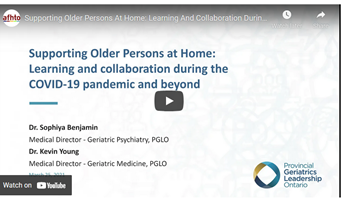
    Supporting older persons at home title screenshot

    Supporting older persons at home slides and video

    On Mar. 25 Provincial Geriatrics Leadership Ontario discussed how to better support older persons in the community using lessons learned during the first year of the COVID-19 pandemic. Slides and video are now available.


    Canada’s Volunteer Awards National Advisory Committee
    Canada’s Volunteer Awards (CVA) will be accepting applications for the CVA National Advisory Committee (NAC) until April 8. Members of the National Advisory Committee play a leading role in the selection of Canada’s Volunteer Awards recipients by reviewing nominations and making recommendations to the Minister of Families, Children and Social Development. They will also support the promotion of the program throughout their term. To apply visit their site.


    AMS Healthcare research fellowships: provider mental health and wellbeing

    AMS Healthcare is offering one-year fellowships of up to $75,000 to early and mid-career academic researchers and scholars and academically trained regulated health care professionals to study and develop expertise/competence in the impact of digital technology/artificial intelligence on compassionate care. Some projects will have an additional focus on the wellbeing and mental health of healthcare providers, patients and caregivers to address the challenges of living and working through the COVID-19 pandemic. Letter of intent due Apr. 7. Visit their site for details.


    Foundations to QI (IDEAS) Program e-Learning Course, Mar. 31 & Apr. 1, 2021
    E-QIP is holding this comprehensive introductory QI course designed for the community mental health sector. You’ll be well versed in a common language and approach to QI with the aim of improving client care, experience and outcomes after this course.
    Find out more here.


    ECHO Managing COVID-19 in Primary Care, Starting Apr. 13, 2021
    UHN’s ECHO series is back- now with 12 parts. Join other primary care providers in this interactive online program.
    Find out more here.


    Building a Resilient Nonprofit Organization through Proactive Risk Management, Apr. 22, 2021
    Charity Village webinar with Risk Management Consultants Lilli Chiu and Isaac Monson from HUB International and insights on how to navigate uncertainty and prepare for the unexpected. Register here.


    Excellence through Quality Improvement (E-QIP) Conference, Apr. 13, 2021
    Hosted by CMHA Ontario, this one-day virtual conference is being offered for FREE.
    Visit their site.

  • The Primary Care Collaborative

    The Primary Care Collaborative

    Primary Care Collaborative logos


    COVID-19 shows the vital roles primary care providers play every day for community health and wellbeing and health system cooperation in Ontario


    Toronto, March 29, 2021 – During COVID-19, we see again and again across Ontario that communities – from people living in large urban centres to smaller cities to towns and rural areas – depend on their local family physicians, family health teams, community health centres, Indigenous primary health care teams, nurse practitioner-led clinics, and other primary care providers in a public health crisis. These providers and organizations are, quite literally, lifelines for the people they serve. The trusted relationships people have with their family doctors, nurse practitioners, healers, mental health professionals and other primary care providers are at the core of local COVID-19 responses, from testing and other direct COVID-19 care, to supports for food security and chronic disease management, to providing credible and culturally safe vaccination information, to knowing how to care for themselves and their loved ones. When the challenges have never been bigger, and the isolation unlike at any other time in our lives, your community providers are there.

    Today, we are announcing we’ve formed the Primary Care Collaborative (PCC), an alliance of comprehensive primary care organizations joined together by common purpose to build on the collaborative work of COVID-19 as we move towards recovery in a time of health system transformation.

    Together, our organizations represent more than 20,000 primary care providers and team members. As Ontario’s primary care providers continue to support their communities through trusted local relationships, partnerships with social services and other providers, and by working with decision makers, we’re committed to ensuring that health system policies and funding acknowledge primary care’s vital role and place in community health and wellbeing. Speaking with one voice, we will advance shared priorities in primary care such as expanded access to teams and better links to home care and mental health supports. The PCC knows that for health care integration and transformation to work for people – for those using the health system and those looking for services to stay well – primary care needs to be the foundation of Ontario’s health system. Robust and well-supported primary care is the heart of all world-class health systems, and people living in Ontario should expect no less. During COVID-19, this is a given. In recovery, when many echo effects of the pandemic will be felt for years to come, it will be of utmost importance.

    QUOTES FROM MEMBERS OF THE PRIMARY CARE COLLABORATIVE

    “The Indigenous Primary Health Care Council appreciates the importance of this collaborative opportunity to strengthen and unify the voice of primary care practitioners across the province. Primary care is the foundation for a high quality, sustainable and integrated system; evidence shows that jurisdictions with high performing primary care place it at the centre of health care delivery. The IPHCC is especially thankful to our partners in the PCC for recognizing that our community-driven Indigenous-governed interprofessional primary care models include Traditional healers and Cultural Service Providers. This is an integral part of promoting a wholistic approach to health and wellbeing for Indigenous people. Great things can happen when the right people come together, and I look forward to advancing our vision for a robust health care system that addresses not just the physical wellbeing of an individual but to the social, emotional, cultural and spiritual wellbeing of the whole community.” Caroline Lidstone-Jones, CEO, Indigenous Primary Health Care Council

    “The Alliance for Healthier Communities’ member centres provide community-based comprehensive primary health care across Ontario, and they are essential to addressing barriers to health and wellbeing that marginalized populations face. Health equity – that is, the idea that everyone deserves a chance to live their healthiest life, but that many people face barriers to doing so – is only achievable where trusted relationships can be built in and by the community. The Alliance is committed to working with our partners in the PCC to ensure the cornerstone of our health system – primary care – can continue to step up for the people in Ontario who face barriers. We have seen throughout the pandemic that we are stronger when we work together, and we look forward to continuing to work collaboratively to build a better future.” Sarah Hobbs, CEO, Alliance for Healthier Communities

    “The Nurse Practitioner-Led Clinic Association is proud to be working with this strong group of primary care association leaders. Often a person’s first point of contact with the health care system, primary care is integral for the health and wellbeing of not only patients, but also the communities in which they live. NPLCs have focused on whole person care since our inception, with nurse practitioner leadership at all levels of the organization. By coming together, this collaborative will provide a united voice for primary care and will allow for us to advocate for health care initiatives across the province.” Jennifer Clement, Past-President, Nurse Practitioner-Led Clinic Association

    “Across the world, cost-effective and high-performing health systems share a common characteristic – they are based on a foundation of comprehensive primary care, which is supported through a team. Primary care is the first point of contact into the health system; jurisdictions that commit to robust investments in primary care are able to move quicker into achieving the Quintuple Aim, ensuring there is a lens towards equitable and accessible care, close to home. AFHTO is pleased to be working with our comprehensive primary care partners to ensure there is a unified voice for primary care, especially as we move towards the daunting task of post-pandemic recovery. We know that this work can only be achieved if we truly work together and we look forward to our ongoing collaboration.” Kavita Mehta, CEO, Association of Family Health Teams of Ontario

    “Ontarians turn to primary care more often than any other part of the health system. Providing high-quality care is truly a team sport. The Ontario College of Family Physicians is pleased to be working together with our primary care partners to create a unified voice – as family physicians, nurse practitioners, interprofessional healthcare providers and team-based primary care. This collaboration will only strengthen our ability to achieve comprehensive, continuous, coordinated and equitable health care for all patients and families across Ontario as envisioned by the Patient’s Medical Home.” Leanne Clarke, CEO, Ontario College of Family Physicians

    “Primary care is foundational to a high performing healthcare system, and the sector is stronger when it is united. This is why the Ontario Medical Association Section on General & Family Practice (SGFP) is so pleased to be part of this newly formed Primary Care Collaborative (PCC) with our partners that also support comprehensive primary care. SGFP represents the 15,000 family doctors in Ontario in advocacy and negotiations and is dedicated to building a united vision for a more integrated, equitable and unified sector. We know that there are many challenges ahead for the healthcare system, and this past year has underscored that incredible things can happen when strong leaders come together in shared purpose. By working collaboratively during much of this pandemic, the PCC has been successful in collectively advocating for and advancing solutions that have made a positive impact on the sector and the health and wellbeing of Ontarians. SGFP is looking forward to continuing to work with PCC to bring out the best in care for Ontarians and to support primary care to thrive in our province.” Dr. David Schieck, Ontario Medical Association, Section on General & Family Practice

    Return to: Primary Care Collaborative Updates


    Media contact for interview requests, comments or inquiries:

    Paula Myers,

    Manager, Membership and Communications

    Association of Family Health Teams of Ontario

    Email: paula.myers@afhto.ca

    Phone: (647) 234-8605 extension 1200


  • Joint Letter on Vaccine dose intervals for Indigenous populations

    To:    Premier Doug Ford
    Christine Elliott, Deputy Premier, Minster of Health

    Cc:    Dr. Dirk Huyer, Coordinator, Provincial Outbreak Response
    Greg Rickford, Minister of Indigenous Affairs
    Dr. David Williams, Chief Medical Officer of Health (MOH)

    Re: Changes to dosing schedule for COVID-19 Vaccine Distribution to Urban Indigenous populations

    March 26, 2021

    Dear Premier Ford and Minister Elliott,

    We write to you today, urgently, with regards to the announcement made on March 18, 2021 that, while on-reserve First Nations people will receive their second vaccine doses within 21-28 days, those living in urban areas will have to wait up to four months for their second doses.

    Indigenous adults were prioritized within the vaccine framework with good reason; due to historical health barriers linked to colonialism and continued pervasive anti-Indigenous racism, Indigenous people living everywhere in Ontario – on reserve and in urban areas – face health vulnerabilities that others living in Ontario do not. For those living in urban areas, this includes higher rates of homelessness and transient housing, overcrowded housing, and poor health status, among other factors. In addition, there are still many Indigenous people living in urban areas who have yet to receive their first shots. This sudden change to the priority of Indigenous people undercuts the confidence and trust in the vaccines themselves, and in the system that is distributing them, as well as the providers tasked with reaching marginalized Indigenous people. This is, simply put, unacceptable, and frankly avoidable.

    We are standing in solidarity with the Indigenous Primary Health Care Council and asking that, at bare minimum, those Indigenous people living in urban areas who’ve already received their first doses of vaccines be grandfathered in, and permitted to receive their second doses within 21-28 days. This allows for continuity of care, and confidence in this process and the vaccine itself.

    Premier, Minister, there is already mistrust mounting in Indigenous communities because of this confusion. There are different approaches being taken across Public Health Units, further adding to the potential for miscommunication and misinterpreted guidance. These moments risk seeing the spread of COVID-19 into First Nations communities, and creating more challenges for all. Urban Indigenous vaccine strategies must be delivered consistently across the province to avoid these ambiguities and variances in the delivery of COVID-19 care for the Indigenous population.
     
    As many Alliance members serve urban Indigenous populations across the province, alongside the members of the Indigenous Primary Health Care Council, we look forward to working with you to ensure that the clearest possible plan and strategies can be enabled to ensure the safety of all Indigenous communities in the province.

    Sincerely,

    Sarah Hobbs, CEO, Alliance for Healthier Communities
    Kavita Mehta, CEO, Association of Family Health Teams of Ontario Leanne Clarke, CEO, Ontario College of Family Physicians

    cc.:
    Shawn Batise, Deputy Minister, Indigenous Affairs
    Nadia Surani, Acting Director, Primary Care Branch, Ministry of Health

    See the pdf version here.

  • Joint Letter on Ensuring Equity in Ontario’s Vaccination Campaign

    March 1, 2021

    To: Premier Doug Ford
    Christine Elliott, Deputy Premier, Minister of Health

    Cc: General (Ret.) Rick Hillier, COVID-19 Vaccine Distribution Task Force
    Dr. Dirk Huyer, Coordinator, Provincial Outbreak Response
    Dr. David Williams, Chief Medical Officer of Health
    Alison Blair, Associate Deputy Minister, Pandemic Response and Recovery
    Patrick Dicerni, Assistant Deputy Minister
    Nadia Surani, Acting Director, Primary Care Branch
    Loretta Ryan, Executive Director, Association of Local Public Health Agencies

    Re: Ensuring Equity in Ontario’s Vaccination Campaign

    Dear Premier Ford and Minister Elliott,

    We are writing today as your partners in Ontario’s vaccination rollout plan. We have appreciated the opportunity to consult with the vaccine task force regularly over the last several months, and the recent meetings with Ret. General Hillier. We are encouraged by the leadership role of Public Health Units in the vaccine rollout, and know that health equity is a key consideration in General Hillier’s communications and in regional plans to ensure an efficient, equitable access to COVID-19 vaccines. Our health professionals and teams stand ready to support #TeamVaccine in Ontario.

    As has been seen and talked about for some time among public health units, in media stories, and among community providers at the front lines of testing and community supports, COVID-19’s effects have not been felt equally in Ontario. We know that communities who’ve seen the highest rates of infections during the pandemic, the highest impacts on health and wellbeing, have been communities already marginalized before the pandemic hit, and for whom health and social services can be more difficult to access. We also know that it’s many of these people who will have difficulty accessing online or phone system booking, are home bound, or are otherwise hesitant or unable to visit mass vaccination clinics or pharmacies. Premier and Minister, we believe it is critical to have a plan to ensure that the people facing the most barriers and risks due to COVID-19 are given particular attention in vaccine plans.

    The good news is that throughout the pandemic, community health leaders and their partners have worked hard to build lines of trust, and to work with other community leaders, local ambassadors and others to ensure that their services, including testing and isolation supports, could reach people marginalized due to a variety of factors.

    From the experience of implementing COVID-19 testing, we know that one-size-fit-all mass vaccination clinics, even if accessibly located within priority neighbourhoods, will not be effective by themselves. Mobile testing clinics that deliver testing to the door, and smaller testing sites located in trusted community spaces, performed by trusted organizations, have been the keys to success. These lessons can be applied to ensure a successful and equitable rollout of the COVID-19 vaccination campaign.

    Premier and Minister, we ask for your leadership in supporting all Public Health Units across Ontario to work with primary care to include and implement the following in the regional vaccination rollout:

    1. A comprehensive, multilingual, and culturally safe approach to addressing vaccine hesitancy and building vaccine confidence in communities where distrust and marginalization, as well as language and social barriers can play a role in vaccine uptake, by partnering with and resourcing community organizations that have existing lines with trust and have already been supporting COVID-19 response in these priority neighbourhoods. This might mean flyers in building lobbies, door-to-door visits, local language radios, leveraging faith leaders, and other high touch strategies that have already been used during testing and isolation campaigns in the hardest hit communities.
    2. A multi-pronged approach that builds access to the vaccine into existing partnerships, mobile units, community testing sites, and pop-up community campaigns with priority populations. This may include innovative solutions that were successful for testing, such as repurposing public buses to set up vaccination clinics outside of seniors’ residences, social housing, and isolated areas within the hardest hit postal codes.
    3. Collection, review, and reporting of race-based and socio-demographic data as the rollout takes place across marginalized communities to ensure that the people who are at the highest risk are being helped first by the vaccine, and to prevent future outbreaks. This type of collection and reporting will enable healthcare and community providers to know which of their clients require additional outreach immediately, and inform a more just and equitable system going forward.

    We have come this far together, building on the strength of individual, tailored community outreach and supports to help reduce the risk of further outbreaks in the hardest hit areas of Ontario’s most marginalized communities. To get Ontario back on its feet, and begin the recovery we all so desperately want to see, we have to start with those who’ve been pushed the furthest down by this pandemic. Mass vaccination sites alone, however well placed or advertised using social media and traditional advertising buys will only take us so far.

    We have to help those at the greatest risk through community approaches that have proven to be successful. We have seen in other jurisdictions, particularly in the United States, that without a coordinated plan to reach the hardest hit communities, vaccination rates in postal codes with the highest number of outbreaks are often the ones with the lowest vaccination rates. We have a chance to write a different story here in Ontario. Together, we can do it.

    Sincerely,
    Sarah Hobbs, CEO, Alliance for Healthier Communities
    Kavita Mehta, CEO, Association of Family Health Teams of Ontario
    Dana Cooper, Executive Director, Nurse Practitioners Association of Ontario
    Jennifer Clement, CEO, Nurse Practitioner-Led Clinic Association
    Leanne Clark, CEO, Ontario College of Family Physicians
    Anthony Dale, CEO, Ontario Hospital Association
    Dr. Samantha Hill, President, Ontario Medical Association
    Dr. Alykhan Abdulla, Chair, Section on General and Family Practice, Ontario Medical Association

    See the pdf version here.

  • Bits & Pieces: cultural safety toolkit, many vaccine resources and more

    Bits & Pieces: cultural safety toolkit, many vaccine resources and more

    Your Weekly News & Updates


    In This Issue  
    • Creating a safer environment for Indigenous Peoples
    • Reminder- Supply Ontario survey
    • Reminder- primary care virtual groups webinar tomorrow
    • Saegis cybersecurity clinic update webinar Mar 4
    • PHAC COVID-19 vaccination toolkit for HCWs, many Ministry resources, and more
    • Wellness Together Canada
    • OCFP Awards – call for nominations
    • CPSO policy consultations including MAID
    • Noninvasive Fetal RhD Blood Group Genotyping Task Force
    • Upcoming events including engaging and supporting caregivers and more

    Creating a safer environment for Indigenous Peoples

    The Indigenous Primary Health Care Council has just released Ne’ iikaanigaana Toolkit: Creating Safer Environments for Indigenous Peoples. Ne’ iikaanigaana is the Anishinaabe word for ‘All Our Relations’.

    The toolkit was created to support mainstream organizations on their journey towards creating safer environments for Indigenous participation, which is inclusive of participating as both an employee and a client or patient seeking services.


    Reminder- Supply Ontario survey

    The government recently established Supply Ontario, a single integrated supply chain across the public sector that will leverage the province’s purchasing power to provide greater value and consistent access to high-quality products and services.

    They’re need your input to help identify opportunities to improve the value they can deliver for your organization and patients, through better supply chain processes. Deadline February 24.


    Reminder- primary care virtual groups webinar tomorrow

    This webinar is in collaboration with two FHTs transitioning in-person programs to virtual. Scarborough Academic FHT will share how they transferred their CBT skills group for depression and anxiety to online along with the benefits and challenges.

    Arnprior FHT is presenting on how they modified an in-person Cardio-Pulmonary Rehab to Virtual in their rural community. In this webinar they will share their patients’ thoughts and feelings on the program adjustment, discussing wins and struggles along the way. Register here.


    Pre-budget submission
    AFHTO submitted recommendations last week to the Ministry of Finance as part of the 2021 Ontario Pre-Budget Consultations. The submission is entitled “The Heart of Health Care: Delivering Better Primary Care for Ontarians.”  This was done in collaboration with the Ontario College of Family Physicians, the OMA Section on General & Family Practice, and the Nurse Practitioners’ Association of Ontario. The submission can be read here.


    Saegis cybersecurity clinic update webinar Mar 4

    This webinar on March 4 will explore Canadian data/trends from the Canadian Centre for Cybersecurity, discuss the top security threats facing your team, and explore best practices to decrease the risk of breaches in the clinic setting. We will take a look at what a cyber-attack looks like, and how to respond if one should happen. Register today.


    COVID-19 vaccine fact sheet, cancer screening update and more

    Recent updates include:

    We continue to update several pages on our site with resources and news:


    Woman in pyjamas sits on the floor wth her head resting against a bed

    Wellness Together Canada

    Wellness Together Canada is Canada’s first and only online platform offering immediate mental health support for people of all ages, in every province and territory, and in both official languages.

    It provides a “stepped care” model where Canadians can be instantly connected to virtual mental health services, from a five-minute self-assessment, to extensive support and resources, to live phone, video or text counselling with a mental health professional or crisis responder.


    All services and resources are available at no cost to users, ever. This includes:

    • Immediate crisis support
    • Mental health self-assessment and monitoring
    • Access to self-directed virtual programs
    • Moderated community of support
    • Virtual group coached anxiety program
    • E-courses, including drop-in mindfulness class
    • Live one-on-one counselling support by video, phone, or text

    Visit Wellness Together Canada for 24/7 access to free mental health and substance use support at wellnesstogether.ca.


    OCFP Awards – call for nominations

    Nominate your colleagues for an OCFP award. Multiple categories ae open, including regional Family Physician of the Year. Deadline Feb. 28, 2021


    CPSO policy consultations including MAID

    CPSO is conducting policy consultations on the issues below. You can provide your input by March 15 for the first and April 12 for the rest:


    Noninvasive Fetal RhD Blood Group Genotyping Task Force

    The PSO Advisory Committee is looking for representation from the following categories to join the Noninvasive Fetal RhD Blood Group Genotyping Task Force:

    • Primary Care (Family Medicine, Midwifery, Nurse Practitioner)
    • Care for Indigenous Populations and/or Remote Care

    This is a short-term task force that will provide evidence-based and clinical/scientific leadership advice on implementation considerations for noninvasive fetal RhD blood group genotyping in Ontario. The terms of reference are here.

    How to Apply (Deadline: February 24, 2021):

    1. Complete and submit the RhD Task Force Survey
    2. Forward your CV to pso@bornontario.ca

    Engaging and supporting caregivers in primary care teams: working together to improve outcomes and enhance the patient, caregiver, and family experience, Feb. 25, 2021

    Cohosted with Ontario Caregiver Organization, this webinar will highlight resources and opportunities for teams to support and engage caregivers.

    Register today.


    Infection Prevention and Control at Work: Basic Awareness Training

    The PSHSA recently released this free, 30-minute training module for Ontario workers to recognize and prevent infection hazards in the workplace. Learn more here.


    Goal Management Training for Treatment of Executive Dysfunction, Feb. 19, 2021
    Learn more about the intervention, research, and models to deliver Goals Management Training virtually. Learn more here. 


    Changing the way we work: Long COVID and lessons from the UK, Feb. 19, 2021
    The COVID-19 CoP by the OCFP is covering learnings from the Dr. Greenhalgh, a renowned primary care researcher and GP in the UK. Learn more here.


    Atopic dermatitis seminar for healthcare professionals, Mar. 1, 2021

    The Eczema Society of Canada and University of Ottawa is hosting this webinar aimed towards primary care providers.
    Find out more here.


    Personal Resilience for Hospice Palliative Care, Mar. 3, 2021
    Learn how to enhance personal resilience during even the most challenging times.
    Find out more here.


    Advancing Excellence in Transgender Health, Mar. 4, 2021
    The aim of this conference is to bridge this gap and provide information and resources to better equip Nurse Practitioners providing care to Gender Diverse individuals. The highlight is hearing the patient perspective. Find out more.

  • AFHTO’s 2021 Pre-Budget Submission

    AFHTO has submitted recommendations to the Ministry of Finance as part of the 2021 Ontario Pre-Budget Consultations. The submission is entitled “The Heart of Health Care: Delivering Better Primary Care for Ontarians.”

    This submission was done in collaboration with the Ontario College of Family Physicians, the OMA Section on General & Family Practice, and the Nurse Practitioners’ Association of Ontario. 

    Our recommendations are the following:

    Recommendation 1:

    MORE ACCESS TO BETTER CARE: EXPANDING INTERPROFESSIONAL TEAM-BASED PRIMARY CARE

    • Ontario must commit to a 10-year, $750 million funding strategy to ensure every Ontarian has access to team-based primary care when needed. Within five years, access to this care must be expanded to, at minimum, half the population with priority on people who need it the most, such as those with complex and chronic illnesses, those with mental health and addiction challenges, and those hoping to live safely at home for as long as possible. Within 10 years, every Ontarian who needs it must have access to team-based primary care.

    Recommendation 2:

    MORE INTEGRATED CARE: EMBED MENTAL HEALTH AND HOME CARE IN PRIMARY CARE

    • Government must work with family physicians, nurse practitioners, primary care teams, and mental health care providers to develop a plan to integrate and embed mental health and addiction supports and resources in primary care. 
    • Government must strengthen the relationship between primary care and home and community care by transitioning the function and associated resources of Ontario Health Home Care and Community Support Service Organization care coordination to primary care.

    Recommendation 3:

    MORE ACCESSIBLE AND CONTINUOUS CARE: STRENGTHEN VIRTUAL CARE FOUNDATIONS IN PRIMARY CARE

    • Government must work with the Ontario Medical Association to implement permanent billing codes into the Schedule of Benefits that address all digital modes of communication, including video, phone, and secure messaging. Government must also provide the necessary IT and administrative resources required by physicians, nurse practitioners, and primary care teams to provide comprehensive virtual care, so patients continue to receive continuity of care, no matter how they choose to access that care.

    • To help facilitate virtual tool integration within electronic medical records (EMRs), upfront infrastructure funding and ongoing subsidies must be provided so that primary care EMRs can continue to be optimized and utilized to their full extent. This includes online booking and the ability to integrate with digital modes of communication, such as email, phone, and video visits.

    The full submission can be read here.

  • Follow-up on ED check-in calls Jan. 26 & 27 – and additional tools and resources

    This email is being sent to EDs/Admin Leads, Board Chairs and Lead Clinicians of AFHTO member organizations.

    Dear triad members,

    We had our first 2021 regional ED check-in calls on January 26 and 27. The eight check-ins last year were valuable to AFHTO for our advocacy and support efforts, and teams tell us the calls remain of value to them, so we’re pleased to continue with them this year.

    This is a follow-up communique with the materials promised on the January calls, and some additional reminders, tools, and resources.

    Vaccine roll-out

    • We polled EDs during the calls for input on vaccine roll-out, as well as training topics and hospital partnerships. Thank you to all EDs who participated! The results of the polls are here.
    • AFHTO’s most recent vaccine roll-out update was circulated and posted on January 22. While we hope to make this collaborative communique a weekly event, we will only send an update when there is new information to share. We expect to send a new update out in the next couple of days. Stay tuned!
    • All PHUs were required to submit their regional vaccination plans to the Ministry on January 20; however, we understand some PHUs received an extension for the submission. Each PHU was directed to meaningfully engage with primary care in the development of these local plans.
    • We encourage all of you to reach out to your local PHU to access their regional plan and identify the role of primary care in vaccination roll out.
    • Please continue to share these regional plans and how local organization is proceeding with AFHTO. It is helpful to learn regional strategies and what is going well, as well as concerns or issues that teams are facing.
    • In preparation for wave 2, regional strategies could include developing vaccination confidence/hesitancy tools, stratifying population based on age/illness, obtaining informed consent now, and establishing a list of staff support and capacity for deployment.
    • The most updated vaccine screening and consent form from the Ministry of Health is now posted on our site. Just a reminder that the Ministry is posting ongoing COVID-19 Vaccine-Relevant Information and Planning Resources on their site.
    • On February 1, the Ministry sent a memo to the primary care associations indicating that the COVAXON access and training at the moment is only for health care providers currently engaged with the hospitals and local PHUs that are administering the vaccines in mass clinics and congregate settings. When more vaccines become available in phase 2 and 3, the ministry will issue usernames and login credentials to primary care providers who indicate they will be administering COVID vaccines. This will be done in collaboration with the PHUs so, once again, it is important to connect with your PHU to see what their rollout training plan is. Please let us know if you have any concerns or questions and will try to seek out any answers you need.

    Conversation with the Mental Health and Additions Centre of Excellence (Ontario Health)

    • The Mental Health and Addictions Centre of Excellence updated members on the work they are doing, particularly on psychotherapy hubs and the possible role of primary care in these models. This work is early in development but will build on the current Ontario Structured Psychotherapy program for depression and anxiety.
    • AFHTO and our provincial primary care partners meet frequently with the Centre of Excellence and will continue the conversation. Working groups or other avenues to further primary care partnerships and to support this work will be discussed.
    • The Centre spoke to their first first measurement-based care webinar series that was held in January: “The Why: Why should Ontario apply measurement-based care in mental health and addiction services?” More about this series can be seen here.
    • We know health care workers are burning out and need ongoing supports. OH has developed some tools to help providers cope with COVID:
    • AFHTO, in partnership with the three other interprofessional primary care associations, wrote to Minister Elliott last week regarding the $3M in federal mental health funding that had been committed to last year, but has yet to flow.
      • Given the tight timelines to spend funds by the end of the fiscal year, we have asked the government to permit the funds to spread into the next fiscal year. This will help ensure the money can be spent thoughtfully to support those who need it the most.

    Knowledge Translation and Exchange (KTE) webinars

    As we look at priorities, we ask triad members to please complete a short survey by Wednesday at noon. The survey is one main question:

    “In your role, what do you think is the biggest opportunity for primary care teams to focus on over the next 3 to 6 months?”

    Please provide your input here.

    Thank you, and please reach out at any time with questions or suggestions on how we can continue to support you.

    Stay well,

    Your AFHTO Team

  • Joint Letter on Vaccination roll-out and Community Providers

    Wednesday, January 27th, 2021

    Subject: Vaccination roll-out

    Dear Premier Ford and Minister Elliott:

    Our members/staff are engaged community health providers who have been fighting on the front lines of the COVID-19 pandemic since it began. We are aware that vulnerable and home-bound individuals in the community are slated as the next priority group to receive vaccinations. These people are cared for by our providers.

    While we understand that currently, there is a shortage of vaccines, and that this reality is outside of the province’s control, we are concerned that there is not a transparent plan around how needles are going to get into the arms of people identified to be in Stage 2, namely those that are vulnerable and/or home-bound and the providers that care for them.

    The province must use this delay to engage with us NOW, so that we are ready to deploy our existing vaccine capabilities to reach our patients expeditiously. Waiting will result in damaging delays.Trying to recreate alternative distribution networks when they currently exist will result in further damaging delays and confusion.

    Community health care providers, including primary care nurses, doctors, and pharmacists, as well as home care nurses have demonstrated experience reaching out to our patients to deliver vaccines. Our members/staff are trained in vaccine handling and program delivery. Patients trust their health care providers the most and for the vulnerable, homebound patients, it is imperative that they receive vaccines from the people who know them best. 34 Public Health Units with 34 different approaches – for the most vulnerable there needs to be a consistent approach so that they do not fall through the cracks.

    It has been well-established since November, that the Pfizer vaccine has a shelf-life of five days after freezing. The risk of our members/staff not utilizing the vaccinations within this time frame is non-existent, as collectively SE Health, VON and Bayshore complete over 40,000 home visits per day. Unlike the recent vaccine rollout, we are certain that doses provided to our members/staff will be used on the cohorts for which they were intended. We base this on our experience delivering vaccination programs, on the number of people we serve and our ability to access them quickly.

    Many who can travel to appointments should be vaccinated through their primary care providers and those who are home-bound will require visits from community nurses. Use our expertise as vaccines are our ‘bread and butter’ and we know our patients best.

    Our members/staff need to be ready to mobilize immediately. For this reason, we are asking for more provincial direction to plan this critical effort and need government and public health leadership to engage with us. We are all in this together.

    Sincerely,

    Kavita Mehta, Chief Executive Officer, Association of Family Health Teams of Ontario

    Stuart Cottrelle Chief Executive Officer, Bayshore Healthcare

    Leanne Clarke, Chief Executive Officer, Ontario College of Family Physicians

    Dr. Doris Grinspun RN, MSN, PhD, LLD (hon), Dr (hc), FAAN, FCAN O.ONT, Chief Executive Officer, Registered Nurses Association of Ontario

    Shirlee Sharkey Chief Executive Officer, SE Health

    Jo-Anne Poirier, Chief Executive Officer, VON Canada

    Dr. Cathy Faulds, MD, CCFP, FCFP, CAC (PC), Family Physician Focus Practice in Palliative Care

    Dr. Thuy-Nga (Tia) Pham, MD, MSc, CCFP, FCFP, East Toronto Family Practice Network Physician Lead

    Cc:
    Matthew Anderson, President and CEO – Ontario Health

    Helen Angus, Deputy Minister of Health

    Emily Beduz, Director of Pandemic Response

    Alison Blair, Associate Deputy Minister – Pandemic Response and Recovery

    Steven Del Duca, Ontario Liberal Party Leader

    Colleen Geiger, President and CEO (acting) – Public Health Ontario

    MPP France Gelinas, NDP Health Critic

    Andrea Horwath, NDP Leader

    Joyce Mankarios, Director of Policy

    Mike Schreiner, Leader of the Green Party of Ontario

    Rana Shamoon, Director of Health Policy (Office of the Premier)

    James Wallace, Chief of Staff (to the Premier)

    Heather Watt, Chief of Staff (to the Minister of Health)

    See the pdf version here.

  • Bits & Pieces: Free PPE portraits, STBBI funding opportunity, and more

    Bits & Pieces: Free PPE portraits, STBBI funding opportunity, and more

    Your Weekly News & Updates


    In This Issue  
    • Free PPE portraits
    • Togetherall funding ended, vaccine education for patients and more
    • Members’ stories
    • Joint letter on paid sick leave
    • Apply for HIV and Hepatitis C funding by Jan. 29
    • Reminder- Now is the Time to Choose Wisely: Advancing Quality Improvement in Primary Care, Jan. 27, 2021
    • Reminder- Call for abstracts- Choosing Wisely Canada
    • Upcoming events including managing COVID-19 in primary care and more

    Free PPE portraits

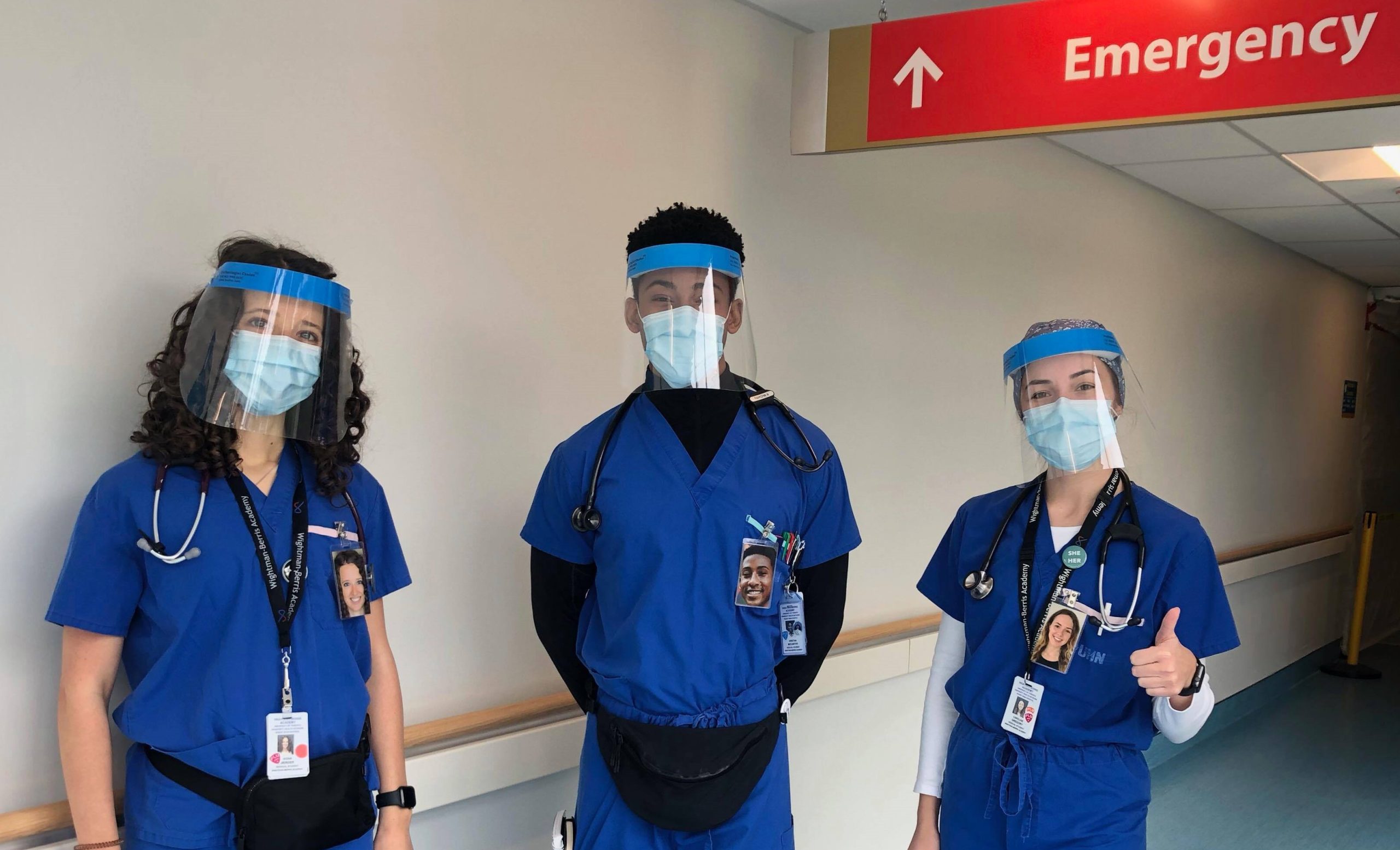
    Three staff with portraits

    PPE Portraits Canada is a national medical and graduate student run initiative (www.ppeportraits.ca) providing free smiling laminated headshots for healthcare professionals to wear on their scrubs so patients can see their faces beneath all their PPE.
     
    They are supported by the Temerty Faculty of Medicine at the University of Toronto as well as medical faculties at other Canadian institutions including McGill University, University of Ottawa, and the University of British Columbia (UBC). Their PPE Portraits (example above) have received IPAC Canada approval at hospitals across the country including UofT-affiliated hospitals in Toronto and Mississauga.
     
    To date they have provided over 1000 healthcare professionals with free PPE Portraits across the country! If you would like your own free PPE Portrait please fill out this form: www.icubp.org/ppeToronto


    Togetherall funding ended, vaccine education for patients and more

    Recent updates include:

    We continue to update several pages on our site with resources and news:


    Members’ stories

    Niagara North FHTMedical hub in Niagara expected for Niagara North FHT in 2022
    Elliot Lake FHT- Dr. Cathy Groh reflects on their community’s efforts to protect one another


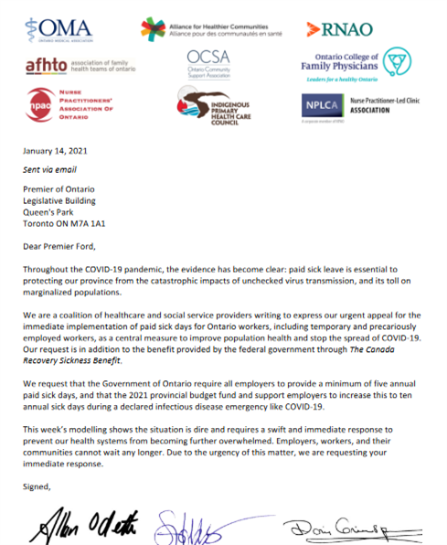
    Picture of Paid sick leave pdf


    Joint letter on paid sick leave

    On Jan. 14, nine healthcare and community organizations sent a letter to Premier Ford requesting paid sick leave:

    We request that the Government of Ontario require all employers to provide a minimum of five annual paid sick days, and that the 2021 provincial budget fund and support employers to increase this to ten annual sick days during a declared infectious disease emergency like COVID-19.

    Read more here.


    Apply for HIV and Hepatitis C funding by Jan. 29

    Members may be eligible to apply for the Public Health Agency of Canada funding to address sexually transmitted and blood-borne infections through:

    Deadline to submit a Letter of Intent (LOI) is January 29, 2021.


    Reminder- Now is the Time to Choose Wisely: Advancing Quality Improvement in Primary Care, Jan. 27, 2021

    Engaging primary care providers in QI is particularly relevant now, as the pandemic has further emphasized the importance of resource stewardship given the urgent care needs and constraints related to COVID-19. Learn more and register here.


    Reminder- Call for abstracts- Choosing Wisely Canada
    Choosing Wisely Canada’s Sixth Annual National Meeting will be offered virtually on May 12 and May 13, 2021. You can submit an abstract by February 1, 2021. Find out more.


    Managing COVID-19 in Primary Care, Jan. 19 – Feb. 23, 2021

    Registration is still open for the final 5 sessions in ECHO Ontario’s Primary Care conversations, hosted by UHN.
    View the remaining topics here.


    Education Series on Measurement-Based Care in Mental Health, starting Jan. 21, 2021
    Free virtual education sessions by Ontario’s Mental Health and Addictions Centre of Excellence, the Ontario Hospital Association and the University of Toronto’s Institute for Health Policy, Management and Evaluation. Register here.


    The COVID-19 vaccine: sharing best practices and answering your questions, Jan. 22, 2021
    The next COVID-19 Community of Practice for Ontario Family Physicians session. Register here.


    Mental health for adults with developmental disabilities during COVID: A virtual course for family caregivers, starting Feb. 2, 2021
    This course will run for 6 weeks beginning on Tuesday February 2, 2021. Find out more here.


    OntarioMD Educates: Digital Health and Virtual Care Curriculum, Jan. 27 & Feb. 24, 2021
    Join the virtual care conversations in this series of 10 sessions. In January, hear about Virtual Care as Core to Practice with COVID and Beyond, and Privacy and Cybersecurity in February. Register here


    ICES Winter Forum: Data and Analytics in Critical Times, Feb. 17, 2021
    Focused on data and analytics to support pandemic planning and response, highlighting Ontario, Canadian and international evidence and perspective. Register here.