Blog

  • COVID-19 in Ontario – A Focus on Diversity: Public Health Ontario Report

    On June 1, Public Health Ontario released Enhanced Epidemiological Summary COVID-19 in Ontario – A Focus on Diversity .

    Purpose

    This report aims to explore neighbourhood-level trends among laboratory-confirmed COVID-19 cases reported in Ontario who do not reside in long term care (LTC) from a health equity perspective. It combines individual case data with neighbourhood-level data on race and immigration as measured by the “ethnic concentration” dimension of the Ontario Marginalization Index (ON-Marg).

    The report findings improve our understanding of how COVID-19 impacts neighbourhoods differently in Ontario, particularly those with greater diversity that may already experience marginalization related to racism and discrimination. This information could be used to inform planning and equitable prioritization of public health and health system resources and interventions.

    Highlights

    • The most ethno-culturally diverse neighbourhoods in Ontario, primarily those concentrated in large urban areas, are experiencing disproportionately higher rates of COVID-19 and related deaths compared to neighbourhoods that are the less diverse.
    • After adjusting for differences in the age structure between neighbourhoods, the rate of COVID-19 infections in the most diverse neighbourhoods was three times higher than the rate in the least diverse neighbourhoods.
    • People living in the most diverse neighbourhoods were also more likely to experience severe outcomes (hospitalizations, ICU admissions and deaths) than people living in the least diverse neighbourhoods:
      • hospitalization rates were four times higher;
      • ICU admission rates were four times higher; and
      • death rates were twice as high.

    Read the full report here.

  • Bits & Pieces: virtual visits webinar materials, members’ stories & more

    Bits & Pieces: virtual visits webinar materials, members’ stories & more

    Your Weekly News & Updates


    In This Issue  
    • Virtual Visits: Beginning to End webinar materials now available
    • Members’ stories
    • Operational requirements for health sector restart and more
    • Questions Are the Answer- patient tips and tools
    • Educational supports for IPAC -Toronto region
    • Research participant recruitment – concussion telerehabilitation study
    • Upcoming events regarding mental health and more

    Virtual Visits: Beginning to End webinar materials now available

    On Wednesday, May 20 we held a discussion around virtual visits (one on one & group) with our expert panel. Panelists went through multiple components of how to conduct a virtual visit and a Q&A portion.

    The recording, slide deck and Q&A document for the webinar are available here. Please log into your AFHTO account first and then click again to access these resources. There were a few questions that were not covered so please find the Q&A document as a follow up in this link. All the resources mentioned within the webinar and in the document can also be found on the AFHTO website here.


    Members’ stories

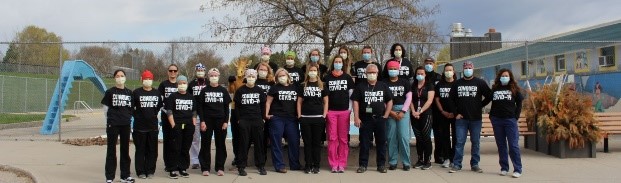
    Oakridge Assessment Centre team, Thames Valley FHT

    Guelph FHT: Guelph FHT urges residents to not let pandemic stop them from seeking medical attention

    North Huron FHT: North Huron Family Health Team lays out guidelines for visiting local doctors

    North Simcoe FHT: North Simcoe FHT’s virtual-care clinic for orphan patients set to expand

    St. Michael’s Hospital Academic FHT: “It’s time we leveled the playing field”, Dr. Tara Kiran

    Promote your team: we regularly post about members on Twitter and Facebook, such as with the above picture from Thames Valley FHT. If you’re on either, please tag us if you’re promoting any programs, activities or good news. Otherwise, feel free to email us at info@afhto.ca with a picture and details if possible. We’re here to highlight how well you’re taking care of your communities right now.


    Operational requirements for health sector restart and more

    Last week the government released the following:

    We continue to update several pages on our site with resources and news:

    We’ll update these on a regular basis as we receive relevant resources, while trying to reduce duplication with other sources. We will continue to update the news page daily.


    Questions Are the Answer- patient tips and tools

    Questions Are the Answer helps patients effectively prepare for making decisions about medical treatment options by asking the right questions. It considers topics for before, during, and after appointments, using past, present, and future medicines, medical tests, and surgeries. You can share these tips and tools from the Canadian Patient Safety Institute with your patients.


    Educational supports for IPAC -Toronto region

    The Toronto region has a mental health and addictions working group, co-chaired by Catherine Zahn, CEO of CAMH, and Heather McDonald, CEO of LOFT Community Services. They have collaborated to develop a resource hub for high-value materials related to infection prevention and control in community settings. It is available on a public-facing website, EENet, so anyone can access.

    They have also created a webinar series hosted by the CAMH IPAC specialist for those in community settings to ask any IPAC-related questions. The webinars are held weekly on Mondays from 12:00 -12:30 pm and anyone can sign up to receive invites. You can sign up here.


    Research participant recruitment – concussion telerehabilitation study

    Researchers in the Department of Occupational Therapy at the University of Toronto are currently recruiting youth with concussion to participate in a study exploring the use of telerehabilitation for concussion management.

    Youth will participate in a 6-week rehabilitation program consisting of education, support and low-intensity exercise delivered by a kinesiologist or occupational therapist through weekly videoconferencing appointments.

    Who can participate?
    •    Youth (ages 13-18 years) experiencing concussion symptoms
    •    At least 2 weeks post-concussion

    For more information or to help with participant recruitment, please contact the research team at oaktelerehab@utoronto.ca or 416-946-3273.


    Ask Me Anything about Health Privacy, June 3, 2020

    Still have questions around Health privacy? Join Kate Dewhirst Law for another AMA. Register here.


    Overview of Managing Common COVID-19 Respiratory Symptoms in Palliative Care and End of Life – A Primer for Front Line Staff, June 4, 2020
    Familiarize yourself with respiratory symptom management in palliative care and end of life. Hosted by the HPCO and CHPCA. Learn more here.


    Re-opening, Warily: Re-Thinking Clinical Practice in a Time of Physical Distancing, June 3, 2020

    Choosing Wisely weekly virtual gatherings during COVID-19. Register in advance.


    Mental Health in the COVID-19 Pandemic (Psychiatric Dimensions of Disasters III), June 6, 2020

    Disaster Psychiatry Canada and University of Toronto Psychiatry are holding a free event for all healthcare professionals. Look forward to mental health discussions in 7 different sessions from morning to afternoon.
    Learn more here.


    Integrated Mental and Physical Health – ECHO Ontario Mental Health, June 5, 2020
    Join this 12-week program beginning on June 5 and ending August 28 to strengthen your capacity in integrated Mental and Physical Health. Learn more and register here.

  • North Simcoe FHT’s virtual-care clinic set to expand

    Orillia Matters article published May 28, 2020

    By Mehreen Shahid

    The North Simcoe Family Health Team hopes to soon expand its virtual-care clinic program from two to five days a week.

    A local health team has a virtual solution for orphan patients in the area.

    Noticing the rising need of family physicians in the area and having five physicians retire in the last year or so, North Simcoe Family Health Team (NSFHT) thought it was time to bring technology in the mix. It wants to connect up to 3,000 local patients with family physicians virtually through a virtual care program it currently offers two days a week.

    “We have relied on telemedicine in the past to connect people with specialists who are in the GTA (Greater Toronto Area),” said NSFHT executive director Andrew Shantz, adding expansion is slated to happen as soon as possible. 

    The model is based on one used a few years ago by the Peterborough Family Health Team, according to Shantz.

    “They partnered with the virtual family physician network, an organization that helps connect physicians through telemedicine to communities,” he said. “We became aware of their situation and contacted (the virtual family physician network) earlier this year to see if they would interested in doing a similar program in North Simcoe.”

    This program doesn’t act as a walk-in clinic, he said, but it does help reduce pressure on the local hospital’s emergency room.

    “We supply the space and equipment and the nursing staff,” he said, adding physicians, who are typically based in larger urban centres, connect with client via telemedicine. “The program is unique because it connects a patient with a primary care provider long-term. This allows a relationship to be developed between the client and the nurse and the client and the physician.”

    Amber Kolsen, a registered nurse working with NSFHT, has been helping run the program, which is currently only offered two days a week.

    “I think it’s a great program,” she said. “We’ve had a lot of positive feedback from clients that have used it, just in terms of how easily accessible it is. It’s frustrating not to have a family doctor.”

    Kolsen said the health team encourages people to inquire about the program and even to try it out.

    “There is no obligation to stick with the program,” she said. “If they have one visit and don’t like the technological aspect, they don’t have to stick with it.”

    In her role, Kolsen said, before COVID-19 restrictions for in-person visits came in place, she had been helping up to 40 people each day, out of the 255 people currently enrolled in the program.

    “Anyone who reaches out will be offered a meet and greet,” she said, adding it’s all done virtually or over the phone these days. “The doctor will review their history and medications.”

    Kolsen said during an in-person visit, she would be the hands and eyes for the doctor to conduct a physical examination, if needed.

    The program has some limitations, she said, in that doctors are unable to see patients with narcotics prescriptions or for acute conditions, which might be best dealt at the ER.

    “The good thing is that the physician is able to provide referrals for specialists,” Kolsen said.

    Visit the NSFHT website for more information.

    To view the full article, click here.

  • Guelph FHT urges residents to not let pandemic stop them from seeking medical attention

    Guelph Today News article published May 23, 2020

    By Anam Khan

    Executive director Ross Kirkconnell of the Guelph Family Health Team said the health system has always been there for residents and the pandemic is no different

    The Guelph Family Health Team has a message for those holding themselves back from seeking medical attention during the pandemic. Don’t.

    “We want to remind people that family practice is available, has been available and always will be available. So don’t put things off that you shouldn’t be,” said Guelph Family Health Team’s executive director Ross Kirkconnell. 

    He said he’s recently been hearing stories of people not visiting their doctors while enduring pain because they believe the health system is busy. 

    “No. If you have symptoms you should be getting it checked like you normally would,” said Kirkconnell.

    Once the pandemic was declared mid-March, the clinics across the city immediately saw a decrease in the number of visits to their clinics across the city.

    “People were reluctant at first to sort of bother the health care system. Everyone was cautious about going anywhere,” said Kirkconnell.

    Now that it has been almost two months, he said the clinics are beginning to see more calls from patients who do not want to wait any longer but still are not at the number of visits they used to be before the pandemic. 

    “Some people can get by with their friends and family for support but at some point, you need care again and we shouldn’t feel bad about that,” said Kirkconnell.

    He said things like vaccines for new babies, chronic pain and necessary checkups should not be put off.  

    Kirkconnell said the system has always been open and now with the pandemic, the clinics are just operating differently.

    The team’s 100 medical professionals manage roughly 80 per cent of their 3,000 daily appointments through phone and video. People who need access to urgent care are seen in-person on an appointment basis. 

    Dr. Will Ruddock at the Guelph Family Health Team said switching to online methods is a two-sided effort as doctors have to make those services accessible and patients have to feel comfortable with the process. 

    “Anecdotally I would say that has really been increasing gradually over the last couple of weeks as everybody gets more comfortable with this,” said Ruddock. 

    He said he urges people to contact their family doctors regarding their concerns so they can be dealt with accordingly. 

    “In a year or five, having gotten started with this, everybody might have more interest in some of their care being done this way,” said Ruddock.

    With distancing measures, increased sanitation and use of masks already in place, Kirkconnell said many of their clinics are even allowing patients to wait in their car till they are called inside for their appointment to further enhance comfort and safety for the patient. 

    “If you need to see a physician or a member of the care team, they are available for you. If you need to go to emergency at the hospital, it’s there for you. Just because its a pandemic doesn’t mean other things stop,” said Kirkconnell. 

    To view the full article, click here.

  • Bits & Pieces: open letter on pandemic pay, updated primary care guidance & more

    Bits & Pieces: open letter on pandemic pay, updated primary care guidance & more

    Your Weekly News & Updates


    In This Issue  
    • Joint open letter on pandemic pay, updated primary care guidance and testing memo
    • AFHTO 2020 Conference: switching things up
    • Nominations to the AFHTO Board of Directors open until July 3, 2020
    • Updated symptoms document and more
    • Update on COVID-19 testing- Primary Health Care Branch
    • Reminder- Ontario Community Support Association meals/essentials delivery
    • Upcoming events including Hospice Palliative Care CoPs and more

    Joint open letter on pandemic pay, updated primary care guidance and testing memo

    Yesterday we submitted an open letter with ten other organizations to Premier Ford and Minister Elliott calling for immediate clarity on the implementation details and timing on pandemic pay for frontline workers. Read the full letter here.

    It was highlighted by the Toronto Star and also picked up across their regional network, landing in many local papers from Hamilton to Windsor, Ottawa and across the GTA.

    On a related note, on Friday, May 22 the government released updated primary care guidance. On Sunday they also provided a memo describing new testing direction for COVID 19 (English and French).  It outlines that testing is available to all people with at least one symptom as well as those who are not experiencing symptoms but are at risk or are concerned about exposure. 



    Excited children at laptop

    AFHTO 2020 Conference: switching things up

    In March, as we prepared to announce our 2020 conference themes and program, the COVID-19 pandemic overtook our plans. Thank you for your patience as we monitored the situation and made decisions about how it might affect the 2020 Conference, set to take place this October in Toronto.

    Based on information from the World Health Organization (WHO), Public Health Canada, Public Health Ontario, and others, we find we cannot hold the conference in-person as originally planned. Our focus and priority are member and stakeholder safety and well-being.

    Last year attendees said they wanted a change so we’re exploring virtual options. Without an in-person component, we can create something new and envision the conference differently. What can it look like without those familiar constraints?

    We’re working on this right now and we need your help. What do you want to hear more about and how would you like it? Tell us in this quick survey. Deadline tomorrow, Wed. May 27, 8:00 a.m.


    Nominations to the AFHTO Board of Directors open until July 3, 2020

    Are you interested in serving on the AFHTO Board of Directors? The governance committee of AFHTO’s board invites anyone who works within an AFHTO member organization to apply. Priority for the directors to be elected will be given to candidates who are:

    • Interprofessional health care providers (IHPs), especially those working in mental health and addiction;
    • Board members, especially community members in the position of Chair of the Board; or
    • Experienced in finance, including accreditation as a financial professional (e.g. CA, CPA, CMA).

    Deadline is July 3, 2020. Find out more here.


    Updated symptoms document and more

    Yesterday the government released an updated symptoms document to include some additional language around how multisystem inflammatory vasculitis may present in children.

    We continue to update several pages on our site with resources and news:

    We’ll update these on a regular basis as we receive relevant resources, while trying to reduce duplication with other sources. We will continue to update the news page daily.
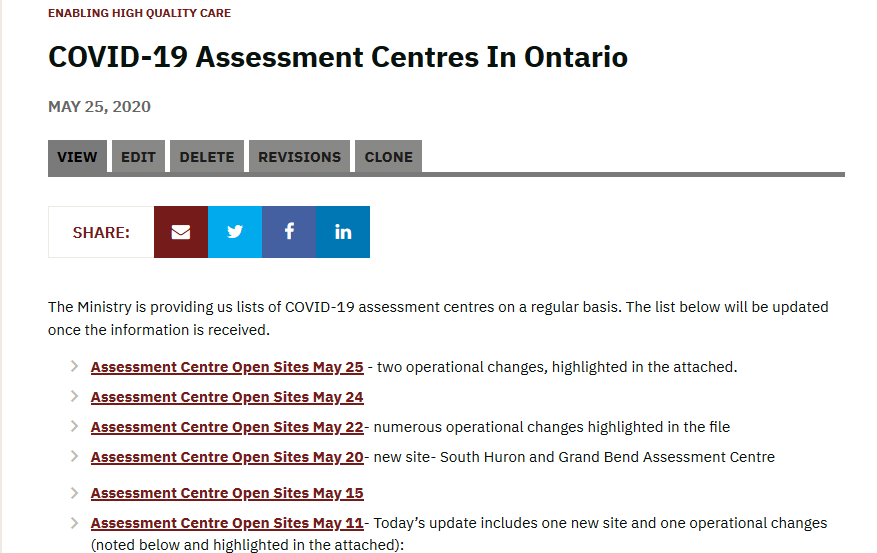

    COVID-19 assessment centres


    Update on COVID-19 testing- Primary Health Care Branch

    Yesterday we received an important email from the Primary Health Care Branch regarding COVID-19 testing. It included a link to the Personal Protective Equipment Intake Form and referred to the list of assessment centres.

    This list is updated on our site on a regular basis.


    Reminder- Ontario Community Support Association meals/essentials delivery

    OCSA seniors help


    Weeks ago Ontario Community Support Association established a link on their website to connect individuals/community providers to meals services/essentials delivery.

    As the province prepares to reopen for business, there are still millions of seniors and people with disabilities and chronic conditions that will continue to need to self-isolate at home. So, they think their work has only just begun.  
     
    If there are cohorts of populations or individuals that members feel need support during COVID-19, please contact OCSA so they can help.  

    In this portal, you can search Meals providers or Essential Service providers by searching based on address. If service providers exist in the area, a referral can be made directly through the portal to the provider. If nothing can be found there, a link will pop up asking to “Sign Me Up” to receive a phone call from a Canadian Red Cross (CRC) Coordinator to make connection to services. 


    Choosing Wisely – Canada’s National Meeting, May 26, 2020
    The Virtual National Meeting will bring together health professionals, patients, system leaders, and researchers from across the country to discuss and engage in topics related to overuse in health care. Learn more here.


    Meeting Social Needs in an Integrated Health System: Social Prescribing During COVID-19 and Beyond, May 27, 2020

    The Alliance for Healthier Communities has made their social prescribing meeting virtual. Join the conversation around integrating healthcare and social supports. Learn more here.


    Driving and Accelerating a ‘One System’ Response: Why COVID-19 has Shone a Spotlight on Integrated Care, May 27, 2020
    This webinar will profile Canadian and international examples that demonstrate what teams have leveraged and accelerated in order to respond to COVID-19 as one connected team and community. Learn more and register here.


    Hospice Palliative Care CoPs, Ongoing

    HPCO hosts virtual CoPs related to:

    • Health Care Consent, Advance Care Planning
    • Rural Hospice Palliative Care
    • Compassionate Communities

    Find out how you can join.


    Psychological PPE: Exploring Compassion Fatigue and Learning How to Keep Ourselves Psychologically Well, May 27, 2020
    The University of Toronto Faculty of Medicine is holding a webinar on Wednesday evening around the impact of compassion fatigue and burnout on health care professionals. Learn more here.


    ECHO Ontario Bariatric Network, June 3- August 26, 2020
    Learn how to work with your patients living with obesity who have received specialty care from a Bariatric Centre of Excellence (BCoE). Find out more.

  • A Joint Open Letter on Pandemic Pay

    May 25, 2020

    Premier Doug Ford
    Queen’s Park
    Toronto, ON
    M7A 1A1

    OPEN LETTER

    Dear Premier Ford,

    As a broad group of healthcare stakeholders whose members employ tens of thousands of front line workers in the fight against COVID 19, we write to you today to seek immediate clarity on the implementation details and timing of the release of pandemic pay to support frontline workers employed by organizations funded by the Ministry of Health and the LHINs.

    On April 25th, we each applauded the Government of Ontario’s announcement that frontline workers would be recognized with temporary pandemic pay for the current challenges they face keeping Ontarians healthy, safe and informed during the pandemic.  

    A month later, it is still not clear whether the efforts of all of our healthcare workers will be recognized or if pandemic pay is restricted to a subset of employees. Also, funding has yet to flow to the front line and in fact for those front-line workers whose organizations are funded by the Ministry of Health and/or LHINs have yet to receive clarity on whether or not they will be considered front line workers eligible for pandemic pay.  This is contributing to extreme morale issues at the front line at a time when staff need to be supported most.  It is also creating unnecessary conflict for employers who are left trying to explain to their employees why they cannot provide neither clarity nor the pay itself.

    Together, we are urging the Provincial Government to immediately communicate the implementation details, including confirmation that the funding is for all workers on the frontline, and release funding so that frontline workers can start to see the benefit now while the economy is opening up and they are still hard at work to contain the pandemic.

    Additionally, to recognize the critical services provided and the team effort required in fighting COVID-19, we continue to urge that pandemic pay be applied to all non-management front line providers, including regulated frontline staff.

    Every day, it becomes increasingly difficult to see this great initiative, that has such great promise for health care worker recognition, be undermined by delay.

    We thank you for your attentiveness to our request and look forward to your reply.

    Yours truly,

    (Original Signed By)

    Justin J. Bates, CEO, Ontario Pharmacists Association
    Anthony Dale, CEO, Ontario Hospital Association
    Lisa Levin, CEO, AdvantAge Ontario
    Kavita Mehta, CEO, Association of Family Health Teams of Ontario
    Kimberly Moran, CEO, Children’s Mental Health Ontario
    Camille Quenneville, CEO, Canadian Mental Health Association, Ontario
    Deborah Simon, CEO, Ontario Community Support Association
    Adrienne Spafford, CEO, Addictions and Mental Health Ontario
    Adrianna Tetley, CEO, Alliance for Healthier Communities
    Alisha Tharani, Executive Director, Mental Health Partners
    Samantha Yau, President, Canadian Society of Hospital Pharmacists Ontario Branch

    Cc:
    Hon. Peter Bethlanfalvy, President of the Treasury Board
    Hon. Christine Elliott, Deputy Premier and Minister of Health
    James Wallace, Chief of Staff to the Premier
    Mark Lawson, Deputy Chief of Staff to the Premier
    Karl Baldauf, Chief of Staff to the President of the Treasury Board
    Leif Malling, Chief of Staff to the Deputy Premier and Minister of Health

    See the pdf version here.

  • Nominations to the AFHTO Board of Directors are open until July 3, 2020

    Nominations to the AFHTO Board of Directors are open until July 3, 2020

    Dear AFHTO members,
     
    Are you interested in serving on the AFHTO Board of Directors? The governance committee of AFHTO’s board invites anyone who works within an AFHTO member organization to apply. We are looking for strategic and emerging leaders to help shape the future of interprofessional team-based care in Ontario!  

    Please share this call for nominations with all who work in your team.

    Six (6) positions are to be elected for a 3-year term on the 14-member board. The AFHTO by-laws call for balanced representation on the board to include the various forms of governance, the regions of the province, and the mix of the professions working within FHTs, NPLCs, and other interprofessional models of primary care.

    Given the composition of the continuing board members, priority for the directors to be elected will be given to candidates who are:

    • Interprofessional health care providers (IHPs), especially those working in mental health and addiction;
    • Board members, especially community members in the position of Chair of the Board; or
    • Experienced in finance, including accreditation as a financial professional (e.g. CA, CPA, CMA).

    To apply:

    The governance committee will review all applications to assist the board in determining the slate of candidates to recommend to the AFHTO membership for ratification at the annual general meeting.

    • Nominees will be informed of their status by September 23, 2020.
    • The slate will be presented to the members at the annual general meeting, which is scheduled for:

    Thursday, October 8, 2020
    9:00 a.m. to 10:00 a.m.
    (More details to follow)


    Sincerely,

    Tom Richard signature


    Dr. Tom Richard
    Chair, AFHTO Board of Directors

  • AFHTO 2020 Conference: switching things up

    In February AFHTO’s Membership Committee and Board approved our 2020 conference themes and program. In March we prepared to announce them and send a call for volunteers but as with everything else, the COVID-19 pandemic overtook our plans. Thank you for your patience as we monitored the situation and made decisions about how it might affect the 2020 Conference, set to take place this October in Toronto.

    Based on information from the World Health Organization (WHO), Public Health Canada, Public Health Ontario, and others, we find we cannot hold the conference in-person as originally planned. Our focus and priority are member and stakeholder safety and well-being.

    Something new

    Last year attendees said they wanted a change so we’re exploring virtual options. Without an in-person component, we can create something new and envision the conference differently. What can it look like without those familiar constraints?

    We want to hear from you

    We’re working on this right now and we need your help. What do you want to hear more about and how would you like it?

    Tell us in this quick survey

    Primary care remains vital as the foundation for the health care system. As you work to keep your patients healthy and out of the emergency department, we know many of you are seeking connection, support, and resources more than ever before. You’ve been checking our COVID-19 resource section, reading our emails and attending our webinars.

    With all of this in mind, we feel the AFHTO Conference, with its focus on team-based primary care, is needed now more than ever, in whatever format best serves your needs. So, tell us what you’d like to see.

    For our Leadership Triad, AFHTO’s Annual General Meeting will proceed on October 8th, 2020 from 9:00 a.m. to 10:00 a.m. More information about that, as well as Board recruitment, will be shared shortly.

    Please stay tuned to your email, our website, Facebook and Twitter for further details as we work to make this event something you can look forward to this year.

  • Windsor FHT Launches Virtual Substance Program

    CTV News article published May 14, 2020

    By Ricardo Veneza

    WINDSOR, ONT. — The Windsor Team Care Centre’s substance abuse services are being forced online by COVID-19 – but the move may be a blessing in disguise.

    A new virtual substance abuse program, part of the One Team Recovery (OTR) initiative, will have its first session on Tuesday, through the online video call platform Go To Meeting. The service will allow up to 25 people to join the group session.

    “They’re really wanting the help,” says Beth Lalonde, an addiction counsellor with the program. “No one wakes up and says, ‘Hey guess what I want to be today? I want to be having a problem with this.’”

    The OTR is a five-week harm reduction program launched in October backed by a $40,880 grant from the Windsor-Essex Community Foundation and Green Shield Canada.

    Lalonde says counselling services have continued during the pandemic through one-on-one video calls and phone conversations, but the options are not good substitutes for in-person and group consultations.

    That led to the launch of the new virtual platform.

    “To reach the masses and to provide a group setting, we just found that this program could offer those extra services and extra supports this way and connect other people, so they don’t feel as alone,” says Lalonde.

    That loneliness may be creating further problems for those struggling with substance abuse.

    Lalonde says while opioid and crystal meth abuse is widespread in Windsor, half of her clients are struggling with alcohol.

    “Because of that isolation component with COVID, we’re seeing that clients are sometimes escalating their drinking or substance use because no one is there to support them,” says Lalonde.

    Yet, at the same time, Lalonde has seen a drastic dip in the number of physician referrals.

    Addiction counsellors at the centre usually have 25 clients at any one time.

    The OTR program has allowed self-referrals since March as a result of the COVID-induced dip.

    Derek Roberts, another addiction counsellor with the team, hopes the virtual platform will allow for more personal discussions with clients at a time when in-person visits are restricted or ill-advised.

    “Ideally we would like to provide the service in-person but, with what’s going on, we’re not able to do that so we’ve got to go on to the next best thing,” says Roberts.

    There are 10 people registered for the first virtual program cycle.

    Roberts and Lalonde will be connecting with the group on Friday to ensure a smooth launch next week.

    The program is already showing promise, according to Roberts, who sees the platform as more convenient for clients – helping to cut down on skipped meetings – and more efficient for the counsellors to potentially see more referrals.

    Roberts expects the program could become a mainstay even as group programs return, as pandemic restrictions are lifted, including those that bring families impacted by addiction together.

    “We know that statistics show for everyone individual’s addiction, that it directly affects five additional people,” says Roberts. “Which are their loved ones and friends.”

    Roberts adds the OTR program has no current wait list. Those seeking help can call 519-250-5524.

    To view the full article, click here.

  • Follow-up to ED calls, May 12 and 13 – PPE, virtual care, and HR updates

    This email was sent to EDs/Administrative Leads, Board Chairs and Lead Clinicians of AFHTO member organizations.

    Thank you to all the executive directors who joined our third round of regional ED calls last week.

    This email is a follow-up to provide the information promised during the calls, as well as other updates and supports, including a link to last week’s webinar with Maria McDonald, which you’ll find in the HR section below.

    PPE

    Question: What are the recommendations related to use of PPE with asymptomatic patients?

    • The Chief Medical Officer of Health recommends that asymptomatic patients should first be screened over the phone prior to visiting the clinic. For non-COVID-19 related visits that are unavoidable, the patient should again be asked the COVID-19 screening questions upon arrival. If the patient screens negative to all questions and exhibits no signs or symptoms of COVID-19, the following is being recommended:   
      • At reception, if able to maintain spatial distance of at least 2 m or separation by physical barrier then no personal protective equipment (PPE) required by reception staff.  
      • Primary care providers should consider wearing procedural masks if within 2 m of a patient.  
      • Proceed with the patient as per Routine Practices, including hand hygiene and apply PPE as required based on the intervention. It’s suggested that a point-of-care risk assessment (PCRA) be performed by every health care worker before every patient interaction and additional PPE precautions be taken based on risk assessment.
    • Check out the OH West PPE site for “Point of Care Risk Assessment – PPE Selection Guide” for guidance on precautions to take based on risk assessment.
    • A one-page summary on the recommendations for asymptomatic patients and the “Point of Care Risk Assessment – PPE Selection Guide” is here.

    Question: How can I access PPE?

    • The ministry recommends the following pathway for accessing PPE:
      • Contact your regular supplier. They are your first point-of-contact and many suppliers have now increased stock.
      • If you’re unable to acquire PPE from your regular supplier, contact your OH regional table.
      • As a last resort, and if you have less than a 5-day supply, contact the Ministry Emergency Operations Centre (MEOC) at eocoperations.moh@ontario.ca
    • The OMA SGFP has secured an arrangement for bulk purchasing of PPE with Surgo Surgical Supply – please connect with your affiliated physician group to get access to this information.
    • The government’s Workplace PPE Supplier Directory also provides information on companies that sell PPE.
    • With our primary care partners, AFHTO continues to advocate for a provincial approach to PPE bulk purchasing and centralized distribution.
    • Guidance for PPE reprocessing is expected shortly. We will share this as soon as it is public.

    Virtual care

    • Kate Dewhirst of Kate Dewhirst Health Law has developed a number of virtual care policies that can be found on her website. The most recent policies and documents can be found on the bottom of her webpage.
    • There have been some concerns about patients recording their appointments. AFHTO is discussing this with the OMA and CMPA and will provide feedback on how to mitigate this risk.
    • We are hearing increasing concerns about analog lines and rural accessibility to virtual care, including the challenge that not all patients have access to the internet or digital tools like computers and phones. We will continue to bring this to the attention of the ministry.
    • Primary care teams have adapted to virtual care almost overnight and are leading patient-centric innovations in their community. Take a moment and learn more about what teams across the province are doing, and please share your initiatives with us at improve@afhto.ca.
    • Teams are also starting to think about what aspects of virtual care they want to become standard in the new normal.
      • We encourage EDs to consider getting input from staff and patients about what recent changes they’d like to maintain. For example, North York FHT has recently done a Virtual Care Provider Experience Survey.
      • AFHTO is working with our primary care partners to roll out a provincial primary care patient survey and provider survey to measure the virtual care experience during the pandemic – stay tuned for more information on that!

    Human Resources

    Canadian Family Physician (CFP), the journal of the College of Family Physicians of Canada, posted a blog by Dr. Kimberly Wintemute and Dr. Guylène Thériault on the “Post-COVID primary care reboot” that you may find of interest.

    To capture the primary care experience, we will be reaching out soon to schedule interviews with executive directors, which we hope to start in early June. We ask you do your best to schedule one with us or to delegate to someone on the team who would be willing to be interviewed. We will hopefully be working with students at the University of Toronto to conduct these interviews, which will provide us with the narrative of how essential the role of team-based primary care was during the pandemic.

    A reminder to keep checking out our COVID-19 section that we regularly update with news, tools, and resources, including the daily situation reports and regular memos from the ministry’s command table.

    We’ll continue to keep you updated, and we’ll arrange another round of check-in calls to happen in about 2-3 weeks’ time.

    Please contact us any time. We’re here to support you.

    Sincerely,

    Your AFHTO Team