Blog

  • Planning document – Recruitment and Retention Initiative 2018-2021

    Shared by the Ministry of Health and Long Term Care

    May 2018

    ** This article is for Triad users only **

    In an effort to ensure transparency and predictability, the ministry is providing multi-year funding for 2018-21. This planning document will provide recipient organizations with the information necessary to undertake multi-year compensation planning.
    In allocating the recruitment and retention funding for 2018-21 the ministry continues to build on the approach adopted in close collaboration with sector associations. The ministry is, once again, looking to provide employers with the flexibility to approve a compensation plan that best addresses the need of the recipient to deliver on its mandate and address recruitment and retention.

    This document provides information on the principles and approach applied to arrive at your organization’s budgetary increase to improve recruitment and retention. As a funding recipient, you are encouraged to consider this methodology when approving a revised compensation plan for your organization in addition to other factors that may be impacting the ability of your organization to recruit and retain skilled health care and administrative professionals. Organizations will be required to report on how the increase is allocated within the organization

    If you have any questions, please contact info@afhto.ca

    Resource includes:

    • Principles
      • Removal of Barriers; Enhanced equity in Compensation; Broad Application; Accountability and Transparency
    • Methodology
    • Terms & Conditions
    • Appendex: Rates used to Calculate Funding Allocation

    Return to: Compensation Funding Webinar – Recruitment & Retention Webinar

  • February 17th Update on COVID-19 Vaccination Roll Out

    Dear Members,

    We are writing to provide you with an update from our united Primary Care COVID-19 Vaccination Action Council (*PC-VAC). Last week’s key messages that we shared with vaccine decision-makers can be found here.

    We are mindful that the news regarding vaccines is evolving daily, and we will have to continue to be prepared for changes and uncertainties in the coming months as a sector. Along with our partners in primary care, we are committed to sharing regular updates, usually weekly, except on weeks where there are no significant new developments to share.

    Earlier this week, the Ministry of Health released updated sequencing of Phase One priority populations for vaccination which sets out the provincial direction for the vaccination program over the coming weeks.

    Engaging Primary Care in Vaccine Rollout – a Practical Guide for Public Health

    Key messages:

    • Public health leadership is committed to strong primary care partnerships in all phases and in all regions. These relationships are key enablers of an effective, efficient, and equitable rollout.
    • To ensure successful partnership with primary care, 1) invite primary care professionals and teams in planning and co-design, 2) involve them in feedback and rollout, and 3) inform them of local opportunities, uncertainties, and changes.
    • The enclosed partnership checklist can inform and validate existing strategies from health leaders involved in local COVID-19 vaccine planning in engaging primary care.

    Collaborating with Others:

    • Over the last two weeks, the collaborative of primary care organizations met with General (retired) Rick Hillier, Chair, COVID-19 Vaccine Distribution Taskforce, who emphasized the importance of an ongoing partnership with primary care provincially and locally.
    • We were pleased to see the addition of Dr. Kieran Moore, the Medical Officer of Health for Kingston, Frontenac and Lennox & Addington Public Health, join the Ontario Ministers’ COVID-19 Vaccine Distribution Task Force. Dr. Moore is a passionate advocate for public health, and as a trained family physician he will ensure that the primary care voice is added to the conversation. PC-VAC is now meeting weekly with Dr. Moore, in addition to Dr. Isaac Bogoch, to provide updates on issues arising from the field.
    • Health and primary care leaders from throughout the country led a virtual roundtable with Prime Minister Justin Trudeau. During the roundtable, the Prime Minister and other participants affirmed what we know to be true: family doctors and primary care professionals are “most knowledgeable and most trusted” and “a core part of getting everyone vaccinated.”
    • Listen to the Evan Solomon Show speak to Dr. Isaac Bogoch about the importance of family physicians and primary care providers in the COVID vaccine rollout. Leveraging the existing relationships primary care has with their patients, based in trust, will accelerate vaccination in the community.

    COVAXON

    • As we had mentioned in our last update, the Ministry of Health has introduced an electronic central repository to input the vaccine information for individuals and manage site inventory called COVAXON. This web-based application will allow for ease in checking people in for their vaccination appointment, capture the consent and personal data information, as well as which health unit region they are in and their vaccination clinic site. While clinics will be required to submit names of the staff (along with user names and email addresses) to request access to the system, the mechanism to apply is not yet finalized however we will advise once we know the information. Please note however that once you get an email from the system, you must reply within 24 hours in order to complete the authentication process.
    • Access for primary care users will fall within phase two and three of the vaccine rollout and training webinars will be available prior to the on-boarding schedule to ensure that everyone is prepared. While it likely won’t be fully integrated into your EMR, we understand COVAXON system will be able to send reports of your vaccinated patients to your EMR.  
    • More on COVAXON will be shared when it becomes available.

    New Resources:

    Reminder of resources from previous weeks

    We look forward to continually updating you on the provincial vaccination strategy. Please do not hesitate to contact us if you have any questions or ideas.

    Yours in good health,

    The AFHTO Team

    *Ontario Primary Care COVID-19 Vaccination Action Council:

    • Alliance for Healthier Communities
    • Association of Family Health Teams of Ontario
    • Indigenous Primary Health Care Council
    • Nurse Practitioner-Led Clinic Association/Nurse Practitioners’ Association of Ontario
    • Ontario College of Family Physicians
    • Ontario Medical Association Section on General and Family Practice
    • Ontario’s Academic Chairs of Family Medicine
  • Bits & Pieces: cultural safety toolkit, many vaccine resources and more

    Bits & Pieces: cultural safety toolkit, many vaccine resources and more

    Your Weekly News & Updates


    In This Issue  
    • Creating a safer environment for Indigenous Peoples
    • Reminder- Supply Ontario survey
    • Reminder- primary care virtual groups webinar tomorrow
    • Saegis cybersecurity clinic update webinar Mar 4
    • PHAC COVID-19 vaccination toolkit for HCWs, many Ministry resources, and more
    • Wellness Together Canada
    • OCFP Awards – call for nominations
    • CPSO policy consultations including MAID
    • Noninvasive Fetal RhD Blood Group Genotyping Task Force
    • Upcoming events including engaging and supporting caregivers and more

    Creating a safer environment for Indigenous Peoples

    The Indigenous Primary Health Care Council has just released Ne’ iikaanigaana Toolkit: Creating Safer Environments for Indigenous Peoples. Ne’ iikaanigaana is the Anishinaabe word for ‘All Our Relations’.

    The toolkit was created to support mainstream organizations on their journey towards creating safer environments for Indigenous participation, which is inclusive of participating as both an employee and a client or patient seeking services.


    Reminder- Supply Ontario survey

    The government recently established Supply Ontario, a single integrated supply chain across the public sector that will leverage the province’s purchasing power to provide greater value and consistent access to high-quality products and services.

    They’re need your input to help identify opportunities to improve the value they can deliver for your organization and patients, through better supply chain processes. Deadline February 24.


    Reminder- primary care virtual groups webinar tomorrow

    This webinar is in collaboration with two FHTs transitioning in-person programs to virtual. Scarborough Academic FHT will share how they transferred their CBT skills group for depression and anxiety to online along with the benefits and challenges.

    Arnprior FHT is presenting on how they modified an in-person Cardio-Pulmonary Rehab to Virtual in their rural community. In this webinar they will share their patients’ thoughts and feelings on the program adjustment, discussing wins and struggles along the way. Register here.


    Pre-budget submission
    AFHTO submitted recommendations last week to the Ministry of Finance as part of the 2021 Ontario Pre-Budget Consultations. The submission is entitled “The Heart of Health Care: Delivering Better Primary Care for Ontarians.”  This was done in collaboration with the Ontario College of Family Physicians, the OMA Section on General & Family Practice, and the Nurse Practitioners’ Association of Ontario. The submission can be read here.


    Saegis cybersecurity clinic update webinar Mar 4

    This webinar on March 4 will explore Canadian data/trends from the Canadian Centre for Cybersecurity, discuss the top security threats facing your team, and explore best practices to decrease the risk of breaches in the clinic setting. We will take a look at what a cyber-attack looks like, and how to respond if one should happen. Register today.


    COVID-19 vaccine fact sheet, cancer screening update and more

    Recent updates include:

    We continue to update several pages on our site with resources and news:


    Woman in pyjamas sits on the floor wth her head resting against a bed

    Wellness Together Canada

    Wellness Together Canada is Canada’s first and only online platform offering immediate mental health support for people of all ages, in every province and territory, and in both official languages.

    It provides a “stepped care” model where Canadians can be instantly connected to virtual mental health services, from a five-minute self-assessment, to extensive support and resources, to live phone, video or text counselling with a mental health professional or crisis responder.


    All services and resources are available at no cost to users, ever. This includes:

    • Immediate crisis support
    • Mental health self-assessment and monitoring
    • Access to self-directed virtual programs
    • Moderated community of support
    • Virtual group coached anxiety program
    • E-courses, including drop-in mindfulness class
    • Live one-on-one counselling support by video, phone, or text

    Visit Wellness Together Canada for 24/7 access to free mental health and substance use support at wellnesstogether.ca.


    OCFP Awards – call for nominations

    Nominate your colleagues for an OCFP award. Multiple categories ae open, including regional Family Physician of the Year. Deadline Feb. 28, 2021


    CPSO policy consultations including MAID

    CPSO is conducting policy consultations on the issues below. You can provide your input by March 15 for the first and April 12 for the rest:


    Noninvasive Fetal RhD Blood Group Genotyping Task Force

    The PSO Advisory Committee is looking for representation from the following categories to join the Noninvasive Fetal RhD Blood Group Genotyping Task Force:

    • Primary Care (Family Medicine, Midwifery, Nurse Practitioner)
    • Care for Indigenous Populations and/or Remote Care

    This is a short-term task force that will provide evidence-based and clinical/scientific leadership advice on implementation considerations for noninvasive fetal RhD blood group genotyping in Ontario. The terms of reference are here.

    How to Apply (Deadline: February 24, 2021):

    1. Complete and submit the RhD Task Force Survey
    2. Forward your CV to pso@bornontario.ca

    Engaging and supporting caregivers in primary care teams: working together to improve outcomes and enhance the patient, caregiver, and family experience, Feb. 25, 2021

    Cohosted with Ontario Caregiver Organization, this webinar will highlight resources and opportunities for teams to support and engage caregivers.

    Register today.


    Infection Prevention and Control at Work: Basic Awareness Training

    The PSHSA recently released this free, 30-minute training module for Ontario workers to recognize and prevent infection hazards in the workplace. Learn more here.


    Goal Management Training for Treatment of Executive Dysfunction, Feb. 19, 2021
    Learn more about the intervention, research, and models to deliver Goals Management Training virtually. Learn more here. 


    Changing the way we work: Long COVID and lessons from the UK, Feb. 19, 2021
    The COVID-19 CoP by the OCFP is covering learnings from the Dr. Greenhalgh, a renowned primary care researcher and GP in the UK. Learn more here.


    Atopic dermatitis seminar for healthcare professionals, Mar. 1, 2021

    The Eczema Society of Canada and University of Ottawa is hosting this webinar aimed towards primary care providers.
    Find out more here.


    Personal Resilience for Hospice Palliative Care, Mar. 3, 2021
    Learn how to enhance personal resilience during even the most challenging times.
    Find out more here.


    Advancing Excellence in Transgender Health, Mar. 4, 2021
    The aim of this conference is to bridge this gap and provide information and resources to better equip Nurse Practitioners providing care to Gender Diverse individuals. The highlight is hearing the patient perspective. Find out more.

  • AFHTO’s 2021 Pre-Budget Submission

    AFHTO has submitted recommendations to the Ministry of Finance as part of the 2021 Ontario Pre-Budget Consultations. The submission is entitled “The Heart of Health Care: Delivering Better Primary Care for Ontarians.”

    This submission was done in collaboration with the Ontario College of Family Physicians, the OMA Section on General & Family Practice, and the Nurse Practitioners’ Association of Ontario. 

    Our recommendations are the following:

    Recommendation 1:

    MORE ACCESS TO BETTER CARE: EXPANDING INTERPROFESSIONAL TEAM-BASED PRIMARY CARE

    • Ontario must commit to a 10-year, $750 million funding strategy to ensure every Ontarian has access to team-based primary care when needed. Within five years, access to this care must be expanded to, at minimum, half the population with priority on people who need it the most, such as those with complex and chronic illnesses, those with mental health and addiction challenges, and those hoping to live safely at home for as long as possible. Within 10 years, every Ontarian who needs it must have access to team-based primary care.

    Recommendation 2:

    MORE INTEGRATED CARE: EMBED MENTAL HEALTH AND HOME CARE IN PRIMARY CARE

    • Government must work with family physicians, nurse practitioners, primary care teams, and mental health care providers to develop a plan to integrate and embed mental health and addiction supports and resources in primary care. 
    • Government must strengthen the relationship between primary care and home and community care by transitioning the function and associated resources of Ontario Health Home Care and Community Support Service Organization care coordination to primary care.

    Recommendation 3:

    MORE ACCESSIBLE AND CONTINUOUS CARE: STRENGTHEN VIRTUAL CARE FOUNDATIONS IN PRIMARY CARE

    • Government must work with the Ontario Medical Association to implement permanent billing codes into the Schedule of Benefits that address all digital modes of communication, including video, phone, and secure messaging. Government must also provide the necessary IT and administrative resources required by physicians, nurse practitioners, and primary care teams to provide comprehensive virtual care, so patients continue to receive continuity of care, no matter how they choose to access that care.

    • To help facilitate virtual tool integration within electronic medical records (EMRs), upfront infrastructure funding and ongoing subsidies must be provided so that primary care EMRs can continue to be optimized and utilized to their full extent. This includes online booking and the ability to integrate with digital modes of communication, such as email, phone, and video visits.

    The full submission can be read here.

  • Wellness Together Canada

    Shared by Wellness Together

    Shared on February 11, 2021

    Now more than ever, the mental health of people across Canada is being challenged. The COVID-19 pandemic is often thought of as a public health crisis, but it is also proving to be a mental health crisis.
    Services nationwide continue to experience unprecedented demand as people struggle to cope with the mental health impacts of isolation, financial uncertainty and the complex challenges brought about by disruptions to daily routines.
    Every person in Canada deserves access to free, immediate and 24/7 mental health support during these trying times. Wellness Together Canada is here to help.

    About Wellness Together Canada
    Wellness Together Canada is Canada’s first and only online platform offering immediate mental health support for people of all ages, in every province and territory, and in both official languages.
    It provides a “stepped care” model where Canadians can be instantly connected to virtual mental health services, from a five-minute self-assessment, to extensive support and resources, to live phone, video or text counselling with a mental health professional or crisis responder.
    The portal is funded by the Government of Canada.

    Available Resources

    • All services and resources are available 24/7 at no cost to users, ever. This includes:
    • Immediate crisis support
    • Mental health self-assessment and monitoring
    • Access to self-directed virtual programs
    • Moderated community of support
    • Virtual group coached anxiety program
    • E-courses, including drop-in mindfulness class
    • Live one-on-one counselling support by video, phone, or text
    • Get Help Now
    • Visit Wellness Together Canada for 24/7 access to free mental health and substance use support at wellnesstogether.ca.
    • For Immediate Crisis Support: Text WELLNESS to 741741.
    • If it is an emergency, phone 911.

    Sharable Resources:

    Return to: COVID-19 Resources: Mental Health and Wellness during COVID-19

  • QI in Action eBulletin # 104 – Identifying Priority Populations for COVID-19 Vaccination from EMRs

    QI in Action eBulletin # 104 – Identifying Priority Populations for COVID-19 Vaccination from EMRs

    In this Issue:

    • What is POPLAR?
    • POPLAR and COVID-19 Vaccine Prioritization
    • Data Security & Privacy
    • How to Register?
    • COVID-19 Cancer Screening Tip Sheet for Primary Care Providers
    • Primary Care Patient/Client Virtual Care Experience Survey
    • Upcoming Webinars

    What is POPLAR?

    The Primary Care Ontario Practice-based Learning and Research Network (POPLAR) is an initiative of Ontario’s six University Departments/Sections of Family Medicine and the Alliance for Healthier Communities. POPLAR securely collects and de-identifies electronic medical record (EMR) data to support practices in delivering optimal care across Ontario and strengthen practice-based clinical research and quality improvement processes.

    POPLAR works with clinicians, researchers, and policy makers, providing information on the vital work primary care does, while supporting practices in delivering optimal care across Ontario. Currently, over 1,000 family physicians are contributing EMR data for over 1.8 million patients to the POPLAR database.

    POPLAR and COVID-19 Vaccine Prioritization

    Building on the work POPLAR has done in the past 10+ years, POPLAR can assist practices wishing to identify patients that should be prioritized for COVID-19 vaccinations. This relies on EMR data that have been extracted from primary care practices, cleaned, and standardized. The data can accurately identify groups of patients meeting various criteria.
    Complex queries can sometimes be difficult to run in EMRs. POPLAR can readily flag patients to be prioritized when the identification parameters rely on multiple criteria (e.g., age range + uncontrolled diabetes + obesity).

    POPLAR data is also linkable to census data, which means that differences in neighborhood socio-economic levels can be added to health data in EMRs; this allows a more comprehensive assessment of risks. This is especially relevant for vaccination prioritization: we know that social challenges our patients live with, such as poverty, can be associated with a greater risk of contracting COVID-19 and greater risk of serious complications once infected.

    POPLAR can obtain aggregate measures from census data at the neighbourhood level, including type of residence, immigration status, average household income, unemployment, education.

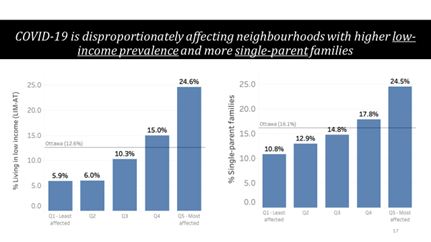
    There is strong evidence in Ontario that the risk of infection varies by neighbourhood and is associated with each neighborhood’s socio-demographic profile. For example, in Ottawa, neighbourhoods with more Black, Middle Eastern, low income, and single-family residents have higher rates of COVID-19 infections.

    COVID an neighbourhood chart- ebulletin #104

    We can only understand the impact of COVID-19 on our practices and our patients through collecting and analyzing accurate and representative health data. The pandemic has exposed many data gaps in Ontario. Our teams are vitally important to ensure that those we serve are included, as our information reflects our settings, patients, and communities. Collectively, primary care’s voice can be heard by providing safe and secure access to real-world data; this is possible with your help!  Register with the POPLAR network member closest to you today to start contributing your EMR data.

    Data Security & Privacy

    POPLAR only studies de-identified patient and practice data. POPLAR complies with robust ethics, governance and security measures. Individual patients have the right to opt out of their data being collected through POPLAR’s networks for research.

    Data for QI in Your practice

    Generation of de-identified EMR dataset


    How to Register?

    Help POPLAR build practical evidence in family medicine, by supporting the collective Culture of Curiosity and by contributing data. The time and effort it takes to safely and securely contribute is minimal. All you need do is fill out a consent form and a brief survey; POPLAR staff will coordinate data extraction at your practice, with all safeguards in place.

    If you are interested in registering, or if you would like to find out more information about POPLAR, please contact Sandeep Gill at Sandeep.gill@afhto.ca, who will then direct your query to your local network contact. More information can also be found on the AFHTO website here.

    COVID-19 Cancer Screening Tip Sheet for Primary Care Providers

    In June 2020, Ontario Health (Cancer Care Ontario) released COVID-19 Tip Sheet #15: Guidance for primary care providers resuming breast, cervical and colorectal cancer screening to support primary care providers as they resumed cancer screening. This updated streamlined tip sheet was developed to continue to support primary care providers with cancer screening based on ongoing fluctuations in COVID-19 cases and local variation in COVID-19 trends.

    Primary Care Patient/Client Virtual Care Experience Survey

    Primary Care Patient/Client Virtual Care Experience Survey

    Last year, we launched the Primary Care Patient/Client Virtual Care Experience Survey for teams to implement in order to capture the patient experience with virtual care. Moving ahead we are collecting teams’ aggregate responses as we create a narrative of how virtual care could be permanently included in the patient care journey – submit your data here!


    Upcoming Webinars:

    Primary Care Virtual Groups – Transitioning A CBT Program & Cardio-Pulmonary Rehab Program To Virtual
    February 17, 2021 (12-1 pm EST)
    This webinar is in collaboration with two Family Health Teams transitioning in person programs to virtual. Scarborough Academic FHT will share how they transferred their CBT skills group for depression and anxiety to online along with the benefits and challenges. Arnprior FHT is presenting on how they modified an in-person Cardio-Pulmonary Rehab to Virtual in the rural community of Arnprior, ON. Learn more and register here.

    Engaging and Supporting Caregivers In Primary Care Teams: Working Together To Improve Outcomes And Enhance The Patient, Caregiver, And Family Experience
    February 25, 2021 (12-1 pm EST)
    In this webinar, learn about the Ontario Caregiver Organization and the key programs, services, and resources they offer. Learn about three key caregiver-related strategies that can positively impact health outcomes and the patient/family/caregiver experience. Find out about resources, programs, and actions that primary care teams can take to help advance these strategies. Learn more and register here.


    Interested in sharing your teams’ initiatives in a future webinar? Email Sandeep Gill – Sandeep.gill@afhto.ca to learn more about the AFHTO KTE Webinar Schedule!

    In Case You Missed It: Check out eBulletin #103 or other back issues here!
    Questions? Comments? Contact us at improve@afhto.ca.


  • Risk Management Toolkit

    Shared by AFHTO & Collaborative Solutions

    Created March 2019

    Purpose of This Document
    This document is designed for use by AFHTO member Boards to support learning and fulfillment of the Board’s role in overseeing the effective management of risk in their organization.
    The document includes the following:

    • definition of risk management and other key terms;
    • a list of requirements related to risk management in the Ministry of Health and Long-Term Care (Ministry)-Family Health Team (FHT) contract and attestation document;
    • an overview of risk management including domains of risk, the key components that make up a risk management approach, and the steps in a standard risk management process;
    • a description of the Board’s role in risk management and common governance practices for the Board to fulfill this role; and,
    • sample tools and links to other refer

    Access the tools:

    Resource includes: 

    1. Introduction
    2. Overview
    3. MOHLTC-FHT Contract Requirements
    4. Overview of Risk Management
      1. Domains of Risk
      2. Essential Components of Risk Management
      3. Typical Risk Management Process
    5. Risk Management and the Board
      1. Role of the Board in Risk Management
      2. Establishing Management Accountability
      3. Effective Governance is Essential to Managing Risk
      4. Organizing for Board Leadership on Risk
    6. Appendix
      1. Sample Risk Framework


  • Strategic Planning Toolkit

    Shared by AFHTO & Collaborative Solutions

    Created January 2019

    Purpose of This Document
    This document is designed for use by Primary Health Care Teams as a guide for developing your own strategic planning process and strategic plan. 

    The toolkit includes the following content: 

    • why strategic planning is important;
    • current Family Health Team (FHT) contract requirements related to strategic planning;
    • key roles in strategic planning and why a strategic plan is essential for the Board’s strategic leadership of the FHT/NPLC;
    • essential steps and components of a strategic planning process;
    • typical contents of a strategic plan, and,
    • tips on developing your strategic plan and integrating it into ongoing strategic decision-making and performance oversight. 
       

    Access the tools:

    Resource includes: 

    1. Introduction
    2. Overview
      1. What is Strategic planning and why we do it
      2. MOHLTC-FHT Contract Requirements
    3. Organizing for Strategic Planning
      1. Setting strategic direction is a key board responsibility
      2. Clarifying roles is the planning process
      3. Strategic planning committees
      4. Board retreats
    4. The Strategic Plan and Planning Process
      1. Standard Strategic Planning Process
    5. Appendix
      1. Environmental Scan List of Contents
      2. SWOT Analysis template
      3. Standard Strategic Planning Process
      4. Sample Board-Level Strategic Planning Questions


    Sample Strategic Plan

  • Bits & Pieces: COVID-19 collaborative home monitoring resources, fact sheets and more

    Bits & Pieces: COVID-19 collaborative home monitoring resources, fact sheets and more

    Your Weekly News & Updates


    In This Issue  
    • COVID-19 collaborative home monitoring program resources now available
    • Happy Psychology month
    • Supply Ontario survey
    • Interprofessional primary care during COVID-19: a survey of the provider perspective
    • Correction-anti-racism webinar series open to members
    • COVID-19 vaccine fact sheet, cancer screening update and more
    • Reminder- primary care virtual groups webinar, Feb. 17, 2021
    • Trans health mentorship call
    • Infection prevention and control at work: basic awareness training
    • Microsoft Teams update
    • PHAC webinar: emerging issues on covid-19 vaccines: allergies, anaphylaxis, and low dead volume syringes
    • Upcoming events including transitioning programs to virtual and more

    COVID-19 collaborative home monitoring program resources now available

    Related to this recently launched program, Georgian Bay FHT has provided resources to help other members set up their own program, including CHMP pathway, patient information handouts and EMR assessment forms.


    Happy Psychology month

    To all our Psychologists, thank you for looking out for Ontarians’ mental health throughout the pandemic. Happy Psychology Month!

    Reminder- The Ontario Psychological Association is also still working with AFHTO to improve access to psychological services in times of need. Last spring, they activated the Disaster Response Network to connect essential front-line workers who needed support from psychologists. Until March 31st, Ontario physicians, nurse practitioners and FHTs may still refer essential workers with no or limited health benefits directly to OPA or inform patients to call 211 to be connected to a psychologist within 48 hours. Up to 6 counselling sessions are offered at no cost.


    Supply Ontario survey

    The government recently established Supply Ontario, a single integrated supply chain across the public sector that will leverage the province’s purchasing power to provide greater value and consistent access to high-quality products and services.

    They’re asking for input to help identify where there may be opportunities to improve the value that the agency can deliver for your organization and patients, through better supply chain processes. Deadline February 24.


    Interprofessional primary care during COVID-19: a survey of the provider perspective
    Thank you to those who participated in the survey led by Drs. Catherine Donnelly (and Jordan Miller and Rachelle Ashcroft. An article has now been published, with input from our own Sandeep Gill.


    Correction- Anti-racism webinar series open to members
    Hosted by Central Brampton FHT’s mental health team & CMHA Toronto Opening Doors Project, Anti-Racism – What is it and Where do you fit in? is a webinar series with four consecutive episodes, which offers an opportunity to explore our own individual identities and how it relates to practicing anti-racism:

    • Part 1: Reflecting on our own Identities -Feb. 17 AND 24
    • Part 2: Building Bridges: Anti-Racism 101- Mar. 3 AND 10

    Members are welcome to attend.


    COVID-19 vaccine fact sheet, cancer screening update and more

    Recent updates include:

    We continue to update several pages on our site with resources and news:


    Reminder- primary care virtual groups webinar, Feb. 17, 2021

    This webinar is in collaboration with two FHTs transitioning in-person programs to virtual. Scarborough Academic FHT will share how they transferred their CBT skills group for depression and anxiety to online along with the benefits and challenges.

    Arnprior FHT is presenting on how they modified an in-person Cardio-Pulmonary Rehab to Virtual in their rural community. In this webinar they will share their patients’ thoughts and feelings on the program adjustment, discussing wins and struggles along the way. Register here.


    Trans health mentorship call

    Rainbow Health Ontario’s Trans Health Mentorship call is a teleconference every other week for Ontario clinicians to connect with peers who have experience caring for trans and non-binary service users.  

    The call is open to any professional (physician, nurse, social worker, mental health worker, etc.) who is or will be working with trans and non-binary service users. Learn more here.


    An employee with glasses, mask and glove cleans a counter


    Infection prevention and control at work: basic awareness training

    A new online training program is now available to help Ontario workers recognize infection hazards in the workplace and what can be done to prevent them. Developed in consultation with infection control consultants and epidemiologists, this free, 30-minute eLearning program from Public Services Health & Safety Association equips workers with knowledge in how infections spread and what action can be taken to protect themselves and others in the workplace.


    Microsoft Teams update

    AFHTO continues its conversations with Ontario Health on extending the Microsoft 365 licensing (which includes Microsoft Teams) to AFHTO members. Ontario Health is working through the details with Microsoft, and they are considering affiliate licensing that would be made available through a licensing provider. AFHTO will advise members when the affiliate licensing has been set up, along with the details on the discount pricing (hopefully before fiscal year end).


    PHAC webinar: emerging issues on covid-19 vaccines: allergies, anaphylaxis, and low dead volume syringes

    Public Health Agency of Canada (PHAC) webinar hosted by the National Collaborating Centre for Infectious Diseases (NCCID):
    English Session
    February 10, 2021 1pm-3:00pm EST
    Register: Click here
     
    French Session
    February 12, 2021  1pm-3:00pm EST
    Register: Click here
     
    Previous Public Health Agency of Canada COVID-19 vaccine webinars for health care providers can be found here.


    Engaging and supporting caregivers in primary care teams: working together to improve outcomes and enhance the patient, caregiver, and family experience, Feb. 25, 2021

    Cohosted with Ontario Caregiver Organization, this webinar will highlight resources and opportunities for teams to support and engage caregivers.

    Register today.


    Waiting Room Revolution – A Podcast About Unlocking the Secrets to a Better Illness Experience

    Drs. Hsien Seow and Samantha Winemaker share the stories of patients and families’ serious illness journeys. Listen to the first 4 episodes today.


    Goal Management Training for Treatment of Executive Dysfunction, Feb. 19, 2021
    Learn more about the intervention, research, and models to deliver Goals Management Training virtually. Learn more here.


    Recognizing and Managing Anxiety Disorders in Primary Care during COVID-19, Feb. 9, 2021
    Ontario Health webinar with experts in the field and resources about how to support patients presenting in primary care with symptoms of anxiety. Register here.


    Personal Resilience for Hospice Palliative Care, Mar. 3, 2021
    Learn how to enhance personal resilience during even the most challenging times.
    Find out more here.


    Advancing Excellence in Transgender Health, Mar. 4, 2021
    The aim of this conference is to bridge this gap and provide information and resources to better equip Nurse Practitioners providing care to Gender Diverse individuals. The highlight is hearing the patient perspective. Find out more.


    Advance Care Planning & Goals of E-Learning Modules, Available until Mar. 31, 2021
    The HPCO is offering their e-modules on person-centred decision making for a limited time. Register before the end of March to access the resources. Learn more here.

  • Winter Highlights 2021: AFHTO Leadership Council

    The AFHTO Leadership Council met on February 4, 2021. Below are the highlights from the winter 2021 council meeting; updates on last week’s meeting with officials at the Ministry of Health; and links to useful resources.

    AFHTO review

    • Highlights of the work that is keeping AFHTO busy were shared with the council, including COVID-19 vaccination roll-out, OHT development, the pre-budget submission, and quality improvement work. Updates on vaccination roll-out and OHT development are later in the communique.
    • The pre-budget submission is underway in collaboration with the Ontario College of Family Physicians, the OMA’s Section on General and Family Practice, and the Nurse Practitioners’ Association of Ontario.
      • Together, we are recommending expansion of team-based primary care; embedding mental health and addiction and home and community care services in primary care; and strengthening virtual care foundations in primary care.
      • The submission will be posted on AFHTO’s site next week, after it has been submitted.
    • An update on the work of AFHTO’s Quality & Knowledge Translation Program was provided to the council and can be read here.
    • Dr. Rob Annis, a member of AFHTO’s board of directors, spoke to governance structure changes that are underway at the Ontario Medical Association. New board members could help drive leadership and change in primary care. Member leaders are encouraged to apply, and physicians are encouraged to vote for primary care representation. The deadline to apply is tomorrow, February 9, and voting is March 23 to April 13. Anyone with questions can contact Dr. Annis.

    COVID-19 vaccination roll-out

    • Leadership council members received an update from Dr. Daniel Warshafsky (Senior Medical Consultant, Office of the Chief Medical Officer of Health, Ministry of Health) and Nadia Surani (Director, Primary Health Care Branch) on the provincial approach to vaccination roll-out.  AFHTO is regularly speaking with the Ministry of Health and the COVID-19 Vaccine Distribution Task Force regarding the role of primary care in vaccine roll-out – in stage 2, but particularly in stage 3 when the general population will be vaccinated.
    • Work is being done to ensure primary care is a pillar in the planning. The pivot of primary care to go into mass vaccination clinics will be part of the planning.
    • As vaccine planning happens across the province, a reminder that PHUs are in charge of the planning and are to engage with primary care. Primary care will determine clinical priorities and will need to decide if there is capacity to support initiatives like mass immunization campaigns. Please connect with your PHU to ensure that they are sharing their vaccine roll-out plans, and share your plans with us.
    • Teams are reminded that they can access the provincial Pandemic PPE Transitional Support stockpile through the remedy system (even if you have more than 7 days of stock you can still access this supply). Ignore the question that asks if you have connected with your supplier first.  
    • A detailed update was circulated on Saturday, February 6, and can be read here.

    OHT development

    Triad survey: Primary care priorities

    • Thank you to triad members who completed a survey that was circulated prior to the leadership council meeting to help AFHTO frame priorities moving forward. Feedback is still welcome.
    • The survey was one question: “In your role as ED, board chair, or lead physician, what do you think is the biggest opportunity for primary care teams to focus on over the next 3 to 6 months?” The following were shared as top priorities and discussed with the council:
      • COVID-19 vaccination roll-out
      • Mental health and addiction challenges and needed support
      • Advancing OHT work
      • Maximizing utility of virtual care
      • Spreading access to team-based programs and services
      • Getting back on track
    • AFHTO will continue to focus on supporting teams in these areas.

    Meeting with the Primary Health Care Branch, Ministry of Health
    AFHTO met with officials from the Ministry of Health’s Primary Health Care Branch on Thursday, February 4, following the leadership council meeting. Here are the highlights of the meeting with the ministry:

    • Mental health and addiction funding letters
      • The letters are in the final stage of approval and, once signed, the Ministry will be sending them out to all interprofessional teams.
      • All FHTs will receive a minimum of $5,000, with a top-up based on roster size. Teams can choose to pool this funding within regions to target areas in greatest need.
      • At the moment, the expectation will be to utilize the funds by fiscal year end, but a parallel stream of work is happening at the Ministry to enable the funding to be carried into next fiscal year. This is still to be determined.
    • Annual Operating Plans and funding support:
      • About 60% of teams submitted their Annual Operating Plans for FY 2020/2021, which the Ministry is currently reviewing in tandem with AOPs submitted in FY 2019/2020. A reminder that you do not have to mention all the COVID-related clinics you are doing as those are one-time events.
      • The Ministry recognizes that program and service delivery targets may be affected as a direct result of COVID. Teams will not be penalized if programs and services are not delivered as planned and should continue to balance urgent/high need service provision with the need to support COVID testing/assessment centres and vaccination roll out.
      • Timelines for AOPs for FY 2021/2022 has not yet been determined.  
      • Although there is not a pool of operational funding to support teams right now, the Ministry continues to ask teams to keep track of COVID-related expenses to enable advocacy for more funding if needed in the next fiscal year (ex. upgrades of IT for virtual care, licenses for virtual care modalities, IPAC in your teams). As we will be entering into a new political cycle, we are hopeful it may create opportunities for further investment in primary care. Teams are advised to start thinking about other increased budgetary demands, such as rent increases, so we can begin advocacy efforts accordingly.
      • Though budget funding requests typically are only reviewed during the AOP submissions, teams are still able to make unsolicited in-year funding requests through their ministry program consultant, although there is no guarantee that those requests will be met.
    • FHT contract:
      • The FHT contract is expiring in March 2022. Although we have had preliminary discussions with the Ministry on opportunities to modernize the contracts, we expect that there will be at least a one-year extension to the current contract due to the impacts of COVID. We will keep members updated as we learn more.
    • Pandemic pay:
      • We have heard that some primary care staff redeployed to an assessment centre run by hospitals still have not received their pandemic pay. The Ministry confirmed that hospitals have been reimbursed for March and April expenses and are still working on the subsequent months’ reimbursement, so this may be creating delays. If you are still having issues in accessing pandemic pay for your staff, please let us know.

    Supply Ontario survey

    • The government recently established Supply Ontario, a single integrated supply chain across the public sector that will leverage the province’s purchasing power to provide greater value and consistent access to high-quality products and services. They are asking for input to help identify where there may be opportunities to improve the value that the agency can deliver for your organization and patients, through better supply chain processes.
    • Please take a moment to fill out this survey by Wednesday, February 24.    

    Webcasts and other supports

    And, finally, for new members of the council who may not have access to the members only section of the website – or any member who may not have signed up for it! – you can set up your log-in here:

    • Click on ‘Member Login’ in the top right corner of AFHTO’s homepage
    • Go to “Create New Account” and follow the steps
    • All individuals are verified as members by AFHTO staff and then permission is granted.
    • If your email address does not show the team where you work, members are encouraged to send a quick email to info@afhto.ca to share this information after creating the account. This helps ensure permission is quickly granted.