
Tectonic shifts: rebuilding primary care in a new world
(more…)
Tag: social determinants of health
-

Bits & Pieces: patient engagement in FHTs case studies, free iCBT & more
Your Weekly News & Updates
In This Issue - Patient and family engagement in primary care case studies
- Free internet-based cognitive behavioural therapy programs
- Are teams in scope for the PPE Data Collection/ CSE Survey?
- Team-based care supporting patient communities through COVID-19 slides and recording
- New resources for re-opening, stress, grief, and bereavement support and more
- United Way Halton and Hamilton wants to help you scale social prescribing- June 23
- Upcoming events regarding virtual care for chronic respiratory disease and more
Patient and family engagement in primary care case studies
On Thursday, June 11, The Change Foundation released Patient and Family Engagement in Primary Care: Building effective patient and family advisory councils in three Ontario communities, a case study report featuring three FHTs. The report finds twenty key lessons in 5 categories- launching, recruiting, operating, relationships and sustaining.
Teams featured:
Free internet-based cognitive behavioural therapy programs
The Government of Ontario is offering a variety of free mental health resources that they can access online. This includes internet-based cognitive behavioral therapy (iCBT) programs, such as AbilitiCBT, by Morneau Shepell, and Beacon Digital Therapy by MindBeacon.
To access these supports, visit covid-19.ontario.ca. If you’re interested in learning more, please visit our site.
Are teams in scope for the PPE Data Collection/ CSE Survey?
On Tuesday, June 9 EOC Operations sent an email titled “Important Update on the Minister’s Order and Direction on PPE Data Collection/ CSE Survey”. We sent a copy to all EDs and Administrative Leads on Wednesday, June 10.
As mentioned in April, teams are encouraged to collaborate with the FHO and FHN to submit a survey together. Multiple sites should be included within one survey. If the FHO/FHN teams can’t collaborate with the FHT then when the FHT submits the survey they should clearly identify that the data included is only for the FHT staff.
Each location is to track individually, but everything is to be submitted in one document. Use the Excel document and make a tab at the bottom for each site (copy and paste the chart into each tab). One tab should be for the FHT and then each FHO/FHN has its own additional tab. If you have any questions, please email info@afhto.ca.
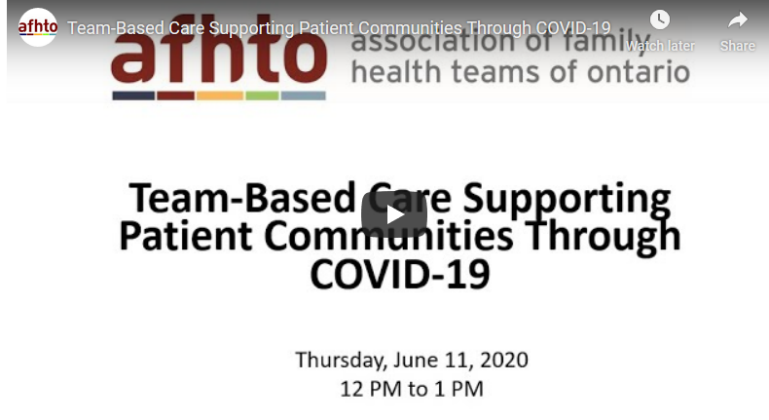
Team-based care supporting patient communities through COVID-19 slides and recording
On Thursday, June 11 we presented the Team-Based Care Supporting Patient Communities Through COVID-19 webinar. Slides and video are now available on our site.
Interested in sharing initiatives your teams are a part of? Email us at improve@afhto.ca.
New resources for re-opening, stress, grief, and bereavement support and more
Resources released within the last week include:
- Recommendations for Regional Health Care Delivery During the COVID-19 Pandemic: Outpatient Care, Primary Care, and Home and Community Care
- PPE and Infection Control for In-office Assessments– OCFP
- COVID-19 Lockdown Lifting: Expert Panel on Resumption of Health Care Services– Miller Thompson LLP webinar recording
- A Governance Guide for Health Service Resumption: What Directors Need to Know– Miller Thompson LLP webinar recording
- Free, confidential stress, grief, and bereavement support line for front line health care workers– Hospice Palliative Care Ontario
We continue to update several pages on our site with resources and news:
- Novel Coronavirus (COVID-19) Updates– the original page, with news and Ministry situation reports (please note that the Ministry Situation Reports on COVID-19 are posted daily so review them to better understand the provincial response)
- COVID-19 assessment centres across Ontario (members only per Ministry request)
- COVID-19 information for Patients, Caregivers and the Public
- Infection control resources and tools for primary care
- H+K Memos and Insight Notes on Government Press Releases
- Management and operations, human resources and COVID-19
- Mental health and wellness during COVID-19
- Providing Comprehensive Care During COVID-19
- Resources for Re-opening – NEW
- Virtual Care, Digital Health and COVID-19
United Way Halton and Hamilton wants to help you scale social prescribing- June 23
United Way Halton and Hamilton is interested in helping to scale social prescribing in a coordinated way in their region. They are hosting a webcast on social prescribing on June 23 at 1 pm to start the conversation, with the hopes of convening interested key stakeholders for roundtable discussions following this webcast. Register here.
Ensuring Appropriateness and Quality in Cancer Care During the COVID-19 Pandemic, June 17, 2020
Join Choosing Wisely Canada for their Weekly Virtual Gatherings during COVID-19. This week they’re discussing how to apply resource stewardship principles to contribute to safe and quality cancer care during this time.
Register here.
Delivering Virtual Care to Manage Chronic Respiratory Disease: Tips for Healthcare Providers, June 17, 2020
Discuss benefits and challenges, clinical tools and resources, barriers, and practical tips for providing virtual care for chronic respiratory disease. Register in advance.
Social Prescribing in Practice Lunch & Learn, June 17, 2020
Continue the conversation on Social Prescribing with the Alliance for Healthier Communities in this follow-up webinar.
Learn more here.
Digital Solutions: Adoption, Adaptation and their role in post-Covid19 health and social care delivery, June 18, 2020
Join IFIC to discuss the balance between keeping people at home and in the community without adversely deferring necessary health services to those who need it. Learn more here.
An opportunity to re-evaluate high value care and clinical preventive services, June 18, 2020
Join this CFPC webinar as part of the COVID-19 Pivots. Learn more here.
-

Bits & Pieces: Dr. Rueben Devlin, June 11 webinar, COVID-19 Innovation grants & more
Your Weekly News & Updates
In This Issue - Dr. Rueben Devlin, Chair of the Premier’s Council, has passed
- Team based care supporting patient communities through COVID-19 webinar
- COVID-19 Innovation grant program
- Member renewal – you can now send in your cheques!
- COVID-19 in Ontario – A Focus on Diversity: Public Health Ontario report
- Phase two, resources for re-opening, more details in situation report #135 and more
- EMR communities of practice transition to OntarioMD – update
- Coping with COVID-19: support for frontline health care workers
- Ambulatory care residency for pharmacists
- Ontario Health survey: COVID-19 response
- Upcoming events hosted by Lung Health Foundation and more
Dr. Rueben Devlin, Chair of the Premier’s Council, has passed
We’re saddened to hear of Dr. Rueben Devlin’s passing. Dr. Devlin was appointed as Special Advisor and Chair of the Premier’s Council on Improving Health Care and Ending Hallway Medicine in June 2018.
You can learn more about his life and legacy here.
Team based care supporting patient communities through COVID-19 webinar
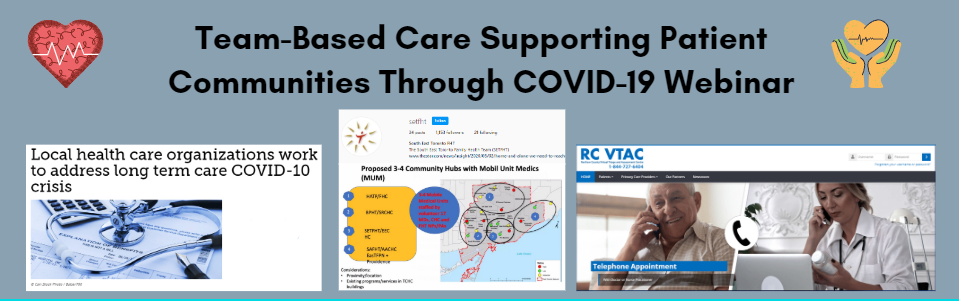
This Thursday, June 11, 2020, we will be hosting a webinar to share initiatives teams are currently doing to help support patients in their communities during COVID-19. Learn from these teams about how they created virtual care communities, helped long-term care homes, engaged with patients via social media and much more! Teams that will be presenting are South East Toronto FHT, Brockton Area and Kincardine FHTs, Arnprior & District FHT, North Renfrew FHT, West Champlain FHT, Petawawa Centennial Family Health Centre and Madawaska Valley FHT. Register here for the webinar!
COVID-19 innovation grant program
Joule’s COVID-19 innovation grant program is providing up to $1,000,000 in flexible funding to CMA members working on innovative solutions – with each initiative eligible for up to $200,000 in funding.
Their focus areas are:
- Supporting and protecting the physical and mental health and well-being of front-line health care workers;
- Improving access to care during the COVID-19 pandemic; and
- Addressing the social determinants of health and improving health equity for vulnerable populations affected by the pandemic.
As long as there is a CMA member on your team, you’re eligible to apply. Deadline June 21.
Member renewal – you can now send in your cheques!
Thank you to the teams who have checked in regarding sending cheques for member renewal. While we still encourage teams to pay via electronic means if they can, we are now accepting cheques again.
Since Canada Post is experiencing delays, we have extended the deadline to July 31. Please don’t delay as access to resources, benefits and members-only updates will be cut off after this date. If you have any questions, please feel free to email info@afhto.ca.
COVID-19 in Ontario – A Focus on Diversity: Public Health Ontario report
On June 1, Public Health Ontario released Enhanced Epidemiological Summary COVID-19 in Ontario – A Focus on Diversity . Findings included that people living in the most diverse neighbourhoods were also more likely to experience severe outcomes (hospitalizations, ICU admissions and deaths) than people living in the least diverse neighbourhoods:
- hospitalization rates were four times higher;
- ICU admission rates were four times higher; and
- death rates were twice as high.
Per a related Globe and Mail article, until recently:
“You couldn’t really go after the general public and test within the context of communities,” said Tia Pham, lead physician at the South East Toronto Family Health Team and one of the co-ordinators of MGH’s assessment centre in Crescent Town.
Phase two, resources for re-opening, more details in situation report #135 and more
Yesterday the province announced that 24 out of the province’s 34 public health units will be permitted to move into stage two as of Friday, June 12, 2020. You can also read H+K’s insight note for more details.
We added a new Resources for Re-opening page and we continue to update several pages on our site with resources and news:
- Novel Coronavirus (COVID-19) Updates– the original page, with news and Ministry situation reports (please note that the Ministry Situation Reports on COVID-19 are posted daily so review them to better understand the provincial response)
- COVID-19 assessment centres across Ontario (members only per Ministry request)
- COVID-19 information for Patients, Caregivers and the Public
- Infection control resources and tools for primary care
- H+K Memos and Insight Notes on Government Press Releases
- Management and operations, human resources and COVID-19
- Mental health and wellness during COVID-19
- Providing Comprehensive Care During COVID-19
- Social Resources for Canadians impacted by COVID-19 -The Upstream Lab- Legal, social isolation, violence, grocery, shelters and drop-in centres, organized by region
- Virtual Care, Digital Health and COVID-19
EMR communities of practice transition to OntarioMD – update
The EMR communities of practice (CoP) transitioned from AFHTO to OntarioMD effective March 31, 2020. It is important that if you wish to participate in any Community of Practice you fill out this form to receive meeting invites and updates about the community. You will also be added to the eMailDodo lists.The form only takes a few minutes to complete.
If you have any problems or concerns, please feel free to reach out to nancy.gunn@ontariomd.com.
Coping with COVID-19: support for frontline health care workers
Message from the Mental Health and Addictions Centre of Excellence at Ontario Health
MHACoE@ontariohealth.caHealth and community care workers across Ontario are showing incredible strength through the COVID-19 pandemic. But even the strongest among us need help sometimes. For health and community care workers, stress, anxiety, exhaustion, and compassion fatigue are all normal responses in this pandemic. It’s ok to say it: this is really hard. And it’s ok to seek support to help with coping.
Five hospitals have partnered with the Ministry of Health and the Mental Health and Addictions Centre of Excellence at Ontario Health to provide confidential support, including access to iCBT. Frontline health and community care workers from across the province can self-refer online or by phone to any of the five hospital access points below:- The Royal Ottawa Mental Health Centre, Ottawa*
- Waypoint Centre for Mental Health Care, Penetanguishene
- Centre for Addictions and Mental Health (CAMH), Toronto
- Ontario Shores Centre for Mental Health Sciences, Whitby
- St. Joseph’s Healthcare, Hamilton
*Les travailleurs de la santé désirant leur premier contact et leur évaluation en français sont invités à remplir le formulaire en ligne du Centre de santé mentale Royal Ottawa.
Health and community care workers from across Ontario can access more information on mental health support here.
Ambulatory care residency for pharmacists
The University of Waterloo/Centre for Family Medicine Family Health Team residency program is fully accredited and aims to produce pharmacy practitioners who are well equipped to provide exemplary patient care in ambulatory care practice settings.
The Centre for Family Medicine (CFFM) Family Health Team in Kitchener is the primary teaching site but required rotations also include Grand River Hospital (GRH), and the School of Pharmacy at the University of Waterloo. Find out more here.
Ontario Health survey: COVID-19 response
Ontario Health is gathering lessons learned about our COVID-19 response to-date and invite you to complete this brief survey by Monday, June 15th to provide them with your input.
This 4-question survey will help to inform future planning. They will also be conducting focus group discussions, and in collaboration with the Ministry of Health, based on what they learn.
Leveraging Virtual Technology to Ensure Seamless Transitions in Care for Patients Living with Chronic Conditions, June 10, 2020
Hosted by Lung Health Foundation. Register here.
COVID-19 Virtual Town Hall with Kawartha Lakes Health Leaders, June 11, 2020
Join this virtual town hall with the City of Kawartha Lakes healthcare leaders. Learn more here.
Delivering Virtual Care to Manage Chronic Respiratory Disease: Tips for Healthcare Providers, June 17, 2020
Hosted by Lung Health Foundation. Register in advance.
Approaches to Advance Care Planning and Goals of Care Conversations, June 15, 2020
Discuss approaches to ACP and Goals of Care conversations and gain awareness of Person-Centered Decision-Making.
Learn more here.