Tag: reports and relevant news

  • AFHTO 2018 Conference: So. Many. Options

     Relationship Design with Starfield in Mind

    October 24 & 25, 2018 – Westin Harbour Castle, Toronto, Ontario

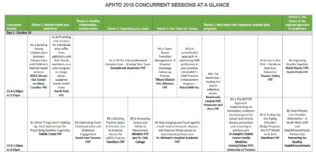
    There are 49 concurrent sessions across six timeslots, including 90-minute sessions. That’s a choice of NINE sessions at a time in a wide range of topics, tailored to primary care!
    See them all at a glance
    Select topics include:
    • De-prescribing sedative hypnotics
    • Collaboration with children’s mental health services
    • Full scope nursing in primary care
    • Emergency preparedness and disaster recovery
    • Improving access for LGBTQ patients and newcomers
    • Adolescent and Senior Outreach
    • Increasing cancer screening rates
    • Creating a Patient and Family Advisory Council
    • Hospital discharge follow-up
    • Managing low back pain and opioid use
    • Advance care planning
    • Learning about the francophone community’s needs
    • Collaborative development of a primary care network in British Columbia

    Register for “Relationship Design with Starfield in Mind” today!

    Or would you like to attend for free? We have 2 openings for program hosts. These volunteers help keep our sessions on track and get complimentary registration in return. See the role description here and email paula.myers@afhto.ca if you’re interested. We also have other volunteer opportunities onsite for deeply discounted registration, such as registration desk, attendee assistance at breakfast and lunch and wayfinding. Email us for more information. And don’t forget, members get 50% off registration. Email us if you haven’t gotten your access code.

     
    PER from White Rose” by Nikolas Titkov is licensed under CC BY SA 2.0
    How to Be a Proper Villain  Can you even be a proper villain without one of these on your lap? If you come to the Heroes vs. Villains Halloween Dinner, you won’t have to find out. A plush version or two will be available for a modest price onsite. At the end of the night, you can return them for donation to Starlight Children’s Foundation so a lucky child will have something else to love. You can indulge in over-the-top treats, signature drinks, and fun activities so join us at the end of a busy day to meet your peers in an entertaining environment. Networking is more fun when costumes are involved- guaranteed icebreakers abound! Prize for Best Persona to be announced soon!
    Conference Highlights:

    For general information, you can visit our conference page.

    We look forward to seeing you at the AFHTO 2018 Conference!


  • Apply now for the 2018 Minister’s Medal – Deadline August 24

    The Ministry of Health and Long-Term Care (ministry) has announced the launch of the sixth annual Minister’s Medal Honouring Excellence in Health Quality and Safety. This annual recognition program aims to honour exceptional work across the health system and showcase successes in cross-sector collaboration of health system partners to deliver high-quality, patient-centred care across the continuum. The theme of this year’s awards is Innovating Integration, which focuses on recognizing the innovative and transformative initiatives being undertaken across the province to improve patient and provider experiences, support better value, and improve health outcomes across the province. Why apply for the Minister’s Medal? The Minister’s Medal is a prestigious and competitive recognition program that aims to highlight the successes of Ontario’s health system partners in providing excellent, high-quality care that puts patients’ needs first. It provides a platform to honour and showcase achievements of health system partners and allows for sharing of these successes across the system. Benefits of being recognized through the Minister’s Medal include:

    • Participation in the award presentation at Health Quality Transformation, Canada’s largest conference on health care quality
    • Increased profile across the province and beyond, increasing potential for additional partnerships and collaboration
    • Recognition and increased engagement of front-line staff dedicated to delivering high-quality care to patients.

    Application templates are now available for download from the Minister’s Medal webpage. Applications are due to your Local Health Integration Network office via email by 5:00pm on August 24, 2018. The award will be presented to one team-based initiative/program and one individual champion at Health Quality Transformation 2018 on October 17, 2018. More information on the program, including profiles of previous years’ winners and honourees, is available on the Minister’s Medal webpage. AFHTO members have been recognized before at the 2014 awards presentations and at the 2016 awards presentations. Consider submitting a nomination on behalf of your team. For any questions related to the Minister’s Medal program, please contact: ECFAA@ontario.ca

  • AFHTO 2018 Conference: announcing Jody Gittel as our closing speaker

     Relationship Design with Starfield in Mind

    October 24 & 25, 2018 – Westin Harbour Castle, Toronto, Ontario

    Featuring Jody Hoffer Gittell Executive Director, Founder, Relational Coordination Research Collaborative
    Transforming Relationships for High Performance – The Power of Relational Coordination Primary care is an essential element of successful systems of care. Yet when people build systems of care, they often neglect primary care. Regional planners say they have not been able to engage primary care, while primary care providers are disillusioned about being part of the solution when their work appears to be undervalued. In the closing plenary Dr. Gittell will share evidence regarding the power of relational coordination – coordinating work through relationships of shared goals, shared knowledge and mutual respect – for addressing these challenges from the systems level to the front line of care. Find out more here.

     Register for “Relationship Design with Starfield in Mind” today!

    We know it’s summer and October seems so far away. There’s plenty of time to register for the AFHTO 2018 Conference. But here are some reasons you should take care of it today: 1. It’s a great way to be productive with hardly any effort – perfect for these long summer days. By registering, you’re investing in your professional development AND booking networking/face time with your colleagues. That’s a lot of work in just a couple of easy steps! 2. You’re guaranteed to get the group rate when you book your hotel room now. Attendees have been caught in the past and paid a premium rate when they forget to book by the early bird deadline. 3. You have more choice than ever- confirm your spot in your favourite concurrent sessions while everyone else is away. There’s plenty of space now but sooner or later these will fill up and you don’t want to miss out. 4. You can start planning your Halloween costume while feeling good about donating to a reputable children’s charity.

    Clone Trooper vs. Spider-Man Clone

    “Clone Trooper vs. Spider-Man Clone (93/365)” by JD Hancock is licensed under CC BY 2.0
    Heroes vs. Villains Halloween Dinner If you want to pack light, complete your transformation from civilian to hero -or villain, we don’t judge- by buying a cape and/or other costume options onsite. At the end of the night, you can return them for donation to Starlight Children’s Foundation. You can come as your secret identity or alter ego and get better insight into your peers. From a Marvel T-shirt to full cosplay, all are welcome, so join us at the end of a jam-packed day to let off some steam! Prize for Best Persona!
    Conference Highlights:

    For general information, you can visit our conference page.

    We look forward to seeing you at the AFHTO 2018 Conference!


  • AFHTO Letter to Minister Elliott

    On July 10, 2018 AFHTO’s CEO sent this letter to Ontario’s new Minister of Health and Long-Term Care and Deputy Premier, the Honourable Christine Elliott. Extending our sincerest congratulations on her appointment, she also expressed our desire to work with the government in improving healthcare for all Ontarians. Excerpts include: “As one of your government’s  goals is the promise to address the issue of hospital overcrowding and ending hallway medicine, creating a robust and well resourced primary health care system is a major solution to address this problem.” “AFHTO members already serve 3 million Ontarians, including 900,000 that were previously unattached to primary health care. By limiting the expansion of team-based care Ontario has created disparities in access. This is highly problematic in a universal health care system and, unfortunately, has created a two-tiered primary health care system.” “Primary health care in Ontario has come a long way, but there is a lot more work to do. AFHTO has three key goals which we hope your government will support:

    • Ensure every community has access to team-based primary health care.
      • Every patient and every community deserve team-based primary care, not just the 30% currently receiving it. The current system of two-tiered health care is not meeting Ontarians’ needs.
    • Support team-based providers in their ongoing efforts to deliver exceptional patient care.
      • FHTs, NPLCs and other interprofessional models of care provide high-quality, team-based care and are always working on improving patient outcomes. Supporting their work will accelerate quality improvement in primary health care.
    • Increase the number of patients able to access team-based primary health care that includes mental health supports.
      • Too many families in communities who are served by team-based primary care are unable to access these teams. These communities need existing teams to take on more patients which can only happen if the teams are allowed to grow. Individuals receiving team-based care experience better outcomes and higher rates of patient satisfaction.”

    To read the letter in its entirety, click here.

  • New Ontario Government Puts Immunization Reporting Requirements On Hold

    On June 20, 2018 Premier-Designate Doug Ford notified OMA that implementation of changes to the Immunization of School Pupils Act (ISPA) and regulations have been paused. The new reporting requirements would have required family physicians to report immunizations provided to children for nine designated diseases to local public health units starting July 1, 2018. Many providers had expressed concern about how these new reporting requirements would be implemented, and these concerns were shared with the Ministry of Health and Long-Term Care (MOHLTC) by several organizations. Once a new minister responsible for health has been appointed on June 29, 2018, they will be tasked to work with the OMA to “prioritize an acceptable solution”.  

  • AFHTO, CAMH and Public Health look to prevent opioid problem before it starts

    Kingston Whig-Standard article published June 11, 2018 By Steph Crosier, Kingston Whig-Standard Preventing the problem before it starts was one of the themes at a Monday workshop aimed at creating better strategies for opioid stewardship in Kingston. “Only prescribing it when it is indicated, thinking about some of the downsides, talking about tapering people,” Dr. Fareen Karachiwalla, associate medical officer of health at Kingston, Frontenac, Lennox and Addington Public Health, said at the event. “The main reason for that is that we know that opioid load in communities is really tied to the number of overdoses, the number of overdose deaths, which is an ongoing problem across Ontario.” The event, hosted at Public Health’s Portsmouth Avenue location, was called the Strategies for Opioid De-Implementation in Primary Care Workshop and featured speakers from Kingston Community Health Care, Canadian Addictions and Mental Health, Queen’s Family Health Team and the Association of Family Health Teams of Ontario. The approximately 45 participants in the workshop were health-care providers from family health teams or community centres, including physicians, social workers, nurse practitioners and pharmacists. “They are all facing the same challenge of how to get people to think really quickly before prescribing an opioid, and how to get some people who are on unsafe doses of opioids to bring down that dose in a safe and thoughtful way,” Karachiwalla said. She pointed out that a large part of the problem with prescribed opioid is linked to the fact that in the 1990s and early 2000s, opioids were heavily marketed to prescribers. Pharmaceutical companies were misleading when it came to side effects of addiction, resulting in minimal awareness for those prescribing the strong painkillers. “So a lot of people who end up misusing opioids or get dependent on them long-term started because of a prescription,” Karachiwalla said. “In the medical field particularly, when people have surgeries or dental procedures, there’s often a large amount of painkillers that are given out, and often those can be diverted or can be misused.” Ironically, opioids aren’t even that effective in treating long-term pain, Karachiwalla explained. “The studies aren’t great, and are more and more showing that [opioids] can actually increase your pain in some ways and reduce your functioning,” Karachiwalla said. “So [the workshop] is about: We’ve gotten so far into this problem, what can providers do in their settings?” Rather than prescribing opioids, the group discussed alternatives to treating chronic pain. “One of the challenges right now in Ontario and many other parts of Canada is that those ancillary pain treatments, things like physio[therapy] and acupuncture and mindfulness, those aren’t as available, and when they are available, they’re often not publicly funded,” Karachiwalla said. “It’s no wonder that this reliance on medication has continued. … “Those alternative treatments are really important, and the government so far has been pretty committed to funding getting more access to chronic pain treatments, but there’s a long way to go still.” Click here to access the Kingston Whig-Standard article

  • Resources from the Public Services Health & Safety Association

    Ontario’s Ministry of Labour (MOL) is conducting safety inspections at Family Health Teams as part of a health care sector enforcement initiative. The goal of these inspections is ensure compliance with the Occupational Health and Safety Act (OSHA). The three priority areas of focus are for these inspections are internal responsibility systems, workplace violence, and needle safety.

    AFHTO has partnered with the Public Services Health & Safety Association (PSHSA) to provide our members with the tools and resources below. We have been working with PSHSA to develop more tools and resources to help you understand and meet your obligations under OSHA. PSHSA is funded by the Ontario Ministry of Labour and works with Ontario’s Public and Broader Public Sector employers and workers, providing training, consulting and resources to reduce workplace risks and prevent occupational injuries and illnesses.


    2018-19 Inspection Blitzes

    The MOL began its 2018-19 inspection blitzes on April 1, 2018. You can see the schedule here.

    For Healthcare Organizations

    • Internal responsibility system – workplace violence prevention
      • Phase 1: Compliance support and education | April 1, 2018 – March 31, 2019
      • Phase 2: Enforcement campaign | July 1, 2018 – March 31, 2019
    • Health care high hazards | April 1 – June 30, 2018
      • For Primary Care, the MOL defines Healthcare High Hazards as internal responsibility system, workplace violence, and needle safety
      • The Healthcare High Hazards initiative is a 3-month extension of the 2017-18 initiative

    Relevant Cross-sector Initiatives


    resources from the Public Services Health and Safety Association (PSHSA) (March 2018)


    Workplace Health & Safety Webinars

    PSHSA holds regular webinars to help employers navigate challenging workplace health and safety issues. Watch this page to see what’s coming up or access past webinars.

    Cannabis in the Workplace

    PSHSA is working with Ontario employers, supervisors and workers to provide information on cannabis and applicable legislation. Some of the areas we are assisting with are around accommodation and suggested control measures for the workplace. PSHSA has partnered with McMillan LLP, a leading business law firm serving public, private and not-for-profit clients across key industries in Canada, the United States and other countries. As the use of medical marijuana in Ontario continues to increase, employers will need to make changing and updating workplace policies a leading priority.

    Joint Health and Safety Committee (JHSC) Assessment Tool: This interactive tool was developed to help JHSCs evaluate and improve their effectiveness (requires Adobe Flash Player)


    resources from the Workplace Safety and Insurance Board (WSIB) (March 2018)

    • Rate Framework: The WSIB is introducing a new model to set premium rates. It comes into effect on January 1, 2020. This page provides information and updates about the rate framework while WSIB transitions to the new model.
    • Compass: Use this to find Ontario workplace health and safety statistics. You can search by business name, business type, and/or business size.

    Resources from AFHTO


    Partnered resources from PSHSA

    Prevention of Workplace Violence is a priority indicator for the 2018 Quality Improvement Plan (QIP) from HQO. The resources on this page will help you address this indicator in your QIP. See also the following documents:

  • AFHTO 2018 Conference: Call for presentation & poster abstracts

    You’re doing the work. Each and every day.

    Now it’s time to share it with everyone.


    Present your ideas and initiatives at the AFHTO 2018 Conference: “Relationship Design with Starfield in Mind”

    Thanks to the 4 Cs of primary care, interprofessional teams are dedicated to providing excellent care for their patients on a daily basis. Primary care teams are tireless in their mission and their rewards are healthier patients and healthier communities. But in this complex health system, sometimes more is needed. What if that little program you’re quietly doing, achieving great results, delivering more efficiencies, relieving patients of unnecessary complications, could spread? What if your peers in other small towns could learn more from your trial and error and go straight to better outcomes? What if this happened all across Ontario? It can, if you submit an abstract to present a concurrent session or poster in 6 core themes at the AFHTO 2018 Conference on October 24 & 25, 2018.

    The deadline to submit abstracts for concurrent sessions and posters is May 4, 2018 at 5:00 PM (EDT)

    Review submission guidelines

    Submit your abstract online

    Reduced registration fee for concurrent session presenters: For each approved concurrent session, up to 2 presenters will each be granted a $50 discount off the conference registration fee. Additional discounts apply for patients presenting at the conference. (Discount doesn’t apply for poster displays.)

    Conference key dates:

    • April 6, 2018: Applications for concurrent session and poster abstracts open
    • May 4, 2018: Deadline to submit concurrent session and poster abstracts
    • Late June 2018: Conference registration opens
    • October 24 & 25, 2018: AFHTO 2018 Conference
    Do you know anyone with interesting and innovative initiatives to share? Please forward this email to your colleagues, community partners and stakeholders to make sure everyone has an opportunity to present their initiatives. And don’t forget, the deadline to join a working group is today, April 6. Come behind the scene and become among the first to learn about new developments in the field, influence conference programming and discover the innovators in your areas of interest. For more information, you can contact us by phone (647-234-8605) or e-mail (info@afhto.ca).


  • 2018 Ontario Budget – A Plan for Care and Opportunity

    2018 Ontario Budget – A Plan for Care and Opportunity An overview of the Ontario government budget

    Overview Today the Liberal government released their 2018 Ontario Budget entitled “A Plan for Care and Opportunity”. This “health-focused” budget included significant new investments in health care, child care, home care and mental health with a total budget spend of $20.3 billion over the next three years.  Additional spending was also announced in education, seniors, social services and growing the economy. We were disappointed to see that there were no new announcements made with regards to additional funding to primary care and interprofessional teams but here are some highlights of the budget that may be of interest to AFHTO members. Primary Health Care:  As mentioned above, no new funding was announced in the 2018 budget for interprofessional primary care teams, but the budget did reference the 2017 commitments that were made:

    • $102 million over three years (starting in 2017/18) to support the expansion of interprofessional primary care teams
    • Approximately $330 million over three years (starting in 2017/18) to support recruitment and retention of health care professionals for primary care teams across the province

    Mental Health Matters: In this 2018 budget, the government is making an additional investment of $2.1 billion over the next four years for mental health and addiction services for people of all ages across the province.  This brings the total investment in mental health and addiction services in Ontario to more than $17 billion over four years. Some of the initiatives that will be rolled out include:

    • Increased access to publicly funded psychotherapy (announced in 2017) in primary care settings and through mental health and additions community agencies for patients with mild to moderate anxiety and depression;
    • Investing $570 million over four years to improve community services and mental health services for children and youth;
    • Investing $175 million over four years to expand school-based supports for mental health and addiction services;
    • Investment of $425 million to provide 2,475 additional supportive housing units over four years to reduce homelessness; and
    • Ongoing investments of $222 million (announced in 2017) to combat the opioid crisis in Ontario which includes the development of supervised injection sites and expanding access for naloxone to front-line community organizations.

    Increased Funding for Hospitals: In 2018-19, the province is investing an additional $822 million to hospitals, contributing to a 4.6% growth in funding, which is the largest single government investment in health care in almost a decade. In addition, the province is investing approximately $19 billion over 10 years to build and renovate hospitals across the province. Ontario is also moving ahead with a commitment to invest up to $10 million to create a Centre of Excellence in Health Care Artificial Intelligence, starting with $1.3 million in 2018-19. New Ontario Drug and Dental Program: The government is introducing a new Ontario Drug and Dental Program which will reimburse 80% – up to a maximum of $400 per singe person, $600 per couple and $700 for a family of four with two children – of eligible prescription drug and dental expenses each year, for those without workplace benefits and not covered by OHIP+ or other government programs. Expansion of OHIP+: On January 1, 2018, the government introduced OHIP+, a no cost drug coverage program, for children and youth under the age of 25, regardless of income. Starting in August 1, 2019, OHIP+ will be expanded to seniors over the age of 65 with the elimination of the annual deductible and co-payment for seniors under the ODB program. Home and Community Care: The government is investing an additional $650 million (including $180 million in new funding) in home care over the next three years to provide more access to home and community health care services. This would include 2.8 million more hours of personal support and 284,000 more nursing visits and 58,000 more therapy visits. Over the next three years, the government will invest an additional $23 million to add an estimated 5,500 PSWs to the workforce, especially in underserviced areas such as rural, northern and remote communities. Over the next three years the government will also invest an additional $38 million in education and training for new and existing PSWs to ensure that they have the skillset they need to work in the increasingly complex home care environment. Home and community care investments of $5 million has also been committed to enable better coordination, scheduling and connections between patients, families and caregivers by enhancing digital information and communication tools – this includes provider access to CRIS and further investments in at home technology. Long-Term Care: The government is investing $300 million over three years in new funding, starting with $50 million in 2018-19, to hire a registered nurse for every long-term care home, and setting a goal of increasing the provincial average to four hours of daily care per resident by 2022. The government is proposing to create 30,000 new long-term care beds over the next 10 years, adding 5,500 new beds by 2022. Other Announcements

    • Launching a new caregiver organization in the Spring of 2018 that will provide support across Ontario, including a single access point for information and resources to help caregivers in their roles.
    • Investment of $75 million over three years to strengthen and expand palliative and end-of-life care, including support for up to 20 new hospices across Ontario.
    • In 2019-20, the government proposes to introduce the new Senior’s’ Healthy Home Program which would provide $1 billion over three years to help seniors with the costs of maintaining their homes, translating to up to $750 per year for every eligible household led by seniors who are 75 years or older.
    • Starting in September 2020, Ontario will implement free licensed child care for preschool-aged children from the age of 2.5 until they are eligible for kindergarten, an investment of $2.2 billion over three years.

    Relevant Links:
  • The Emerging Role of Social Work in Primary Health Care: Study

    The Emerging Role of Social Work in Primary Health Care: A Survey of Social Workers in Ontario Family Health Teams

    Article published in Health & Social Work (February 2018)

    Abstract

    Primary health care systems are increasingly integrating interprofessional team-based approaches to care delivery. As members of these interprofessional primary health care teams, it is important for social workers to explore our experiences of integration into these newly emerging teams to help strengthen patient care. Despite the expansion of social work within primary health care settings, few studies have examined the integration of social work’s role into this expanding area of the health care system. A survey was conducted with Canadian social work practitioners who were employed within Family Health Teams (FHTs), an interprofessional model of primary health care in Ontario emerging from a period of health care reform. One hundred and twenty-eight (N = 128) respondents completed the online survey. Key barriers to social work integration in FHTs included difficulties associated with a medical model environment, confusion about social work role, and organizational barriers. Facilitators for integration of social work in FHTs included adequate education and competencies, collaborative engagement, and organizational structures. Note: An invitation to participate was sent to the Mental Health and Social Worker CoP mailing list. Authors:

    • Rachelle Ashcroft, PhD, University of Toronto
    • Colleen McMillan, PhD, University of Waterloo
    • Wayne Ambrose-Miller, PhD, University of Windsor
    • Ryan McKee, MD, The Centre for Family Medicine FHT, McMaster University
    • Judith Belle Brown, PhD, King’s University College, Western University

    Click here for the full article