Tag: Patient Engagement

  • February 17th Update on COVID-19 Vaccination Roll Out

    Dear Members,

    We are writing to provide you with an update from our united Primary Care COVID-19 Vaccination Action Council (*PC-VAC). Last week’s key messages that we shared with vaccine decision-makers can be found here.

    We are mindful that the news regarding vaccines is evolving daily, and we will have to continue to be prepared for changes and uncertainties in the coming months as a sector. Along with our partners in primary care, we are committed to sharing regular updates, usually weekly, except on weeks where there are no significant new developments to share.

    Earlier this week, the Ministry of Health released updated sequencing of Phase One priority populations for vaccination which sets out the provincial direction for the vaccination program over the coming weeks.

    Engaging Primary Care in Vaccine Rollout – a Practical Guide for Public Health

    Key messages:

    • Public health leadership is committed to strong primary care partnerships in all phases and in all regions. These relationships are key enablers of an effective, efficient, and equitable rollout.
    • To ensure successful partnership with primary care, 1) invite primary care professionals and teams in planning and co-design, 2) involve them in feedback and rollout, and 3) inform them of local opportunities, uncertainties, and changes.
    • The enclosed partnership checklist can inform and validate existing strategies from health leaders involved in local COVID-19 vaccine planning in engaging primary care.

    Collaborating with Others:

    • Over the last two weeks, the collaborative of primary care organizations met with General (retired) Rick Hillier, Chair, COVID-19 Vaccine Distribution Taskforce, who emphasized the importance of an ongoing partnership with primary care provincially and locally.
    • We were pleased to see the addition of Dr. Kieran Moore, the Medical Officer of Health for Kingston, Frontenac and Lennox & Addington Public Health, join the Ontario Ministers’ COVID-19 Vaccine Distribution Task Force. Dr. Moore is a passionate advocate for public health, and as a trained family physician he will ensure that the primary care voice is added to the conversation. PC-VAC is now meeting weekly with Dr. Moore, in addition to Dr. Isaac Bogoch, to provide updates on issues arising from the field.
    • Health and primary care leaders from throughout the country led a virtual roundtable with Prime Minister Justin Trudeau. During the roundtable, the Prime Minister and other participants affirmed what we know to be true: family doctors and primary care professionals are “most knowledgeable and most trusted” and “a core part of getting everyone vaccinated.”
    • Listen to the Evan Solomon Show speak to Dr. Isaac Bogoch about the importance of family physicians and primary care providers in the COVID vaccine rollout. Leveraging the existing relationships primary care has with their patients, based in trust, will accelerate vaccination in the community.

    COVAXON

    • As we had mentioned in our last update, the Ministry of Health has introduced an electronic central repository to input the vaccine information for individuals and manage site inventory called COVAXON. This web-based application will allow for ease in checking people in for their vaccination appointment, capture the consent and personal data information, as well as which health unit region they are in and their vaccination clinic site. While clinics will be required to submit names of the staff (along with user names and email addresses) to request access to the system, the mechanism to apply is not yet finalized however we will advise once we know the information. Please note however that once you get an email from the system, you must reply within 24 hours in order to complete the authentication process.
    • Access for primary care users will fall within phase two and three of the vaccine rollout and training webinars will be available prior to the on-boarding schedule to ensure that everyone is prepared. While it likely won’t be fully integrated into your EMR, we understand COVAXON system will be able to send reports of your vaccinated patients to your EMR.  
    • More on COVAXON will be shared when it becomes available.

    New Resources:

    Reminder of resources from previous weeks

    We look forward to continually updating you on the provincial vaccination strategy. Please do not hesitate to contact us if you have any questions or ideas.

    Yours in good health,

    The AFHTO Team

    *Ontario Primary Care COVID-19 Vaccination Action Council:

    • Alliance for Healthier Communities
    • Association of Family Health Teams of Ontario
    • Indigenous Primary Health Care Council
    • Nurse Practitioner-Led Clinic Association/Nurse Practitioners’ Association of Ontario
    • Ontario College of Family Physicians
    • Ontario Medical Association Section on General and Family Practice
    • Ontario’s Academic Chairs of Family Medicine
  • QI in Action eBulletin # 104 – Identifying Priority Populations for COVID-19 Vaccination from EMRs

    QI in Action eBulletin # 104 – Identifying Priority Populations for COVID-19 Vaccination from EMRs

    In this Issue:

    • What is POPLAR?
    • POPLAR and COVID-19 Vaccine Prioritization
    • Data Security & Privacy
    • How to Register?
    • COVID-19 Cancer Screening Tip Sheet for Primary Care Providers
    • Primary Care Patient/Client Virtual Care Experience Survey
    • Upcoming Webinars

    What is POPLAR?

    The Primary Care Ontario Practice-based Learning and Research Network (POPLAR) is an initiative of Ontario’s six University Departments/Sections of Family Medicine and the Alliance for Healthier Communities. POPLAR securely collects and de-identifies electronic medical record (EMR) data to support practices in delivering optimal care across Ontario and strengthen practice-based clinical research and quality improvement processes.

    POPLAR works with clinicians, researchers, and policy makers, providing information on the vital work primary care does, while supporting practices in delivering optimal care across Ontario. Currently, over 1,000 family physicians are contributing EMR data for over 1.8 million patients to the POPLAR database.

    POPLAR and COVID-19 Vaccine Prioritization

    Building on the work POPLAR has done in the past 10+ years, POPLAR can assist practices wishing to identify patients that should be prioritized for COVID-19 vaccinations. This relies on EMR data that have been extracted from primary care practices, cleaned, and standardized. The data can accurately identify groups of patients meeting various criteria.
    Complex queries can sometimes be difficult to run in EMRs. POPLAR can readily flag patients to be prioritized when the identification parameters rely on multiple criteria (e.g., age range + uncontrolled diabetes + obesity).

    POPLAR data is also linkable to census data, which means that differences in neighborhood socio-economic levels can be added to health data in EMRs; this allows a more comprehensive assessment of risks. This is especially relevant for vaccination prioritization: we know that social challenges our patients live with, such as poverty, can be associated with a greater risk of contracting COVID-19 and greater risk of serious complications once infected.

    POPLAR can obtain aggregate measures from census data at the neighbourhood level, including type of residence, immigration status, average household income, unemployment, education.

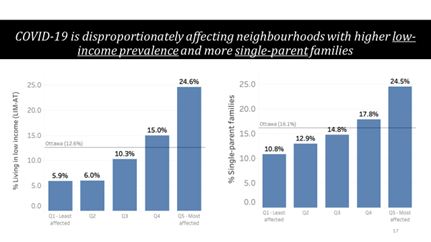
    There is strong evidence in Ontario that the risk of infection varies by neighbourhood and is associated with each neighborhood’s socio-demographic profile. For example, in Ottawa, neighbourhoods with more Black, Middle Eastern, low income, and single-family residents have higher rates of COVID-19 infections.

    COVID an neighbourhood chart- ebulletin #104

    We can only understand the impact of COVID-19 on our practices and our patients through collecting and analyzing accurate and representative health data. The pandemic has exposed many data gaps in Ontario. Our teams are vitally important to ensure that those we serve are included, as our information reflects our settings, patients, and communities. Collectively, primary care’s voice can be heard by providing safe and secure access to real-world data; this is possible with your help!  Register with the POPLAR network member closest to you today to start contributing your EMR data.

    Data Security & Privacy

    POPLAR only studies de-identified patient and practice data. POPLAR complies with robust ethics, governance and security measures. Individual patients have the right to opt out of their data being collected through POPLAR’s networks for research.

    Data for QI in Your practice

    Generation of de-identified EMR dataset


    How to Register?

    Help POPLAR build practical evidence in family medicine, by supporting the collective Culture of Curiosity and by contributing data. The time and effort it takes to safely and securely contribute is minimal. All you need do is fill out a consent form and a brief survey; POPLAR staff will coordinate data extraction at your practice, with all safeguards in place.

    If you are interested in registering, or if you would like to find out more information about POPLAR, please contact Sandeep Gill at Sandeep.gill@afhto.ca, who will then direct your query to your local network contact. More information can also be found on the AFHTO website here.

    COVID-19 Cancer Screening Tip Sheet for Primary Care Providers

    In June 2020, Ontario Health (Cancer Care Ontario) released COVID-19 Tip Sheet #15: Guidance for primary care providers resuming breast, cervical and colorectal cancer screening to support primary care providers as they resumed cancer screening. This updated streamlined tip sheet was developed to continue to support primary care providers with cancer screening based on ongoing fluctuations in COVID-19 cases and local variation in COVID-19 trends.

    Primary Care Patient/Client Virtual Care Experience Survey

    Primary Care Patient/Client Virtual Care Experience Survey

    Last year, we launched the Primary Care Patient/Client Virtual Care Experience Survey for teams to implement in order to capture the patient experience with virtual care. Moving ahead we are collecting teams’ aggregate responses as we create a narrative of how virtual care could be permanently included in the patient care journey – submit your data here!


    Upcoming Webinars:

    Primary Care Virtual Groups – Transitioning A CBT Program & Cardio-Pulmonary Rehab Program To Virtual
    February 17, 2021 (12-1 pm EST)
    This webinar is in collaboration with two Family Health Teams transitioning in person programs to virtual. Scarborough Academic FHT will share how they transferred their CBT skills group for depression and anxiety to online along with the benefits and challenges. Arnprior FHT is presenting on how they modified an in-person Cardio-Pulmonary Rehab to Virtual in the rural community of Arnprior, ON. Learn more and register here.

    Engaging and Supporting Caregivers In Primary Care Teams: Working Together To Improve Outcomes And Enhance The Patient, Caregiver, And Family Experience
    February 25, 2021 (12-1 pm EST)
    In this webinar, learn about the Ontario Caregiver Organization and the key programs, services, and resources they offer. Learn about three key caregiver-related strategies that can positively impact health outcomes and the patient/family/caregiver experience. Find out about resources, programs, and actions that primary care teams can take to help advance these strategies. Learn more and register here.


    Interested in sharing your teams’ initiatives in a future webinar? Email Sandeep Gill – Sandeep.gill@afhto.ca to learn more about the AFHTO KTE Webinar Schedule!

    In Case You Missed It: Check out eBulletin #103 or other back issues here!
    Questions? Comments? Contact us at improve@afhto.ca.


  • February 6th Update on COVID-19 Vaccination Roll Out

    Dear Members,

    We are writing to provide you with an update from our united Primary Care COVID-19 Vaccination Action Council (*PC-VAC). This week’s key messages that we shared with vaccine decision-makers can be found here.

    We are mindful that the news regarding vaccines is evolving daily, and we will have to continue to be prepared for changes and uncertainties in the coming months as a sector. Along with our partners in primary care, we are committed to sharing regular updates, usually weekly, except on weeks where there are no significant new developments to share.

    New Resources:

    • The Ministry has provided a number of guidance documents describing common side effects following vaccination including an After Care sheet and Guidance for Health Care Workers.
    • We know that vaccine supply issues are an ongoing concern but phase 1 continues to roll out with the intent to accelerate the vaccination of long-term care, high-risk retirement, and First Nations elder care residents. Please click here to read the most up to date COVID-19 Vaccination Technical Briefing.
    • The OCFP has developed a resource for special populations and the recording for their most recent Community of Practice session on New Vaccines, building vaccine confidence and more from February 5, 2021 can be found here.
    • A COVID-19 – Allergy/Immunology BASE™ Managed Specialty Group is now available through Ontario eConsult. Physicians and nurse practitioners can ask COVID-19 vaccine allergy related clinical questions to Allergy and Clinical Immunology specialists electronically and receive a response within days.

    Patient Resources:

    Other Information:

    • The updated prioritization framework for the population is being finalized for approval by the cabinet over the next few weeks and we will share the guidance document once it is received.
    • The COVID-19 Science Table released its lessons learned from Israel’s vaccine rollout, including: “leveraging primary care providers, including family doctors, nurse practitioners and other community-based clinicians who have established relationships with patients is key to promoting vaccine confidence, while increasing human resources required to administer vaccines as quickly as the supply will allow.”
    • The Ontario Hospital Association released a media statement calling for the need to migrate vaccination efforts away from hospitals to public health, primary care, and pharmacies.
    • We continue to work with public health to encourage all the public health units to engage primary care early, are supporting connections with local primary care leaders, and are soon releasing a practical guide to primary care partnership in vaccine rollout. Please ask your PHU for your region’s vaccine rollout strategy if you have not seen it and share with us so we can support best practices across the province.  
    • COVAXON is the provincial system to record COVID vaccination, adverse events and eventually also integrate the approved prioritization sequence.  
      • See ADM Memo to Primary Care – COVID-19 Vaccination and COVAXON, February 1, 2021.
      • The prioritization framework will be integrated into COVAXON and an associated scheduling system is planned that will enable patients to choose their preferred locations and make direct appointment bookings.
      • While it likely won’t be fully integrated into your EMR, we understand COVAXON system will be able to send reports of your vaccinated patients to your EMR.  

    To facilitate coordinated action in primary care, we are seeking to understand beliefs relating to the COVID-19 vaccine and what supports are needed for healthcare professionals in primary care. Please complete this new, very brief survey to help gain a better understanding of your perspectives and experience. Click here to access the survey.

    We look forward to continually updating you on the provincial vaccination strategy. Please do not hesitate to contact us if you have any questions or ideas.

    Yours in good health,

    The AFHTO Team

    *Ontario Primary Care COVID-19 Vaccination Action Council:

    • Alliance for Healthier Communities
    • Association of Family Health Teams of Ontario
    • Indigenous Primary Health Care Council
    • Nurse Practitioner-Led Clinic Association/Nurse Practitioners’ Association of Ontario
    • Ontario College of Family Physicians
    • Ontario Medical Association Section on General and Family Practice
    • Ontario’s Academic Chairs of Family Medicine
  • Follow-up on ED check-in calls Jan. 26 & 27 – and additional tools and resources

    This email is being sent to EDs/Admin Leads, Board Chairs and Lead Clinicians of AFHTO member organizations.

    Dear triad members,

    We had our first 2021 regional ED check-in calls on January 26 and 27. The eight check-ins last year were valuable to AFHTO for our advocacy and support efforts, and teams tell us the calls remain of value to them, so we’re pleased to continue with them this year.

    This is a follow-up communique with the materials promised on the January calls, and some additional reminders, tools, and resources.

    Vaccine roll-out

    • We polled EDs during the calls for input on vaccine roll-out, as well as training topics and hospital partnerships. Thank you to all EDs who participated! The results of the polls are here.
    • AFHTO’s most recent vaccine roll-out update was circulated and posted on January 22. While we hope to make this collaborative communique a weekly event, we will only send an update when there is new information to share. We expect to send a new update out in the next couple of days. Stay tuned!
    • All PHUs were required to submit their regional vaccination plans to the Ministry on January 20; however, we understand some PHUs received an extension for the submission. Each PHU was directed to meaningfully engage with primary care in the development of these local plans.
    • We encourage all of you to reach out to your local PHU to access their regional plan and identify the role of primary care in vaccination roll out.
    • Please continue to share these regional plans and how local organization is proceeding with AFHTO. It is helpful to learn regional strategies and what is going well, as well as concerns or issues that teams are facing.
    • In preparation for wave 2, regional strategies could include developing vaccination confidence/hesitancy tools, stratifying population based on age/illness, obtaining informed consent now, and establishing a list of staff support and capacity for deployment.
    • The most updated vaccine screening and consent form from the Ministry of Health is now posted on our site. Just a reminder that the Ministry is posting ongoing COVID-19 Vaccine-Relevant Information and Planning Resources on their site.
    • On February 1, the Ministry sent a memo to the primary care associations indicating that the COVAXON access and training at the moment is only for health care providers currently engaged with the hospitals and local PHUs that are administering the vaccines in mass clinics and congregate settings. When more vaccines become available in phase 2 and 3, the ministry will issue usernames and login credentials to primary care providers who indicate they will be administering COVID vaccines. This will be done in collaboration with the PHUs so, once again, it is important to connect with your PHU to see what their rollout training plan is. Please let us know if you have any concerns or questions and will try to seek out any answers you need.

    Conversation with the Mental Health and Additions Centre of Excellence (Ontario Health)

    • The Mental Health and Addictions Centre of Excellence updated members on the work they are doing, particularly on psychotherapy hubs and the possible role of primary care in these models. This work is early in development but will build on the current Ontario Structured Psychotherapy program for depression and anxiety.
    • AFHTO and our provincial primary care partners meet frequently with the Centre of Excellence and will continue the conversation. Working groups or other avenues to further primary care partnerships and to support this work will be discussed.
    • The Centre spoke to their first first measurement-based care webinar series that was held in January: “The Why: Why should Ontario apply measurement-based care in mental health and addiction services?” More about this series can be seen here.
    • We know health care workers are burning out and need ongoing supports. OH has developed some tools to help providers cope with COVID:
    • AFHTO, in partnership with the three other interprofessional primary care associations, wrote to Minister Elliott last week regarding the $3M in federal mental health funding that had been committed to last year, but has yet to flow.
      • Given the tight timelines to spend funds by the end of the fiscal year, we have asked the government to permit the funds to spread into the next fiscal year. This will help ensure the money can be spent thoughtfully to support those who need it the most.

    Knowledge Translation and Exchange (KTE) webinars

    As we look at priorities, we ask triad members to please complete a short survey by Wednesday at noon. The survey is one main question:

    “In your role, what do you think is the biggest opportunity for primary care teams to focus on over the next 3 to 6 months?”

    Please provide your input here.

    Thank you, and please reach out at any time with questions or suggestions on how we can continue to support you.

    Stay well,

    Your AFHTO Team

  • Follow-up on ED check-in calls – and additional tools and resources

    Dear triad members,

    We had our regional ED check-in calls on November 17 and 18. This is a follow-up communique with the material promised on the calls, and some additional reminders, tools, and resources.

    Mental health and wellbeing

    • We are pleased to share that the federal government is providing one-time mental health and addictions funding to help alleviate the increase in demand and a backlog of services due to COVID-19. Approximately $3 million will be distributed to interprofessional primary care teams, including AHACs, CHCs, FHTs, and NPLCs, to increase access to mental health and addictions supports for patients in Q4.
      • All FHTs will receive a minimum of $5,000, with a top-up based on roster size, to be used in Q4. Funding distribution is in the final stages of approval, and we expect teams to receive it by end of year. Teams can choose to pool this funding within regions to target areas in greatest need.
    • We continue to post resources on our mental health and wellbeing page. Please check them out and encourage your staff do so as well. These are very challenging times, and we hope these resources give a bit of guidance and support.

    AFHTO’s OHT and KTE supports

    • AFHTO conducted seven polls on the calls to get a sense of work on the ground and where supports are needed or should focus. The results of the polls can be seen here.
    • AFHTO heard loud and clear that a webinar series on OHTs would be helpful! We will organize these now and kick them off in the new year. Please email topic suggestions to Bryn Hamilton.
    • We will also begin organizing KTE webinars based on your poll feedback. The top four areas of interest were patient/caregiver engagement, mental health, digital equity, and social determinants of health. If you have ideas for KTE topics, please send them to Sandeep Gill.

    #PrimaryCareAlwaysThere

    • We are speaking up against the narrative that primary care was or is closed during the pandemic. This includes communicating the benefits of virtual and in-person care – and that virtual care is care.
    • The Twitter campaign is #PrimaryCareAlwaysThere. We encourage you share stories about how your teams supported your patients and communities and use the hashtag. Let us also know so we can share your examples with our ministry and OH colleagues during our discussions.
    • Thank you to all who participated in our summer research about how primary care stepped up. Taking what we learned, we created Crossing Chasms: Primary Care Teams’ Response to COVID-19 to show the great work done by our teams. We also created a video. Please share this widely, and keep letting us know how you are supporting your communities so we can continue to highlight how pivotal primary care is in the pandemic response.

    Microsoft Teams discount

    • AFHTO has been exploring a group purchase of Microsoft Teams for a member discount. We have learned that the summer survey AFHTO conducted has indicated that the number of users was not enough for us to qualify for Microsoft Canada’s affiliate program.
    • Ontario Health, as part of their digital strategy, is in negotiations with Microsoft Canada on an agreement to offer Microsoft 365 (which includes Teams) at a discount to healthcare providers and organizations. The discount will be extended to the broader healthcare sector, and AFHTO has initiated conversations with Ontario Health about offering this discount to AFHTO members. An update will be provided in January.

    QSC patient advisor application

    • AFHTO is recruiting a patient advisor representative for the AFHTO quality steering committee (QSC). Our hope is for the advisor to be a patient of one of our teams!
    • More information is here. Please consider speaking with patients who you think may be interested and circulating this across your team.

    Primary care patient/client and provider virtual care experience surveys

    • In August, we launched the Primary Care Patient/Client Virtual Care Experience Survey for teams to capture the patient experience with virtual care. AFHTO is collecting teams’ aggregate responses to create a narrative of how virtual care could be permanently included in the patient care journey – click here to submit your data!
    • There is also a patient/client survey created by Women’s College Hospital Institute of Health Systems Solutions and Virtual Care (WIHV), who is conducting a third-party evaluation of virtual care in the COVID-19 era on behalf of the ministry. You can provide the survey link to patients.
    • WIHV is also conducting a third-party evaluation of virtual care in the COVID-19 era on behalf of the ministry to measure the provider experience on virtual care. Please share this short 10-15 minute online survey with all providers on your team.
    • Both WIHV surveys include the opportunity to enter a draw to win one of four $50 gift cards to the Bay, Shoppers Drug Mart, or Amazon. Your participation will remain anonymous and confidential.
      • If you have any questions or would like to share your current virtual patient/client survey results with WIHV, please email rebecca.liu@wchospital.ca.
      • Please reach out to jamie.fujioka@wchospital.ca if you have any questions or concerns about the provider experience survey.
    • This research is important as the ministry looks at the future of virtual care – please spread the word, and we encourage you to participate!

    Friendly reminders

    • A new agency called Supply Ontario has been created to centralize government procurement, including stabilizing access to PPE for the long term. The goal is to have the inaugural board in place early in the new year. In the meantime, a reminder that primary care can access the provincial stockpile. Even if you have more than 7 days of stock, you can access the pandemic PPE transitional support and send any questions to your regional supply chain lead.
    • The Physiotherapy Clinical Education Team at Queen’s is coordinating clinical placements for 2021. If any teams have a PT in place and would be able to supervise a student, please email Melanie Law at lawm@queensu.ca.
    • Please send your AOP to the ministry as soon as able. While there is no set deadline on it, we encourage teams aim to submit in before the end of the year.

    This was our last round of ED check-in calls for 2020, and we look forward to connecting in the new year.

    We thank and applaud you for your persistence and commitment to delivering the best quality primary care during very trying times. We hope you, your staff, and your friends and families find some down time next month to rest.

    Please reach any time with questions or suggestions on how we can continue to support you.

    Stay well,

    Your AFHTO team 

  • QI in Action eBulletin #101: Primary Care Team Lessons and Patient & Provider Virtual Experience During COVID-19

    QI in Action eBulletin #101: Primary Care Team Lessons and Patient & Provider Virtual Experience During COVID-19

    In collaboration with the Alliance for Healthier Communities

    In this Issue:

    • Crossing Chasms: Primary Care Teams’ Response to COVID-19 Pandemic
    • Thank You for Sharing Your Teams’ Experiences During The COVID-19 Pandemic
    • Primary Care Patient/Client Virtual Care Experience Survey  
    • Primary Care Experience Surveys – Updated Version for OH QIPs
    • Provider virtual care experience survey
    • IHP experience during COVID-19
    • Coordinating Care During the COVID-19 Pandemic: An Evaluation of Providers’ Perspectives of their Practices (The CONCEPT Study)
    • Survivors of Homicide Victims and Mental Health Project FOCUS GROUPS WITH SERVICE PROVIDERS
    • Upcoming Events

    Crossing Chasms: Primary Care Teams’ Response to COVID-19 Pandemic

    Crossing Chasms

    In July we asked teams to participate in an AFHTO Research Project to look at how teams stepped up during the pandemic and we received an overwhelming response. A special thank you to our teams for participating in this very important work!

    Click here to see a recap of how teams stepped up during the first wave of the pandemic and continue to do so. We have also recorded your experiences within a video!

    trillium day presentation 2020

    Thank You for Sharing Your Teams’ Experiences During The COVID-19 Pandemic

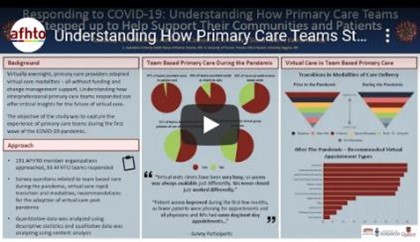
    We are sharing your experience! AFHTO along with our research partners presented at Trillium Research Day demonstrating the value of primary care teams’ response to COVID-19 and patients’ experience with virtual care. Please see the video for the poster presentation and visit our site to see the other research we presented!


    Primary Care Patient_Client Virtual Care Experience Survey

    Primary Care Patient/Client Virtual Care Experience Survey  
    In August, we launched the Primary Care Patient/Client Virtual Care Experience Survey for teams to implement in order to capture the patient experience with virtual care. Moving ahead we are collecting teams’ aggregate responses as we create a narrative of how virtual care could be permanently included in the patient care journey – submit your data here!

    Another option of patient experience data collection is to provide the survey link created by Women’s College Hospital Institute of Health Systems Solutions and Virtual Care (WIHV). WIHV is conducting a third-party evaluation of virtual care in the COVID-19 era on behalf of the Ontario Ministry of Health. If you would like to share your current virtual survey and results, please email Rebecca Liu – Rebecca.Liu@wchospital.ca.

    NOTE: Participation in this survey should only take 10-15 minutes and includes the option to enter a draw for one of four $50 gift cards to Amazon, the Bay or Shoppers Drug Mart. This data will go directly with WIHV and you will not have access to the data.  

    This research will be important as the Ministry looks at the future of virtual care – please spread the word and encourage your patients to participate!

    Primary Care Experience Surveys – Updated Version for OH QIPs
    We have heard from multiple teams that they would like to see an updated version of the Patient Experience Survey. We have had conversations with our partners about next steps as many of the questions within are aligned with QIPs. To do this update, there will be a thorough review of all current teams’ surveys. Please share your current survey with Sandeep Gill at Sandeep.gill@afhto.ca, to help support this important initiative!

    Provider virtual care experience survey
    Women’s College Hospital Institute of Health Systems Solutions and Virtual Care (WIHV) is conducting a third-party evaluation of virtual care in the COVID-19 era on behalf of the Ontario Ministry of Health, measuring the provider experience on virtual care. The objectives are to provide the Ontario Ministry of Health anonymous feedback on:

    • Health care Provider experiences with and preferences for virtual care during the pandemic;
    • The types and features of virtual services which provide the most value for health care providers;  
    • The clinical utility and appropriate uses of virtual services in Primary Care; and
    • Policy recommendations related to virtual care services in Primary Care for the provincial government.  

    You can participate in providing feedback by filling this short 10-15 mins online survey, which includes the opportunity to enter a draw to win one of four $50 electronic gift cares to the Bay, Shoppers Drug Mart or Amazon. Your participation will remain completely anonymous and confidential. Feel free to reach out to Jamie Fujioka (Jamie.fujioka@wchospital.ca) if you have any questions or concerns.

    This research will be important as the Ministry looks at the future of virtual care – please spread the word and we really encourage you to participate!

    IHP experience during COVID-19

    IHP experience during COVID-19

    At the beginning of COVID-19, Dr. Catherine Donnelly reached out to IHPs to hear their experience during the pandemic. You can review the findings from the earlier survey here. We are now seven months since the initial restrictions of COVID-19 and Queen’s University researchers are interested in hearing about your experiences working in Family Health Teams during this time. You are invited to participate in a brief web-based survey to understand the evolving experiences of interprofessional health care providers in Family Health Teams in Ontario during the COVID-19 pandemic. Complete the web-based survey here.

    Coordinating Care During the COVID-19 Pandemic: An Evaluation of Providers’ Perspectives of their Practices (The CONCEPT Study)
    Researchers are writing to invite you to participate in an exciting research endeavour evaluating existing complex care programs within team-based care models, and how these programs have been impacted by the COVID-19 pandemic. This study will evaluate providers’ perspectives on existing care coordination practices for patients with multiple comorbidities and adaptations made during the COVID-19 pandemic.  

    If you agree to participate in this study, you will be asked to complete an electronic survey which should take about 10 minutes to complete. You are asked to answer each question based on your opinion of the care coordination provided in your team before and during COVID-19. You may also seek clarification from your physicians, NPs or IHPs within your team in order to answer some of the questions.
     
    Your participation in this study is voluntary. You may decide not to be in this study, or to be in the study and then change your mind later. You may refuse to answer any question you do not want to answer. You may choose to end your participation at any time without having to provide a reason.

    Responses will be kept strictly confidential. No identifying information is being collected and only aggregate data will be presented or published.

    The survey can be accessed using this link:  The CONCEPT Study Survey
                                     
    Thank you for considering this request.  If you have any questions, please contact Ms. Joanne Permaul, Study Coordinator, at jpermaul@msh.on.ca or Dr. Donatus Mutasingwa, Principal Investigator, at dmutasingwa@msh.on.ca.

    Survivors of Homicide Victims and Mental Health Project FOCUS GROUPS WITH SERVICE PROVIDERS

    Led by The Centre for Research and Innovation for Black Survivors of Homicide Victims (The CRIB), the Factor-Inwentash Faculty of Social Work, and the Canadian Mental Health Association Ontario (CMHA Ontario), the Survivors of Homicide Victims and Mental Health Project is exploring the impact of supporting surviving family members and friends of murdered victims (survivors), and the service providers (i.e. clinicians, law enforcement, legal services, medical professionals, etc.) that support them. They are recruiting for providers from the Brantford, Toronto, Thunder Bay, Ottawa, and Windsor regions.

    LINK TO REGISTER: SERVICE PROVIDER FOCUS GROUPS Or visit:https://serviceprovfocusgroups.eventbrite.ca

    If you have any questions, please contact Megan McPolland at megan.mcpolland@mail.utoronto.ca.

    Upcoming Events:
    Health Promotion Ontario conference
    Nov. 5- 26, 2020
    The Annual Health Promotion Ontario conference will be a free virtual experience this year. There will be a four-part webinar series on Health Promotion in a Global Pandemic in November. Find out more here.

    Employing Digital Health Tools During COVID-19 – and Beyond
    November 16, 2020 12:00 pm – 1:15 pm EST
    As part of Digital Health Week, eHealth Centre of Excellenc will be hosting a webcast/webinar that provides a comprehensive overview of how their suite of digital health tools can be used during COVID-19 and beyond.
    You’ll have an opportunity to learn more about their innovative EMR decision support tools, virtual visit platforms, Ontario eServices Program (eReferral & eConsult), eCE Automates “bots”, tablets, and ePrescribing, as well as hear from a primary care physician on how these tools have impacted his practice.
    Please join Ted Alexander, VP of Partnerships and Clinical Innovation, for this webinar (with an interactive Q&A session to follow). Register here.

    2020 CMHO Virtual Conference
    Nov 23-Dec 4
    Register today for 2020 CMHO Virtual Conference sessions. They’re covering the latest in innovating and advancing child and youth mental health, with short, engaging sessions and leading speakers spread over two weeks. Click here to find out more.

    Virtual Learning Exchange in Virtual Primary Care
    The virtual learning exchange will be delivered in three 90-minute webinars and will focus on the following identified priority topics within the overarching theme of virtual primary care:

    • Cultural Safety and Indigenous Partnership (November 27, 2020, 1:30-3:00pm ET)
    • Enhancing Equity and Access (January 29, 2021, 1:30-3:00pm ET)
    • Patient and Family Centred Care (March 5, 2021, 1:30-3:00pm ET)

    To find out more information please click here.

    Interested in sharing your teams’ initiatives in a future webinar? Email Sandeep Gill – Sandeep.gill@afhto.ca to learn more about the AFHTO KTE Webinar Schedule!

    In Case You Missed It: Check out eBulletin #100 or other back issues here!
    Questions? Comments? Contact us at improve@afhto.ca.


  • QI in Action eBulletin #100- Rx: Social Prescribing

    QI in Action eBulletin #100- Rx: Social Prescribing

    In collaboration with the Alliance for Healthier Communities

    In this Issue:

    • What is Social Prescribing?
    • What does Social Prescribing look like in practice?
    • Social prescribing: tools for equitable healthcare
    • Reminders
    • Upcoming Virtual Events

    What is Social Prescribing?

    Social prescribing is an evidence-based plan to address the social determinants of health, with focus on social isolation and loneliness. Importantly, social prescribing reduces reliance on expensive and inappropriate medical interventions and gives patients the confidence to manage their own health.

    Social Prescribing is:

    • A structured means of referring people who visit their doctor or nurse practitioner to a range of local, non-clinical services that seek to address people’s needs in a holistic way.
    • An asset-based approach that goes beyond treating illnesses, recognizing clients as people with a range of talents and non-medical needs.
    • A way to support individuals in taking greater control of their own health and enable them to engage with and contribute back to the community.
    A survey conducted with providers from the Alliance for Healthier Communities (n=31), identified 42% of participating providers report social prescribing has decreased the number of repeat visits by patients, and 84% of believe social prescriptions have improved their patient’s health.

    What does Social Prescribing look like in practice?

    Throughout the pandemic, many teams stayed open to meet the ongoing healthcare and social needs of their communities and clients. From your interviews and surveys (still open until Sept 18th!) we heard that the majority of teams reached out to vulnerable patients and made proactive check-in calls to screen for and support health and social needs. Humber River FHT conducted telephone outreach to assess social determinants of health and domestic safety. Central Lambton and Delhi FHTs worked directly with migrant workers to deliver trusted health and social care.
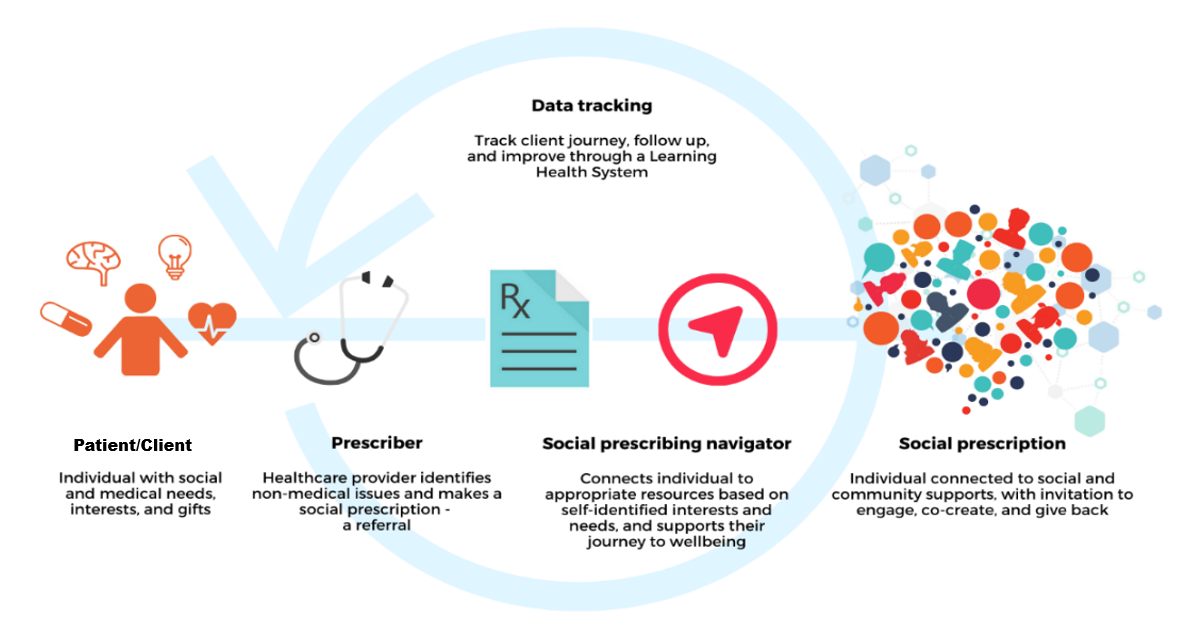
    Social prescribing is a way to capture, formalize and continue this work. It looks different in different communities, depending on local needs and capacity, but generally includes these 5 components:

    Social prescribing components

    How are you using Social Prescribing in your team – let us know! Interested in learning more and implementing in your team? Join us at the AFHTO conference or drop us a line at improve@afhto.ca.

    Social prescribing: tools for equitable healthcare:

    Reminders:
    Responding to COVID-19: Understanding How Primary Care Teams Stepped up to Help Support Their Communities and Patients
    AFHTO in collaboration with Dr. Rachelle Ashcroft and Dr. Catherine Donnelly are conducting a research study to capture the efforts of all our members to ensure no story is left untold. This information will help influence and shape how teams will continue to adapt virtual care after the pandemic, as well as to meet patient needs.

    September 18th, 2020 is the last day to participate in a survey, don’t miss your chance to participate! Please click here to share your team’s story.

    Primary Care Patient/Client Virtual Care Experience Survey
    The Primary Care Patient/Client Virtual Care Experience Survey was created to help fill informational gaps to inform future planning and further support the implementation of virtual care in primary care. We also highly recommend you report back to AFHTO to support AFHTO’s Provincial Initiative. To further support practices in expanding and solidifying virtual care in primary health at a provincial-level, AFHTO will be collecting the practice-level aggregate responses to the survey.

    Upcoming Events

    Electronic Asthma Management System (eAMS) – Tool Demonstration Webinar
    Tuesday September 15, 2020 – 12:00 – 1:00 pm EDT
    The Electronic Asthma Management System (eAMS) is an evidence-based clinical decision support system developed to improve your ability to deliver best care for patients with asthma. Learn more about the tool by registering here.

    AFHTO 2020 Conference Tectonic shifts: rebuilding primary care in a new world
    Thursday, October 8, 2020 – Friday, October 9, 2020
    Before 2020, anyone with experience in Ontario’s healthcare system thought they knew what change meant. Now such changes seem almost a lifetime ago. COVID-19 has shifted our priorities with a focus on how to support our patients and our teams in new ways of delivering care. Primary care has risen to the challenge, but the ground is still shifting, and the future is uncertain. In short, we need to rebuild primary care for this new world.

    Register an individual or team for the conference here. Early-bird registration closes October 1, 2020.


    In Case You Missed It: Check out eBulletin #99 or other back issues here!
    Questions? Comments? Contact us at improve@afhto.ca.


  • Bits & Pieces: ED mentorship, $83 million in grants, IHP sessions & more

    Bits & Pieces: ED mentorship, $83 million in grants, IHP sessions & more

    Your Weekly News & Updates


    In This Issue  
    • Reminder- ED Mentorship Program
    • Ontario Trillium Foundation redirecting $83 million in grants
    • IHP session leads needed for AFHTO 2020 conference
    • Primary care patient/client virtual care experience survey
    • New Chief Executive Officer for Indigenous Primary Health Care Council
    • Reminder-COVID-19 ED interviews end soon
    • Updated COVID case definition, symptoms, guidance and more
    • Hospice Palliative Care Ontario tools mailed to teams
    • Invitation for primary care sites to collaborate on a research study on chronic low back pain
    • Upcoming events regarding 211 Ontario – connecting patients to community programs and services and more


    Reminder- ED Mentorship Program

    We are looking for EDs from different regions and working/funding models to join our ED Mentorship Program as mentors!
     
    Mentoring is about supporting people to develop their leadership skills. It’s a relationship based on trust that is designed to help a mentee take on increasing initiative, build confidence, and excel as leaders. New EDs can learn from others who have experience and who are willing to help them in developing their skills and expanding their knowledge.

    If you are interested in becoming a mentor, please complete this survey and we will be in touch. More information is here.


    Ontario Trillium Foundation redirecting $83 million in grants

    The Ontario Trillium Foundation (OTF) will be redirecting $83 million from its Capital and Grow granting streams to support Ontario nonprofits through the Resilient Communities Fund. This is to support rebuilding the capacity of eligible non-profit organizations that have been impacted by COVID-19. Relevant details include:

    • Two intake deadlines: September 2 and December 2, 2020
    • Grants are for one year, starting from $5,000 to $150,000

    AFHTO members and partners may be eligible to apply. Find out if you’re eligible here.


    IHP session leads needed for AFHTO 2020 conference

    Planning is on track for the AFHTO 2020 Conference and this includes the sessions for interprofessional healthcare providers! There will be a virtual group session on Wednesday, October 7, from 12:30 to 1:15 p.m., and it will be followed by the IHP break-out sessions from 1:30 to 2:30.

    We’re looking for volunteers to lead the popular break-out sessions by coordinating topics, presenters, and a moderator. Leads are needed for the following professions: dietitians, health promoters, nurse practitioners, occupational therapists, psychologists, nurses, respiratory therapists, social workers, administrative staff, physician assistants, and chiropodists.

    These one-hour sessions between peers need a lead to happen. If you’re interested, please contact Beth MacKinnon by Tuesday, August 18, 2020. The lead will receive a $20 discount on their conference fee.


    Primary Care Patient/Client Virtual Care Experience Survey

    Primary care patient/client virtual care experience survey

    The rapid adoption of virtual care during the pandemic not only addresses the current needs but it will most likely shape the future of primary care delivery, beyond the pandemic. As a result, we formed a working group with a number of patients, primary care, health system and health research organizations to create the Primary Care Patient/Client Virtual Care Experience Survey.

    This is to help fill informational gaps to inform future planning and further support the implementation of virtual care in primary care. Different tools, guides and templates are available to help. This is a public survey which non-members can use as well, so feel free to share with your peers. Visit our site to find out more.


    New Chief Executive Officer for Indigenous Primary Health Care Council


    New Chief Executive Officer for Indigenous Primary Health Care Council

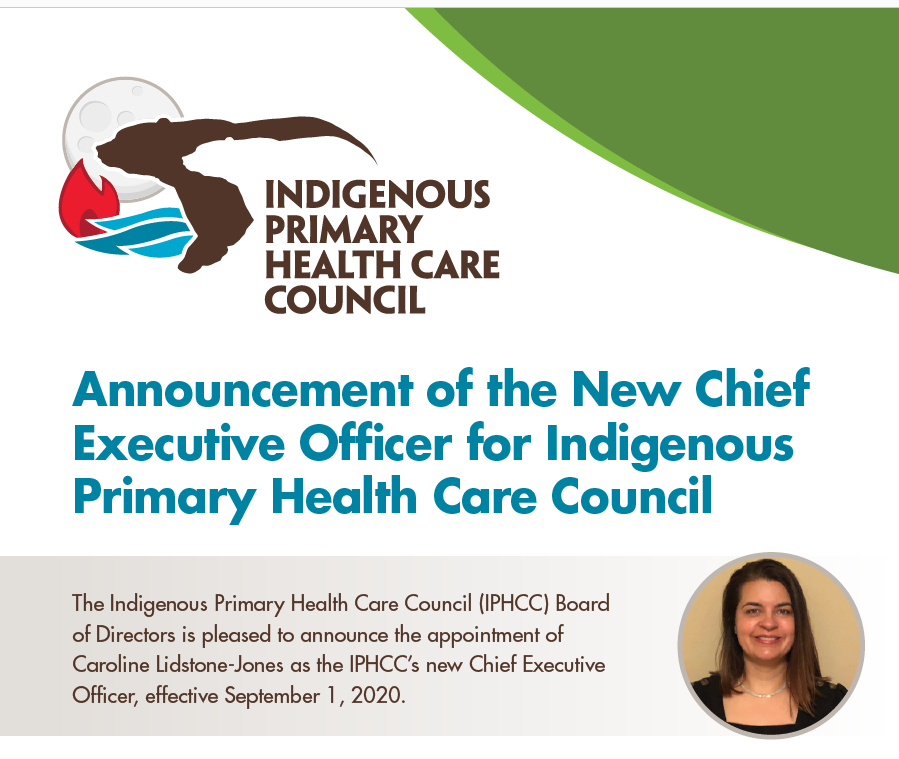
    Congratulations to Caroline Lidstone-Jones who has been appointed as the inaugural Chief Executive Officer of the Indigenous Primary Health Care Council (IPHCC) effective September 1, 2020. Learn more here.


    Reminder: COVID-19 ED interviews end soon

    AFHTO, in partnership with the University of Toronto and Queen’s University, wants to understand the initiatives your team has taken on to continue to provide comprehensive primary care during this pandemic. Visit our site to fill out the Doodle poll to schedule your participation.


    Updated COVID case definition, symptoms, guidance and more

    Several documents have been updated and shared to the Ministry’s website as of Aug. 6 including:

    We continue to update several pages on our site with resources and news:


    Hospice Palliative Care Ontario tools mailed to teams

    Advance Care Planning, Goals of Care and health care decision making conversations are becoming more prevalent and more important than ever, with the aging population and COVID-19. Tools to help you and your patients have been mailed to your team either in March or July. You can use them in your waiting room and directly with your patients. Everything you, your patients and families need can also be found at SpeakUpOntario.ca   

    HPCO would like your feedback on whether you are getting more requests from patients to talk about health care decision making, if you found these resources useful, or if you’re looking to receive more resources. Please feel free to reach out to them at nav.dhillon@hpco.ca.


    Invitation for primary care sites to collaborate on a research study on chronic low back pain

    A PhD student at Queen’s University is looking for primary care sites to collaborate on his research on team-based primary care for the management of chronic low back pain. He is looking for them to participate in a virtual focus group (via Zoom) to understand their experiences. There is also the opportunity to assist with patient recruitment to participate in telephone interviews to understand their experiences with access. If you would like to learn more, please email Kyle at kyle.vader@queensu.ca and he can provide you with more information about how to get involved in this research.


    211 Ontario – connecting patients to community programs and services, August 20

    This webinar shows how 211 can assist primary care teams. It will provide some baseline information about 211’s Accredited enquiry service and Standards driven resource database of benefit to patients when trying to access services in the community – particularly services during COVID-19, such as mental health services, food and other basic needs. Register here.


    Governing through COVID-19 and Beyond, August 25, 2020

    Webinar on governance at this time of   uncertainty and change. Topics include resumption of services; what governors  should know about Ontario Health Teams; and where we  can go from here to continue to strengthen organizational governance practices and prioritize board efforts. Register today!


    The Lung Health Foundation Events

    Medicinal Cannabis – Treating Symptoms of Lung Cancer, August 17, 2020
    Learn more about the endocannabinoid system and apply to your practice. Find out more here.

    Medicinal Cannabis in Chronic Pain, August 24, 2020
    Enhance your knowledge by better understanding how to access medical cannabis. Learn more here.


    Child and Youth Mental Health Webinar Series for Primary Care Providers – Supporting Families With Screentime During COVID, August 19 & 26, 2020

    The CHEO is holding a 2-part webinar series that will cover on-demand topics around the use of technology by youth. Find out more here.


    ECHO Ontario Mental Health – Fall Programs, September 2020 – June 2021
    Join Project ECHO for any of their 6 mental health programs being offered this fall. Topics include addictions, DBT, Trans healthcare, OCD and IDD. View the offerings here.


    Electronic Asthma Management System (eAMS) – tool demonstration, Sep. 15

    The Electronic Asthma Management System (eAMS) is an evidence-based clinical decision support system developed to improve your ability to deliver best care for patients with asthma.

    The system can be used by any provider and is fully integrated with OSCAR EMR and Telus PS EMR. Find out more here.

  • QI in Action eBulletin #99: Capturing Primary Care’s Response to COVID-19

    QI in Action eBulletin #99: Capturing Primary Care’s Response to COVID-19

    In this Issue:

    • Primary Care Patient/Client Experience Virtual Care Survey
    • Responding to COVID-19: Understanding How Primary Care Teams Stepped up to Help Support Their Communities and Patients
    • IHP Experience During the Early Phase of COVID-19
    • Upcoming Virtual Events

    Primary Care Patient/Client Virtual Care Experience Survey

    Primary Care Patient/Client Virtual Care Experience Survey


    The rapid adoption of virtual care during the pandemic not only addresses the current needs but it will most likely shape the future of primary care delivery, beyond the pandemic.

    As a result, the Association of Family Health Teams of Ontario (AFHTO) formed a working group with a number of primary care, health system and health research organizations to measure the patient/client experience with virtual care during the COVID-19 pandemic. These organizations included: Quality Improvement in Primary Care Council (QI in PC Council), Women’s College Hospital Institute for Health System Solutions and Virtual Care (WIHV), eHealth Centre of Excellence (eCE), Ontario Health (Quality) (OH(Q)), and Partnering for Quality.

    We created the Primary Care Patient/Client Virtual Care Experience Survey to help fill informational gaps to inform future planning and further support the implementation of virtual care in primary care. This survey can also be used for quality improvement purposes to allow providers to look at ways to improve their care delivery.

    For online surveys, a template survey for Microsoft Forms has been created that can be duplicated. If you will be using SurveyMonkey, please email Sandeep.gill@afhto.ca and a copy of the survey will be shared with you.

    Ocean (CognisantMD) is offering a free platform to patient experience data; however, please refer to this guide  to ensure that you have completed all the steps to qualify. For your convenience, eCE has created an Ocean eForm version of the survey, now available to be imported to your Ocean (CognisantMD) site. Instructions on how to import and configure the survey and data extraction can be found here.

    We also highly recommend you report back to AFHTO to support AFHTO’s Provincial Initiative. To further support practices in expanding and solidifying virtual care in primary health at a provincial-level, AFHTO will be collecting the practice-level aggregate responses to the survey. Please click here to find more information.

    Responding to COVID-19: Understanding How Primary Care Teams Stepped up to Help Support Their Communities and Patients
    Since the beginning of the COVID-19 pandemic, we’ve heard countless stories of our teams’ commitment, diligence and initiative to continue providing team-based primary care around the province. We’re here to ensure that your hard work gets noticed – but to do so, we need your help.

    AFHTO in collaboration with Dr. Rachelle Ashcroft and Dr. Catherine Donnelly are conducting a research study to capture the efforts of all our members to ensure no story is left untold. This information will help influence and shape how teams will continue to adapt virtual care after the pandemic, as well as to meet patient needs.

    Interviews end August 14- don’t miss your chance to participate! Please sign up for a 30-minute interview to share your team’s story.

    IHP Experience During the Early Phase of COVID-19
    At the beginning of pandemic Dr. Catherine Donnelly and Dr. Rachelle Ashcroft created a survey to capture the interprofessional health provider (IHP) experience as the transition to virtual care began. The objective of the study was to describe the state of IHP practice within primary care teams during the COVID-19 pandemic.

    Some of the preliminary findings of the study were that 48% of IHPs felt that teamwork collaboration increased during the pandemic, 18% of IHPs felt that it remained the same whereas 34% felt it decreased.

    Most of the IHPs delivered care to patients via phone. Before the pandemic this was the most popular mechanism of virtual care delivery. As the pandemic progressed and teams explored creative ways to outreach to patients, teams started to explore social media. The preliminary findings of this survey are that IHPs are the least confident with patient care delivery via social media compared to other virtual care options and in-person care.

    As the pandemic evolves so does the expertise of providers with virtual care. Dr. Catherine Donnelly and Dr. Rachelle Ashcroft will release another survey to capture the IHP experience at multiple time points. Stay tuned for the next survey!

    Upcoming Virtual Events
    211 Ontario – Connecting Patients to Community Programs and Services Webinar
    Thursday August 20, 2020 – 12:00 – 1:00 pm EDT
    A webinar about how 211 can assist Family Health Teams. 211 has been helping the people of Ontario navigate community, health, and social services for many years. Learn more about 211 Ontario by registering here.

    Electronic Asthma Management System (eAMS) – Tool Demonstration Webinar
    Tuesday September 15, 2020 – 12:00 – 1:00 pm EDT
    The Electronic Asthma Management System (eAMS) is an evidence-based clinical decision support system developed to improve your ability to deliver best care for patients with asthma. Learn more about the tool by registering here.

    AFHTO 2020 Conference Tectonic shifts: rebuilding primary care in a new world
    Thursday, October 8, 2020 – Friday, October 9, 2020
    Before 2020, anyone with experience in Ontario’s healthcare system thought they knew what change meant. Now such changes seem almost a lifetime ago. COVID-19 has shifted our priorities with a focus on how to support our patients and our teams in new ways of delivering care.

    Primary care has risen to the challenge, but the ground is still shifting, and the future is uncertain. In short, we need to rebuild primary care for this new world. Registration to open soon. Learn more here.


    In Case You Missed It: Check out eBulletin #98 or other back issues here!
    Questions? Comments? Contact us at improve@afhto.ca.


  • Measuring the Patient/Client Experience with Virtual Care in Primary Care

    Measuring the Patient/Client Experience with Virtual Care in Primary Care

    Measuring the Patient/Client Experience with Virtual Care in Primary Care 

    Let's Capture the Patient Experience with Virtual Care!

    Purpose: 
    In the last year, Ontarians attended nearly 1,000,000 virtual care visits (Ontario Telemedicine Network, 2019). Virtual care is provided through a vast number of modalities such as voice, video, teleconference, online platforms, and mobile texting (Pearl et al, 2014). While many primary care practices in Ontario have provided virtual care in varying degrees prior to the COVID-19 pandemic, virtually overnight, primary care providers shifted most of their practice to virtual care to reduce COVID-19 spread. With this major transition in the delivery of care, it is important to understand how patients/clients are experiencing virtual care so that care can be optimized to best meet their needs. 

    This survey was created to help fill informational gaps to inform future planning and further support the implementation of virtual care in primary care. This survey can also be used for quality improvement purposes to allow providers to look at ways to improve their care delivery. 

    Survey Development: 
    The rapid adoption of virtual care during the pandemic not only addresses the current needs, but it will most likely shape the future of primary care delivery beyond the pandemic. As a result, the Association of Family Health Teams of Ontario (AFHTO) formed a working group with a number of primary care, health system and health research organizations to measure the patient/client experience with virtual care during the COVID-19 pandemic. These organizations included: Quality Improvement in Primary Care Council (QI in PC Council), Women’s College Hospital Institute for Health System Solutions and Virtual Care (WIHV), eHealth Centre of Excellence (eCE), Ontario Health (Quality) (OH(Q)), and Partnering for Quality. 

    AFHTO created a first draft of the survey based on a literature review of virtual care surveys used in primary care. Due to the need to start surveying during the pandemic, and because many of the questions were adopted from existing and/or validated surveys, this survey did not undergo testing. The draft questions were reviewed and refined by the working group members. 

    Additionally, AFHTO engaged with four Ontario Health Primary Care Quality Advisory Committee patient advisors and one of AFHTO’s Quality Steering Committee patient advisors to review and refine questions. The focus of the patient engagement is to identify questions that are meaningful to patients/clients and can help inform quality improvement of patient/client experience with virtual care in the primary care setting. 

    How this Survey can be Used:
    Data from this survey can be used to inform quality improvement and planning efforts. The survey was not designed to be used for benchmarking or comparative reporting; however, results can help guide practices as they plan service changes to improve their patients’ experience with virtual care. This survey complements practices’ existing patient/client experience surveys (ex: Primary Care Patient Experience Survey developed by OH(Q)).

    Practices can deploy surveys based on the type of visit the patient had:
    Thinking of your most recent visit, was it provided to you in person or virtually (i.e., phone, video, or messaging)? 
    a)    In person ⇒ please complete practice’s existing patient/client experience survey
    b)    Virtually ⇒ please complete the Patient/Client Virtual Care Experience Survey

    The results from this survey will help provide a high-level overview of the patient/client experience with virtual care; however practices are  encouraged to capture few additional data elements to provide a more comprehensive picture of virtual care provided and support the interpretation of the patient/client experience. In particular, the collection of the following two elements will be helpful: 

    a) Virtual Appointment – Reason for Visit/Appointment 

    To accurately capture this information, it is recommended that this data is extracted from the EMR via searches/queries and provide the context for the results of this survey within similar timelines. Queries can be structured to search for which appointment modality (i.e. in-person, telephone, video etc.) was used with which reason for the visit/appointment.

    b) Additional Demographic and Health Equity Data 

    The pandemic has highlighted health care inequities already existing in the population. It is important for practices to understand the variances in their patients’/clients’ experiences which can help inform quality improvement and service planning. It is important to capture social determinants of health (SDOH) such as health-related behaviours, socioeconomic factors, and environmental factors, as they can account for 80-90% of a person’s health (Magnan, 2017). Towards the end of the survey, a few questions capture demographic and health equity data, however practices are strongly encouraged to examine the following resources for additional questions:

    Data Collection: 
    Practices may choose to implement the survey via various modalities such as website, online survey platforms (ex., Microsoft Forms, SurveyMonkey, RedCap, Qualtrics etc.), email, paper, and telephone. For online surveys, a template survey for Microsoft Forms has been created that can be duplicated. If you will be using SurveyMonkey, please email improve@afhto.ca and a copy of the survey will be shared with you. 

    Ocean (CognisantMD) is offering a free platform to patient experience data; however, please refer to this guide to ensure that you have completed all the steps to qualify. For your convenience, eCE has created an Ocean eForm version of the survey, now available to be imported to your Ocean (CognisantMD) site, titled “Primary Care Patient/Client Virtual Care Experience Survey”. Instructions on how to import and configure the survey and data extraction can be found here. 

    For telephone appointments there may be some options available such as adding telephone surveys as an additional duty to screeners at your clinic, creating a telephone survey student project, looking for volunteers and using a telephone survey software. 

    Once you have identified the method of dissemination, it is recommended that the survey be fielded for a specific period (ex. 3 weeks) and that practices review results prior to relaunching the next round of the survey. This will allow you to conduct Plan-Do-Study-Act (PDSA) cycles that are manageable and will allow for time to implement quality improvement changes to improve patient/client experience. 

    Survey PDFs:


    AFHTO Provincial Initiative: Help Provide a Provincial Overview of the Patient/Client Virtual Care Experience! 
    Some survey questions may not be applicable to your practice. In collaboration with patient advisors we have identified 5 core questions that we highly recommend remain consistent when being asked. The 5 core questions include: 2, 3, 5, 7, 8 (Appendix A).

    We also highly recommend you report back to AFHTO to support AFHTO’s Provincial Initiative. To further support practices in expanding and solidifying virtual care in primary health at a provincial level, AFHTO will be collecting the practice-level aggregate responses to the survey. 

    A minimum of 5 responses per question will be required for the submission of aggregate results. At the end of June 2021, an aggregate report will be generated with the findings from this survey without any identification of practices. This data will not be used for practice-level funding or public reporting and will only be used to support planning and quality improvement at a regional and provincial level. Participation is highly encouraged, however voluntary. If you choose to participate, please fill in this survey within the first week of the given months: 

    • The week of November 1st, 2020
    • The week of February 1st, 2021
    • The week of May 1st, 2021


    For more information, please contact: 

    improve@afhto.ca

    References: 
    Magnan, S. 2017. Social Determinants of Health 101 for Health Care: Five Plus Five. NAM Perspectives. Discussion Paper, National Academy of Medicine, Washington, DC. doi: 10.31478/201710c
    Pearl R. Kaiser Permanente Northern California: current experiences with internet, mobile, and video technologies. Health Aff (Millwood). 2014;33(2):251-257. doi:10.1377/hlthaff.2013.1005
    OTN. “Virtual Care in Action.” OTN, 28 Aug. 2019, www.otn.ca/virtual-care-in-action-archives/