Tag: Measurement and Quality Improvement

  • Bits & Pieces: GoodLife 7-day trial available, summer perks, patient-centered performance measurement & more

    Bits & Pieces: GoodLife 7-day trial available, summer perks, patient-centered performance measurement & more

    Your Weekly News & Updates


    In this Issue:  
    • GoodLife 7-day trial available
    • Summer perks
    • Patient-centered performance measurement
    • Project ECHO Ontario Bariatric Network – update your knowledge on post bariatric care and obesity management
    • Seeking caregiver input
    • Join the Ontario Quality Standards Committee
    • Upcoming events including Considerations for Primary Care Teams as a Not-for-Profit Corporation and more

    GoodLife 7-day trial available
    Reminder that AFHTO members can save up to 40% off regular GoodLife Fitness rates. The annual Corporate Membership rate is $519, and the bi-weekly payment will be $24.

    At this time all identified members on our ‘Bits & Pieces’ mailing list as of June 24 are already eligible for the discount.

    To register, please email info@afhto.ca for your membership ID. Once you’ve received your ID, you can register online. For more information:

    On the fence? Would you like try it out before committing? You can get a complimentary 7-day pass at www.goodlifeatwork.com/trial.
     
    Class schedules can be found online and filtered by area on their site.  Pressed for time? The Fit Fix is a great way to get a quick workout in. It allows you to do a full body workout in just 20 minutes! Perfect to squeeze in at lunch or just before work. If you have any questions, please email info@afhto.ca.


    Perkopolis summer

    Summer perks for the whole family

    And don’t forget, AFHTO members are eligible to sign up for Perkopolis discounts, which include travel and activities such as Ripley’s Aquarium, African Lion Safari, Universal Orlando and more.

    Other perks include shopping, movies and theatre. Check with your administrator if your team is already signed up and you can register right away. It’s free to sign up!


    Patient-centered performance measurement
    “Balancing patient priorities for technical and interactional aspects of care in a measure of primary care quality” – article in Primary Health Care Research & Development, Volume 20 focused on results of a co-designed survey where patients were asked to determine the relative priorities of each of a series of primary care measures in the patients’ relationship with their primary care provider. Authors include Dr. Carol Mulder, former Provincial Lead of the QIDS Program at AFHTO and lecturer at Queen’s University and Dr. Nadiya Sunderji Psychiatrist in Chief, Waypoint Centre for Mental Health and Assistant Professor at University of Toronto.


    Project ECHO Ontario Bariatric Network – update your knowledge on post bariatric care and obesity management
    The Ontario Bariatric Network is launching a new Project ECHO in post bariatric care and obesity this coming fall. A series of six sessions will be hosted by seven Bariatric Centres of Excellence across Ontario. Join one of their knowledge sharing networks with other primary care providers and specialist from the Bariatric Centres of Excellence to share best practices and discuss cases using videoconferencing technology.  Sessions are open to all primary care providers and interprofessional health care providers, are offered at no cost and are eligible for Continuing Medical Education credits.

    To register or for more information on session details please visit their site or view the flyer.


    Seeking caregiver input
    Baycrest Caregiver Input


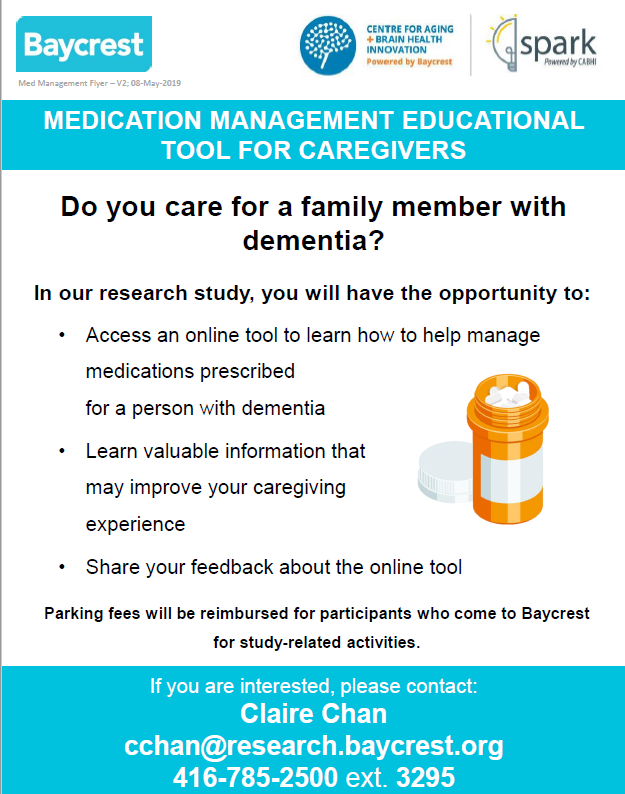
    Baycrest GEMH is recruiting caregivers of people with dementia who might want to participate in an online learning module regarding medication management and dementia.  Please circulate the flyer and/or email to any of your patients’ caregivers who you think  might be interested.


    Join the Ontario Quality Standards Committee
    Health Quality Ontario is seeking volunteers for its Ontario Quality Standards Committee. The committee provides advice on its quality standards program, including on ways to enhance the adoption and impact of the standards. Deadline July 18, 2019.


    Considerations for Primary Care Teams as a Not-for-Profit Corporation, July 17, 2019
    Join AFHTO & Grant Thornton LLP for their second webinar in the Financial Webinar Series. Register here.


    AFHTO 2019 Conference, September 19- 20, 2019
    Members get 50% off registration; plus early bird rates are in effect! Get your member access code from your administrator and come explore Health System Integration Built on The Foundation of Team-Based Primary Health Care. Register now!


    Charting the Future of Primary Care: Leadership, Teams, and Culture, September 11 – 12, 2019
    Ivey Academy partnership program with the Harvard Medical School. Find out more here.


    OMD EMR: Every Step Conference, September 26, 2019
    Early-bird registration has opened for the OMD conference, held in Toronto. Learn more here.
  • 2019/20 Quality Improvement Plans available

    In April Health Quality Ontario received 1,024 Quality Improvement Plans (QIPs) from hospitals, primary care organizations, long-term care homes, and LHIN home and community care services across Ontario. All of the 2019/20 QIPs are now available on QIP Navigator.

    You can use the Download QIPs tool to download the full QIP of any organization, or use the Query QIPs tool to search all submitted QIPs for a key word or indicator of interest. These tools are a great way to find out what organizations in your area are working on this year or read about the lessons organizations have learned during their efforts to address the key quality issues targeted by the QIPs.

    Another source for ideas and inspiration is Quorum, Health Quality Ontario’s health care quality improvement community. You can browse the new Indicators & Change Ideas page to explore and comment on approaches to improvement for this year’s QIP indicators, or search for the QIP tag to read spotlight stories and interviews related to the QIPs.

    It’s clear from initial observations on the 2019/20 QIPs that organizations are focusing their efforts on the three critical themes of timely and efficient transitions, service excellence, and safe and effective care. If you or your team have any questions about the QIPs or about Health Quality Ontario’s quality improvement resources, please contact QIP@HQOntario.ca.

  • D2D 5.1: Getting Started and Changing Gears

    AFHTO members have just released the 7th iteration of their performance measurement report, Data to Decisions 5.1. Voluntary participation in team-level measurement remains high. 90% of members have contributed so far, with over 60% in D2D 5.1. This makes D2D 5.1 a unique picture of primary care across the province, at the LHIN level, and (for the second time) at the sub-region level. Many AFHTO members are going even further than that. 43 teams chose to unmask themselves and are again openly sharing their data with their peers. Some are even putting their reports out on their public websites or sharing them in social media! AFHTO members have clearly gotten started with measurement.

    The North Stars

    The FHTs of the North East LHIN are a shining example of where measurement can take us. The Northeastern Ontario Family Health Teams Network (NEOFHT) continue to lead the way in D2D. 17 of their 27 teams participated in D2D 5.1 – the fourth time in a row they had the highest number of participating teams in the province (the runner up was South West LHIN at 13 teams). Several of our tiny-but-mighty regions are also shining bright; 100% of the teams in Waterloo-Wellington and 86% of the teams in Mississauga-Halton contributed data.

    With this level of sustained commitment, it is not surprising that the 27 NEOFHT teams are taking some big next steps together.  Having seen how D2D helped them compare at a team level, they wanted to do more. They wanted to be sure that any patient going to any team in the North East could expect to have the same kind of care, no matter where they went. In partnership with their QIDSS, the FHT Executive Directors started by agreeing on common indicators to track how they are doing on the 9 most common programs offered in their teams. The impressive thing is that they’re not just talking about it; they’re putting their money where their mouth is. They’re combining QI forces and resources to bring all 27 teams up to the same level in technical tools and training. This ensures that everyone can capture all the data the same way, making it not only possible but easier and more efficient to compare progress and learn from each other.

    The North East LHIN teams are not alone. The Champlain LHIN teams have also invested in sharing common program-level data between their 21 teams. The teams of ESC openly share their quality improvement projects to learn from each about what is working to improve care among their 9 teams. These are clear signs that measurement is becoming a part of the AFHTO culture across the province.

    Changing gears: Learning from each other

    AFHTO members are proud of their progress in building measurement into their culture, and they are dissatisfied that this has not yet led to improvement in performance across all teams. AFHTO members are not content to come in 9th place[i], after the gold, silver and bronze medals have been handed out. We are not content to get the participation ribbon. Measurement is the starting gate for improvement, but it is not the finish line. AFHTO has made it a strategic priority to demonstrate the value of team-based primary care in Ontario. That is where D2D started. Now AFHTO is ready to change gears and take on the improvement challenge in earnest.

    We are not starting with an empty tank. AFHTO members have strong relationships with their patients and with each other. As Barbara Starfield observed, relationships are the unique and powerful contribution of primary care to a sustainable healthcare system. AFHTO will be leveraging the networks built over the past five years in the form of at least ten leadership committees involving members from teams across the province. These long-standing relationships give AFHTO members a solid grounding to support their improvement efforts. Those relationships are already paying off.

    • OntarioMD has been partnering with AFHTO from the beginning when they produced D2D 1.0. Since then, AFHTO and OntarioMD have been working together to improve access to EMR data to help teams improve the health outcomes of their patients.
    • Through partnerships with Community Health Ontario and LEADS Canada, AFHTO is investing in leadership, which is just as important in improvement as measurement.
    • AFHTO has partnered with private and not-for-profit companies alike to offer LEAN and practice facilitation training to AFHTO members (from KM&T and the Centre for Effective Practice, respectively).
    • Research partnerships continue to buoy AFHTO’s efforts. Most recently, AFHTO has partnered with Dr Judith Belle-Brown (president-elect of NAPCRG and long-standing primary care researcher from Western University) to help members learn from each other what it is about teams with high and ever improving performance that other teams can replicate to have similar outcomes.

    D2D was AFHTO’s way to get started by measuring. AFHTO is now changing gears to move beyond measurement to improved outcomes. We’re continuing on our journey to excellent team-based care for #EveryCommunityEveryPatient in Ontario.

    See an infographic summary of the D2D 5.1 results here.

    See the aggregate data for each LHIN region here.

    [i] In 2017, Canada came in ninth out of eleven countries (Australia, Canada, France, Germany, Netherlands, New Zealand, Norway, Sweden, Switzerland, UK, and the US) in the Commonwealth Fund’s annual Health Care System Performance Rankings.

  • D2D 5.0: Demonstrating the value of primary care teams – AGAIN!

    D2D 5.0: Demonstrating the value of primary care teams – AGAIN!

    The results are in for D2D 5.0. As usual, AFHTO members have full access to all the data through the interactive report. A summary of performance at the province and LHIN levels is available on AFHTO’s public web page. Some of the highlights from this most recent release of D2D are listed below.

    • The good news about cost continues! D2D 5.0 shows a continuing downward trend in healthcare costs among patients of teams, particularly those supported by QIDSS.
    • High quality STILL is related to lower cost: AFHTO members keep showing that measuring quality in a way that reflects what matters to patients helps demonstrate the value of team-based primary care.
    • Participation in measurement remains high and growing: A few new teams joined two-thirds of their peers to contribute even more data for more indicators, compared to previous iterations.
    • Quality improvement activity remains high too: Performance is holding. Conversations are continuing and integration between EMRs and hospitals is growing. Stay tuned for more analysis coming soon from the new “team characteristics” aspect of D2D.
    • Sub-region reporting is here: AFHTO members can now compare performance to peers within their own sub-region. External partners can connect with teams in the sub-regions for more information.
    • Opening up to learning: 36 teams have taken the big step to completely open reporting. They and their peers can now easily contact each other to compare notes on performance.
    • Coming soon – FINALLY! What makes a high performing team? Thanks to nearly 90 teams who shared data about their team’s characteristics, AFHTO members can now start to unravel the mystery of what makes a high performing team.

    What’s Next?

    After Data, then Decisions! The next steps with D2D are about using the data. AFHTO members are invited to a post-launch webinar on October 12th to share stories about using D2D to move beyond measurement to improvement. In the meantime, members can check out change ideas and other resources to support improvement through AFHTO’s Information to Action initiative.

    Good news re: cost

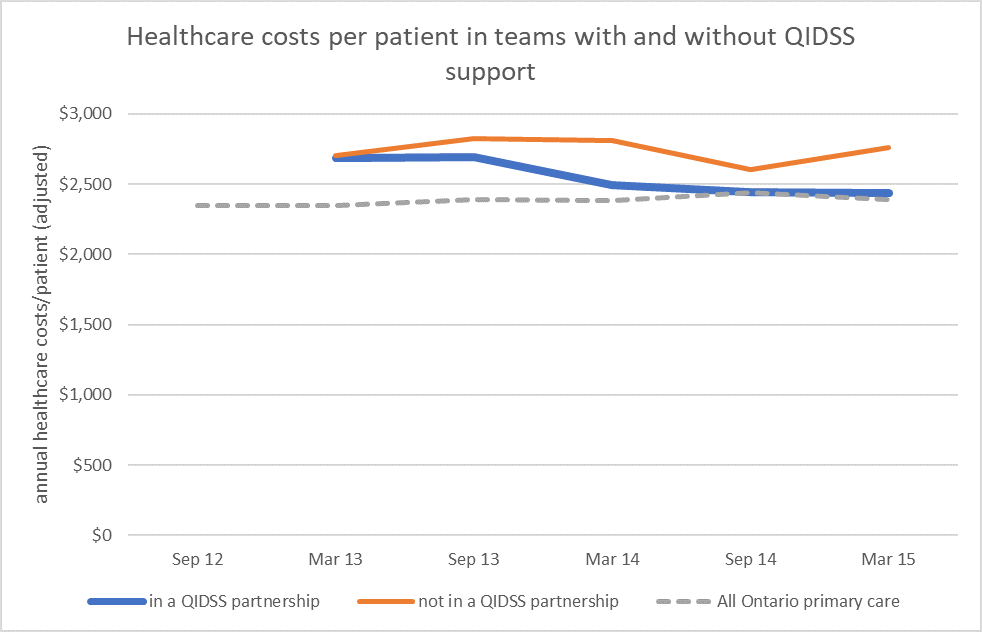
    The average healthcare cost per person (adjusted for patient complexity) is on a downward trend, especially for teams supported by QIDSS.  The average healthcare costs for each patient served by teams with QIDSS support is just under $2500 per year as of March 2015, the most recent year for which data are available.  D2D 5.0 is showing that these costs are starting to drop, even while costs across the province are relatively stable.  This is consistent with other analyses which illustrate that the introduction of team-based care in Ontario was associated with moderate improvements in processes related to some aspects of chronic disease management (Kiran et al., 2015)

    D2D 5.0 healthcare cost graph


    High quality is related to lower costs

    The relationship between higher quality and lower healthcare system cost persists in D2D 5.0. The relationship remains stronger among non-rural teams, for whom just under half of the variation in total cost (not including LTC institutionalization costs) is explained by variation in the composite quality score, once patient complexity is considered. (The Quality Roll Up Indicator is a composite score based on 14 measures covering as many of Starfield’s 4Cs (first Contact accessibility, Coordination, Comprehensiveness, and Continuity) and weighted according to what’s important to patients). The strength and robustness of the analysis continues to grow slowly with the addition of new teams to the data set each iteration and the increasing amount of data available for each contributing team. Work continues to validate the structure of the QRU to further reduce the data capture burden associated with the generation of the composite measure.

    Participation remains high and growing

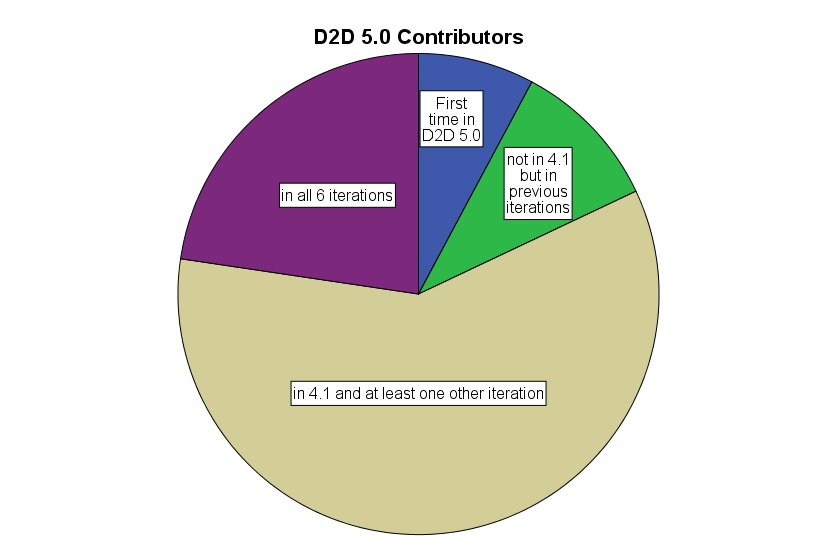
    • 122 (66%) teams contributed to D2D 5.0, slightly up from 117 teams in D2D 4.1. The history of contribution among D2D 5.0 teams is shown in figure 1. Overall, 172 (or 93% of 184 teams) have contributed to at least one iteration, with 22% of members contributing to only one iteration and 64% contributing to 3 or more (data not shown).

    D2D 5.0 contributors

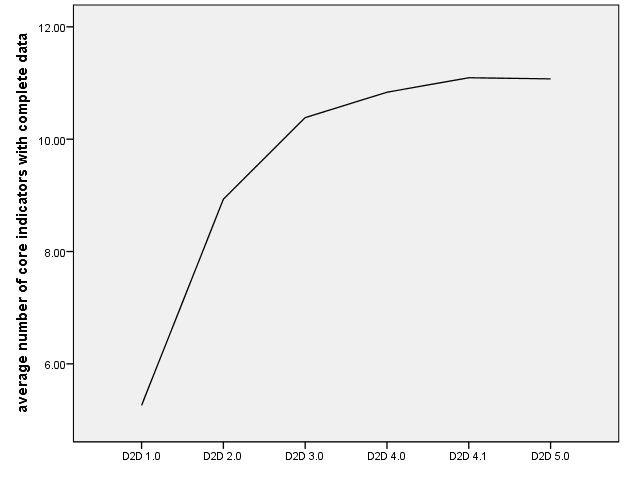
    • More data being contributed for each team: The average number of indicators for which teams had complete data has gone up steadily, plateauing at an average of about 11 out of 15. Work is underway to validate the Quality Roll-Up indicator’s structure with the hope of reducing the number of indicators required to generate it. This might reduce and focus data capture burden for teams.

    D2D 5.0 more data contributed


  • D2D 4.1: Starting to move beyond measurement

    Today’s release of Data to Decisions (D2D) 4.1 contains early signals that variation in performance between teams is decreasing.  Reducing variation is an important goal in quality improvement. So the observed change is an early and encouraging signal that the needle on performance is starting to move in response to measurement.  In the meantime, data from D2D 4.1 continue to show that higher primary care quality is associated with lower total health system cost.

    With D2D 4.1, the amount of data teams are able to contribute continues to grow. As with previous iterations of D2D, members are clear that this is due in large part to the network of Quality Improvement Decision Support (QIDS) Partnerships, available to most (but not all) primary care teams. Thanks to these partnerships, voluntary participation is holding steady at about two-thirds of all members. Changes coming soon to address other barriers for participation include:

    • Change the comparator to 75th percentile instead of average values to increase effectiveness of comparison as a driver for change
    • Emphasize the value of ongoing/continuous measurement, even in the absence of specific interventions to improve performance
    • Encourage the USE, not just contribution, of D2D data
    • Clearly communicate updates in Primary Care practice report (data now current to within 6 months compared to 1.5 years previously)
    • Highlight the value of D2D to collective as well team-level efforts to improve

    Measurement puts a lens on what does need work. AFHTO is expanding its collective focus beyond measurement to improvement. Activities offered to support members in efforts to improve performance include:

    D2D 4.1 is making collaboration at the LHIN level easier. 100% of teams provided information about their LHIN location. This is consistent with what happened in D2D 4.0 (when LHIN was introduced as a peer characteristics). It is also in line with requests of teams in several LHINs to unmask their identity to others in their own LHIN to make comparisons more meaningful. Sharing information in this way is helping these teams work together with their LHINs on primary care transformation while keeping the focus of measurement on the comprehensive generalist nature of high quality primary care.

    The journey towards manageable meaningful measurement and improvement in primary care continues. The next iteration – D2D 5.0 – will be out in the fall of 2017.  Relevant Links:

  • D2D 3.0: Progress in meaningful measurement for primary care

    Today’s release of Data to Decisions (D2D) 3.0 demonstrates significant progress by family health teams and nurse practitioner-led clinics to advance manageable and meaningful measurement for improved patient care.

    AFHTO members are guided by the Starfield Principles – focusing on the relationship with patients and the primary care team’s ability to deliver the care patients value. Its objective is to optimize quality, access and total health system cost of care for patients. D2D uses indicators from Health Quality Ontario’s Primary Care Performance Measurement Framework, with some modifications guided by input from front line providers.

    AFHTO members have made progress in:

    • Capturing EMR data to measure outcomes: The composite measure of diabetes is the first time a clinical outcome indicator based on EMR data has moved out of academic research into a performance report. It reflects how the entire interprofessional team contributes to care, and not just physician activity based on billing data. This data capture was made possible through standardized queries across multiple EMR platforms, developed by members but now available to any user of these EMRs within or beyond AFHTO.
    • Using EMR data to measure best practice rather than incentive payment: For the first time, percent of eligible children immunized is measured according to Public Health Agency of Canada (PHAC) guidelines. The results illustrate a difference in definition from that used for physician billing incentives related to Rotavirus immunization which is part of PHAC recommendations but not in the incentive definition.
    • Improving data quality: AFHTO members are measuring and improving the quality of their EMR data as a source of timely information for quality improvement. Measuring can also have a direct and immediate impact on patient care. In the process of measuring their EMR Data Quality for the first time, one team found a systemic issue affecting flow of information from a lab to their EMR. They fixed the problem, improved their ability to detect colorectal cancer, and in their words, “saved lives”!
    • Voluntarily increasing participation in D2D: Nearly two-thirds of AFHTO members submitted their data to D2D 3.0, continuing the growth from D2D 1.0 (27%) and 2.0 (54%). This gives insight into the care of nearly 2 million Ontarians.

    All three Starfield elements are now in place:

    1. Quality is reliably and comprehensively measured through a composite indicator. It reflects the experience of the entire patient, not just isolated body parts. It is calibrated according to what matters most to patients in their relationship with their provider. While refinements continue, it is now possible to compare quality over time and between settings in a more meaningful way than is possible by just examining physician billing data.
    2. Capacity of the entire clinical team is being measured for the first time. Forty-six teams contributed data to measure time spent delivering primary care relative to the number of patients served. This approach considers the contribution of the entire team and provides a mechanism for exploring the impact of patient complexity on the human resources required to deliver high quality care.
    3. Total cost of care is now in its third iteration of D2D. It has been refined in conjunction with the Institute for Clinical Evaluative Sciences to help teams explore aspects of costs that might be sensitive to change in primary care delivery. This measure captures more than 85% of the allocatable public spending per person in Ontario; it is adjusted to reflect age, sex, and complexity of patients to allow comparison over time and between primary care settings. This indicator is now identified as a priority by Health Quality Ontario for system measurement.

    AFHTO members are well-equipped to take the next steps to improve quality

    Results from D2D 3.0 suggest that there is solid and growing engagement with measuring performance. This can be leveraged as we turn our attention now to improving. The D2D interactive report allows teams to compare their own data over time and with their peers across the province. Clinical leadership within and among primary care teams is proving to be the key ingredient in getting people to participate in measurement, improve data capture and act on results.

    Measurement continues to become more meaningful: Follow up after hospitalization

    To be added to the next D2D, this indicator will use EMR data to capture all hospitalized patients receiving in-person OR phone contact with ANY clinician within 7 days of discharge from hospital. Unlike the current indicator based on physician billing data, this approach encourages more patient-centered and efficient follow-up (e.g. phone call by pharmacist to address mediation issues rather than forcing a patient to come in to see the doctor).

    Access to hospital discharge data is the crucial pre-requisite for this indicator – and for excellent quality primary care in general. AFHTO continues to encourage members and external partners such as OntarioMD, eHealthOntario and hospitals to expedite implementation of Hospital Report Manager in all regions.

    Ministry and LHINs are encouraged to support spread

    • Cost-effective, high-performing health systems are based on a strong foundation of comprehensive primary care; robust measurement is a key ingredient.
    • D2D provides a way forward. It is grounded in the Primary Care Performance Measurement Framework to ensure consistency and relevance for all Ontarians, and focussed on what is meaningful and manageable for primary care providers. The tools and processes developed by AFHTO are already being adopted beyond its membership.
    • Spread requires support – to further develop clinical leadership and deploy Quality Improvement Decision Support Specialists to enable more teams and other primary care providers participate in measuring and improving quality.

    Click here to see D2D 3.0 aggregate results.

    The Association of Family Health Teams of Ontario (AFHTO) is the advocate, network and resource centre for interprofessional comprehensive primary care teams.

  • Video: Why D2D Matters – A family doctor’s perspective

    Data to Decisions (D2D) is a membership-wide report on performance in primary care. In this 4 minute video, Dr. Michelle Greiver, North York FHT, describes the reasons she values Data to Decisions. Share this video with your colleagues, physicians and board members to start conversations about how your team could benefit from D2D.

    Next steps for participating in D2D are outlined on the Data to Decisions: Advancing Primary Care webpage.

    Additional AFHTO members have shared their experiences participating in D2D:

    “I see D2D 2.0 as a unique reflection of interdisciplinary care. Reporting how we are doing as teams can help those of us in the trenches measure, improve and ultimately advocate for team-based care across Ontario” Cathy Faulds, lead physician, London FHT

    “I see D2D 2.0 as a way to make measurement more reflective of how I work every day with my team and with my patients.  I like the idea of having input into what those measures are. D2D 2.0 gives me a way to do that” Rob Annis, family physician, Board member North Perth FHT (Listowel) and AFHTO

    “D2D 2.0 lets me see how our team stacks up against other teams like us so we can see where the gaps are locally as well as across the province. This gives me a sense of pride in what we have already been able to achieve – and helps me focus my energy on what is most important” Kavita Mehta, Executive Director of South East Toronto FHT, AFHTO board member

    “D2D moves quality improvement to the next level. Optimizing the patient experience happens when we measure the things that are truly meaningful to both patients and their healthcare providers.” Dave Courtemanche, Executive Director, City of Lakes FHT (Sudbury), QIDSS host team

    “AFHTO members are delivering great value – D2D 2.0 gives us a way to demonstrate that in a way that we and our partners can see and act on it!” Randy Belair, Executive Director Sunset Country FHT, QIDSS host team, AFHTO president

    Click here for information about how to contribute to D2D today.

  • D2D 2.0 report release: AFHTO members advance primary care measurement

    AFHTO members are leading the way to advance manageable and meaningful measurement across primary care. This work is critical. Around the world, cost-effective, high-performing health systems are based on a strong foundation of comprehensive primary care; robust measurement is a mandatory ingredient for strengthening that foundation.

    D2D 2.0 demonstrates significant progress in this journey:

    • More than 100 family health teams and nurse practitioner-led clinics have voluntarily submitted their data.
    • This gives insight into the care of over 1.7 million Ontarians.
    • Comparative analyses indicate the results are representative of the full AFHTO membership of Family Health Teams (FHTs) and Nurse Practitioner-Led Clinics (NPLCs).

    The D2D journey is revealing how to get better at measuring what matters most:

    • AFHTO members are shaping implementation of Health Quality Ontario’s Primary Care Performance Measurement Framework (PCPMF) – in identifying priority measures for system and practice level and in refining these measures.
    • Working with the Institute for Clinical Evaluative Sciences (ICES), AFHTO members are leading the way to measure the average cost of all health care received by the panel of patients served by each team, adjusted for the characteristics of that patient panel.  This measure is highly important since it:
      • Can be calculated for the panel of patients in any type of primary care practice in the province.
      • Enables cost to be monitored over time to better understand the impact of improvements in quality of primary care and the health of patients on the sustainability of health care system.
    • To better reflect the many facets of comprehensive primary care that matter to both patients and providers, AFHTO members have completed their first iteration of a composite measure of quality.
    • Working across such a large number of primary care teams is enabling innovation to simplify data extraction from EMRs and improvement in data quality.

    D2D 2.0 shows encouraging results for AFHTO members and provides guidance for further improvement (click here for table):

    • Overall, AFHTO members are performing better than the provincial average on same day/next day access (40% better), cancer screening (10% better), and patient satisfaction with their involvement in decision-making (4% better).
    • There are preliminary indications that patient satisfaction with the courtesy of office staff has improved over the past 3 years (20% improvement).
    • Most teams rank high on some indicators and lower on others. D2D enables teams to compare themselves to their peers and pinpoint their improvement activity.

    AFHTO has created a series of handouts that highlight some of the exciting results we have seen to date and illustrate how we got there.

    The D2D journey continues. Measures will continue to be refined to become more and more meaningful to providers and their patients, and acted upon to improve care. Watch for the next iteration in January 2016.    

  • AFHTO launches Data to Decisions 1.0: comparing measures across teams for the first time

    Data to Decisions 1.0: Advancing Primary Care (D2D 1.0) is the tangible result of our collective “get started” effort in team-based performance measurement across the AFHTO membership. D2D 1.0 is a summary of primary care data that are currently available, comparable and mean the most to AFHTO members in their efforts to advance quality of care for their patients. AFHTO members can access D2D 1.0 in the Members Only website.

    Why D2D 1.0?

    Measuring our performance helps us demonstrate the value of patient-centered, relationship-based comprehensive primary care.  It helps us fulfill our commitment to our patients by helping us find the gaps locally AND provincially so we can direct the attention of our funders and partners to work with our members to improve the system.  Measurement also helps us use our resources to develop processes and tools that can help ALL primary care providers use manageable and meaningful measurement to improve quality. The measures in D2D 1.0 were selected by members through a process that began with Indicator Working Group review of indicators defined by the HQO’s Primary Care Performance Measurement Framework and aligned with the Starfield principles, and culminated with a vote by members on a short list based on data availability and feasibility. Fifty members contributed their data in this completely voluntary initiative. D2D 1.0 can be used by ALL members – whether or not your team has contributed data. The report is accompanied by a suite of supporting materials to help teams use the data to advance their work to improve quality for their patients.

  • Advancing primary care measurement with D2D 1.0 and the Starfield Model

    Two big steps in our progress to measure, improve and demonstrate the value of interprofessional primary care:

    • Close to 50 FHTs submitted their data for the Data to Decisions (D2D) 1.0 report.  Whether or not your FHT/NPLC contributed data, the summary results can help you and your team. AFHTO members can access D2D 1.0 on the Members Only website.
    • D2D 1.0 is a starting point – the Starfield Model is the eventual destination. AFHTO’s approach to primary care measurement focuses on the relationship with our patients and our ability to deliver the care patients value. Its objective is to optimize quality, access and total health system cost of care for patients, using indicators from Health Quality Ontario’s Primary Care Performance Measurement Framework. The model and a case study of its implementation was just published in the Healthcare Management Forum – The Starfield model: Measuring comprehensive primary care for system benefit.

    Getting the most value from D2D 1.0 To make sure D2D 1.0 is as useful as possible for you, AFHTO members will be asked to complete a survey that will guide the design of supporting materials. We expect that it will be the conversations, not the data themselves, that are the most important value of D2D 1.0.  The conversations that are already starting are making it easier for teams to get at the data they need for meaningful measurement, measurement that reflects the work and impact of all members of the interprofessional primary care team. Learn more at the AFHTO Conference Consider registering for:

    • Using D2D 1.0: physician-specific workshop on Oct 15, 2014, 10 AM – 12 noon
    • Performance measurement: why bother? Oct 16, 2014 from 9:30am to 10:15am Concurrent Session Presentation on AFHTO’s approach to performance measurement, mapping out the journey from D2D 1.0 to the eventual destination of the Starfield model.

    Data to Decisions (D2D) 1.0 D2D 1.0 is a summary of primary care data that are currently available, comparable and mean the most to AFHTO members in their efforts to advance quality of care for their patients.  Please see brief slide deck for more information. Please contact Carol Mulder with any questions or suggestions for D2D 1.0.