Tag: Highlights

  • The Starfield model: Measuring comprehensive primary care for system benefit

    AFHTO’s approach to primary care measurement focuses on the relationship with our patients and our ability to deliver the care patients value. Its objective is to optimize quality, access and total health system cost of care for patients, using indicators from Health Quality Ontario’s Primary Care Performance Measurement Framework. An article describing the model and a case study of its implementation was published in Healthcare Management Forum – The Starfield model: Measuring comprehensive primary care for system benefit.

    Authors:

    • Angie Heydon, MBA, Executive Director, The Association of Family Health Teams of Ontario
    • George Southey, MD, CCFP, FCFP, Dorval Medical Family Health Team

    Abstract:

    Comprehensive primary care describes the long-term relationship between patient and provider in which medical services, support for self-care, and care coordination are the foundation. Research has associated comprehensive primary care with better system quality, equity, and efficiency. A performance measurement method is needed to enable teams delivering such care to optimize their performance and to evaluate the benefits over time. This article describes “The Starfield Model”—an approach to measuring quality, capacity, and total cost of care at this scope of service—and the results achieved by a small family health team in implementing this model. This experience suggests that real benefits arise from meaningful feedback to providers. The model has the potential to work in any payment system of primary care, thereby providing insight into all types of comprehensive primary care practices. Click here to access the full article.

  • Tungasuvvingat Inuit FHT wins Innovation in Public Health and Primary Health Care Award

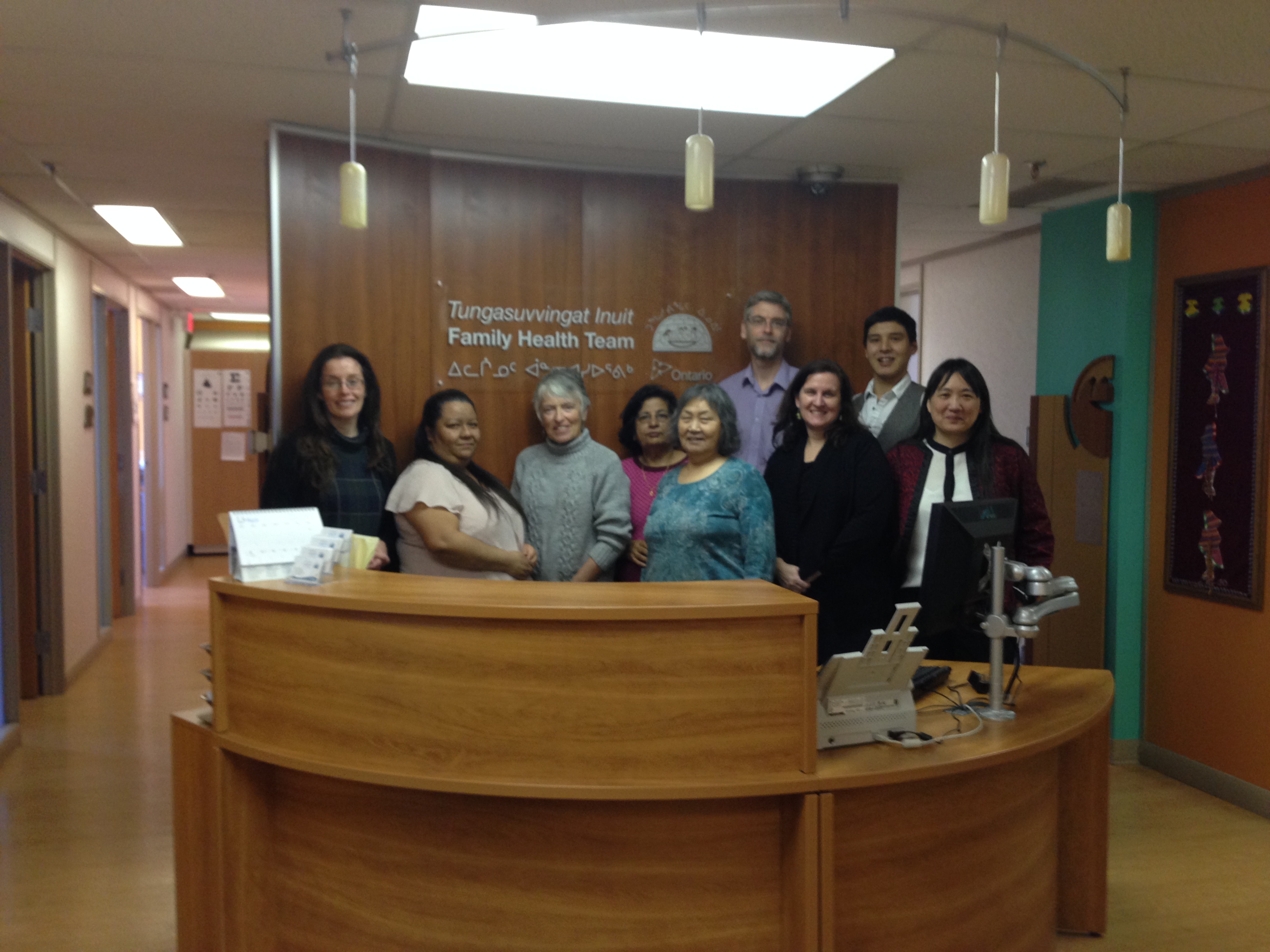
    The Tungasuvvingat Inuit Family Health Team (TIFHT) was honoured with this award at a the “Prevent More to Treat Less” conference, jointly sponsored by the Association of Ontario Health Centres and the Association of Local Public Health Agencies, together with a range of partners including AFHTO. Since March 2011 TIFHT has provided Primary Health care services to Ottawa’s Inuit population. Nominated by Ottawa Public Health,  the team was described as providing “innovative, holistic model of culturally safe, community-based primary care with interdisciplinary services that incorporate an understanding of the determinants of health and a respect for Inuit diversity, values, culture, language, knowledge and self-determination.” To enhance health equity, efficiency and effectiveness, TIFHT and Ottawa have developed a powerful partnership — a partnership that has ensured many more people from Ottawa’s Inuit community can access culturally appropriate services that address the communities most pressing health needs. photoTIFHT has facilitated community engagement, informed needs assessments, adapted health education resources, and influenced public health approaches to collectively identify priority health concerns. This has been accomplished through ongoing dialogue, sharing promising practices, community consultations, and Elder participation in service and program planning. This integration of public health into primary care services has meant clients who might otherwise avoid mainstream health services get the supports they need. Both Ottawa Public Health and the Tungasuvvingat Inuit Family Health Team are focused on controlling communicable diseases.  Working together they have enhanced access to testing, treatment and vaccines.  They also have designated liaisons, and developed collaborative case management. Both organizations also want to improve the oral health of the Inuit Community in Ottawa. They are working together they run a  monthly dental screening clinic, located at the Family Health Team’s site.  And now this dynamic partnership is in the process of developing joint activities related to smoking cessation and suicide prevention. This is an excellent example of how working together Public Health and Primary Health Care providers can promote population health and advance health equity for a population that is vulnerable to poor health.

  • Nominations to the AFHTO Board of Directors are open until July 14

    Dear fellow AFHTO members: Are you interested in serving on the AFHTO board of directors? The Governance Committee of AFHTO’s board invites anyone who works within an AFHTO member organization to apply. Please share this call for nominations with all who work in your team. FIVE people are to be elected for a 3-year term on the 14-member AFHTO board. The AFHTO by-laws call for balanced representation on the board to include the various forms of governance, the regions of the province, and the mix of the professions working within FHTs, NPLCs and other interprofessional models. In reviewing the composition of nine continuing board members, priority for the five directors to be elected will be given to candidates who are:

    • Interprofessional health providers or physicians
    • From AFHTO members located in NE Ontario and the Toronto area
    • From community-governed FHTs and NPLCs

    To apply:

    • Click here to read AFHTO’s Nominations and Elections policy.
    • Click here for information on the role and requirements of AFHTO board members.

    The Governance Committee of the AFHTO board will review all applications to assist the AFHTO board to determine the slate of candidates to recommend to the AFHTO membership for election at the AFHTO annual general meeting.

    • Nominees will be informed of their status by September 12.
    • Nominees who are not recommended for the slate will have until September 22 to determine whether they wish to proceed with having their name go forward on the election ballot.
    • The election will take place at the Annual General Meeting in conjunction with the AFHTO annual conference.  This year it will be held:

    Wednesday October 15, 2014 9:00 AM – 10:00 AM The Westin Harbour Castle 1 Harbour Square Toronto, Ontario M5J 1A6

    Sincerely, Jennifer Kennedy Chair, Governance Committee AFHTO Board of Directors Executive Director, North Renfrew Family Health Team

  • AFHTO 2014 “Bright Light” Awards nominations open

    Nominations now closed. Thank  you to all who submitted nominations. Confirmation emails will be sent by end of day Wednesday, August 13 2014. If you have submitted a nomination and have not received a confirmation email by then, please contact us at info@afhto.ca.

    Little innovations, big impact – Bright Light Award winners are innovators, making meaningful changes to improve the patient experience, health outcomes and reduce overall costs to the health care system. The awards program recognizes leadership, outstanding work and significant progress being made to improve the value delivered by interprofessional primary care teams across Ontario.

    Awards will be presented at the third annual AFHTO 2014 Conference Awards Dinner, on October 15, 2014. Winners in four award categories will receive an education grant*. Deadline to complete the online form and submit supporting documents was August 8, 2014.

    Make a nomination:

    1. Review the Bright Lights nomination guide to prepare your nomination.
    2. Complete the online nomination form. All nominations must be completed online and in full. To avoid the risk of losing information, it is best to complete the online form in one session.
    3. Submit supporting documents to info@afhto.ca:
      1. Supporting evidence and materials as appropriate.
      2. Nominee photos (1-4 high-quality photos in png. or jpg. format to be featured at the awards dinner on Oct. 15.)
      3. Signed statement of attestation to release photos for AFHTO use.

    Award nominations will be reviewed and selected by the “Bright Light” Review Committee.

    Award Categories

    One or more awards will be presented in each of the following categories:

    1. Accountability and governance for patient-centred care
    2. Engaging the patient in their care*
    3. Responding to community needs
    4. Team collaboration in patient-centred care*
    5. Integrating the community around the patient
    6. Using data to improve transitions of care and care coordination*
    7. Clinical innovations in comprehensive primary care*

    * Thank you to our generous sponsors for providing education grants to award winners in the categories marked above:

    • Boehringer Ingelheim for providing two award recipients in the Team collaboration in patient-centred care and Clinical innovations in comprehensive primary care categories with the opportunity to attend the Institute for Healthcare Improvement Conference on March 15-17, 2015, in Dallas, Texas.
    • Merck Canada Inc. for providing a $3,000 education grant for the “Bright Light” award recipient in the Engaging patients in their care and Using data to improve transitions of care and care coordination categories.

    Please note: Sponsors have no role in establishing award criteria, call for nominations, judging or selecting the program winners.

  • Registration for the AFHTO 2014 Conference is now live!

    Takes place on Wednesday, October 15 and Thursday, October 16 at the Westin Harbour Castle in Toronto. Click here for more information on the conference. We look forward to seeing you!

  • AFHTO 2014 Conference: Thank you for submitting abstracts!

    Over 150 submissions were received for concurrent session and poster presentations at the AFHTO 2014 Conference. Thank you to all those who applied!

    A confirmation e-mail has been sent to the contact person for each abstract submission. If you are part of a group that has prepared an abstract, please ensure your group contact has received the e-mail with line: “AFHTO 2014 Conference: thank you for submitting abstract”. If your group has NOT received this confirmation, please contact conference@afhto.ca by Tuesday, May 13, 2014 at 1:00 PM (EST). The confirmation e-mail is your assurance that your abstract has been received and will be reviewed by a working group for presentation at the conference.

    Final concurrent session and poster presentations will be selected by June 9, 2014. The program will be announced when registration opens in late June 2014.

    We look forward to seeing you at the AFHTO 2014 Conference! In Partnership with Patients: True Integration of Care October 15 & 16, 2014 Westin Harbour Castle, One Harbour Square, Toronto

  • AFHTO 2014 Conference: One week left to submit a presentation or poster abstract (May 12)

    Take advantage of this opportunity to share your knowledge and experience in advancing patient-centred care!

    Due date for all concurrent session and poster abstracts is May 12 at 9:00 AM

    Reduced registration fee for concurrent session presenters: Up to 2 presenters will each be granted a $50 discount off the conference registration fee for each approved concurrent session. (Discount does not apply for poster presentations.) Key dates:

    • Deadline for presentation abstracts: May 12, 2014 at 9:00AM (EST)
    • Notification of acceptance for presentation: June 9, 2014
    • Conference registration opens: late June  2014
    • AFHTO 2014 Conference: October 15 & 16, 2014
  • Celebrating the 10th anniversary of Family Health Teams in Ontario

    Ten years ago the concept of “Family Health Teams” was first announced. This anniversary follows a week in which two important studies have published evidence of the value of interprofessional collaboration in Ontario’s Family Health Teams, and in interprofessional primary care models across Canada. To mark this event, the Association of Family Health Teams of Ontario received recognition in Ontario’s Legislature and issued the news release below.

    ****************************************************************************

    Ontario’s Family Care Teams are Providing Better Care and Better Value to Patients March 17th – Toronto – On the 10th anniversary of the creation of Family Health Teams in Ontario, the Association of Family Health Teams of Ontario (AFHTO), proclaimed the success of team-based primary care models to enhance patient outcomes, save the province money, and improve patient and provider satisfaction. “Evidence from around the world and right here in Ontario show that when patients have access to high quality, team-based primary care that patients, providers and the health care system all benefit from improved health outcomes at a better cost,” said Angie Heydon, Executive Director of AFHTO. “As a result, we believe all patients should have access to this high standard of care in the province.” A recent Ontario study concluded that interprofessional care is resulting in:

    • Enhanced access to primary care and other health care services.
    • Improved coordination, collaboration and patient-centredness.
    • Better clinical outcomes.
    • Enhanced patient and provider satisfaction.
    • More system efficiency.
    • Decreased wait times for primary care, diagnostic testing and mental health assessments.

    AFHTO is embarking on a province-wide campaign to enlist support from MPPs of all parties in the hopes of securing broad support for the expansion and enhancement of family care teams in the province as soon as possible. “Family care teams are providing care to almost a million people who didn’t previously have a doctor. They’re keeping patients out of the emergency rooms. And they’re helping enhance disease prevention and health promotion initiatives in the province.” Remarked Keri Selkirk, AFHTO President and Executive Director of the Thames Valley Family Health Team, “We’re providing better care, and saving the province money. It just makes sense to redouble efforts to ensure that more patients are benefitting from this care.” AFHTO is a not-for-profit association representing Ontario’s family care teams, which includes Family Health Teams, Nurse Practitioner-Led Clinics, and others who provide interprofessional comprehensive primary care. 

  • Healthcare Team Model Best for Patients and Healthcare System

    The Conference Board of Canada has published a new report Getting the Most out of Health Care Teams: Recommendations for Action.  Click here for the full report. Key points from the report are summarized in the Conference Board of Canada’s press release, reproduced below: Billions of dollars in savings could be realized Ottawa, March 10, 2014 – Making interprofessional primary care (IPC) teams the standard model for delivery of primary health care services across Canada could help improve patient outcomes while reining in costs. Canada’s population is aging, prevalence of chronic conditions is growing and, in turn, demand for health care and health care costs are rising. IPC team care could save the health care system almost $3 billion in direct and indirect costs of diabetes and depression complications alone. An IPC team is a group of professionals from different disciplines who work together and communicate under an arrangement to provide health services in a community. A new Conference Board of Canada publication, the last in a four-part series, outlines the actions required to improve IPC team care in Canada and increase access to team-based care for Canadians. “The evidence tells us that team-based care significantly improves the health and wellness of patients with and at risk for chronic conditions, reduces emergency room visits, and offsets costs in other parts of the health care system,” said Thy Dinh, Senior Research Associate. “There has been an increased use of the interdisciplinary team model for delivering primary care, but barriers, such as funding and how we pay team members, still exist.” HIGHLIGHTS

    • Increasing access to IPC teams for Canadians with Type 2 diabetes could reduce medical complications by 15 per cent annually.
    • IPC team care could also save the health care system almost $3 billion in direct and indirect costs of diabetes and depression complications.
    • IPC teams have been shown to produce multiple benefits, compared to care provided by a solo provider.

    Barriers to implementing IPC exist among individual team members, within practices, and throughout the primary care system. These barriers include inappropriate governance, leadership, and pay structures, and inadequate inter-professional education and training programs. The Conference Board study, Getting the Most out of Health Care Teams: Recommendations for Action, outlines what governments, health care providers and administrators, and patients can do to ensure IPC teams function well and deliver quality primary care services for Canadians. Recommendations for federal, provincial and territorial governments:

    • Adopt a funding and payment system that supports IPC.
    • Mandate and support the development and use of interprofessional education and training programs on the core competencies of collaboration for all health professionals.

    Recommendations for health care providers and administrators:

    • Provide appropriate mix of service providers to meet service requirements in the most cost-effective way and within the available funding and supply of health care professionals.
    • Establish protocols for and implementation of standardized patient hand-offs, referrals, and care coordination among providers on the team and across the health care system.
    • Optimize use of communications technology, physical space, and other supports to facilitate collaboration.

    Recommendations for all three of the above:

    • Engage in, support, and establish a strong and stable governance structure.
    • Make it easier for Canadians to access team-based care.
    • Monitor and evaluate cost-effectiveness, performance and knowledge sharing on a regular and consistent basis.
    • Adopt accountability measures for IPC team models, which are linked to performance.

    Recommendations for patients:

    • Be open to receiving care from and consulting with different health providers.
    • Request greater access to inter-professional health teams.

    This is the final report in the Canadian Alliance for Sustainable Health Care’s (CASHC) research series Improving Primary Health Care Through CollaborationLaunched in 2011, CASHC is a program of research and dialogue, investigating various aspects of Canada’s health care challenge, including the financial, workplace, and institutional dimensions, in an effort to develop forward-looking qualitative and quantitative analysis and solutions to make the system more sustainable. The report findings will be presented at a Conference Board of Canada webinar, Improving Primary Health Care through Collaboration, on April 22, 2014 at 02:00 p.m. EST.
  • Interprofessional Collaboration in Ontario’s Family Health Teams: A Review of the Literature

    We are pleased to share the following literature review exploring current research on interprofessional Family Health Teams (FHTs) across Ontario. This review collects and analyzes existing evidence on the initial improvements to primary healthcare access, patient outcomes and reduction of system costs. A Review of the Literature – Click here for full article Authors: Sophia Gocan, RN, MScN; Mary Ann Laplante, RN, BScN; & A. Kirsten Woodend, RN, BScN, PhD Abstract: Background: In Ontario, 200 interprofessional Family Health Teams (FHTs) have been established since 2005 to improve primary healthcare access, patient outcomes, and costs. High levels of interprofessional collaboration are important for team success; however, effective team functioning is difficult to achieve. FHTs are in their infancy, and little is known about the determinants that have influenced the quality of team collaboration or the outcomes that FHTs have achieved. The objective of this article is to examine current knowledge regarding FHT team functioning. Methods and Findings: A search of the literature resulted in eleven articles for final analysis, which were primarily qualitative in nature. A narrative synthesis of study findings was completed. A number of common challenges to interprofessional collaboration were identified. Nevertheless, patients and providers described improved healthcare access, greater satisfaction, and enhanced quality of healthcare using a FHT approach. Collaboration was fostered by effective leadership, communication, outcome evaluation, and training for both professionals and patients alike. Conclusions: Ontario FHTs have generated improvements in healthcare access and outcomes. Collaborative team functioning, while present, has not reached its full potential. Supportive public policy, education for patients and providers, and evaluation research is needed to advance FHT functioning. Click here for the full article.