Feb. 3 – Premier Kathleen Wynne helped open a new pregnancy clinic in Thorncliffe Park, an initiative driven by South East Toronto FHT and their partners. The neighbourhood has the highest birth rate and highest proportion of children under age 14 in Toronto. Partners include The Midwives Clinic of East York — Don Mills, Toronto East General Hospital, Thorncliffe Neighbourhood Office, Sunnybrook Health Sciences Centre, Flemingdon Community Health Centre and South Riverdale Community Health Centre. Click here for further details.
Tag: Highlights
-
Ensuring access to team-based primary care
AFHTO continues to give top priority to advocacy for increased funding to enable our members to recruit and retain the staff needed to deliver comprehensive team-based primary care. AFHTO members have been highly effective in meeting with their local MPPs to raise awareness and political pressure. AFHTO, together with our collaborators in interprofessional primary care – AOHC and NPAO – continue to find every opportunity to press the issue, together with our recommended solution. Today, AFHTO presented to the Ontario Legislature’s Standing Committee on Finance and Economic Affairs regarding the Pre-Budget Consultations on the urgent need for sufficient funding to enable primary care organizations to attract and keep these professionals. Click here to access AFHTO’s submission.
On February 5, AFHTO responded to a column in the Toronto Star about home and community care and the current strike by workers in 10 Community Care Access Centres – Eric Hoskins’ best chance to fix the ailing health system. Our letter emphasizes the critical role of primary care, and points out how the work of primary care teams has been grossly undervalued in relation to other parts of Ontario’s health system.
Please continue to do your part in this campaign. Click here to access resources to help you as you meet with or write to your local MPP.
Ontario Budget Talks portal: AFHTO members have your say and ask the government to address recruitment and retention The Ontario government has recently opened Budget Talks 2015, an online portal for Ontarians to offer feedback to the government on 2015/16 budget planning. In keeping with the work already begun, you can visit Budget Talks 2015 to lend your voice to the call to support recruitment and retention in primary care teams and/or vote for messages posted by your peers:
- Unfair Treatment for Family Health Team and other Primary Care staff, posted by Markham FHT
- Recruitment, Retention and Migration of primary care inter-health professionals, posted by Registered Dietitians
- If you have posted on Budget Talks please e-mail info@afhto.ca with the details.
-
Quality improvement in primary care – Summary of 2014-15 QIPs
Jan. 8 – Health Quality Ontario has released reports summarizing the quality improvement plans (QIPs) submitted this year by health care organizations across Ontario. The Insights into Quality Improvement – Key Observations: 2014-15 Quality Improvement Plans are reports that span acute hospitals, inter-professional primary care organizations, home care, and long-term care and are part of HQO’s new quality improvement plan report series highlighting emerging trends, lessons learned, and opportunities for quality improvement across Ontario’s health sectors. This is the second year that inter-professional primary care organizations submitted QIPs. The primary care report provides information on what providers in Ontario are focusing on to improve quality of care, what change ideas may lead to improvements in future years, and where there may be opportunities to learn from others.
-
Seasons greetings from AFHTO
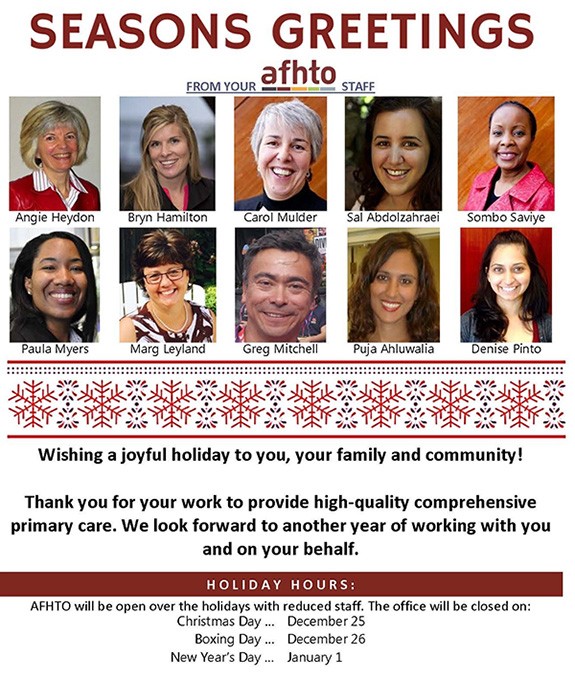 Wishing a joyful holiday to you, your family and community!
 -
St. Michael’s Academic FHT’s income security project profiled in the Toronto Star
Dec. 15 – St. Michael’s Academic Hospital FHT was profiled for their work addressing patients’ income security in the Toronto Star. Dr. Andrew Pinto and Karen Tomlinson (both of whom presented on this project at AFHTO’s 2014 conference) along with Dr. Gary Bloch were all recognized for their innovative focus on one of the key social determinants of health. Click here for further details.
-
HQO Releases Report On End-of-Life Care in Ontario
Dec. 15 – Health Quality Ontario’s (HQO) End-of-Life Health Care in Ontario report was released today. Click here to download the full report and recommendations. The report addresses where the health system must improve to ensure the best end-of-life care for all Ontarians, and highlights the need for an increased number of professionals trained in palliative care. The report also identifies the need for a more patient-engaged approach to end-of-life care, encouraging productive, informed conversations about end-of-life care between patients, their loved ones and their care providers. The End-of-Life Health Care in Ontario report is accompanied by recommendations from HQO’s Ontario Health Technology Advisory Committee (OHTAC) and builds on important work by Cancer Care Ontario, the Local Health Integration Networks, the Registered Nurses’ Association of Ontario, and the Ontario Medical Association, among others. For more information:
- Download the full report and recommendations.
- For background on the report, click here to see the news release.
- See the Globe and Mail column, Ontario’s piecemeal palliative care gets a roadmap to recovery, by Andre Picard.
-
AFHTO members participating in Ontario Low Back Pain pilot program
Nov. 26 – The government of Ontario announced the launch of a pilot program as part of the province’s Low Back Pain Strategy. Six AFHTO member organizations will be participating in this pilot:
- City Centre Health Care in Windsor in partnership with the Essex County Nurse Practitioner-Led Clinic in Essex
- The Mount Forest, East Wellington and Minto-Mapleton Family Health Teams in partnership with each other
- Couchiching Family Health Team in Orillia
- Belleville Nurse Practitioner-Led Clinic
The government announcement indicates that these organizations will be able to provide additional hours for a range of allied health providers such as chiropractors, physiotherapists, occupational therapists, kinesiologists and registered massage therapists to:
- Provide faster, more accurate assessment of low back pain problems
- Use a more holistic approach to treating patients suffering from low back pain
- Educate patients on low back pain self-management techniques
- Refer patients to an appropriate health care provider as needed
Click below for more information: