The Ontario government has opened Budget Talks 2016, an online portal for Ontarians to offer feedback to the government on 2016/17 budget planning, which provides another opportunity to raise awareness of the need for sufficient funding for recruitment and retention. Use this opportunity to continue the call to support recruitment and retention in primary care teams by voting or commenting on the portal. If you’d like resources to assist you, click here (log in to the Members Only section first.)
Tag: Highlights
-
Season’s Greetings | Holiday Hours Inside
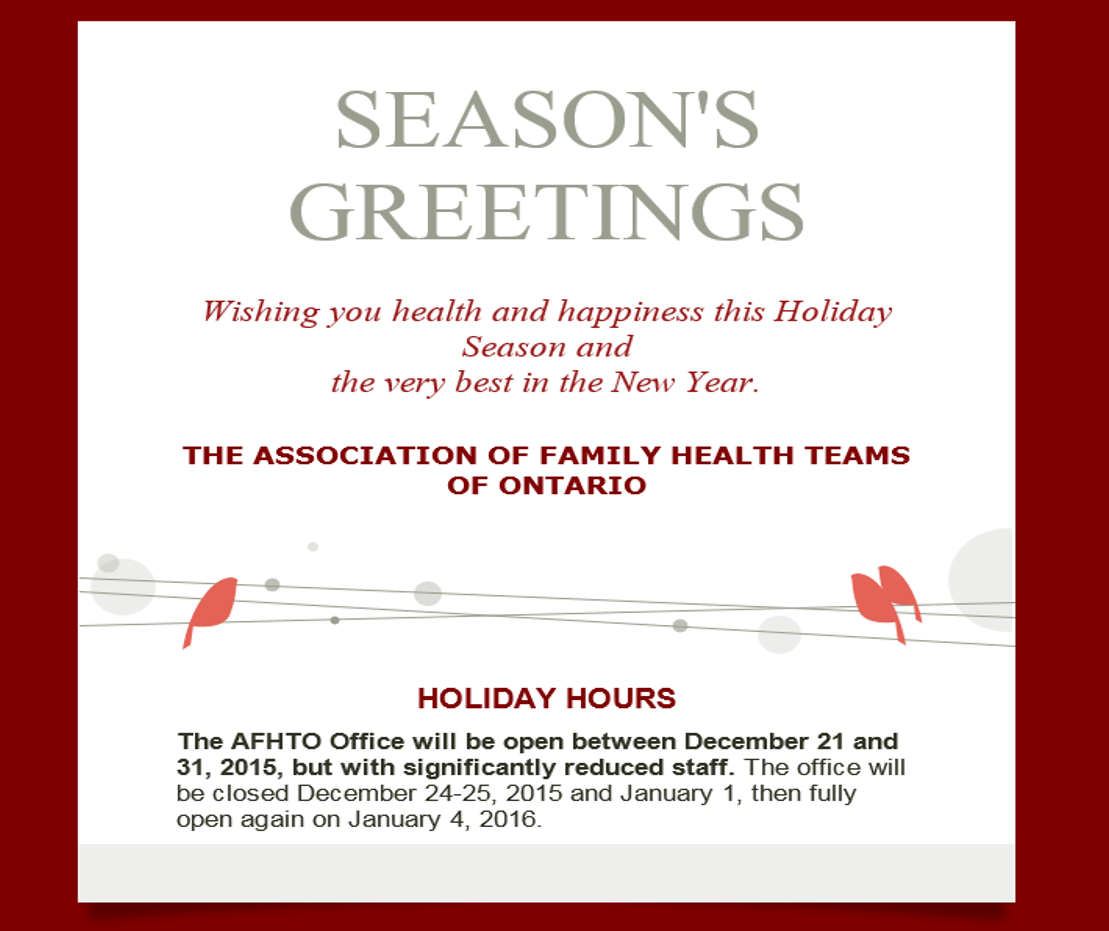
For help with questions regarding data submissions for D2D during this period, please contact Greg Mitchell, greg.mitchell@afhto.ca.
-
AFHTO’s initial response to Patients First Discussion Paper
On December 17, 2015, Ontario’s Ministry of Health and Long-Term Care released its discussion paper Patients First: A Proposal to Strengthen Patient-Centred Health Care in Ontario. On its release, AFHTO issued the statement below from Dr. Sean Blaine, AFHTO President and Clinical Lead, STAR Family Health Team in Stratford ON. This was published in various newspapers including The Kingston Whig-Standard, Woodstock Sentinel Review and Beacon Herald in January. AFHTO will be working with its members in each region of the province to develop a more detailed response to the questions posed in the discussion paper. Particular attention will be paid to those areas where great care must be taken to gain the most benefit for patients and communities, and avoid unintended negative consequences.
AFHTO’s statement on the release of
Patients First: A Proposal to Strengthen Patient-Centred Health Care in Ontario
Comparative studies tell us our health system is not performing as well as it could. How can we make it better? We need to have the right people in the right place at the right time to deliver the most appropriate care. This requires effective planning, strong relationships, meaningful measurement and engaged leadership from health professionals. Across the world, cost-effective and high-performing health systems are built on a strong foundation of comprehensive primary care. Over the past decade, Ontario has taken steps to strengthen primary care. Family health teams and nurse practitioner-led clinics emerged as innovative models for bringing together health professionals – doctors, nurses, pharmacists, dietitians, for example – to deliver such care. Unfortunately, only 25% of Ontarians receive their care from such team-based models. Ontario also aimed to improve planning, relationships and performance by setting up Local Health Integration Networks (LHINs). But two parts most critical to keeping people healthy – primary care and public health – were left off the LHINs’ mandate. More needs to be done to ensure people can get the appropriate care and support they need when they need it. With the Patients First proposal, the Ontario government launches the next phase of health system evolution. The proposal would bring all parts of the health system under a single jurisdiction for planning and performance reporting, and focus attention on how best to meet the needs of people living in each community. It pays particular attention to strengthening primary care. These are absolutely critical steps toward ensuring more comprehensive and equitable health care services for all Ontarians. Public health departments must be connected to LHINs. These organizations are focused on understanding whole communities to prevent sickness and the spread of communicable diseases. Public health professionals analyze communities to identify and monitor health risks, and target public education and other programs to promote health wellness and illness prevention within a population. Equally important is the ongoing care individuals and their families receive over their lifetimes. This is primary care – your “medical home” – delivered by family doctors, nurse practitioners and primary care teams who know you, care for you, and coordinate specialized health services when you need them. The proposal also merges community care access centres (CCACs) into the LHINs enabling greater local coordination of care, and more efficient use of health resources. If LHINs then deploy care coordination expertise into primary care settings, it will help patients and families identify a single point of contact to navigate and access programs and services. As a family doctor working in a family health team, I can see the potential in this proposal, as well as some cautions:
- Greater consistency: Right now we see significant variation in the access, experience and cost of health care in Ontario. Many of these variations are the result of unique local problems. By planning and monitoring at the local level, gaps can be identified and local solutions can be found – but only if local leadership is engaged and empowered to harness all sectors of the health system to address the unique needs of that community.
- Better coordination of care for patients: Moving care coordinators from the CCAC to the LHIN could help break down silos that have long separated my patients from getting care they need. But the LHIN will have to ensure these care coordinators work much more closely with family doctors and nurse practitioners; otherwise, this just moves one bureaucracy into another.
- Measurement for improvement: This is critical to assessing and improving quality of care. While many primary care teams have been measuring performance, this will be new for the majority of our primary care colleagues. As we’ve learned – there’s nothing to fear from being held accountable. But clinicians will need to receive support to help identify and capture the most meaningful and manageable data to improve care for patients.
- Spreading best practice: Performance measures must be consistent and comparable across the province, to help clinicians learn from one another. By identifying those who excel at care delivery, we can spread and scale up improvements to providers in a positive and not punitive way.
Every region of this province empowered to bring together all local health system players to focus on every community’s true health needs. Primary care strengthened and supported to wrap the most appropriate care around each person. If well implemented, Patients First is an important next step to improve our health system for better health for all Ontarians. Sean Blaine MD Family Physician, Stratford, Ontario Clinical Lead, STAR Family Health Team President, Association of Family Health Teams of Ontario (AFHTO) Note: This statement was published in various newspapers including The Kingston Whig-Standard, Woodstock Sentinel Review and Beacon Herald in January.
-
Ministry releases Patients First: A Proposal to Strengthen Patient-Centred Health Care in Ontario
On December 17, 2015, Ontario’s Ministry of Health and Long-Term Care released its discussion paper – Patients First: A Proposal to Strengthen Patient-Centred Health Care in Ontario. The paper addresses four components:
- More effective integration of services and greater equity
- Timely access to primary care and seamless links between primary care and other services
- More consistent and accessible home and community care
- Stronger links between population and public health and other health services.
The Ministry is requesting feedback on this discussion paper over the next two months or so. AFHTO will be working with its members in each region of the province to develop a more detailed response to the questions posed in the discussion paper. Particular attention will be paid to those areas where great care must be taken to gain the most benefit for patients and communities, and avoid unintended negative consequences.
-
HQO & ICES Report on Quality of Mental Health Services in Ontario
Health Quality Ontario (HQO) and the Institute for Clinical Evaluative Sciences (ICES) released Taking Stock: A report on the quality of mental health and addictions services in Ontario. The report finds variation both in access to and quality of mental health services across the province. Key Findings
- Visits to physicians’ offices for mental illness or addiction account for about 10% of all visits in Ontario.
- People in rural areas are less likely to have a follow-up visit with a physician within seven days of leaving the hospital after admission for mental illness or addiction than urban residents (23.1% compared to 30.4%).
- People with the lowest incomes are less likely to have a follow-up visit with a physician within seven days of leaving the hospital after admission for mental illness or addiction than those with the highest incomes (26.9% visit compared to 32.5%).
- Youth are more likely to visit an emergency medical department for mental illness or addiction without first having contact for these issues with a physician (42.7% of people 16-24 years old vs. 29.8% those aged 25 and above).
To learn more about the status of mental health services in Ontario, please click on the links below. Relevant links
- Taking Stock: A report on the quality of mental health and addictions services in Ontario– HQO report, Dec. 16, 2015
- “The quality of mental health services varies across the province, says new report” – HQO news release, Dec. 16, 2015
-
AFHTO releases two statements: care coordination/population-based primary care
December 7, 2015 – Today the Association of Family Health Teams of Ontario released two new statements as part of members’ ongoing work to improve access and integration of care in a sustainable health system. These two statements respond to and build on recent reports:
- AFHTO response to the Expert Advisory Committee’s recommendations on population-based primary health care for Ontario – primary care teams have the leadership and willingness to step up
- Transitioning care coordination resources to primary care – bringing greater system efficiency and patient-centredness by transferring this function from CCACs
Related statements include:
- Optimizing the value of and access to team-based primary care – an evidence-informed statement released last June
- The Starfield Principles – aimed at optimizing performance by measuring quality, capacity and total health system cost of care
Family Health Teams (FHTs) and Nurse Practitioner-Led Clinics (NPLCs) have the leadership, dedication and willingness to step up to play their part in building a primary care system that understands and meets the needs of our patients and communities. Throughout the transformation process, they want to be heard, valued, and supported to succeed – above all else, with sufficient funding to stabilize the workforce and ensure sufficient capacity to deliver quality care. Furthermore, AFHTO members call upon the Ministry to begin the process of transitioning care coordination resources from CCACs to primary care teams. The Ministry must work with primary care teams, LHINs, hospitals and other stakeholders to transfer all functions currently carried out by CCACs to the most appropriate bodies, to achieve greater efficiency and integration in care delivery. Population-based primary care and integrated care coordination are predicated on the availability of and access to primary care teams – currently limited to about one in four Ontarians. To spread access, AFHTO recommends the Ministry continue and strengthen its support for the field to:
- Develop common understanding and measurement of population needs and team capacity.
- Harness the will and expertise of local champions to spread team capacity in their communities, recognizing that different strategies and solutions will emerge to meet unique local realities.
- Expand access where:
- Capacity is sufficiently developed to manage additional demand without decreasing quality of care, and
- Physicians are ready to commit to minimum requirements for meaningful collaboration and communication with the team.
Advances by AFHTO members to measure results, through the Starfield Principles, are guiding the way to understand and assure progress toward government’s priorities of access, quality, and system sustainability. AFHTO policy positions can be accessed here. We look forward to working with the Ministry, LHINs, patients, communities, and health system colleagues to improve health and health care.
-
Primary care teams in a population-based health system
Population-based primary care is about effective management of the health of defined groups of people. It ensures all within this group are attached to a regular primary care provider and can access the appropriate care when they need it. The province’s Ministry of Health and Long-Term Care convened an Expert Advisory Committee to recommend how to ensure access to appropriate care for all Ontarians. Their report Patient Care Groups: A new model of population based primary health care for Ontario, was released on October 15, 2015. Two hundred leaders from AFHTO-member organizations convened shortly thereafter to look into the role for primary care teams in a population-based health system. This included examination of the functions that would need to be further developed and strengthened in such a system. The key messages from this session:
- Family Health Teams (FHTs) and Nurse Practitioner-Led Clinics (NPLCs) have the leadership, dedication and a fundamental commitment to the well-being of their patients. They are willing to:
- Step up to play their part in building a primary care system that understands and meets the needs of our patients and communities.
- Stand up and be counted – using measurement to demonstrate their value and improve on it.
- Build on the relationships they have been developing with other teams, other providers, and their LHINs.
- AND there is significant caution about how change is implemented. Most importantly members want:
- To be heard. Members are cautiously optimistic about closer LHIN alignment; they want thoughtful consideration and adequate consultation with FHTs/NPLCs.
- To be valued. Primary care is the foundation of a sustainable health system; policy, planning and resourcing need to strengthen this foundation.
- To be supported to succeed. Above all else, sufficient funding is needed to stabilize the workforce and ensure sufficient capacity to deliver quality care. IT infrastructure and EMR connectivity are also in need of further development.
Click to read AFHTO’s response to the Expert Advisory Committee’s recommendations.
- Family Health Teams (FHTs) and Nurse Practitioner-Led Clinics (NPLCs) have the leadership, dedication and a fundamental commitment to the well-being of their patients. They are willing to:
-
Undervalued: The revolving door of dietitians
Sudbury Northern Life article published on November 30, 2015. Article pasted in full below Jonathan Migneault – Sudbury Northern Life
Lower salaries to blame, says Dietitians of Canada
Sudbury’s City of Lakes Family Health Team has had three registered dietitians since 2008, due to a high turnover rate.“We joke that primary care just has a revolving door,” said Ashley Hurley, the family health team’s current registered dietitian. According to a new report from Dietitians of Canada, the situation in Sudbury is not uncommon for primary care dietitians in Ontario. A survey of dietitians across the province found that only 16 per cent of primary care dietitians, like Hurley, have been in their current positions for more than five years. The report found that 35 per cent of primary health care dietitians plan to leave their current position within the next two years, and an additional 49 per cent report they are undecided whether they will leave. The reason for the high turnover rate across Ontario, said Hurley, is that many registered dietitians in her field feel undervalued, because they do not earn as much as other professionals in primary care who have similar levels of education. Registered dietitians who work in family health teams make between $51,641 and $62,219 a year. Registered nurses, occupational therapists, social workers, respiratory therapists and chiropodists, who work in the same teams, make between $55,251 and $66,568 a year. The Ministry of Health and Long Term Care funds and determines the salary ranges, which were first set in 2005, and adjusted in 2009, when all family health team professionals received a 2.25 per cent salary increase. But Angie Heydon, CEO of the Association of Family Health Teams of Ontario, said even at the high end, those ranges are below the rates health care professionals make in other sectors, such as hospitals. “As a result, there is high staff turnover as professionals leave these primary care positions to work in more lucrative settings,” she said. Those settings include hospitals, public health and the Community Care Access Networks. Dietitians of Canada argue the lower salaries for registered dietitians in the field date back an error in the salary structure that has not been corrected since 2005. “We’re a relatively small group, and it’s always the squeaky wheel that gets the grease,” said Hurley. Leslie Whittington-Carter, Dietitians of Canada’s co-ordinator of Ontario government relations, said correcting the job classification would help address the high turnover rate in primary care. Registered dietitians need a at least a four-year bachelor degree, a one-year internship, and to complete a national exam to perform their duties. Thirty-four per cent of dietitians working in primary care have a master’s degree, and 54 per cent specialize in diabetes education. Hurley said registered dietitians play a vital role in managing chronic diseases, such as diabetes, heart disease and hypertension. They also play an important role in early child development, through proper nutrition, and healthy aging. “With seniors, for example, if we can keep them well nourished as they age, it can lead to fewer hospitalizations, shorter stays, fewer readmissions,” she said. Click here to access the article on the Sudbury Northern Life website. -
Video: Why D2D Matters – A family doctor’s perspective
Data to Decisions (D2D) is a membership-wide report on performance in primary care. In this 4 minute video, Dr. Michelle Greiver, North York FHT, describes the reasons she values Data to Decisions. Share this video with your colleagues, physicians and board members to start conversations about how your team could benefit from D2D.
Next steps for participating in D2D are outlined on the Data to Decisions: Advancing Primary Care webpage.
Additional AFHTO members have shared their experiences participating in D2D:
“I see D2D 2.0 as a unique reflection of interdisciplinary care. Reporting how we are doing as teams can help those of us in the trenches measure, improve and ultimately advocate for team-based care across Ontario” Cathy Faulds, lead physician, London FHT
“I see D2D 2.0 as a way to make measurement more reflective of how I work every day with my team and with my patients. I like the idea of having input into what those measures are. D2D 2.0 gives me a way to do that” Rob Annis, family physician, Board member North Perth FHT (Listowel) and AFHTO
“D2D 2.0 lets me see how our team stacks up against other teams like us so we can see where the gaps are locally as well as across the province. This gives me a sense of pride in what we have already been able to achieve – and helps me focus my energy on what is most important” Kavita Mehta, Executive Director of South East Toronto FHT, AFHTO board member
“D2D moves quality improvement to the next level. Optimizing the patient experience happens when we measure the things that are truly meaningful to both patients and their healthcare providers.” Dave Courtemanche, Executive Director, City of Lakes FHT (Sudbury), QIDSS host team
“AFHTO members are delivering great value – D2D 2.0 gives us a way to demonstrate that in a way that we and our partners can see and act on it!” Randy Belair, Executive Director Sunset Country FHT, QIDSS host team, AFHTO president
Click here for information about how to contribute to D2D today.
-
Report: Changes needed to improve retention, services and access to dietitians in Ontario’s primary health care
On November 25, Dietitians of Canada released the Dietitian Workforce in Ontario Primary Health Care Survey Report. Over four hundred dietitians working in FHTs, NPLCs, CHCs and FHOs were surveyed in spring 2015 to describe the current workforce and roles of the dietitian, and to identify factors supporting the integration of their roles into the healthcare system. Patient access to nutrition care, challenges working to full potential and high turnover all arose as key issues. Highlights from the report include:
- 87% of respondents are not satisfied with compensation.
- 35% intend to leave their current position within the next two years, and another 49% are undecided. Only 22% plan to stay in their current position beyond the next two years.
- Poor integration with other sectors (acute care, LTC, homecare, public health) is perceived.
- Due to lack of resources (time and FTEs), RDs are not practicing to their full scope which includes prevention and promotion activity.
These findings are in line with AFHTO’s 2014 report, Toward a Primary Care Recruitment and Retention Strategy for Ontario. As outlined by AFHTO and our colleagues, the inability to offer competitive compensation to interprofessional healthcare providers is a huge barrier to attracting and keeping skilled providers in primary care teams. Staff turnover, and the challenge of finding replacements, create gaps in care. Underfunding holds back the value of primary care teams. While they continue to deliver more value to patients and the health system, this sector remains woefully undervalued. AFHTO and our colleagues continue to advocate on behalf of primary care teams to strengthen recruitment and retention across the sector. For further information, please click on the links below:
- AFHTO policy position and report: Toward a Primary Care Recruitment & Retention Strategy for Ontario
- News release – Dietitians of Canada
- Report: The Dietitian Workforce in Ontario Primary Health Care Survey Report, November 25, 2015, Dietitians of Canada [PDF]
- “Dietitians in Primary Health Care Factsheet”, November 25, 2015, Dietitians of Canada
- “Undervalued: The revolving door of dietitians”, NorthernLife.ca, November 30, 2015