Tag: Highlights

  • Five Things You Need to Know About Family Health Team Pharmacists

    Published in the Ontario Pharmacist magazine, Vol. 81, Issue 2, 2017, click here for the full article. By: Heather Hadden, BScPhm, ACPR, RPH and Suzanne Singh, BScPhm, ACPR, PharmD, RPH While patients typically encounter pharmacists at their local commu­nity pharmacy, or at the hospital if admitted with an acute ill­ness, it is increasingly important that patients have access to pharmacists at all major intersection points within the healthcare system. This can help mitigate risks that may result from fragmented care and ensure safe and effective medication use. Strong partnerships between pharmacists through the continuum of health ser­vices across Ontario can be leveraged to elevate our collective professional profile and make a difference. Pharmacists embedded within Ontario’s family health teams (FHTs) play an important role in today’s healthcare system and contribute to the enhance­ment of intraprofessional collaboration.

    1. What are FHTs?

    FHTs are interprofessional prac­tice sites that were created to expand access to comprehensive primary healthcare services across Ontario. Since 2005, 184 FHTs have been operationalized, with over 3 million Ontarians currently enrolled in FHTs over 200 com­munities within 14 Local Health Integration Networks (LHINs).1 About 170 pharmacists are cur­rently employed as salaried FHT employees funded by the Ontario Ministry of Health and Long-Term Care.

    1. What do FHT pharmacists do?

    FHT pharmacists are typically engaged in four core activities:2

    • Patient care – FHT pharmacists work with patients at all ages and stages of life. Patients may self-refer, or be referred for scheduled appointments (e.g., for compre­hensive medication reviews), or ad-hoc consultation as nec­essary. FHT pharmacists often lead programs that focus on high-alert medications (e.g., opioids, antithrombotics), chronic disease management (e.g., diabetes, hypertension, angina, heart failure, asthma, COPD, smoking cessation), or vulnerable patient populations at risk of adverse events (e.g., post-hospitalization discharge, elderly with multimorbidity and polypharmacy).
    • Education – FHT pharmacists wear multiple hats as educators in their work with patients, family physicians and other clinicians or FHT staff, pharmacy students, and other health professional learners. FHT pharmacists advise on best practices on medication use and also increase awareness about the expanded scope of practice for pharmacists.
    • Quality improvement and practice/ system-level projects – FHT pharmacists help determine processes to complete medication reconciliation and may be involved in quality improvement initiatives that help evaluate the impact of patient care services. FHT pharma­cists may also participate in FHT, LHIN, or other initiatives to help integrate FHT care with the rest of the healthcare system.
    • System navigation – The key placement of FHT pharmacists embedded within the primary care team helps foster linkages in the healthcare system to promote effective and efficient resource utilization, with attention to optimizing medication use.

      FHT pharmacists report that working at a FHT practice is professionally rewarding.3,4

    1. How can FHT pharmacists partner with pharmacists working at com­munity and hospital practices to provide effective care?

    FHT pharmacists are uniquely posi­tioned within an interprofessional primary care practice to support seamless transitions as patients tra­verse various sectors of the healthcare system. Given that a solo FHT pharmacist may be employed at a FHT with a large patient roster, it is essential to help coordinate pharmacist services so that the most vulnerable patients at highest risk for adverse events benefit from care coordination. This may be facilitated by intraprofessional collab­orative practice models. For example, the FHT pharmacist may refer patients to the community pharmacist for expanded scope activities, or the FHT pharmacist and community pharma­cist may adopt a shared-care approach to managing complex patients. Simi­larly, the hospital and FHT pharmacist may collaborate around discharge planning.

    1. What is one key challenge that FHT pharmacists face today?

    Unfortunately, the pharmacist position is not automatically included in the base funding for a FHT and so not all FHTs have a minimum 1.0 full-time equivalent pharmacist integrated in the team. We need to work on this. No family doctor working in a group practice would set up their practice without a nurse or an administrative professional; the same view should now apply to pharmacists. Pharmacists need to unapologeti­cally promote pharmacist integration into primary care teams such as FHTs. Having a pharmacist working within a FHT is helpful for all pharmacists in a given community, and as a profession we have a responsibility to continue to advocate for funding from the Minis­try of Health and Long-Term Care for pharmacists. It is important that we are capitalizing on the skills and knowl­edge of pharmacists to deliver safe and high-quality care wherever and whenever necessary.

    1. How can you connect with a FHT pharmacist in your local community?

    Each LHIN in Ontario has a FHT phar­macist liaison. Contact the authors to learn who the FHT pharmacist liaison is in your LHIN and to discuss collabo­rative opportunities. For more information, email Heather Hadden at heather.hadden@trillium­healthpartners.ca or Suzanne Singh at suzanne.singh@sinaihealthsystem.ca The authors would like to acknowledge the contributions of Lisa Dolovich, Chair of the Ontario Primary Care Team Pharmacists Working Group. References:

    1. Rosser WW, Colwill JM, Kasperski J, Wilson L. Progress of Ontario’s Family Health Team model: a patient-centered medical home. Ann Fam Med 2011; 9(2):165-171.
    2. Dolovich L. Ontario pharmacists prac­ticing in family health teams and the patient-centered medical home. Annals of Pharmacotherapy 2012:46(4):S33-9.
    3. Farrell B, Pottie K, Haydt S, Kennie N, Sel­lors C, Dolovich L. Integrating into family practice: the experiences of pharmacists in Ontario, Canada. International Journal of Pharmacy Practice 2008;16:309-315.
    4. Pottie K, Haydt S, Farrell B, Kennie K, Sellors C, Martin C, Dolovich L. Pharmacist’s identity development within multidisciplinary primary health care teams in Ontario; qualitative results from the IMPACT project. Research in Social and Administrative Pharmacy 2009;5:319-26.
    Click here to access the article (PDF)

  • Public Health within an Integrated Health System – Primary Care & Public Health Collaboration

    Expert Panel Report: Public Health Within an Integrated Health System

    Patients First legislation includes a requirement for the public health sector and the province’s local health integration networks (LHINs) to work together to reduce health disparities and improve access to health care services. The Government of Ontario established the Expert Panel on Public Health (“Expert Panel”) in January 2017. Their report, “Public Health within an Integrated Health System” was released on July 20, 2017.

    Primary Care & Public Health Collaboration Toolkit

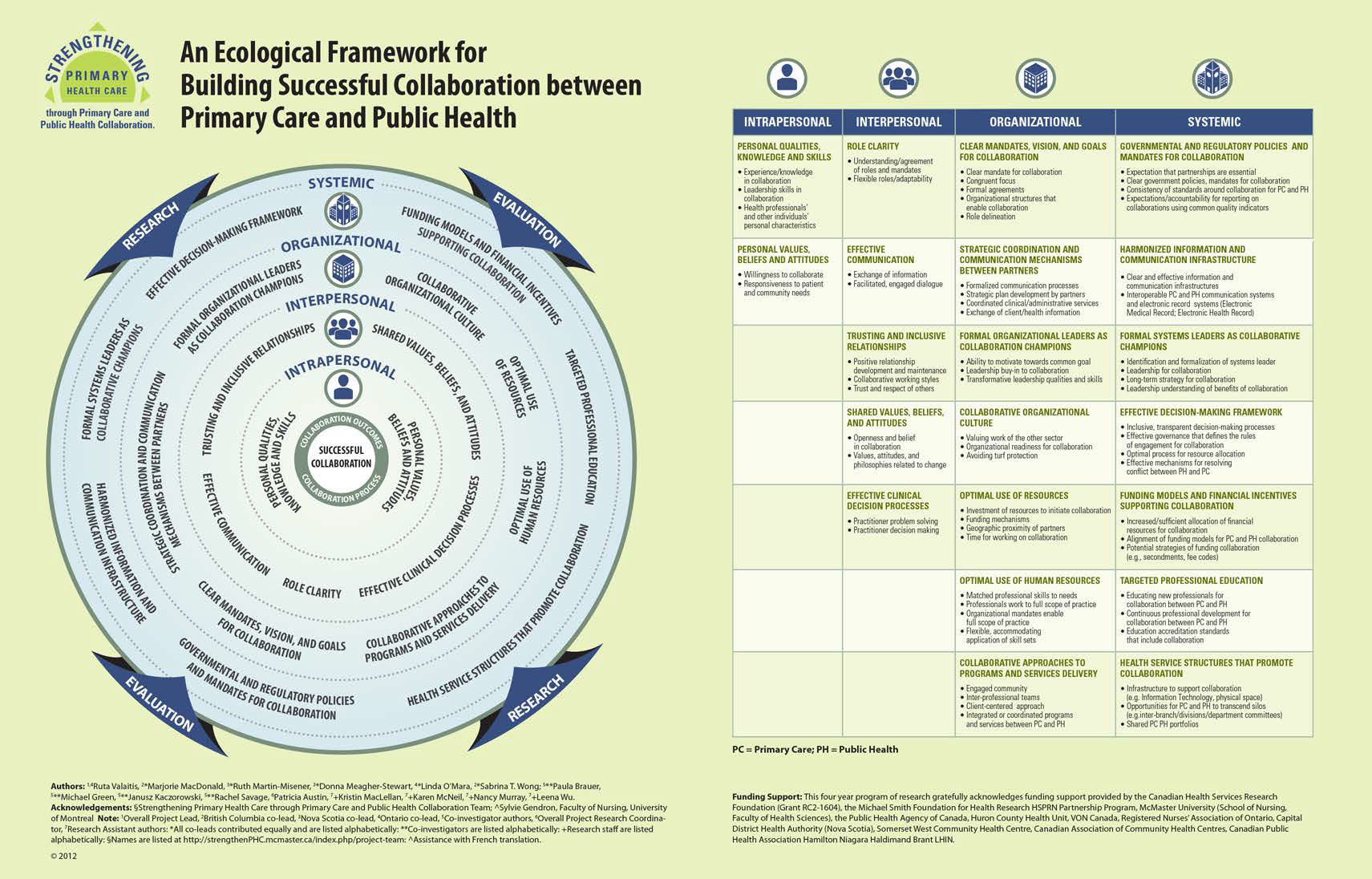
    To help primary care and public health organizations collaborate effectively, researchers from McMaster and other universities have compiled Primary Care & Public Health Collaboration Toolkit  for practitioners, managers, policy makers, and students working in the public health and primary care sectors. The toolkit is intended to develop knowledge, skills, and attitudes that support collaboration between public health and primary care. It is structured around an evidence-based Ecological Framework  for Building Successful Collaboration between Public Health and Primary Care.

    Click for full size (opens in a new tab).
     

  • Patients Struggling with Opioid Addictions Should Be Treated in Primary Care Settings

    CTV News Article published July 19, 2017. Article in full pasted below. Sheryl Ubelacker, The Canadian Press TORONTO – A small proportion of Ontario doctors who treat people battling opioid addictions prescribe the majority of the medications used to treat the disorder, a study has found, raising concerns about the quality of patient care and access to therapy. Most of these physicians work in addiction treatment centres located in urban areas and see dozens of patients each day, say researchers, whose study was published Wednesday in the journal Drug & Alcohol Dependence. The top 10 per cent of methadone providers – 57 physicians – wrote prescriptions for 56 per cent of the total patient days of methadone dispensed, the study found. For buprenorphine, known by the brand name Suboxone, the 64 highest-volume providers were responsible for prescribing 61 per cent of the total days of the drug given to patients. This extreme clustering of services among a small group of physicians creates a vulnerable opioid maintenance therapy system, said senior author Tara Gomes, a scientist at St. Michael’s Hospital and the Institute for Clinical Evaluative Sciences (ICES) in Toronto. “It can be challenging to find physicians interested in treating this population, and any changes to this group of physicians may affect a large number of patients who are currently seeking treatment for their opioid addiction.” Gomes said little was known about prescribing patterns among doctors who provide opioid addiction treatment in Ontario, despite the growing number of people who have become dependent on such drugs as hydromorphone, oxycodone and heroin. Patients receiving this therapy are often prescribed a longer-acting but less euphoria-inducing opioid such as methadone or buprenorphine, which are taken under close medical supervision. Using ICES health-care data, Gomes’ team identified 893 doctors who provided methadone or Suboxone more than once in 2014 to people eligible for the Ontario Drug Benefit Program, stratifying them into low-, moderate- and high-volume prescribers. Most were family practitioners. On average, each high-volume methadone prescriber treated 435 patients who were eligible for coverage of the drug under the program over the one-year study period. The patients had an average of 43 office visits that year, 43 urine drug screens and 190 days of methadone treatment. Gomes said that translated into an office visit and urine drug test – given to detect the presence of non-treatment opioids like oxycodone – every four to five days. These high-volume methadone providers billed the Ontario Health Insurance Plan (OHIP) for a daily average of 97 patients, approximately half of whom engaged directly with the prescribing physician. On average, doctors billed $648,352 to OHIP for all services provided to methadone patients in 2014; almost 46 per cent of the payment was to cover the cost of urine drug tests. Patterns among high-volume buprenorphine prescribers were different, with doctors treating 64 patients with the drug in 2014 and billing 22 urine drug screens per patient. Patient volume was lower among these prescribers, with physicians billing an average for 51 patients daily, of whom six were treated with buprenorphine. Total OHIP billings were lower than for high-volume methadone providers due to a smaller patient population. But similar to methadone, almost 41 per cent of the total cost was due to urine drug tests. Gomes said the large number of patients seen by high-volume methadone prescribers raises concerns about the quality of care patients receive, particularly when coupled with frequent clinic visits for urine drug screens. While regular urine testing is considered beneficial in the first few months of treatment, there is no evidence that ongoing weekly clinic visits and urine drug screens are linked to reduced opioid abuse. “There’s such a high degree of burden on the individuals when they are seeking treatment for their opioid abuse disorder to have regular visits with their physician … (and) also having to go to the pharmacy every day for their daily dose,” Gomes said. Spending several hours a week travelling to and from clinics, waiting to see the doctor and providing urine samples may interfere with a patient’s ability to meet his or her family and work responsibilities, she added. “So you can imagine there’s a huge amount of burden on them in the system and if they have to come in every four or five days for a urine drug screen, that can lead to a lot of people leaving addiction programs because it’s just too much for them to take on.” Study co-author Dr. Mel Kahan, medical director of the substance use service at Women’s College Hospital in Toronto, said ideally patients trying to get off opioids who have been stabilized on either methadone or Suboxone should be looked after in primary-care settings, such as a community health centre or by a family health team. “They don’t need to be looked after in a specialized clinic, and the problem is that if all the patients are looked after in specialized clinics, then the clinics get jammed up. … And the quality of care would be better in a primary-care setting,” Kahan said Tuesday. Patients struggling with an opioid addiction should be able to access Suboxone, in particular, because it is safer than methadone, carrying little risk of overdose, he said. The medication also is easier for primary-care physicians to provide, as it requires no complex training or special licensing to prescribe, as is the case with methadone. Click here to access the CTV News article. Relevant Links

  • Central Lambton FHT and Partners Expand Funding for Inwood Kids Program

    The Petrolia Topic article published July 18, 2017. Article in full pasted below. Melissa Shilz, Postmedia Network This summer marks the fifth year of the Inwood Kids Program, a rural summer camp run through the Central Lambton Family Health Team and other partners like the Oil Heritage District Community Centre. The program has something for all ages, and children as young as one and up to the age of 15 can attend. Sarah Milner, Executive Director of CLFHT, grew up in the small community and knew something was needed for the youth living there once school was out. With no public transport system in place and limited resources, they developed a plan to offer youth a program that would encourage healthy and active lifestyles, but she said the program runs deeper than just giving kids something fun to do. “Initially it was kind of a way to start outreach and to form that relationship here in a more informal way,” she said. “We want to help people get the services they need – counseling or health…it’s as much about the parents as it is the kids.” Since they began the program, they’ve seen the number of kids attending increase. A report by the Family Health Team also found that 22 per cent of the kids had no other summer activities that they participated in. “For some of these kids, this is their big thing for their summer,” she said. Milner said with Inwood being such a rural area, the program aims to prevent isolation, keep youth active and offer them activities for development. For those kids living in smaller towns, it gives them a chance to socialize without the worry of traveling to a bigger town. It also gives parents an opportunity to engage with healthcare practitioners and ask questions. While in previous years the program has ran for three weeks in the afternoons, this year it has been expanded to five weeks after the Alvinston Optimists gave a donation of $1000. Each year they’ve had different sponsors backing the program, including the County of Lambton, but the Optimists are planning on making it a permanent fixture in their budget. Optimist President Marjorie Cumming said she only wish they knew about the program sooner – they would have given funding from the start. “Now we’ve got them on the list for every year,” she said. Optimist Tom Park said when they heard about the program, they jumped on board to help right away. He said they support a number of programs in the area, and even offer scholarships to Brooke-Alvinston students heading off to college or university. “We do whatever we can to support our youth and youth programs,” he said. “It’s what we do…we give things to the community that the kids can use.” mschilz@postmedia.com Click here to access The Petrolia Topic article.

  • AFHTO Bright Lights Awards: just one week left to nominate your team or colleague!

    • Are you proud of what your team has accomplished?

    • Do you want your colleagues to be recognized for the amazing work they do?

    • Do you think it would be great to see your initiative spread across the province?

    If you’ve said yes to any of the above, submit a Bright Lights nomination! They’ve started to pour in so don’t be left out- send in your nominations and supporting documents before the deadline, Wednesday, July 26.

    Small, rural and Northern teams are encouraged to apply. You can watch this webinar or view the slides if you’ve never submitted a nomination before. To complete your nomination:

    While preparing your nomination, consider applying for a 2017 Minister’s Medal as well. Nominations for the Minister’s Medal close on August 8, 2017. Register for the Bright Lights awards ceremony and reception at this year’s AFHTO conference to see who the awards recipients are! Winners will be announced at the ceremony on October 25, 2017 (and not before!). If you have any questions or concerns, please contact us and we’ll be happy to assist.

  • META-PHI program helping more patients with opioid addiction thanks to to ARTIC

    More Ontarians are filling opioid prescriptions now than ever before according to a recent report by Health Quality Ontario. Nearly two out of every 1,000 Ontarians visited an emergency department within a week of being dispensed an opioid and the death rate from opioid overdoses has nearly quadrupled in Ontario in the last 25 years. A first-of-its-kind program, Mentoring, Education, and Clinical Tools for Addiction: Primary Care-Hospital Integration (META:PHI), reduces emergency room visits for opioid and alcohol addictions and improves patient care. META:PHI provides patient’s with easy and fast referral between emergency departments, addiction specialists and family physicians. Developed by Dr. Meldon Kahan and his team at Women’s College Hospital, in Toronto, the program’s rapid-access clinics have spread to seven additional communities across Ontario thanks to support from Adopting Research to Improve Care (ARTIC) – a program of the Council of Academic Hospitals of Ontario (CAHO) and Health Quality Ontario with the mandate of accelerating the spread of programs which have been shown to improve care. Patients have reported the clinic’s patient-centred approach made them feel less stigmatized – something patients living with addiction often feel. The program is expected to spread more in years to come. Relevant Links


  • Kirkland District FHT Awarded Grant for Care Planning

    Northern News article published on July 6, 2017. Article in full pasted below. Northern News Staff. Northern News KIRKLAND LAKE – The Kirkland District Family Health Team has received a grant of over $70 thousand from Boehringer Ingelheim Canada Ltd. that will assist with funding a position to assist patients with care planning. The Kirkland District Family Health Team is committed to helping patients and their families address complex care needs and assist with management of these conditions using a multi-disciplinary approach. In collaboration with community partners and the interdisciplinary team that is in place at the Family Health Team, the team will work to address the needs of patients that are frequenting the emergency room and have had inpatient stays at the hospital due to chronic disease and the co morbidities associated with such diseases. This approach will provide patients with a group appointment attended by all care providers involved in supporting the patient and will help to establish goals, monitor outcomes and improve the overall health of the patient. This unique approach will also assist patients that are most in need of having a Provider establish ongoing care. Tin Woolings says the initiative will make a difference to patients in a number of ways. “So far we have survery some of the patients, we have surveyed them over three months. The response from the patients have been very positive. They feel that people understand their situation, not just their medical situation but their personal situation, that people are interested. They feel quite satisfied with the outcome and they are usually more knowledgable. They are aware of their plan of care moving into the future so they maybe seeing a dietician, the respiratory therapist and those appointments are all made, if they are required, at that point.” According to Woollings patients are identified either at the emergency department, through being discharged at the hospital or identified within the provider practice, that you usually have complex care need and there is some more complex care planning is required for an individual rather than just a single appointment with the provider.” Health Team Executive Director Mandy Weeden says they also “wanted to partner and form a collaborative relationship with the hospital and other organizations that are providing care to patients for a number of reasons. One was to not duplicate a service but to insure everybody was on the same page and working towards common goals fore the patient because often what happens is you get a number of service providers involved and they will have different goals for the patient. We identify goals that are meanful to the patient and are going to improve their health outcomes and their quality of life and have their family support them.” She added “we look forward to working with our partners to improve the health and well being of patients. This is a very unique opportunity for our rural team and we are pleased to embark on this journey with patients and families.” Click here to access the Northern News article.

  • AFHTO office closed Friday, June 30 – Monday, July 3, 2017

    The AFHTO office will be closed from Friday, June 30 to Monday, July 3, 2017 for the Canada Day long weekend. We will reopen on Tuesday, July 4, 2017. If you have any questions, please email info@afhto.ca and we will be happy to reply upon our return. Have a great long weekend!

  • Effectiveness of Group Cognitive Behavioral Therapy for Insomnia (CBT-I) in a Primary Care Setting:Study

    Published in Behavioral Sleep Medicine, May 2017 Abstract Objective/Background: Primary care is where many patients with insomnia first ask for professional help. Cognitive-behavioral therapy for insomnia (CBT-I) is the recommended treatment for chronic insomnia. Although CBT-I’s efficacy is well established, its effectiveness in real-life primary care has seldom been investigated. We examined the effectiveness of CBT-I as routinely delivered in a Canadian primary care setting. Participants: The patients were 70 women and 11 men (mean age = 57.0 years, SD = 12.3); 83% had medical comorbidity. Methods: For the first 81 patients who took the six-session group program we compared initial and postprogram sleep diaries, sleep medication use, Insomnia Severity Index (ISI), the Hospital Anxiety and Depression Scale (HADS), and visits to the family physician. Results: Sleep onset latency, wake after sleep onset, total sleep time, sleep efficiency, and ISI scores improved significantly (p < .001). Mood ratings also improved (p < .001). Use of sleep medication decreased (p < .001). Effect sizes were medium to large. Eighty-eight percent of patients no longer had clinically significant insomnia (ISI score ≤ 14) by the last session; 61% showed at least “moderate” improvement (ISI score reduction > 7). Wait-list data from 42 patients showed minimal sleep and mood improvements with the passage of time. Number of visits to the family physician six months postprogram decreased, although not significantly (p = .108). Conclusions: The CBT-I program was associated with improvement on all sleep and mood measures. Effect sizes were similar to, or larger than, those found in randomized controlled trials, demonstrating the real-world effectiveness of CBT-I in an interdisciplinary primary care setting. To continue reading, go to the article in Behavioral Sleep Medicine. Authors

    • Dr. Judith R. Davidson, Kingston Family Health Team, Department of Psychology, Department of Oncology
    • Samantha Dawson, MSc. (PhD Candidate Clinical Psychology), Department of Psychology, Queen’s University
    • Adrijana Krsmanovic, MSc., Department of Psychology, Queen’s University

    Relevant Links

  • AFHTO “Bright Lights” Awards – nominations now open!

    Calling all AFHTO Members to shine a light on your team’s accomplishments. Nominate an outstanding team or individual for a “Bright Lights” Award by July 26, 2017.

    The “Bright Lights” Awards recognize leadership, outstanding work and significant progress being made to improve the value delivered by interprofessional primary care teams across Ontario. Select award recipients will receive an education grant valued at $3,000. “Bright Lights” Award recipients are:

    • Innovators – making small changes for maximum impact to improve patient experience and outcomes
    • Team Players – interprofessional teams, collaborators and relationship builders
    • Demonstrating Impactcan show how their work is benefitting the health care system

    NEW FOR 2017 –Awards will be presented at the AFHTO 2017 Conference Awards ceremony, which will be held at lunchtime on October 25, 2017. This means it’s now open to all attendees at AFHTO 2017 Conference. Not sure if your team’s achievements merit recognition? Never submitted a nomination before?  You can watch this webinar or view the slides for an overview of what reviewers are looking for and tips for writing a nomination.

    Award Categories

    Awards will be presented in seven categories this year:

    1. Effective leadership and governance for system transformation*
    2. Planning programs for equitable access to care
    3. Employing and empowering the patient and caregiver perspective
    4. Strengthening partnerships*
    5. Optimizing use of resource*s
    6. Using data to demonstrate value and improve quality of care*
    7. Clinical innovations for specific populations

    Education grants will be given to award recipients in the categories* above thanks to the generous donations of our sponsor Merck Canada. Funding is being finalised for other categories, so stay tuned for further developments.

    Shine a light on your team – Make a nomination today:

    • Review the nomination categories in advance (see nomination guide pg. 3 for descriptions).
    • Review the nomination evaluation criteria (see nomination guide pg.3 for details).
    • Complete the online nomination form and send all supporting materials before July 26, 2017.
    • Submit supporting documents to info@afhto.ca:
      • One to four high-quality photos of nominees in png. or jpg. format to be featured at the Awards Ceremony on October 25.
      • Signed statement to release photos for AFHTO use.
      • Any supporting evidence and materials as appropriate.
      • Deadline to submit photos is August 11, 2017.

    We look forward to seeing your nominations and recognizing ALL the excellent work being done!