Tag: eBulletin

  • Data to Decisions eBulletin #80: Small things matter.

    Baby step by baby step, walking the measurement talk – to better health

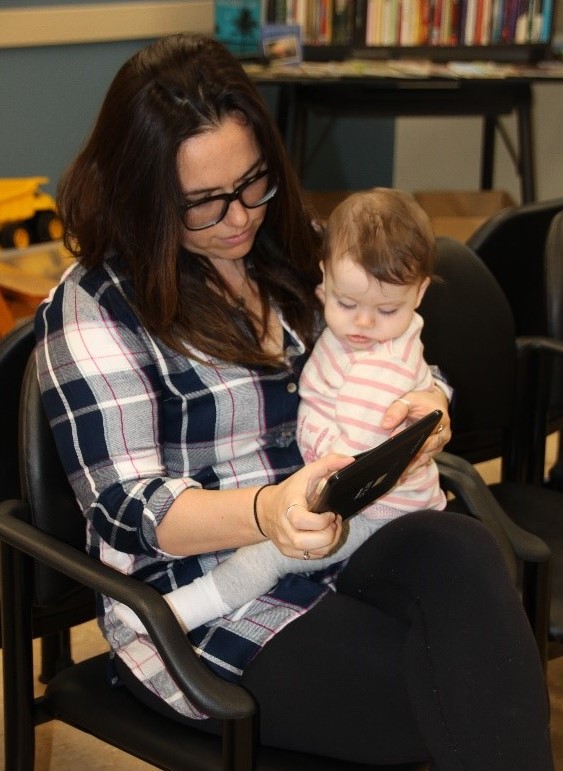
    Imagine the conversation. “Hey, my sweet baby, what do you think about putting your vaccination into the tablet here? That way the doctor will know that you have had your shots, and all your information will be in one spot. It also means that when we see the doctor, we don’t need to do this and instead can talk about other things that matter to us.” The baby agrees! So do the staff of the primary care team. “Thanks! Now that we know about the shots you got from public health, we know you’re safe and we can focus on your friends that aren’t there yet!” A smart conversation, don’t you agree?

    Unpacking the processes and progress behind the picture

    Change doesn’t come in one swoop, or from a single source. It comes, as we see here, through many small steps – intentional steps, taken in consistent and coordinated ways, over time, by many. If we unpack all the changes that made the real-life story above happen, what do we see? For starters, we see electronic medical record (EMR) maturity, reflected in the growing numbers of teams measuring, reporting, and improving EMR data quality – 57 teams for over 4 years and counting. Clinical leadership is key to making changes stick – and AFHTO teams are doing that, with more than three-quarters of teams identifying clinical champions for quality and a similar proportion participating in at least two iterations of D2D.

    A mother holds her baby on her lap in a waiting room. Mother and baby are looking at a tablet, which the mother is holding.
    Photo used with permission.

    We can imagine the moms at yoga class talking about vaccination and using the tablets to keep the team informed. The whole team, patients included, help move the needle in the right direction. Steady, albeit small, improvements matter: In D2D 6.0, we see a cohort of teams showing improvement across many indicators in each iteration of D2D. Small changes, the right changes, matter. Small things, like tablets, like baby vaccines, are beautiful. They are the stuff of change.

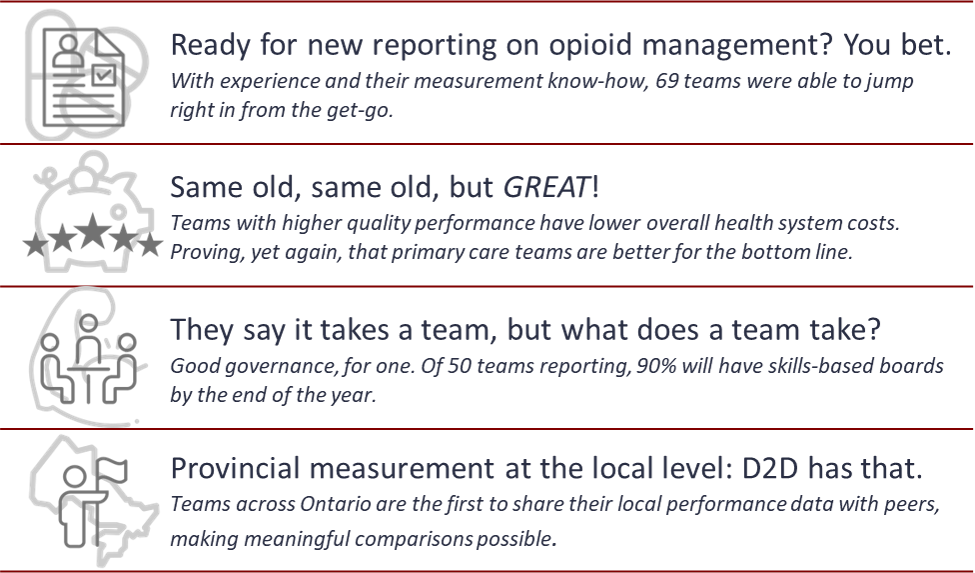
    At a Glance: Highlights from D2D 6.0

    Looking for more?

    Check out D2D 6.0 by the Numbers for a summary of aggregate results. To help you put these numbers into context, we’ve compiled a list of province-wide comparative rates and their sources for each of the indicators, along with their highest, lowest, and mean values in each iteration of D2D. Check out the LHIN-specific summary to see how primary care teams are doing in your region. Visit the interactive display platform to view your team’s data and compare with your peers. In Case You Missed It: Check out eBulletin #79 or peruse other eBulletin back issues here!    

  • Data to Decisions eBulletin #79: Focus on follow-up

    Don’t be left behind! There’s one week left to submit your data for D2D 6.0. Even if you’re one of the 90% of teams who have already participated at least once, it’s worth doing again. Missed the announcement? Check out this page to find out what’s new and interesting. The resources on our updated planning & preparation page will make it easy to get your data ready. And, of course, you can always contact us for help.

    • NEW to D2D: Contribute your D2D Data ANONYMOUSLY to research partners at Queen’s University, so they can help us demonstrate the value of teams even more robustly than we have done so far! Simply answer “yes” to the consent question, and we’ll do the rest.
    • Some of you have been asking about the Diabetes Care Calculator. We’ve refreshed it to make it a bit more comprehensive – it now provides rates for the individual components, for teams who want to include that data in their submission. Download it here.

    Research pays – literally! Congratulations to East End FHT in Timmins, who won a $50 Visa gift card for participating in the Measurement of Organizational Readiness for Patient Engagement (MORE) survey conducted by our research partners at St. Michael’s Hospital. AFHTO members were well-represented; of the 149 participating teams from across Ontario, at least 62 were FHTs and at least 10 were NPLCs. Results will be shared in an upcoming webinar; stay tuned for details! Freshen up your patient experience survey! Consider switching it up with the Patient Perceptions of Patient-Centredness (PPPC) questionnaire, a validated tool that looks at what patient-centredness means… to patients. Don’t let the long name scare you – it’s just 14 breezy questions about how well patients think their providers listen to them, understand them, and include them in decision-making. In addition to getting a break from the same-old, same-old, you’ll gain new insights and help us understand better how well D2D is measuring quality according to what matters to patients. Contact laura.belsito@afhto.ca for more information or a copy of the survey. After a summer of consultation, AFHTO is ready to take measurement to the next level. We’re going to keep measuring – it’s our strong suit! — but we will measure better to get better. We’ll use measurement to show value and achieve even better outcomes. Here’s how:

    • Members say that timely and appropriate follow-up after hospitalization is their #1 priority for demonstrating the value of team-based primary care. This is not new. AFHTO members have been into this since D2D 1.0. However, members still have trouble getting information about discharges, getting everyone to agree on exactly what “follow-up” is, and tracking it in their EMRs. That has made it hard to make progress across the membership. With this summer’s recent reminder of how important follow-up is to members, AFHTO staff are ramping up efforts to address these challenges.
    • It’s not just about follow-up. Other things matter too. Starting in September 2019, you’ll be able to share your work on local improvement activities via D2D 7.0. In the proposed “local improvement” section, you’ll report on indicators of improvement, not performance, as is the case for most of D2D right now. You will also have space to tell your peers what you’re working to improve, and how.
    • The nature of teamwork will also come into sharper focus in D2D 7.0. Members have long wanted D2D to include measures of the value of the entire team. Members will soon have a chance to compare themselves with their peers on measures of teamwork and change ideas to become even higher-performing teams.

    With follow-up in mind, the teams of the NE LHIN are coming together for a workshop on all things follow-up in Sudbury on November 27th. The workshop will include external partners such as OntarioMD, the Northeast Ontario [hospital] Network (NEON) and the Patient-Oriented Discharge Summaries (PODS) project. It is intended to help teams make concrete progress in three challenging aspects of follow-up: getting hospital information, tracking follow-up in EMRs and actually doing the follow-up in a patient-centered way. If you’re in the north, please come. If you’re not, stay tuned for lessons learned! More help for members: AFHTO welcomes two new staff members to the QIDS program: Jenny Cockram, who worked with us in 2015 on the Patients Canada survey and on videos about QIDS Specialists and the value of D2D, and Sine MacKinnon, a journalist with a long history in healthcare. Thanks in advance for your help, Jenny and Sine! In Case You Missed It: Check out eBulletin #78 or other back issues here!

    D2D 6.0 TimelineD2D 6.0 timeline


  • Data to Decisions eBulletin #78: Taking D2D to the Next Level

    The figures mentioned in the email originally sent on Aug. 2 were incorrect. This has now been updated to show the correct information. The member survey on “bringing D2D to the next level”, is now closed. Thank you to all the teams who weighed in! We heard from just over 70 people representing at least 40 teams (21% of AFHTO members). Analysis is still ongoing but it’s looking like follow-up after hospitalization is important to many teams. AFHTO’s board will consider this in September as it sets goals for the association.

    • See-through D2D: The vision of transparency with D2D data is taking shape. In the “next level” survey, nearly three quarters of teams are either already unmasked in D2D or planning to do so in D2D 6.0. If your team is thinking about this and wants to talk to someone who has already done it, let us know and we’ll put you in touch.

    Get ready for a little help from your (research) friends: The “next level” survey also said that nearly two thirds of teams are leaning towards sharing their ANONYMOUS D2D data with research partners at Queen’s. Teams will have a chance to formally agree to this when they submit their data to D2D 6.0. If you are among the 37% of teams that have not yet had a chance to discuss this, you may want to schedule meetings with board or executive team now to be ready to make that commitment when you submit your D2D data soon. And about D2D, it’s that time again! D2D data submission starts in just 3 short weeks (August 23rd). Visit the updated D2D Planning and Preparation page for resources to get your team’s data ready to submit. Contact improve@afhto.ca if your team needs help AFHTO 2018 Conference registration now open! Don’t forget to register for the AFHTO 2018 conference before the early bird deadline on October 1st.  Of particular relevance to the push to the “next level” are the IHP Profession-Based Networking Session and EMR Networking and Knowledge Exchange Session. In Case You Missed It: Check out eBulletin #77 or  other back issues here!

    D2D 6.0 Timeline

  • Data to Decisions eBulletin #77: Summer’s here and the time is right… for D2D!

    Building a culture of improvement… together. Over the past four years, AFHTO members have built a solid foundation of performance measurement in primary care. Individual teams have been translating this growing strength into providing ever-better care. AFHTO’s board of directors recognizes that it’s now time to do this across the AFHTO membership. This will help AFHTO and our members deliver on the promise of high-quality care for all patients. It will also advance our strategic priorities of demonstrating the value of team-based primary care and showing leadership across the primary care sector in Ontario. Here’s what you can do now:

    • Last week, your team’s leadership triad received an email from Rob Annis, the President and Chair of AFHTO’s Board of Directors, inviting each team to help us select a set of common indicators for members to focus their collective improvement efforts on. We’re asking EDs and administrative leads to respond to this survey on behalf of their teams. Please talk to yours! Although we’re grateful to the 15% who have already responded, we would love to hear from some more. That way we can be sure we understand the entire membership’s priorities.
    • We have an opportunity to get help, and possibly funding, to support this effort. Researchers at Queens University can help us dig deeper into the D2D data and turn it into a tool for collective improvement. Starting with D2D 6.0, we will be asking teams permission to share their anonymized data with the research team. Read here to learn more and talk to your board about saying “yes.”

    Get ready! D2D 6.0 is (almost) here. The data-submission platform will be open from August 23rd until September 13th.  But there’s no need to wait! All the tools you need to start gathering and compiling your data are available now. In response to member requests for more consistency, we’ve kept the changes to a minimum. Here are the small changes we’ve made:

    • To reflect changes HQO has made to the myPractice report, we’ve changed several indicators so that palliative-care patients are now excluded from the calculation.
    • With the help of your data, we’ve shortened the Team Profile section of D2D. Where we used to have 6 questions about 49 characteristics that enable quality improvement, we now have 1 question about 8 characteristics that your data showed us were particularly meaningful.
    • We’ve added a question on high-dose opioid dispensing. Data for that indicator comes from the myPractice

    To get started, check out our page of D2D planning & preparation resources; download your myPractice team-level report and your Cancer Care Ontario Screening Activity Report; and compile your patient-experience survey data. As always, feel free to contact us for help! Welcome, QIIMSs!  Three Quality Improvement and Information Management Support (QIIMS) people have come on board to support Ontario’s 25 Nurse Practitioner—Led Clinics. We’re thrilled to welcome them into the QIDS Specialists community of practice. Registration is now open for the AFHTO 2018 Conference. Join us on October 24th and 25th for Relationship Design with Starfield in Mind.

    In Case You Missed It: Check out eBulletin #76 or peruse other eBulletin back issues here!

    D2D 6.0 Timeline

  • Data to Decisions eBulletin #76: Comings and Goings

    Farewell to Greg: After nearly four years supporting QIDSS across the province in building a culture of measurement, Greg Mitchell is leaving AFHTO. Fortunately, Greg leaves the state of measurement in primary care in very good shape. Greg’s legacy includes the leadership and productivity of the small but mighty group of QIDSS known as the Algorithm Project Team and the high and sustained participation of members in Data to Decisions (D2D). Another aspect of his legacy that will continue to flavour the work of AFHTO for years to come is his passion for food and travel, preferably both at the same time! In fact, he’s off to pursue both passions at once in a trip of a lifetime to the Galápagos and Machu Picchu! Greg, we appreciate all you’ve done with us and for us and know you will continue to be a strong contributor to quality in Ontario’s precious healthcare system. Thanks for everything and best wishes! Picture of Greg Mitchell
    Speaking of D2D: It’s ba-ack! The submission platform for D2D 6.0 will open in mid-August and close in mid-September. The interactive display will go live in early October. Watch this space for updated Data Dictionary, Step-by-Step Guide, and Data Input Toolkit, coming by the end of June Also coming? A refreshed and updated myPractice report from HQO. By June 30, you will receive an Excel table with all the team-level myPractice report indicators, including D2D and opioid-prescribing indicators, refreshed to September 30, 2017. Shortly afterwards, you’ll receive your full myPractice report.

    Thanks to everyone who joined us on Monday for Strategies for Opioid De-Implementation in Primary Care. Nearly 100 people participated in Toronto, and another 50 joined remotely from Kingston – AFHTO’s first-ever experiment in hosting an event in two places at once! We were delighted to have a truly interprofessional crowd there. In addition to physicians, NPs and pharmacists, we also had OTs, PTs, & kinesiologists; mental health & social workers; QI specialists and program planners; and more! Many thanks to our organizing partners, the Centre for Addiction and Mental Health (CAMH) and KFL&A Public Health for helping us bring it all together. Missed out, or want to see something again? Slide decks, videos, and other resources will be available here soon! There’s no “I” in team, but there’s a “team” in QI! We want you to tell us how your team functions as a team, and how that helps you deliver better care. So far, seven of your peers have participated in our QI Enablers Study, and we’ve got another four lined up, but the door’s still wide open for more! Curious about what we’re hearing? Here are some examples:

    • “Teamwork means the patient’s always first [and] 50% of your job is not your job.”
    • “It’s high stakes. And it’s high heart.”
    • “If we don’t toot our own horn, who’s going to, right?”

    An emerging theme is the many tools teams use to foster collaboration and strong relationships: IHP roadshows, Better Rounds, Dazzlers, and what one team calls “hallway sex” are just a few of them! Want to share your stories? Contact Laura Belsito for information or to schedule a team interview. In Case You Missed It: Check out eBulletin #75 or peruse other eBulletin back issues here!


  • Data to Decisions eBulletin #75: Don’t Miss Out!

    Image source. Licensed by creative commons.
    Image source. Licensed by creative commons.
    May 28th is the deadline to register for Strategies for Opioid De-Implementation in Primary Care. This one-day, interprofessional workshop takes place on June 11th, 2018. It’s for any member of a primary care team who is interested in improving care for patients who use opioids, whether you work directly with them or not. Want to know more? Check out this page for a list of speakers and topics, schedule, frequently asked questions, and more. Or contact us. Act fast – there are only a few spots left! Last call! If you’re still putting the finishing touches on your abstract for the AFHTO 2018 conference, don’t forget that tomorrow (May 4th) is the deadline. Submit your abstracts here, or visit this page to review the six core themes. Make yourself heard! The QIDS program is putting a pause on our usual spring and summer activities to allow for a period of reflection and member consultation. If you have ideas about how we can all move together toward a culture of education, innovation, and trust, we want to hear them! We’ll be asking for your thoughts through an online survey in the coming months. You can read about the consultation activities here. Don’t want to wait for the survey? Talk to your representatives on AFHTO’s leadership and quality committees. Contact us if you need help getting connected. Getting more value from D2D: AFHTO members have made great progress in developing a solid measurement culture, and this has caught the attention of external observers. We now have an opportunity to collaborate with researchers at Queens University using the D2D data. This means we get help answering questions about high-performing teams and other topics of interest and potentially some revenue to support your quality improvement efforts. Starting with D2D 6.0, we’ll be asking your consent to share your team’s (anonymized) D2D data with the research team. Nothing will be shared without your consent. We’ll provide more details once the i’s are dotted and the t’s are crossed. In the meantime, you can learn more about this potential collaboration here. In Case You Missed It: Check out eBulletin #74 or peruse other eBulletin back issues here!

    Help spread the word about D2D – invite others to sign up for the eBulletin online. 

  • Data to Decisions eBulletin #74: Strategies for Opioids De-Implementation and MORE

    Do you have patients who use opioids to manage their pain? Register now for Strategies for Opioid De-Implementation in Primary Care on Monday, June 11th, 2018.


    This one-day, interprofessional workshop is designed with primary care teams in mind. It’s for any member of the team who is interested in improving care for these patients, whether you work directly with them or not. Experts in the areas of pain, addictions, and medication management will share tools and strategies you can start using now that are based in solid science. We’re presenting this workshop in partnership with Centre for Addiction and Mental Health (CAMH), alongside these other partnered resources.

    • For the first time, we’re presenting this workshop in two places at once! Our main location will be I downtown Toronto at the YMCA GTA Central. We’ll also have a satellite session in Kingston, at KFL&A Public Health.
    • Want to know more? Check out this page for a list of speakers and topics, schedule, frequently asked questions, and more. Or contact us.

    Attention Executive Directors: When it comes to patient engagement, is your team ready for MORE? Tell us where your team is on the journey towards patient partnership by completing this 15-minute questionnaire. Our research partners at St. Michael’s Hospital have developed The Measuring Organizational Readiness for Patient Engagement (MORE) survey to help us understand how ready primary-care teams are to work with patients as partners – and how we can help them. Bonus: There’s a chance to win a $50 gift Visa gift card. Got a story to tell? An idea to share? Consider telling it at the AFHTO 2018 conference, Relationship Design with Starfield in Mind – October 24th and 25th. Abstract submission opens tomorrow (April 6th) and closes Friday, May 4th. Learn more about this year’s conference, including the six core themes, here. In Case You Missed It: Check out eBulletin #73 or peruse other eBulletin back issues here!


  • Data to Decisions eBulletin #73: D2D 5.1 – Getting Started and Changing Gears

    AFHTO members have just released the 7th iteration of their performance measurement report, Data to Decisions 5.1. Voluntary participation in team-level measurement remains high. 90% of members have contributed so far, with over 60% in D2D 5.1. This makes D2D 5.1 a unique picture of primary care across the province, at the LHIN level, and (for the second time) at the sub-region level. Many AFHTO members are going even further than that. 43 teams chose to unmask themselves and are again openly sharing their data with their peers. Some are even putting their reports out on their public websites or sharing them in social media! AFHTO members have clearly gotten started with measurement.

    The North Stars

    The FHTs of the North East LHIN are a shining example of where measurement can take us. The Northeastern Ontario Family Health Teams Network (NEOFHT) continue to lead the way in D2D. 17 of their 27 teams participated in D2D 5.1 – the fourth time in a row they had the highest number of participating teams in the province (the runner up was South West LHIN at 13 teams). Several of our tiny-but-mighty regions are also shining bright; 100% of the teams in Waterloo-Wellington and 86% of the teams in Mississauga-Halton contributed data. With this level of sustained commitment, it’s not surprising that the 27 NEOFHT teams are taking some big next steps together. Having seen how D2D helped them compare at a team level, they wanted to do more. They wanted to be sure that any patient going to any team in the North East could expect to have the same kind of care, no matter where they went. In partnership with their QIDSS, the FHT Executive Directors started by agreeing on common indicators to track how they are doing on the 9 most common programs offered in their teams. The impressive thing is that they’re not just talking about it; they’re putting their money where their mouth is. They are combining QI forces and resources to bring all 27 teams up to the same level in technical tools and training. This ensures that everyone can capture all the data the same way, making it not only possible but easier and more efficient to compare progress and learn from each other. The North East LHIN teams are not alone. The Champlain LHIN teams have also invested in sharing common program-level data between their 21 teams. The teams of ESC openly share their quality improvement projects to learn from each about what is working to improve care among their 9 teams. These are clear signs that measurement is becoming a part of the AFHTO culture across the province.

    Changing gears: Learning from each other

    AFHTO members are proud of their progress in building measurement into their culture, and they are dissatisfied that this has not yet led to improvement in performance across all teams. AFHTO members are not content to come in 9th place[i], after the gold, silver and bronze medals have been handed out. We are not content to get the participation ribbon. Measurement is the starting gate for improvement, but it is not the finish line. AFHTO has made it a strategic priority to demonstrate the value of team-based primary care in Ontario. That is where D2D started.  Now AFHTO is ready to change gears and take on the improvement challenge in earnest. We are not starting with an empty tank. AFHTO members have strong relationships with their patients and with each other. As Barbara Starfield observed, relationships are the unique and powerful contribution of primary care to a sustainable healthcare system. AFHTO will be leveraging the networks built over the past five years in the form of at least ten leadership committees involving members from teams across the province. These long-standing relationships give AFHTO members a solid grounding to support their improvement efforts. Those relationships are already paying off.

    • OntarioMD has been partnering with AFHTO from the beginning when they produced D2D 1.0. Since then, AFHTO and OntarioMD have been working together to improve access to EMR data to help teams improve the health outcomes of their patients.
    • Through partnerships with Community Health Ontario and LEADS Canada, AFHTO is investing in leadership, which is just as important in improvement as measurement.
    • AFHTO has partnered with private and not-for-profit companies alike to offer LEAN and practice facilitation training to AFHTO members (from KM&T and the Centre for Effective Practice, respectively).
    • Research partnerships continue to buoy AFHTO’s efforts. Most recently, AFHTO has partnered with Dr. Judith Belle-Brown (president-elect of NAPCRG and long-standing primary care researcher from Western University) to help members learn from each other what it is about teams with high and ever improving performance that other teams can replicate to have similar outcomes.

    D2D was AFHTO’s way to get started by measuring. AFHTO is now changing gears to move beyond measurement to improved outcomes. We’re continuing on our journey to excellent team-based care for #EveryCommunityEveryPatient in Ontario. See an infographic summary of the D2D 5.1 results here. See your results here. See the aggregate data for each LHIN region here. [i] In 2017, Canada came in ninth out of eleven countries (Australia, Canada, France, Germany, Netherlands, New Zealand, Norway, Sweden, Switzerland, UK, and the US) in the Commonwealth Fund’s annual Health Care System Performance Rankings.

      D2D 5.1 Timeline

    In Case You Missed It: Check out eBulletin #72 or peruse other eBulletin back issues here!

    Help spread the word about D2D – invite others to sign up for the eBulletin online. 
  • Data to Decisions eBulletin #72: Learning through continuous measurement

    First, let’s talk mental health: Do you have any older patients with depression who are not making progress with their treatment? There is support available for them and for you! No matter where you are in Ontario, you can sign your patients up to get better access to scarce geriatric psychiatry support at no charge. In addition, you and your patients will be compensated for your expenses and efforts. This is because the support is being offered in the context of a research project coming out of CAMH. The project is equal parts service to you and your patients, and exploration of the effectiveness of any strategies you and your patients end up using. The project came out of awareness that there are many outstanding questions in the literature about what exactly is the best approach for treatment-resistant depression in seniors. For more information about the project, contact peter.selby@camh.ca. To organize a meeting, recruitment, or on-site education about OPTIMUM and/or treatment for depression in older patients, contact athina.perivolaris@camh.ca.
    You’re right – the D2D deadline is coming around again! Measurement works to improve outcomes when it is continuous. You can contribute as much data as you want to D2D again until February 8th. D2D data can help with program planning and quality improvement. It also helps demonstrate the value of teams. For your convenience, here are links to some reports you might find useful with D2D and other work:

    New to D2D? Here’s an introduction. Also, check out our Planning & Preparation page for a video walkthrough, and many other resources. And you’re always welcome to reach out to us with any questions.

    Is there something to learn about single-site teams design and quality of care? D2D 5.0 shows that single-site teams tend to have lower costs and better quality than multi-site teams. What is that about? Is there something that every team (no matter how many sites) can learn to do from this? Join your peers in the QI enablers study so we can find the answer(s) together. Please let carol.mulder@afhto.ca know if you have time for a phone interview to help us all get closer to the answer. Using D2D: Your peers at CFFM are using data from D2D to celebrate success and drive improvement. They created an infographic (right) to tell their story (Click on the image to enlarge it). How are YOU using data in your team? Share a picture with us for the next eBulletin! In Case You Missed It: Check out eBulletin #71 or peruse other eBulletin back issues here!
      D2D 5.1 Timeline
    Help spread the word about D2D – invite others to sign up for the eBulletin online. 
     

  • Data to Decisions eBulletin #71: Measure, Learn, Improve

    Are you ready for D2D? The D2D 5.1 submission platform opens next week Jan 11! It will remain open until February 8.  D2D helps demonstrate the value of teams. It also helps focus local improvement work in teams. And as always, how much data you submit is totally up to you. In addition to your own patient experience survey data, here are links to other data you might want:

    New to D2D? Here’s a helpful introduction. If you’re thinking of getting started, check out our Planning & Preparation page where you’ll find a video walkthrough, and many other resources. And you’re always welcome to reach out to us with any questions. Learning more about moving beyond measurement to improvement: Thanks to the team profile data from nearly 90 teams in D2D 5.0, some hints are coming out about what makes it easier to improve. The jury isn’t in yet, but it appears that single-site teams do better i.e. have lower costs and higher quality. Could it be about co-location? Something else? Please join your peers in the QI enablers study to get us all closer to answers that can help all teams, no matter how many sites they have. Please contact Carol Mulder to schedule your phone interview for the study. Meanwhile, keep turning your information into action! Check out the (new and improved) Information to Action web page.  You don’t need to do ALL of these things though — just pick the one(s) you think might be useful for you. Most of them are free and available to any interested team. Contact Laura Belsito, our clinical KTE specialist, for help in getting started. It’s also Schedule A season soon. Shop online for indicators that might be easier to track and/or mean more to you and your team. The Program Performance Measures Catalogue (PPMC) was built by AFHTO members for AFHTO members.  It gives you a way to draw on the wisdom of your peers and, at the very least, pick indicators that make it easier to compare between teams. Refer to the quick reference guide and video walk through on how to use it and check out even more program planning resources here!

      Couchiching FHT found a way to celebrate their progress in team-based care even before they hit it big time with not one but TWO AFHTO Bright Lights awards. They celebrated their progress with their own version of a bright light. How do you celebrate your progress with improvement? Please send your pics (and this release form indicating permission from everyone in the picture) to improve@afhto.ca.
    In Case You Missed It: Check out eBulletin #70 or peruse other eBulletin back issues here!
     D2D 5.1 Timeline
     
    Help spread the word about D2D – invite others to sign up for the eBulletin online.