Blog

  • QI in Action eBulletin #95: Made-In Ontario High Impact Actions in Primary Care

    In this issue

    • Primary Care Virtual Community
    • High Impact Action Items
    • Local Change Ideas
    • Upcoming Webinars

    Primary Care Virtual Community:

    The primary care virtual community is Ontario’s novel collaborative designed to unleash the power of primary care in health system change. As a community, they have co-defined a list of High Impact Actions that are felt to spark meaningful improvements in primary care, building on lessons learned from the UK’s own transformation efforts. The community has also shared insight on the actions they feel are within their control, in addition to where support is needed. As a community they continue to work collaboratively to refine the list of High Impact Action Items for Ontario. Here is the latest list of 10:

    High Impact Action Items:

    1. Navigate & Coordinate

    • Promote patient navigator role that can enable easier patient/caregiver access to resources including those that go beyond health care resources. This could include linking home care coordination to primary care.

    2. Integrate EMRs

    • Either single or intra-operable EMR/EHR systems that can both push and pull required information. Integration of EMRs can enhance quality of care provided and practice efficiency by promoting easier and better communication.

    3. Access to Mental Health and Addictions

    • Provide mental health and addictions supports in the community, embedding these supports in primary care.

    4. Organizing Primary Care

    • Come together at the local level to organize primary care and move towards more team-based care for more Ontarians, opening up the FHO model for primary care delivery.

    5. Practice Facilitation & Change Management

    • Provide dedicated resources to enable peer -to -peer coaching and uptake by providers. A QI-enabled, evidence-driven health care system, in turn, enables best practices.

    6. Build the Extended Team

    • Identify and provide support to the extended team that wraps around the patient/ family/caregivers and provide supports to enable the team to be high performing.

    7. Streamline & Reduce Administrative Burden

    • Reduce bureaucracy and administrative burden.

    8. Recognize and Support Primary Care Continuity

    • Promote the patient/caregiver and provider relationship, ensuring that the care is provided according to the principles of comprehensiveness and continuity.

    9. Build Connections to Address the Social Determinants of Health

    • Recognize the social determinants of health as factors that influence health and well being outside of access to healthcare services, adopting practices like social prescribing.

    10. Patients as Partners

    • Empower patients to take greater control and ownership over their health.

    Local Change Ideas:

    The Primary Care Virtual Community has given communities the opportunity to identify what’s meaningful to them. What are their pain points, headaches or areas that can be improved? And more importantly what changes can be made at the local level to support providers, their clinical practices and the delivery of patient care. Building on the change ideas identified in the primary care high impact actions for Ontario, this document highlights local challenges and solutions to improve clinical practices and care delivery in your own communities. This document is only the beginning of creating a repository of change ideas. Please complete this survey to provide local change ideas within your community!

    The February 13th and the November 21st Virtual Community focused on Organizing Primary Care – the community learned from a number of primary care leaders about how they are mobilizing the primary care community to self-organize and identify what their needs are. We’re pleased to share their lessons and advice with the release of Primary Care Physicians: Working Together for Change primer which highlights strategies that can be employed for organizing primary care at the local level.

    Resources:

    Upcoming Webinars:

    • Improving cancer screening rates in your practice and reducing related disparities – Feb 20, 2020 – Sign up here

    In Case You Missed It: Check out eBulletin #94 or other back issues here!
    Questions? Comments? Contact us at improve@afhto.ca.

  • Winter Highlights 2020: AFHTO Leadership Council

    The Leadership Council Members met on February 5, 2020. Below are the highlights from the winter 2020 Leadership Council Meeting.

    Supporting AFHTO through reallocation funding

    • Members are asked to consider supporting AFHTO’s governance and leadership program through in-year reallocation funding if year-end surpluses are available.
    • The ministry recently clarified the additional information needed for reallocation requests to support OHT implementation and/or AFHTO projects. The requirements are posted here.

    Organizing primary care and supporting OHT development

    • AFHTO continues to develop supports and tools for OHT development.
    • In partnership with OCFP and SGFP, AFHTO has been facilitating regional physician information sessions in communities. Sessions focus on providing clinicians with information on OHTs and supporting the development of regional physician networks.
    • Physician engagement sessions are encouraged to help ensure OHTs are anchored in primary care and to identify local opportunities for change. If interested, please contact Bryn Hamilton.
    • AFHTO will be releasing two documents – “Primary Care Physicians: Working Together for Change” and “Primary Care: Local Change Ideas” shortly!
    • Tools and webcasts continue to be developed with our partners on collaborative governance strategies and OHT governance structures.
    • The Primary Care Virtual Community continues to bring together leaders in health system integration, with a focus on 10 high-impact action items to strengthen primary care. Register now!

    Advocating for team-based primary care in health system transformation

    • The 2020 pre-budget submission was submitted in January to the Ministry of Finance. AFHTO will be meeting with Minister Elliott, MPP France Gelinas (NDP health critic), and Minister Tibollo’s staff in February to discuss the recommendations. A meeting already occurred earlier this year with staff in the premier’s office to provide them with an introduction to AFHTO and team-based primary care.
    • AFHTO is working with associations who represent health care providers in team-based care to develop an advocacy platform on what we agree is needed from a primary care perspective for OHTs to be successful. We are still looking for patient quotes or short success stories about the impact of team-based care. Please contact Beth MacKinnon if you have one to share.

    Quality improvement work continues

    • The Quality Improvement in Primary Care Council has partnered with the eHealth Centre for Excellence to work on an environmental scan on post-hospital discharge.
    • AFHTO is collaborating with partners through the Primary Care and Mental Health and Addiction Table on two projects: an OHT guidebook with innovative mental health and addiction models highlighted, as well as digital health and streamlining referral forms.
    • Knowledge translation webinars continue, focusing on virtual care and online booking, as well as QI success in mental health and addiction. Please contact Sandeep Gill if there are any KTE webinars you would recommend.

    Staying on top of coronavirus preparedness

    Ministry update on OHT development

    • An update on OHT development was provided by Allison Costello (Director, Integrated Care Branch) and Phil Graham (Executive Lead, Ontario Health Teams) from the Ministry of Health.
    • There is a focus on setting a policy framework on large items like funding, accountability, and performance indicators, so it can be clear to teams on what to expect. However, this framework is still in development and not ready to be shared.
    • OHT candidates that have been approved are being brought together on February 19 and 20 to discuss policy barriers and to work with support partners through RISE. OHTs are asking for some rules and parameters, and ones that teams would consider helpful will be discussed during this two-day session. This will include those for shared decision-making and home care.
    • The budget setting process for the next fiscal is underway, and officials are looking at what can be done regarding supports. Clinical engagement is a priority and resources to support this are being considered. However, no commitments can be made at this time.

    Calling all members!

    • Would two EDs, two board chairs, and two physicians or nurse practitioners consider serving on a committee for external requests? Requests are frequent from stakeholders, and AFHTO is looking for feedback on suggested webinar topics, training tools, etc. regarding what would be of most value.
    • Input would be requested once a month. It’s not expected to take much time.
    • We’re still looking for one board chair and one physician or nurse practitioner for this committee. If you’re interested, please contact Bryn Hamilton.
  • Primary Care Physicians: Working Together for Change

    Connecting physicians regionally is a powerful way to spark change, to improve the delivery of comprehensive patient services, and to influence health service decision making. 

    There is power in speaking with a collective voice, and there is an opportunity to strengthen the primary care sector by working better together within the shifting landscape of health care delivery in Ontario.

    Below are tools and resources to support clinical leaders who may wish to consider how they may best work together to strengthen the primary care sector and to help deliver a coordinated continuum of care in their region and for their patients.


    Primary Care Physicians: Working Together for Change


    Primary Care: Local Change Ideas


    Sample tools & resources


    More is in development! Check back regularly for new tools and resources.

    Coming soon:

    • Network agreements
    • Strategic priorities
    • Additional Terms of Reference
    • More surveys

    Please send any tools or resources that you would like to add to the repository to Bryn Hamilton at bryn.hamilton@afhto.ca


  • Government to phase out red and white OHIP cards

    January 9, 2020

    News from the Ontario Ministry of Health


    Government of Ontario Protecting the Health Care System from Fraud

    Switching to Secure Photo Health Card is Easy and Free


    Ontario is protecting the health care system against fraud by ensuring the final transition to a more secure photo health card. As of July 1, 2020, red and white health cards will no longer be accepted for Ontario Health Insurance Plan (OHIP) services.
    “The advanced security features of the photo health card help protect our public health system and is another measure to improve value for taxpayers’ dollars,” said Christine Elliott, Deputy Premier and Minister of Health. “While there is no cost to convert or renew an Ontario photo health card, there could be significant costs by allowing red and white health cards, which could be used fraudulently, to remain in circulation. Each month, individuals using these outdated cards access up to $108 million in health services.”

    Starting this month, individuals with red and white health cards will begin to receive letters letting them know that they will need to get a photo health card at a ServiceOntario centre before the July 1, 2020 deadline.

    Photo health cards can easily be obtained for free at ServiceOntario by:

    • Bringing the right original documents (proof of Canadian citizenship or OHIP-eligible
    • immigration status; proof of residency in Ontario and proof of identity);
    • Completing a Health Card Re-Registration form ahead of time or by getting one at
    • ServiceOntario; and
    • Visiting a ServiceOntario centre.

    For the complete memo on OHIP red and white cards (EN), please see here [PDF].

    Resources:

  • Reallocation Requests

    AFHTO has confirmed the ministry’s willingness to be flexible in considering reallocation requests to support OHT implementation and/or AFHTO projects.

    However, FHTs are still obliged to follow the conditions imposed by Article 7.3 and Article 12 (see below) within the Family Health Team Agreement. 

    This means:

    • The ministry cannot approve reallocation requests for something that was not pre-approved and already purchased.
    • The ministry cannot approve reallocation requests over $10K for items that are not competitively acquired (single sourced). Three (3) quotes are required.
    • Any spending by a FHT on OHT-related activities must ensure that the FHT remains accountable to the ministry and that responsibility cannot be passed to a third party. 
    •  FHTs are eligible to reallocate funds equaling the lesser of up to 10% of the total annual budget or $10,000 (the “tolerance threshold”) between semi-global budget categories without written ministry approval, except: 
      • From any category to the Physician Consulting category 
      •  From any category to Physician Compensation, including Specialist Sessionals 

    When making your request, please keep in mind it can not be described as a ‘donation’ or ‘sponsorship.’ Teams must clearly identify the goods, equipment or service being purchased (i.e., teams need to outline what they are buying).

    Examples of acceptable requests:

    Reallocation to support OHT implementation, approved samples:

    • OHT project management support from February 1 to March 31, 2020.
    • Cost sharing of project management costs. Continued support of the stakeholder partners during leadership meetings including, but not necessarily limited to, further development of governance structure, researching best practices for priority populations, and leading the execution planning of year one population.
    • Consulting costs to review the current state and to make recommendations for service delivery models for home and community care for defined population.  
    • Cost sharing of Ontario Health Team planning/organizing/staffing/consulting.
    • Consulting fees – FHT strategic focus areas and planning.  
    • ECost sharing of coordination, data analysis, and facilitation for Primary Care Engagement Session.
    • Cost sharing of connecting clinical data elements across sectors for reporting and analytics. The intent is to put in place a proof of concept for pulling in Primary Care Data from 1-2 EMRs into a broader Clinical Data Repository. The goal is to create an environment where primary care and acute care can correlate data for reporting and analytics purposes.

    Reallocation to support AFHTO projects – please choose one of the following when making your requests:

    • To help support ongoing implementation of Ontario Health Teams and the development of clinical pathways.
    • To help improve primary care connectivity, achieve better alignment across the sector, and strengthen leadership capacity.
    • To help develop a suite of tools and resources to support effective board oversight and promote collaborative governance strategies across sectors.  
    • To help develop strategies to spread innovations across organizations and regions and support platforms which enable cross-provincial dialogue, knowledge transfer and exchange. 


    Article 7.3
    All Funding shall be applied directly to the payment of Schedule “B” expenditures, and for no other purpose.  The Recipient shall expend the Funding in each Funding Year only in accordance with the Annual Budget for each Funding Year.  No changes to the approved items in Schedule “B” are permitted without the prior written consent of the Ministry, unless otherwise specified in this Agreement.
    This article imposes an obligation on the recipient to request prior written consent from the ministry to deviate from their budget and the purpose of the budget. 

    Article 12.0 
    The Recipient shall acquire goods, equipment and services purchased with the Funding as follows: 
    1. where the cost of the goods, equipment or service is between $10,000 and $100,000, inclusive, the Recipient has the option of acquiring such goods, equipment or service through either: (i) an invitational competitive process in which the Recipient obtains quotes from 3 or more vendors, or (ii) an open competitive process, and
    2. where the cost of the goods, equipment or service is over $100,000, the Recipient  must acquire the goods, equipment or service through an open competitive process.
     

  • Our new location

    Our new location

    AFHTO new location lunchroom view


    We’re happy to announce we have officially moved into office space subleased from the Ontario College of Family Physicians.

    We’re now sharing space with OCFP and Centre for Effective Practice staff in the heart of downtown Toronto. Phone extensions will be updated today but our main line is working. All email addresses remain the same.

    “Co-locating provides AFHTO an opportunity to strengthen our partnerships and align opportunities for joint advocacy, policy and resource development. By moving downtown, we are also closer to our Ministry, Ontario Health and political contacts which helps with strengthening our relationships”, explains Kavita Mehta, CEO, AFHTO.

  • Bits & Pieces: prescriptions are for more than just drugs, new location & more

    Bits & Pieces: prescriptions are for more than just drugs, new location & more

    Your Weekly News & Updates


    In This Issue  
    • Prescriptions are for more than just drugs
    • Our new location
    • Novel coronavirus updates including Q & A on personal protective equipment supply
    • Reminder- Improving cancer screening rates and reducing related disparities, Feb. 20
    • Lung cancer screening for people at high risk
    • The Promise of Virtual Care slides and video
    • Regional Geriatric Program of Toronto online education modules
    • Lung health needs assessment
    • Upcoming events including the Primary Care Virtual Community and more

    Prescriptions are for more than just drugs

    Ontario Health Teams should use ‘social prescribing’ to improve our health and wellbeing.

    Healthy Debate opinion piece by Kate Mulligan, Director of Policy and Communications at the Alliance for Healthier Communities and Kavita Mehta, CEO, AFHTO

    Most of the conversation about ending hallway health care in Ontario has focused on the back door of the hospital – moving people out of hospital and back into communities. But what if we could focus on the front door and prevent hospitalization in the first place? And what if we could do this by strengthening partnerships between health and social services, which are known to impact determinants of health?

    Read the full article here.

    AFHTO will be working with the Alliance on spreading social prescribing in team-based primary care and is looking forward to working collaboratively together on this important work.


    AFHTO new location lunchroom view

    Our new location

    We’re happy to announce we have officially moved into office space subleased from the Ontario College of Family Physicians.

    We’re now sharing space with OCFP and Centre for Effective Practice staff in the heart of downtown Toronto. Phone extensions will be updated today but our main line is working. All email addresses remain the same.

    “Co-locating provides AFHTO an opportunity to strengthen our partnerships and align opportunities for joint advocacy, policy and resource development. By moving downtown, we are also closer to our Ministry, Ontario Health and political contacts which helps with strengthening our relationships”, explains Kavita Mehta, CEO, AFHTO.


    Novel coronavirus updates including Q & A on personal protective equipment supply

    We continue to update the relevant page on the Novel Coronavirus, including with the latest situation reports and Q & A on personal protective equipment supply. “Health care providers facing immediate challenges with their personal protective equipment supply levels can email the ministry at EOCLogistics.MOH@ontario.ca.”

    If you have any questions, you can also email EOCOperations.moh@ontario.ca.


    Reminder- Improving cancer screening rates and reducing related disparities, Feb. 20
    Primary care plays a central role in cancer screening, but screening efforts don’t reach everyone. St. Michael’s Hospital Academic FHT worked with patients living with low income to understand barriers to screening and co-design solutions. On Feb. 20 join Drs. Aisha Lofters and Tara Kiran as they share practical, evidence-based ways to improve cancer screening rates and reduce income-related disparities.

    Register here.


    UHN Lung cancer screening

    Lung cancer screening for people at high risk

    Ontario’s Lung Cancer Screening for People at High Risk programming is now available at the University Health Network. Teams can support patients in pursuing low-dose CT screening either through providing a referral or inviting them to self-present by calling 416-340-4154.  

    The following is the entry criteria:

    • Current or former smoker age 55 to 74
    • Have smoked cigarettes daily for at least 20 years in their lifetime (not necessarily 20 years in a row).

    For eligible self-presenters, screening staff will contact the primary care provider for a mandatory physician referral to authorize LDCT for screening. For more information, please visit their site.


    HQO virtual care

    The Promise of Virtual Care slides and video

    Ontario Health (Quality) has posted Quality Rounds Ontario on the topic of The Promise of Virtual Care recorded session and the slide deck on their website. Questions and answers will be posted on Quorum in the coming weeks. One of the most common questions was where viewers could find a copy of the OTN Primary Care eVisit evaluation; click here to access that evaluation.


    Regional Geriatric Program of Toronto online education modules
    Co-developed with geriatric clinical experts from Ontario, 2 new educational modules in the sfCare Learning Series have been launched for clinicians, which build on the knowledge from the introductory modules on the topics of delirium and urinary incontinence:


    Lung health needs assessment
    The Centre for Effective Practice (CEP) and the Ontario Lung Association (OLA) are seeking feedback from family physicians, primary care nurse practitioners and other healthcare providers who treat patients with respiratory conditions about their clinical education needs relating to lung health. Respond to the survey here.


    Primary Care Virtual Community, Feb 13, 2020
    The Primary Care Virtual Community brings together leaders in primary care interested in enabling meaningful system change. The virtual community is a collaboration developed by the OCFP and AFHTO and convened by The Change Foundation. This session’s focus is organizing primary care – learn from 9 communities across Ontario who are strengthening primary care by bringing the sector together.

    Register today!


    Improving cancer screening rates and reducing related disparities, Feb. 20
    On Feb. 20 join Drs. Aisha Lofters and Tara Kiran as they share practical, evidence-based ways to improve cancer screening rates and reduce income-related disparities. Register here.


    Advance Care Planning Lead Trainer Program, Feb. 11 & 13, 2020 (and more)
    Are you a health service provider who has the support to build and sustain a team of volunteer facilitators? Hospice Palliative Care Ontario invites you to participate in this interactive training program that will guide you in training your volunteers to facilitate community Advance Care Planning presentations to the general public. Find out more here.


    Is your work making you wheeze? Feb. 25, 2020
    Attend this webinar suitable for healthcare providers and other employees, hosted by the Lung Association. View all Lung Associations’ upcoming events here.


    Black Physician Association Ontario Annual Health Symposium, Feb. 29, 2020
    Keynote speaker will be the inspiring Dr. Lisa Robinson, Associate Dean of Inclusion and Diversity at the University of Toronto. Learn more here.


    Primary Care Electronic Medical Record Tools for Advance Care Planning and Palliative Care, March 12, 2020
    In the third webinar in the HPCO Winter webinar series, our Board Director Dr. Kevin Samson, along with Justin Wolting from the eHealth Centre of Excellence, will be presenting to assist health care professionals and support staff.
    Learn more here.

  • AFHTO response to public health modernization

    As government undergoes public health modernization, AFHTO is pleased to provide a few recommendations to better align primary care with public health. Together with government, we will build more coordinated, integrated and person-centered health care for the people of Ontario.

    1. Strengthen the relationship between primary care and public health to better align with health system transformation- we recommend that public health be better integrated within the health system planning as a full partner that, alongside primary care, ensures prevention, health promotion, wellbeing, and chronic disease management be part of the full continuum of care for patients and the population being served.
    2. Improved communications and integrated digital health systems – Though the ideal state is to create one electronic medical record for patients, in absence of adopting one EMR for the province, we suggest thought be given on how better to integrate, connect, and coordinate health promotion, health protection, and health care between primary care and public health.
    3. Establish local pubic health service delivery areas that are aligned with Ontario Health Teams – We suggest delivery areas be aligned with Ontario Health Teams or with existing municipal boundaries to avoid confusion for providers who are seeking local resources or supports.

    Read the full document here.

  • Prescriptions are for more than just drugs

    Prescriptions are for more than just drugs. Ontario Health Teams should use ‘social prescribing’ to improve our health and wellbeing.

    Healthy Debate opinion piece by Kate Mulligan and Kavita Mehta

    Most of the conversation about ending hallway health care in Ontario has focused on the back door of the hospital – moving people out of hospital and back into communities. But what if we could focus on the front door and prevent hospitalization in the first place? And what if we could do this by strengthening partnerships between health and social services, which are known to impact determinants of health? This is a top ten recommendation of both the Premier’s Council on Improving Healthcare and Ending Hallway Medicine and the primary care virtual community’s list of high impact action items for healthcare transformation.

    With the new rollout of the Ontario Health Teams (OHTs), there is an opportunity to do this by weaving social prescribing into the tapestry of our healthcare system. Social prescribing is model of care coordination at the crossroads between health care and social services. Social prescribing helps people get connected to social and community services for their “non-health issues,” from social isolation and loneliness to physical activity, food security and housing. In the process, it frees up valuable clinician time and resources by addressing social needs and moving people’s care a step upstream.

    Read the full article here.

  • Bits & Pieces: practising equity-focused health care, improving cancer screening rates & more

    Bits & Pieces: practising equity-focused health care, improving cancer screening rates & more

    Your Weekly News & Updates


    In This Issue  
    • Practising equity-focused health care
    • Novel coronavirus updates including OMA summary guidance
    • Improving cancer screening rates and reducing related disparities, Feb. 20
    • Reminder- shortening the diagnostic odyssey: rare disease in primary care, Feb. 12
    • Members’ stories
    • Spotlight on organizing primary care, Feb. 13
    • Two new quality standards – anxiety disorders and OCD
    • Call for participation-toxicity management models of care working group
    • Upcoming events on Advance Care Planning Lead Training and more

    St. Michael's Hospital Academic FHT SDOH booklet


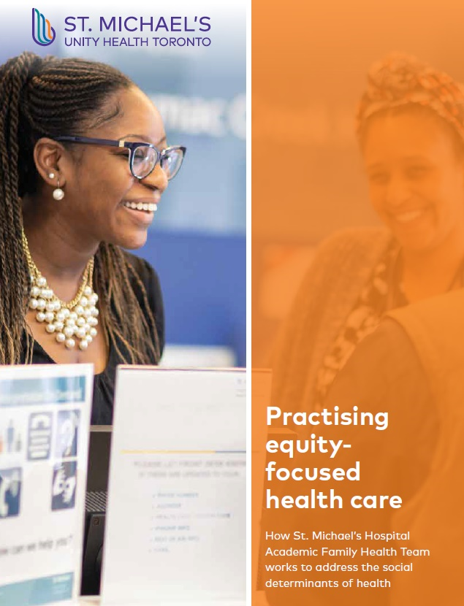
    Practising equity-focused health care

    Over the years St. Michael’s Academic FHT has won a Bright Light Award for, and presented at the conference on, their work addressing the social determinants of health. They have a website focused on their continuing efforts, including tools, income security health promotion, and integrating SDOH into QI programs.

    They also have a comprehensive brochure. Feel free to review for ideas for your own team.


    Novel coronavirus updates including OMA summary guidance

    We continue to update the relevant page on the Novel Coronavirus, including with the latest situation reports. The Ministry of Health has updated guidelines for primary care, along with posters and a website for healthcare providers. The latest update is a summary guidance document from the OMA.

    The OCFP has also put together Tips for Screening for 2019-nCoV which includes clinic preparedness that you may find helpful. If you have any questions, you can also email EOCOperations.moh@ontario.ca.

    For EDs, Lead Clinicians and Board Chairs:
    The Ministry of Health and Ontario Health (Shared Services) are requesting you complete this short survey by end of day tomorrow, Wednesday, February 5, to assist in tracking provider preparedness. This will help them identify where support is needed, and they will work with suppliers to distribute resources accordingly.


    Improving cancer screening rates and reducing related disparities, Feb. 20
    Primary care plays a central role in cancer screening, but screening efforts don’t reach everyone.

    St. Michael’s Hospital Academic FHT worked with patients living with low income to understand barriers to screening and co-design solutions. On Feb. 20 join Drs. Aisha Lofters and Tara Kiran as they share practical, evidence-based ways to improve cancer screening rates and reduce income-related disparities. Register here.


    Reminder- Shortening the diagnostic odyssey: rare disease in primary care, Feb. 12

    On Feb. 12 Sanofi Genzyme’s rare disease education webinar will increase your awareness about two rare inherited disorders – Fabry disease and Pompe disease and will highlight why primary care is essential in reducing the long and cumbersome diagnostic delays these patients experience. You may also leave with the realization that these rare diseases are not as rare as you think. Register here.


    Members’ stories
    Akausivik Inuit FHT- Canada honours Qapik Attagutsiak, 99, wartime Inuit bone collector. As a midwife, she helped deliver hundreds of babies and helped set up Akausivik Inuit FHT.


    Spotlight on organizing primary care, Feb. 13

    Join us for our next Primary Care Virtual Community session on February 13th 8:00am-9:30am, Ontario’s innovative collaborative designed to unleash the power of primary care in health system change. More than 1,000 people have now connected through this virtual community, a collaboration developed by the OCFP and AFHTO and convened by The Change Foundation.

    As a community, we have co-defined a list of High Impact Actions that are felt to spark meaningful improvements in primary care. Building on the momentum from our most recent Primary Care Virtual Community held in November 2019, we will be continuing to shine a spotlight on the high impact action of organizing primary care.

    In our upcoming session, the community will engage with those in primary care from across Ontario on the emergent ways in which primary care is self-organizing and building meaningful connections locally.

    We will be hearing nine primary care clinicians as they share their experiences and learnings on how they, in partnership with others, have been able to enable and accelerate the local organization of primary care. Register today!


    Two new quality standards – anxiety disorders and OCD
    Ontario Health (Quality) has released two new quality standards:

    They come with patient conversation guides and recommendations for system adoption too. Questions? Contact QualityStandards@HQOntario.ca.


    Call for participation-toxicity management models of care working group

    Cancer Care Ontario is seeking GPO, GP and Nursing representation for a Models of Care Working Group to improve the delivery of toxicity management for adult cancer patients currently undergoing systemic and radiation treatment. If you’re interested in participating, please contact Ada Payne, Lead, Models of Care at ada.payne@cancercare.on.ca by February 15, 2020.


    Quality Rounds Ontario: The Promise of Virtual Care, Feb. 6, 2020
    With opening remarks by Bill Hatanaka, Board Chair, and Matthew Anderson and Incoming President and CEO, Ontario Health. Register today.


    Advance Care Planning Lead Trainer Program, Feb. 11 & 13, 2020 (and more)
    Are you a health service provider who has the support to build and sustain a team of volunteer facilitators? Hospice Palliative Care Ontario invites you to participate in this interactive training program that will guide you in training your volunteers to facilitate community Advance Care Planning presentations to the general public. Find out more here.


    Primary Care Virtual Community, Feb 13, 2020
    The Primary Care Virtual Community brings together leaders in primary care interested in enabling meaningful system change. The virtual community is a collaboration developed by the OCFP and AFHTO and convened by The Change Foundation.

    Register today!


    Shifting the feeding and eating conversation – An introduction to Satter Feeding Dynamics and Eating, Feb 28, 2020

    Hosted by Nutrition Connections, this workshop will provide a deeper understanding of the Satter Feeding Dynamics Model (fdSatter) and the Satter Eating Competence Model (ecSatter), along with strategies for application. Learn more here.