Blog

  • Ontario’s Action Plan: Responding to COVID-19

    On March 25, 2020, Ontario Finance Minister Rod Phillips released Ontario’s Action Plan: Responding to COVID-19 (OAP) in the Legislature. The action plan is a fiscal and economic update, which constitutes another legislative step in the Ontario government’s response to the pandemic.

    Due to the COVID-19 pandemic, governments around the world have had to respond in unprecedented ways using whatever public policy instruments they have to combat the economic uncertainty this crisis is creating. Ontario had to shelve their budget, which was expected today, in favour of a more focused economic update and one-year plan that accounts for today’s current economic reality with targeted measures to address health care capacity, struggling people and the businesses where they work. 

    The OAP is a $17-billion action plan in response to the COVID-19 pandemic. Funding announced can be divided into the following three categories: 

    1.    Direct support for health care;
    2.    Direct support for people and jobs;
    3.    Deferrals to help people and businesses increase cash flow.

    The foremost objective of today’s fiscal update is to provide stability to Ontario’s health care system and support for Ontario’s most vulnerable groups.  

    In Ontario’s 2020 Action Plan, the deficit is pegged at $20.5 billion for 2020-21. The government’s intention with this plan is to ensure that immediate challenges are met while still giving Ontario the ability to respond to future capacity challenges associated with COVID-19. Once the government begins to gain clarity on our ability to “flatten the curve,” they will begin planning what will be required to support Ontarians in the “recovery phase.”  

    The Ontario government has been closely coordinating with the federal government with regard to their public policy responses to COVID-19. These measures are meant to complement each other’s plans. 

  • Bits & Pieces: new COVID-19 guidance for primary care; COVID-19, HR, privacy & risk webinar & more

    Bits & Pieces: new COVID-19 guidance for primary care; COVID-19, HR, privacy & risk webinar & more

    Your Weekly News & Updates


    In This Issue  
    • COVID-19 guidance for primary care
    • HR, privacy and risk management during the COVID-19 pandemic – Mar. 27 webinar
    • Reorganizing COVID-19 resources on our site
    • Shift to Virtual Care-Primary care response to COVID-19
    • Early lessons: tackling a global crisis with a community response
    • Member renewal payments-hold cheques please
    • Upcoming events including NPAO COVID-19 peer support group and CMHA Ontario and Mental Health Works Webinars – In response to COVID-19 pandemic

    COVID-19 guidance for primary care
    The Ministry has released the latest version of COVID-19 Guidance: Primary Care Providers in a Community Setting. Please use this version as your guidance document for your teams.

    Highlights include:

    • Implementing a system for virtual and/or telephone consultations
    • Referrals to local assessment centres
    • Conducting clinical examination and specimen collection using Contact/Droplet precautions
    • Link to latest case definition, signage and PHO IPAC recommendations

    HR, privacy and risk management during the COVID-19 pandemic –Mar. 27 webinar
    These are uncertain times and the way we are now practicing primary care has changed dramatically in the last few weeks. As we move towards more virtual care and accommodating more work from home, there are a lot of questions around how to support our staff and ensure that patient and provider safety be paramount in this ‘new normal’.  Things are evolving every day and new announcements of support are continuing to be announced.

    Making sense of it all can be a challenge with the ongoing flow of information so join us for a Q and A with Maria McDonald of McDonald HR Law and Kate Dewhirst of Kate Dewhirst Health Law to learn more about what you need to know during this challenging time.

    If you would like to submit your questions in advance to ensure they are addressed during the webinar, please feel free to send them to info@afhto.ca and we will make sure that Maria and Kate are aware of them prior to the presentation. We will add the slides and recording to our site within a business day or so of the webinar.


    Reorganizing COVID-19 resources on our site
    Every day new information on COVID-19 comes and we know it’s hard to sort through it all. Considering this we have reorganised the resources and updates on our site into several pages:

    We’ll update these on a regular basis as we receive relevant resources, while trying to reduce duplication with other sources. We will continue to update the news page daily.

    *Please also note that the list of essential workplaces in response to COVID-19 was released yesterday. Primary care and the interprofessional care provided by teams are essential though not explicitly noted – as we try to get some clarity on this, the recommendation is to shift to as much virtual care as possible. We continue to press the Ministry and Ontario Health around the issue of lack of PPE and hope they will have some information in the coming days.


    Shift to Virtual Care - Primary Care Response to COVID-19 Pandemic Document


    Shift to Virtual Care-Primary care response to COVID-19

    On Thursday, Mar. 19 we sent the email “Update on COVID-19 and Moving Towards More Virtual Care”. It listed different tools teams might use for virtual care and activities to support patients and families during this period of self-isolation and physical distancing.

    We have now compiled those and more in Shift to Virtual Care-Primary care response to COVID-19, a document outlining what fellow teams have done to support their patients. You can also find more information on our Virtual Care, Digital Health and COVID-19 page.


    Early lessons: tackling a global crisis with a community response
    Longwoods article co-authored by Dr. Tia Pham, South East Toronto FHT on East Toronto Health Partners (ETHP)’s response to COVID-19 and lessons which may help other OHTs.


    Member renewal payments-hold cheques please
    We understand members are focused on COVID-19 right now. As we plan for the upcoming year with membership renewals please note that our building will be closed starting tomorrow. If you plan to pay by cheque, please hold for about two weeks. We can still accept payments via Interac and EFT. We’ll provide another update as soon as we’re able to do so. Please contact info@afhto.ca for further information.


    NPAO COVID-19 peer support group webinar, Mar. 26
    Infectious disease outbreaks like COVID–19 can be worrying and can affect your mental health.  Because of this NPAO has set up a group chat webinar for NPs where you can share your thoughts, experiences, concerns, etc. with your colleagues. Join at 7:00 pm – 8:00 pm for free.


    Understanding Bronchiectasis Webinar, April 21, 2020
    Learn more about this neglected pulmonary disease. By the end of this webinar, you will be able to help patients self-manage the disease and avoid the acquisition of nontuberculosis mycobacteria. Find out more here


    CMHA Ontario and Mental Health Works Webinars – In response to COVID-19 pandemic, April 2-17, 2020
    For health care professionals and workers: with topics relevant to both hospitals and clinics, as well as telehealth professionals and those who work to support patient outcomes, such as custodial staff, security professionals, and administrators.

    1. Mental Wellness for Healthcare Professionals – April 2, 6-7 pm
    2. Stress Management in Healthcare Settings -April 6, 5:30-630 pm
    3. Mental Health for Telehealth –April 15, 6-7 pm
    4. Mental Health for Support Staff: Taking Care of Yourself – April 17, 6-7 pm
  • Early Lessons: Tackling a Global Crisis with a Community Response

    Longwoods article published Mar. 23, 2020

    By Thuy-Nga (Tia) Pham, Jeff Powis, Mark Fam, Ian Fraser and Anne Wojtak

    In the 17 years since the SARS crisis, Ontario has invested in our public health system and improved connections across the healthcare system to better respond ‘as one.’ Although we are still a long way from having a fully integrated healthcare system, we at least understand the imperative to think and act like one system, and every day there are leaders and clinicians stepping-up to lead positive change.

    As the COVID-19 crisis escalates, we see similar critical success factors for developing integrated systems of care such as Ontario Health Teams, and the response to large-scale healthcare emergencies – both scenarios are complex and dynamic, requiring a shared sense of purpose, trusted personal and organizational relationships across different sectors, distributed leadership, and a strong role for organized primary care networks. However, large-scale emergencies further demand the system make changes quickly, within a precarious context, and with significantly higher stakes.

    For the East Toronto Health Partners (ETHP), the investment in building our core partnership over more than two decades helped accelerate our initial response to the novel coronavirus. The ETHP are a network of healthcare and social services organizations, recently named as one of the first Ontario Health Teams, that have partnered to better integrated care in our East Toronto community of more than 300,000 residents. The core leadership for the ETHP includes patients and caregivers, the East Toronto Family Practice Network, Michael Garron Hospital, Providence HealthCare (Unity Health Toronto), South Riverdale Community Health Centre, VHA Home HealthCare and WoodGreen Community Services. Our broader partnership includes more than 50 other health and social services organizations. The story of our planning for COVID-19 is not just about preparing our hospital to provide acute care for pandemic patients but about mobilizing our community and primary care providers as a whole. This includes management of pandemic patients outside of the hospital and provision of services which are essential to support a local pandemic response.

    Started planning early

    As in the rest of Ontario, our local infection control specialists have been monitoring the coronavirus situation in China since it started. As broad community transmission began in China in early January, and the first presumptive case of COVID-19 in Canada occurred, it had the effect of a shot from a starter pistol. Leaders from our East Toronto Family Practice Network-EasT-FPN (established in September 2019 as the voice of our 270 local family physicians at our Ontario Health Team leadership table), connected immediately with our infection control specialists at Michael Garron Hospital (MGH). Our historical fabric of solid partnerships meant a tacit agreement to take care of our community together.

    Our family physician leaders from EasT-FPN represent all family practice models that exist in East Toronto. This level of organized physician leadership and diversity of voices has proved invaluable in the current crisis. When the medical department chiefs and hospital leaders from MGH first came together for emergency pandemic planning, community family medicine and our Community Health Centre partners were at the table. This partnership between the hospital and our local family physicians enabled rapid, shared decisions on Personal Protective Equipment (PPE) stocks, supply distribution and mask-fit testing for all community clinicians in East Toronto. Through the EasT-FPN connections, and with winter flu surge funds made available by the hospital, arrangements for mask-fit testing and PPE distribution for local family practices happened quickly, starting with the family physician practices in Chinatown East given the initial higher risk for their population.

    As early as January, our emergency pandemic planning team started investigating best practice solutions to divert potentially infected, lower needs patients from the hospital, including opening a community-based testing and assessment centre properly equipped with PPE. The team at the South East Family Health Team (sic) (SETFHT) initially volunteered to host the assessment centre in their location – a building owned by MGH across the street from the main hospital, but after broad community consultation the assessment centre was eventually housed within the hospital itself. EasT-FPN sent out a call to all family physician practices to participate in rotational staffing for the centre.

    Dr. Jeff Powis, MGH’s infection control lead, set up weekly calls for all family physicians starting in February. Knowing the need for broader engagement across our Ontario Health Team (OHT) organizational partners, we subsequently established weekly calls for all leaders across ETHP, including home care, community services, mental health and addictions services, independent living, housing, homeless support services and others. These calls enable local problem-solving, sharing up-to-date best evidence, decision-making, common messaging, sharing human resources practices, and greater consistency in response across in our community, keeping us a few steps ahead of official provincial communications.

    Lessons Learned

    The COVID-19 efforts are pushing us well beyond our capacity – the overloading of our hospital phone system and long waits to access our assessment centre, one of the first to have opened in Toronto, are just the tip of the iceberg. However, we are still taking precious moments to flag the lessons we are learning.

    1. This is not the time to ‘pause’ our OHT work with community partners; in fact, it is becoming more critical. The speed at which a system can innovate and change is dependent on the strength of its relationships. Advancing our partnerships and our integrated leadership models allows us to respond at every level, from ensuring our community health and social care partners are ready, to prioritizing PPE and COVID-19 assessments for the health care workers who need them the most.
    2. Organized primary care leadership is essential. Our ability to quickly connect, communicate, and coordinate with local family physicians would be nearly impossible without our new Family Practice Network. Due to this network, the hospital was able to grant temporary hospital privileges within a 24-hour period to all members of EasT-FPN who did not already have them. This rapid credentialing, with information facilitated by EasT-FPN, enables all our community physicians to access IT systems and other resources to help stem the tide of COVID-19. Additionally, as the pandemic progresses, this will allow the hospital to plan physician human resource cross-training.
    3. In a crisis situation, ‘fires’ can quickly spread without quick acts of containment. Concerns from other tenants in SETFHT’s location forced a swift relocation of the assessment centre to an isolated ambulatory care clinic space at the main hospital, but the cooperation across multiple partners enabled the centre to still open within a week of its announcement. Within two hours of asking for physicians to staff the assessment centre, the East FPN filled 3-weeks of shifts, enabling 12-hour coverage, 7 days/week. This amazing contribution from primary care colleagues meant the community of East Toronto could get rapid access to COVID-19 assessments while enabling emergency physicians to focus on other critical volumes coming to the hospital.
    4. We have been struggling with digital health advancements and clinical updates, use of virtual care, and communication tools for a long time. Email and teleconferences are last century’s technology, so now our digital health strategy must shift in real-time. From collaborating with other hospital partners to establish online assessment screening and test results reporting, to exploring rapid deployment of virtual ICU capacity, we will build new models to deliver care to our community. With the onset of COVID-19, patients have been scared to visit their regular physicians’ offices, and rapid introduction and expansion of video consults has enabled clinicians to continue providing safe care to patients.
    5. Funding and access to PPE is an issue for the hospital, for primary care and our community partners. All of us across ETHP contribute to the fight, and all of us need the resources to do that. For example, when our partners at South Riverdale Community Health Centre needed urgent supplies of PPE to maintain critical Consumption and Treatment Services in the community, the hospital stepped-up.  The commitment and ability to share what limited resources we have is an important principle for how we work as partners.
    6. Although obvious, it deserves restating, we need ongoing recognition and support for our frontline healthcare workers. The viral video from Spain of community members cheering from their balconies for health care workers is an example of how a small gesture can go a long way to supporting the resilience of our teams.  We try to replicate that now at the hospital, perhaps not with songs sung across balconies, but with an amazing positive energy at our staff screening entrance that welcomes our teams every day.
    7. We need to think about how we will engage our patients and caregivers in our emergency plan to the same degree we have in other aspects of our integrated care work. Given that it will take months to deal with the pandemic, we will need patients, caregivers and our community involved in co-designing solutions to help all of us manage through this crisis.

    Knowing the pandemic one day will abate, we must capitalize on the platform COVID-19 provided to leapfrog our efforts in healthcare transformation. The months ahead will be arduous for all of us – patients, families and healthcare providers alike. While no one wants an emergency like this one, we can already see how challenges provide a spark for innovations when relationships and systems such as the OHT exist to facilitate them. The work we do together now will go a long way in determining our path to becoming ‘one’ coordinated system.

    About the Author

    Thuy-Nga (Tia) Pham MD, MSc, CCFP, FCFP is the Physician Lead for the South East Toronto Family Health Team and Associate Professor, Department of Family and Community Medicine, University of Toronto.

    Jeff Powis MD, FRCPC, MSc is the Medical Director, Infection Prevention and Control at Michael Garron Hospital, Toronto East Health Network and Assistant Professor, Department of Medicine, University of Toronto.

    Mark Fam, MHA is Vice-President Programs at Michael Garron Hospital, Toronto East Health Network and Adjunct Faculty, Institute for Health Policy, Management and Evaluation, Dalla Lana School of Public Health, University of Toronto.

    Ian Fraser MD, FRCPC is the Chief of Staff at Michael Garron Hospital, Toronto East Health Network and Director of the Provincial Weaning Centre of Excellence for prolonged ventilation and a lecturer in the Division of Respirology, Faculty of Medicine, University of Toronto.

    Anne Wojtak DrPH, MHSc is the Lead for Integrated Care for the East Toronto Health Partners and Adjunct Faculty, Institute for Health Policy, Management and Evaluation, Dalla Lana School of Public Health, University of Toronto.

    To view the full article click here.
     

  • Londoners and Thames Valley FHT organize to supply doctor’s offices, ‘love-bomb’ health-care workers

    The London Free Press article published Mar. 20, 2020

    By Randy Richmond

    A handful of Londoners have turned some casual conversations into a grassroots effort supplying thousands of gloves and masks to local medical clinics.

    And they want more people stuck at home, especially business leaders, to step up and help.

    “We all need to get out of this mindset of hurt. It’s really easy to focus on that, but I think the key right now is to band together and be a village,” said Diana House, a London real estate investor and developer.

    “Business people are sitting at home right now because their companies are closed. They are the people who need to rise up and say, ‘How can we help?’ “

    Help is needed to keep medical clinics and doctors’ offices in London operating, said Dr. Mario Elia, a family doctor and professor of family medicine at Western University.

    “If we do end up seeing big numbers over the next few weeks, we want to make sure that family docs can keep seeing patients, safely and timely, and that requires us to have adequate equipment,” he said.

    Besides masks and gloves, doctors need eye protection and gowns, he said.

    “Some docs are at kind of a critical time, if they do not get more, they may need to close in the near future. One of the issues that has come up in other countries is when health care workers start working in unsafe conditions, they start getting sick and the whole system just collapses.”

    Family doctors should be the first place people go when they suspect they have some symptoms of coronavirus, but are not at an urgent stage, Elia said.

    The assessment centres should be for those who don’t have a family doctor and whose symptoms aren’t severe, he said.

    Elia and House are part of a loose network of medical and non-medical people who began putting their minds to the needs of doctors and medical staff in the coming weeks.

    “They are starting to prepare for the coming weeks and potentially months. The question was, ‘Who’s preparing to support them?’ ” House said.

    The conversations touched on child care and pet care for doctors and nurses under siege, and where medical professionals might live between shifts to avoid infecting their families.

    All those matters remain part of the discussion, but it became clear that getting supplies to medical clinics is the first challenge, House said.

    The network found a local supplier and bought, at cost 15,000 pairs of surgical gloves and 700 masks, and began tapping other sources.

    There are other places besides doctors’ offices that have masks and gloves, such as nail salons, dental offices, podiatrists, tattoo parlours, spas and veterinarian clinics.

    So, they’ve been contacting those businesses, other suppliers, Western University and Fanshawe College for help, House said.

    The Thames Valley Family Health Team has taken on the job of coordinating and collecting supplies, and medical students have helped distribute the first supplies to clinics.

    “It’s been a really beautiful thing to see the community get together,” House said. “It’s very grassroots, very much evolving. The goal is to keep the medical clinics open for as long as possible to divert as many people away from the hospital as we can.”

    The effort has worked so well, the clinics have enough gloves for now, Elia said.

    But surgical masks, gowns and eye protection are still needed, he said.

    Doctors’ offices are out of swabs, in short supply at the moment in London, but that’s because swabs are being directed to public health officials who are organizing the testing for the virus at emergency departments, Elia said.

    House knows dental clinics and other services will need gloves and masks when they re-open, but says the focus now has to be on medical clinics and hospitals.

    “I really think we’re in a triage situation and I think the resources need to go to medical first. We are trying to pull as many strings as we can to try to make sure the resources go to the right place,” she said.

    “They’re the ones who are going to get us through this. How can we just love-bomb them and shower them with support any way we can to make what’s going to be a very difficult season for them maybe a little bit easier?”

    There are going to be dozens of ways ordinary people can help, House said.

    “It doesn’t have to be this. It could be finding a health care worker and adopting them and saying, ‘Every time I go to the grocery store, I’m going to buy them groceries.’ “

    To view the full article, click here.

  • Letter from AFHTO’s President and Board Chair

    Letter from AFHTO’s President and Board Chair

    Tom Richard

    Dear AFHTO teammates,

    I just wanted to reach out to all of you while I have a moment to thank you for your tremendous efforts over the last couple of weeks. Like you, I have been busy working with our team to realign services, develop innovative ways to contend with COVID-19 while also continuing to provide essential care to our patients.

    In addition, working with public health and our hospital to martial resources to meet the pending demand has been a daunting planning process. I know all of you have also been working hard to make sure we can be as prepared as possible for this pandemic.

    Through this, I have observed firsthand the dedication and commitment of all our IHPs, physicians, nurse practitioners and administrative staff as we strive to contend with something that we have never before experienced. Everybody has made the patient’s interest and well-being their first priority as we plan and prepare for COVID-19.

    Your association continues to be here to support you. They have responsibly embraced social distancing and are trying to work as much as possible from home but continue to represent and assist you with matters that are of critical importance to team-based care.

    As many of you may know, the Ministry email from March 18th allows interprofessional primary care teams to re-deploy any clinical resources where they are most needed to contend with COVID-19. We are all encouraged to work closely with Public Health experts to facilitate a coordinated and effective response to this virus.

    Additionally, the Ministry has decided to delay the Annual Operating Plans and has loosened reporting timelines as they understand the challenges we are all facing now.

    I know many of you may be feeling anxious and tired, but I can assure you that our ability to adapt and confront this pandemic as a team puts us in a much stronger position to mitigate the eventual impact. By supporting our patients and each other, we will get through this and be successful in demonstrating the great value that team-based care brings to Ontario.

    Last night as I reviewed my many emails, I came across one from a grocery store chain about how they were contending with the difficult circumstances they faced as a result of this pandemic. A phrase that caught my eye was “TOUGH TIMES DON’T LAST, TOUGH TEAMS DO!” I thought this captured perfectly that attitude we must all embrace in these uncertain times.

    Look out for your patients and look after your colleagues. Support each other in the coming weeks and not only will we succeed in dealing with this pandemic, but we will also ensure that team-based care is the model of care that should be offered to all in Ontario.

    Take care,

    Dr. Tom Richard
    President and Board Chair
    Association of Family Health Teams of Ontario

  • Getting started on a COPD registry (Archived)

    This page has been archived. For the most recent version of this page, please click here.


    This document explains how to use standardized queries in your EMR to start building chronic disease registries.  The instructions below focus on COPD. The COPD query is intended for teams that do not yet have a reliable list of COPD patients and don’t have the time or resources to start from scratch in reviewing all their patients to generate such a list.  Right now, it is also only for teams with PSS or Accuro although work is continuing to expand the standardized query to OSCAR and Nightingale. The following steps will help your team use the query to generate a list of COPD patients, starting from your EMR.

    Step 1. Estimate how many patients you think this will affect.  Multiply the number of patients your team serves by 0.12 (the average rate of COPD in Ontario) to get a rough idea of how many of your patients likely have COPD.  If you still think this is a big enough group of patients for you to generate a registry for, carry on to step 2.

    Step 2. Import the query into your EMR.  Right now, you can only do this if have either Telus PSS,  QHR Technologies Accuro or OSCAR EMRs.  You will likely need the help of your QIDSS, IT staff or other person who usually works with your EMR to do this.

    • For PSS, click here to import the PSS SRX file into your EMR.
    • For Accuro, download the query “AFHTO COPD Frontend Search” from their publisher.
      • Click here for instructions on how to download the query
    • For Nightingale EMR queries cannot be exported and shared so please access the “how to” instructions on Trello – they explain the process to create a COPD registry.
    • For OSCAR copy the query text into a Notepad file and save locally to your computer.  Instructions on how to import the query into your OSCAR EMR can be found here.

    Step 3.  Run the query in your EMR. Again, you might need the help of your QIDSS, IT staff or other person who usually runs queries in your EMR.  Running the query will produce a list of patients with COPD.  The list will not be perfect – probably 15% of the patients identified by the query will NOT have COPD.  The query gets you STARTED in building the COPD registry but doesn’t do the whole job for you.

    Step 4. Find the patients who might not have COPD. Review the list of patients generated by the query to separate out those patients that are clearly already coded as having COPD.  What’s left will the list of patients who MIGHT have COPD based on other data in the EMR besides formal coding.

    Step 5. Prepare your physicians to review the list  Subdivide the list of possible COPD patients into separate, shorter lists for each physician.  Work with your physicians to find out if they would prefer a list on paper or electronically and how they might like it sorted (ie by name or most recent visit or some other parameter).

    Step 6Invite each physician to review their list of patients.  They know their patients best and can likely quickly confirm which ones do or do not have COPD, even though that information might not be easy for others to find in the EMR.

    Step 7Clean up your EMR data.  Add COPD codes to the EMR for each patient that the physician confirms as having COPD.  This so-called “data cleaning” work is a great job for a student.  AFHTO has created a toolkit to assist members in recruiting and using students for data clean-up. Click here for the toolkit.

    Step 8Re-run the query .  After you have corrected the EMR, re-run the query to generate a list of patients with COPD.  This is your new COPD patient registry.  Going forward, you can run the query anytime you need to generate a list of COPD patients.  You can use the list to invite patients to a lung health program, track progress with outcomes on these patients once you have started such a program or any other purpose. This query was produced by and for QIDSS in support of all AFHTO members. 

    If you have any questions please contact improve@afhto.ca.

     
  • Ontario shifting to virtual-first model in bid to halt spread of COVID-19

    The Star article published Mar. 16, 2020

    By Megan Ogilvie

    Family doctors across Ontario are rapidly transitioning to a “virtual-first” care model as a way to halt the spread of COVID-19 in their offices and waiting rooms.

    Starting this week, most doctors will talk to patients on the phone, by video conference or through email as a first-step to determine who needs to come to the office for an in-person appointment.

    Patients who require face-to-face care, including pregnant women, babies requiring scheduled vaccines and some seniors with chronic health conditions, will have in-person appointments. But many patients will receive virtual advice on how to care for their condition at home.

    As well, some patients will be told upcoming, non-urgent appointments will be postponed for weeks or months. For example, Cancer Care Ontario on Monday advised physicians to postpone cervical cancer screening for low-risk women.

    For the most part, these province-wide measures are in place to protect family doctors, nurse practitioners, office staff and patients from getting infected with COVID-19.

    “We don’t want to bring healthy patients into an office where they could be potentially exposed to COVID-19 by mistake,” said Dr. David Kaplan, a family physician at North York General Hospital and the North York Family Health Team. “It’s part of social distancing. If you want to keep people out of communal spaces, it’s the same for keeping people out of waiting rooms. This is just another way that family doctors can help.”

    Dr. Thuy-Nga (Tia) Pham, physician lead for the South East Toronto Family Health Team, said her patients are welcoming virtual care, especially with so many having questions about COVID-19.

    Last week, the province’s Ministry of Health, after discussions with the Ontario Medical Association, announced new billing codes to allow family physicians and nurse practitioners to move to virtual care.

    Pushing more routine appointments to virtual visits will help family physicians more effectively deal with the surge in patients needing treatment or advice on COVID-19. And seeing more patients virtually will help preserve face masks, disposable gowns and other protective equipment which could be in short supply as the COVID-19 pandemic progresses.

    To view the full article, click here.

  • Update on COVID-19 and Moving Towards More Virtual Care

    This email was sent to EDs/Administrative Leads, Board Chairs and Lead Clinicians of AFHTO member organizations.

    These are challenging times and we really appreciate the phenomenal care that is being provided by everyone working in team-based primary care and in health care. As the foundation of the health care system, your relationships with your patients and families are based on trust and they are looking to you now more than ever to be there for them during these very uncertain times. But through it all, taking care of yourself and your team to ensure there is a healthy workforce is paramount and important for your own health and well-being.

    However, things are ramping up and there is a real need to start capacity planning should there be a need to redeploy health human resources to the ongoing fight against COVID-19. In the next few days you’ll receive a survey from the Ministry who are looking at capacity in the system – we’ll send that as soon as we get it, and would request that you prioritize filling that in as soon as you receive it.

    Planning for More Virtual Care
    Today Ontario’s Chief Medical Officer of Health issued a memo Re: Managing Health Worker Illness and Return to Work COVID-19. In the document he makes recommendations related to travel and return to work for health care providers. He also notes:

    While other services are decreasing their operations, in health care you are being called upon to care for patients and to be ready for surge. I am asking, where there may be an opportunity, for all health system employers to facilitate work arrangements that enable appropriate employees to work from home or to work virtually, if not re-deployable.

    Health system employers should also consider a review of their services and practices to identify how they can provide services to patient groups virtually or remotely.

    These are uncertain times, but the recommendation is to try to accommodate care for patients virtually as much as possible. If your providers, including IHPs and admin staff, do need to come into the clinics please ensure they are well protected. We are very aware of the PPE challenges in primary care and continue to press the Ministry and Ontario Health for updates on the supply issues and hope to have some information on that when provided.  

    We are currently working on business continuity plans and collecting policies related to accommodating staff to work from home and hope to share that with you soon – a reminder that we are posting materials on our site daily including the Ministry’s COVID-19 Situation Reports. If you have anything you can share, please send to info@afhto.ca and we will make sure to share it with the teams.

    Many teams have already started virtual care or employing some activities to support patients and families during this period of self isolation and social distancing. Here are some tools you may want o implement with your teams:

  • Annual Operating Plans: Update from Primary Health Care Branch, Ministry of Health

    Email Sent on behalf of Fernando Tavares, Program Manager, Interprofessional Programs Unit, Primary Health Care Branch.
     
    Dear Colleagues,
     
    We have recently received questions from several of you regarding the deadline for the 2020/21 Annual Operating Plans (AOPs) and other timelines in the context of the work that is currently happening to deal with the impact of COVID-19 in Ontario.
     
    At this time, we understand that your attention should be focused on planning and supporting patients, caregivers, and staff who may be impacted by COVID-19.
     
    Annual Operating Plans
     
    After much consideration, we have decided to delay the distribution of the 2020/21 AOPs. If you wish to get a head start on your AOP, you are welcome to use last year’s version as it will be very similar to this years template.  We want to give extra time to organizations whose staff and leaders might be working on COVID-19 planning.
     
    COVID-19
     
    We have been receiving a lot of questions regarding operational issues generated by the spread of COVID-19.  We wanted to share our key messages that have been developed for staff on how to respond to these questions.
     

    • The Ministry of Health is supportive of interprofessional primary care teams supporting locally driven initiatives. The Ministry is asking for teams to deploy clinical resources where they are most needed.
    • Interprofessional primary care teams should take the lead from Public Health experts (at the Federal, Provincial and Municipal levels), who are taking the lead on the response to the COVID-19 Pandemic.
    • The Ministry will consider reimbursing for extraordinary expenses incurred on a case by case basis, and should contact their Ministry representative.   
    • For issues related to critical shortages PPE of supplies and equipment, please contact EOCLogistics.MOH@ontario.ca.

    We will continue to monitor this situation closely, and please reach out to your Ministry contact if you have additional questions or concerns.
     
    Reporting Timelines:
     
    As teams head into year end reporting, a number of question have come up with regard to pressures in meeting these timelines. We want to reassure you that staff have been directed to be flexible on report submission timelines. We understand that we are in uncharted waters, and things will come up that are not within your control, nor expected. We will work with you to address these issues as they arise but be reassured that deadlines will be treated as guidelines until things get back to normal.
     
    On behalf of the Primary Health Care Branch staff, we thank you for your continued work toward keeping our communities safe and healthy.  

    Fernando Tavares
    A/Program Manager, Interprofessional Programs Unit
    Primary Health Care Branch
    Ministry of Health
    49 Place D’Armes Floor 3, Kingston, ON, K7L 5J3

  • Bits & Pieces: ON state of emergency, COVID-19 updates & more

    Bits & Pieces: ON state of emergency, COVID-19 updates & more

    Your Weekly News & Updates


    In This Issue  
    • Ontario declares state of emergency
    • COVID-19 updates including memo
    • Selecting an IPAC representative
    • Virtual visit billing codes, PPE recommendations & steps to reduce spread
    • Members’ stories
    • Registration now open for Project ECHO Ontario Bariatric Network (OBN) series starting April 2, 2020
    • NPAO Patient Choice Award
    • Upcoming events including Leading in turbulent times

    Ontario declares state of emergency
    Today, the Government of Ontario announced that it is making an order declaring a state of emergency under s 7.0.1 (1) the Emergency Management and Civil Protection Act.

    Updates relevant to health care include:

    • $100 million for increased capacity in hospitals to assist with the effective treatment of COVID-19 patients both in critical care and medicine beds.
    • $50 million for more testing and screening through public health, including additional funding to support extraordinary costs incurred to monitor, detect and contain COVID-19 in the province. This includes contact tracing, increased laboratory testing capacity and home testing.
    • $50 million to further protect frontline workers, first responders and patients by increasing the supply of personal protective equipment and other critical supplies and equipment to protect them.
    • $25 million to support frontline workers working in COVID-19 assessment centres, including the creation of a new fund to provide respite care, child care services and other supports as they are needed.
    • $4 million for Indigenous communities to support transportation costs for health care professionals and the distribution of critical supplies.

    You can also read H+K’s insight note on the declaration here.


    COVID-19 updates including memo

    For EDs, Lead Clinicians and Board Chairs:
    At this time only 107 of 193 members have either completed this short survey to track provider preparedness, or otherwise contacted us. The Ministry of Health and Ontario Health (Shared Services) have emphasised the importance of filling this out. Please do so as soon as possible. This is a direct link to the spreadsheet, with no need to log in.

    Health care providers facing immediate challenges with their personal protective equipment supply levels can email the ministry at EOCLogistics.MOH@ontario.ca.We have also asked Ontario Health for an update on PPE supply and hope to get some information to you soon.

    We continue to update the relevant page on COVID-19, including the self-assessment tool and a memo from the provincial command table dated Mar. 16. If you have any questions, you can also email EOCOperations.moh@ontario.ca.

    You can also read H+K’s memo on yesterday’s press conference from the Ontario government here.


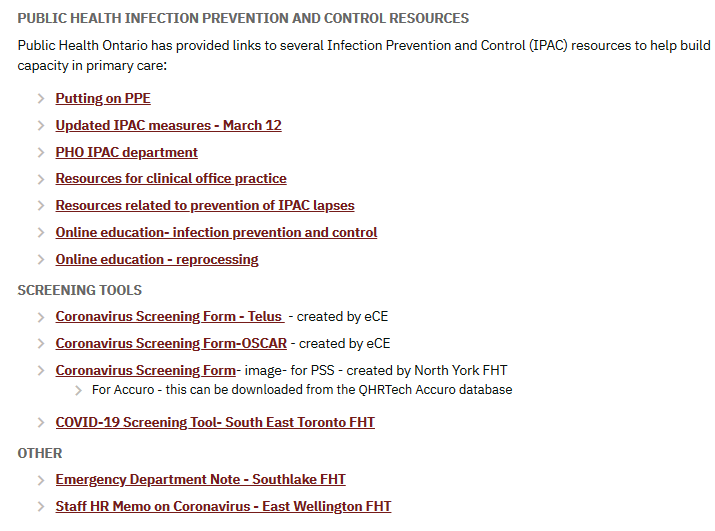
    Infection control resource page

    Selecting an IPAC representative

    During emergencies like the COVID-19 pandemic, clinical sites may start thinking about their own policies including infection control.  Per a regional IPAC Specialist at Public Health Ontario, selecting an IPAC representative may be very different from team to team. Hamilton FHT, for example, has designated Quality Improvement individuals who take on this role.

    Smaller teams may not have this option and may choose to find someone who is interested in the role, or whose current role most closely fits with the role (e.g., patient safety).  

    It may also be the case that they do not wish to have an overarching IPAC person but have an individual at each clinical site that is responsible for IPAC.

    If you are looking at training for your team you may want to consider:

    • IPAC Canada keeps a list of paid courses here. They cover a lot of ground and have a lot of information that may not be applicable to a team setting.
    • Free Public Health Ontario resources are shown on our infection control resource page.

    We’re working with PHO to develop tools, resources and webinars for our members once we’re able to focus more on everyday concerns and will be surveying our members shortly to get your thoughts on what is needed. But in the meantime, please share any resources you have developed by sending them to info@afhto.ca.


    Virtual visit billing codes, PPE recommendations & steps to reduce spread


    Members’ stories

    Bancroft Community FHTBancroft Community FHT Doctor presented with Council of the College of Physicians and Surgeons Award

    South East Toronto and North York FHTsYour next visit to a doctor may not be face to face. Ontario shifting to virtual-first model in bid to halt spread of COVID-19


    Project ECHO Ontario Bariatric Network

    Registration now open for Project ECHO Ontario Bariatric Network (OBN) series starting April 2, 2020

    Update your knowledge on post bariatric care and obesity management by joining the upcoming videoconferencing series hosted by Guelph General Hospital Bariatric Centre of Excellence. Discuss patient cases and learn about leading surgical and medical treatment options for patients with obesity and strategies to identify and prevent potential post – operative complications. Sessions are offered at no cost to all practitioners and allied health professionals working in primary care.

    Find out more and register here.


    NPAO Patient Choice Award
    Nominations for this award are submitted by patients, based on their description of their nurse practitioner’s professional qualities, approach to patient care and specific stories of dedication and how the nurse practitioner has made a difference in their lives or the lives of others. You can find a poster for your wait room and more information here. Deadline June 22, 2020.


    Leading in turbulent times – how to guide your teams through the Coronavirus pandemic, March 19, 2020
    Learn how to apply LEADs framework so you can lead to support and protect the community from widespread exposure.
    Learn more here.


    Electronic Asthma Management System (EAMS) – OSCAR Tool Demonstration, March 24, 2020
    Join this webinar for an hour-long demonstration to learn more about EAMS. Register here!


    Managing the Complex Patient: Diagnosis, Treatment and Follow-Up: CHEP+ Conference, April 4, 2020
    The second annual CHEP+ conference is accredited and now being offered online. Learn to cover C-CHANGE guidelines. Find out more here.


    Rainbow Health Ontario Conference, CANCELLED
    The RHO conference was cancelled, and paid conference registration fees will be fully refunded. Click here for more information.


    Understanding Bronchiectasis Webinar, April 21, 2020
    Learn more about this neglected pulmonary disease. By the end of this webinar, you will be able to help patients self-manage the disease and avoid the acquisition of nontuberculosis mycobacteria. Find out more here


    Together We Care: OTLCA & ORCA Conference, CANCELLED
    This convention has been cancelled, including the OLTCA’s general meeting and leadership dinner. The ORCA general meeting will proceed via webinar. Click here for more information.


    Insomnia Interventions: First-Line Treatment for Insomnia in Primary Care, POSTPONED
    This program has been postponed. Click here for more information.