Blog

  • QI in Action eBulletin #99: Capturing Primary Care’s Response to COVID-19

    QI in Action eBulletin #99: Capturing Primary Care’s Response to COVID-19

    In this Issue:

    • Primary Care Patient/Client Experience Virtual Care Survey
    • Responding to COVID-19: Understanding How Primary Care Teams Stepped up to Help Support Their Communities and Patients
    • IHP Experience During the Early Phase of COVID-19
    • Upcoming Virtual Events

    Primary Care Patient/Client Virtual Care Experience Survey
    Primary Care Patient/Client Virtual Care Experience Survey


    The rapid adoption of virtual care during the pandemic not only addresses the current needs but it will most likely shape the future of primary care delivery, beyond the pandemic.

    As a result, the Association of Family Health Teams of Ontario (AFHTO) formed a working group with a number of primary care, health system and health research organizations to measure the patient/client experience with virtual care during the COVID-19 pandemic. These organizations included: Quality Improvement in Primary Care Council (QI in PC Council), Women’s College Hospital Institute for Health System Solutions and Virtual Care (WIHV), eHealth Centre of Excellence (eCE), Ontario Health (Quality) (OH(Q)), and Partnering for Quality.

    We created the Primary Care Patient/Client Virtual Care Experience Survey to help fill informational gaps to inform future planning and further support the implementation of virtual care in primary care. This survey can also be used for quality improvement purposes to allow providers to look at ways to improve their care delivery.

    For online surveys, a template survey for Microsoft Forms has been created that can be duplicated. If you will be using SurveyMonkey, please email Sandeep.gill@afhto.ca and a copy of the survey will be shared with you.

    Ocean (CognisantMD) is offering a free platform to patient experience data; however, please refer to this guide  to ensure that you have completed all the steps to qualify. For your convenience, eCE has created an Ocean eForm version of the survey, now available to be imported to your Ocean (CognisantMD) site. Instructions on how to import and configure the survey and data extraction can be found here.

    We also highly recommend you report back to AFHTO to support AFHTO’s Provincial Initiative. To further support practices in expanding and solidifying virtual care in primary health at a provincial-level, AFHTO will be collecting the practice-level aggregate responses to the survey. Please click here to find more information.

    Responding to COVID-19: Understanding How Primary Care Teams Stepped up to Help Support Their Communities and Patients
    Since the beginning of the COVID-19 pandemic, we’ve heard countless stories of our teams’ commitment, diligence and initiative to continue providing team-based primary care around the province. We’re here to ensure that your hard work gets noticed – but to do so, we need your help.

    AFHTO in collaboration with Dr. Rachelle Ashcroft and Dr. Catherine Donnelly are conducting a research study to capture the efforts of all our members to ensure no story is left untold. This information will help influence and shape how teams will continue to adapt virtual care after the pandemic, as well as to meet patient needs.

    Interviews end August 14- don’t miss your chance to participate! Please sign up for a 30-minute interview to share your team’s story.

    IHP Experience During the Early Phase of COVID-19
    At the beginning of pandemic Dr. Catherine Donnelly and Dr. Rachelle Ashcroft created a survey to capture the interprofessional health provider (IHP) experience as the transition to virtual care began. The objective of the study was to describe the state of IHP practice within primary care teams during the COVID-19 pandemic.

    Some of the preliminary findings of the study were that 48% of IHPs felt that teamwork collaboration increased during the pandemic, 18% of IHPs felt that it remained the same whereas 34% felt it decreased.

    Most of the IHPs delivered care to patients via phone. Before the pandemic this was the most popular mechanism of virtual care delivery. As the pandemic progressed and teams explored creative ways to outreach to patients, teams started to explore social media. The preliminary findings of this survey are that IHPs are the least confident with patient care delivery via social media compared to other virtual care options and in-person care.

    As the pandemic evolves so does the expertise of providers with virtual care. Dr. Catherine Donnelly and Dr. Rachelle Ashcroft will release another survey to capture the IHP experience at multiple time points. Stay tuned for the next survey!

    Upcoming Virtual Events
    211 Ontario – Connecting Patients to Community Programs and Services Webinar
    Thursday August 20, 2020 – 12:00 – 1:00 pm EDT
    A webinar about how 211 can assist Family Health Teams. 211 has been helping the people of Ontario navigate community, health, and social services for many years. Learn more about 211 Ontario by registering here.

    Electronic Asthma Management System (eAMS) – Tool Demonstration Webinar
    Tuesday September 15, 2020 – 12:00 – 1:00 pm EDT
    The Electronic Asthma Management System (eAMS) is an evidence-based clinical decision support system developed to improve your ability to deliver best care for patients with asthma. Learn more about the tool by registering here.

    AFHTO 2020 Conference Tectonic shifts: rebuilding primary care in a new world
    Thursday, October 8, 2020 – Friday, October 9, 2020
    Before 2020, anyone with experience in Ontario’s healthcare system thought they knew what change meant. Now such changes seem almost a lifetime ago. COVID-19 has shifted our priorities with a focus on how to support our patients and our teams in new ways of delivering care.

    Primary care has risen to the challenge, but the ground is still shifting, and the future is uncertain. In short, we need to rebuild primary care for this new world. Registration to open soon. Learn more here.


    In Case You Missed It: Check out eBulletin #98 or other back issues here!
    Questions? Comments? Contact us at improve@afhto.ca.
     

  • Nominate a partner or healthcare inspiration for an AFHTO Board award

    Nominate a partner or healthcare inspiration for an AFHTO Board award

    The AFHTO board invites all member EDs, lead clinicians and board chairs to help them select the recipient of a Board award.

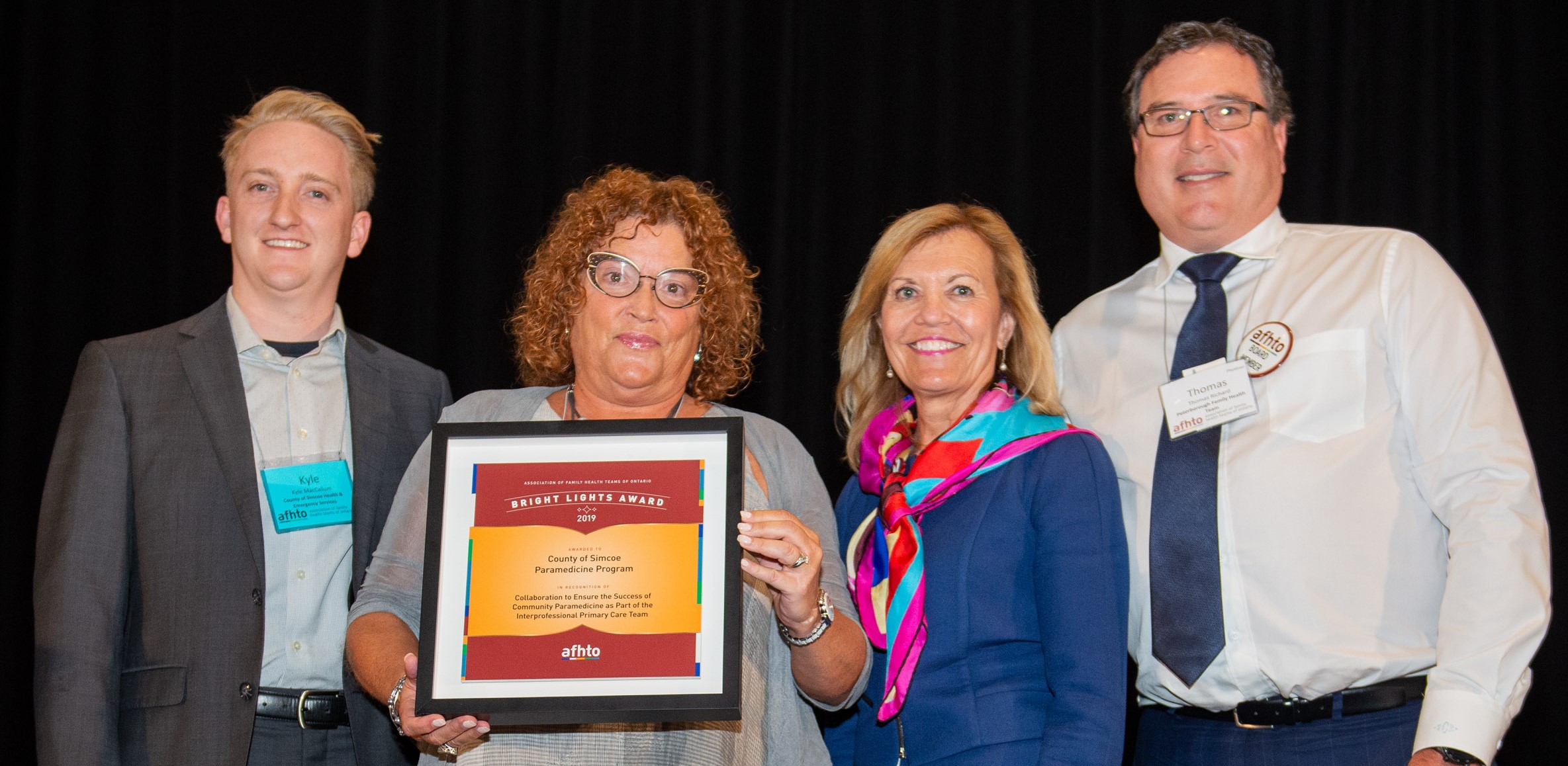
    Merideth Morrison, Director, Performance, Quality & Development, Health & Emergency Services accepts the 2019 Board award with Kyle MacCallum  on behalf of the County of Simcoe Community Paramedicine Program from Minister Hon. Christine Elliott and AFHTO president Dr. Thomas Richard

    The Board award recognizes an individual (or a group) who is not an AFHTO member but has significantly contributed to the development and growth of team-based primary care within their local community or at the provincial level.

    The winner(s) will receive their award(s) during the virtual Bright Lights Awards Ceremony at the AFHTO 2020 Conference on Oct. 8, 2020.

    Submit a nomination for the Board Award category by August 21, 2020.

    Find out more about the criteria here. You can find the nomination template here.

    If you have any questions, please contact us at info@afhto.ca or call 647-234-8605 x 1200.

  • Provincial Pandemic PPE Transitional Support Program Announcement

    This email was sent to EDs/Administrative Leads, Board Chairs and Lead Clinicians of AFHTO member organizations.
     
    From the beginning of the COVID-19 pandemic primary, community and mental health care organizations have struggled with a reliable supply chain in accessing personal protective equipment (PPE). Further to that, costs have increased substantially and as sectors started to ramp up their in-person care, there have also been delays on when PPE is received.
     
    We have flagged this issue constantly with the Ministry and Ontario Health and earlier this year we sent an open letter to the Minister with our colleagues at the Ontario College of Family Physicians and the Nurse Practitioners’ Association of Ontario, encouraging the Ministry to streamline procurement and distribution of PPE so that primary care providers are not left on their own to find the supplies they need to provide safe care to their patients.
     
    We are pleased that the Ministry and Ontario Health have heard the concerns of the non-acute sectors and have now developed a provincial pandemic PPE transitional support program. This program is to support Primary Care, Community-based Physician Specialists and Community Health providers, providing them with enough PPE to meet their re-opening needs without the expectation that those providers first attempt to source PPE through their regular supply chain.
     
    There is no charge for accessing the PPE which will be distributed through the Ontario Health regions. At the moment there is no timeline of how long this program will be in effect, but it is available now to help organizations with their in-person fall/winter planning.
     
    Through this program, the following types of PPE can be requested:

    • Surgical Masks
    • Gloves
    • Gowns (one-time use)
    • Hand Sanitizer
    • Face Shields
    • Disinfectant Wipes

    For more information please see attached:

    If you have any questions, please contact your Regional PPE Lead:

    Region     Regional Supply Chain Leads

    Central Region   

    Debbie Roberts: Debbie.Roberts@lhins.on.ca
    Susan Gibb: Susan.Gibb@lhins.on.ca

    East Region   

    Paul McAuley: Paul.McAuley@3so.ca
    Leslie Motz: lmotz@lh.ca

    North Region    

    Matthew Saj: sajm@tbh.net
    Michael Giardetti: giardetm@tbh.net

    Toronto Region    

    Rob Burgess: Robert.Burgess@sunnybrook.ca
    Nancy Kraetschmer: Nancy.Kraetschmer@tc.lhins.on.ca
    West Region   Toby O’Hara:  hmmscovid19@hmms.on.ca
  • Measuring the Patient/Client Experience with Virtual Care in Primary Care

    Measuring the Patient/Client Experience with Virtual Care in Primary Care

    Measuring the Patient/Client Experience with Virtual Care in Primary Care 

    Let's Capture the Patient Experience with Virtual Care!

    Purpose: 
    In the last year, Ontarians attended nearly 1,000,000 virtual care visits (Ontario Telemedicine Network, 2019). Virtual care is provided through a vast number of modalities such as voice, video, teleconference, online platforms, and mobile texting (Pearl et al, 2014). While many primary care practices in Ontario have provided virtual care in varying degrees prior to the COVID-19 pandemic, virtually overnight, primary care providers shifted most of their practice to virtual care to reduce COVID-19 spread. With this major transition in the delivery of care, it is important to understand how patients/clients are experiencing virtual care so that care can be optimized to best meet their needs. 

    This survey was created to help fill informational gaps to inform future planning and further support the implementation of virtual care in primary care. This survey can also be used for quality improvement purposes to allow providers to look at ways to improve their care delivery. 

    Survey Development: 
    The rapid adoption of virtual care during the pandemic not only addresses the current needs, but it will most likely shape the future of primary care delivery beyond the pandemic. As a result, the Association of Family Health Teams of Ontario (AFHTO) formed a working group with a number of primary care, health system and health research organizations to measure the patient/client experience with virtual care during the COVID-19 pandemic. These organizations included: Quality Improvement in Primary Care Council (QI in PC Council), Women’s College Hospital Institute for Health System Solutions and Virtual Care (WIHV), eHealth Centre of Excellence (eCE), Ontario Health (Quality) (OH(Q)), and Partnering for Quality. 

    AFHTO created a first draft of the survey based on a literature review of virtual care surveys used in primary care. Due to the need to start surveying during the pandemic, and because many of the questions were adopted from existing and/or validated surveys, this survey did not undergo testing. The draft questions were reviewed and refined by the working group members. 

    Additionally, AFHTO engaged with four Ontario Health Primary Care Quality Advisory Committee patient advisors and one of AFHTO’s Quality Steering Committee patient advisors to review and refine questions. The focus of the patient engagement is to identify questions that are meaningful to patients/clients and can help inform quality improvement of patient/client experience with virtual care in the primary care setting. 

    How this Survey can be Used:
    Data from this survey can be used to inform quality improvement and planning efforts. The survey was not designed to be used for benchmarking or comparative reporting; however, results can help guide practices as they plan service changes to improve their patients’ experience with virtual care. This survey complements practices’ existing patient/client experience surveys (ex: Primary Care Patient Experience Survey developed by OH(Q)).

    Practices can deploy surveys based on the type of visit the patient had:
    Thinking of your most recent visit, was it provided to you in person or virtually (i.e., phone, video, or messaging)? 
    a)    In person ⇒ please complete practice’s existing patient/client experience survey
    b)    Virtually ⇒ please complete the Patient/Client Virtual Care Experience Survey

    The results from this survey will help provide a high-level overview of the patient/client experience with virtual care; however practices are  encouraged to capture few additional data elements to provide a more comprehensive picture of virtual care provided and support the interpretation of the patient/client experience. In particular, the collection of the following two elements will be helpful: 

    a) Virtual Appointment – Reason for Visit/Appointment 

    To accurately capture this information, it is recommended that this data is extracted from the EMR via searches/queries and provide the context for the results of this survey within similar timelines. Queries can be structured to search for which appointment modality (i.e. in-person, telephone, video etc.) was used with which reason for the visit/appointment.

    b) Additional Demographic and Health Equity Data 

    The pandemic has highlighted health care inequities already existing in the population. It is important for practices to understand the variances in their patients’/clients’ experiences which can help inform quality improvement and service planning. It is important to capture social determinants of health (SDOH) such as health-related behaviours, socioeconomic factors, and environmental factors, as they can account for 80-90% of a person’s health (Magnan, 2017). Towards the end of the survey, a few questions capture demographic and health equity data, however practices are strongly encouraged to examine the following resources for additional questions:

    Data Collection: 
    Practices may choose to implement the survey via various modalities such as website, online survey platforms (ex., Microsoft Forms, SurveyMonkey, RedCap, Qualtrics etc.), email, paper, and telephone. For online surveys, a template survey for Microsoft Forms has been created that can be duplicated. If you will be using SurveyMonkey, please email improve@afhto.ca and a copy of the survey will be shared with you. 

    Ocean (CognisantMD) is offering a free platform to patient experience data; however, please refer to this guide to ensure that you have completed all the steps to qualify. For your convenience, eCE has created an Ocean eForm version of the survey, now available to be imported to your Ocean (CognisantMD) site, titled “Primary Care Patient/Client Virtual Care Experience Survey”. Instructions on how to import and configure the survey and data extraction can be found here. 

    For telephone appointments there may be some options available such as adding telephone surveys as an additional duty to screeners at your clinic, creating a telephone survey student project, looking for volunteers and using a telephone survey software. 

    Once you have identified the method of dissemination, it is recommended that the survey be fielded for a specific period (ex. 3 weeks) and that practices review results prior to relaunching the next round of the survey. This will allow you to conduct Plan-Do-Study-Act (PDSA) cycles that are manageable and will allow for time to implement quality improvement changes to improve patient/client experience. 

    Survey PDFs:


    AFHTO Provincial Initiative: Help Provide a Provincial Overview of the Patient/Client Virtual Care Experience! 
    Some survey questions may not be applicable to your practice. In collaboration with patient advisors we have identified 5 core questions that we highly recommend remain consistent when being asked. The 5 core questions include: 2, 3, 5, 7, 8 (Appendix A).

    We also highly recommend you report back to AFHTO to support AFHTO’s Provincial Initiative. To further support practices in expanding and solidifying virtual care in primary health at a provincial level, AFHTO will be collecting the practice-level aggregate responses to the survey. 

    A minimum of 5 responses per question will be required for the submission of aggregate results. At the end of June 2021, an aggregate report will be generated with the findings from this survey without any identification of practices. This data will not be used for practice-level funding or public reporting and will only be used to support planning and quality improvement at a regional and provincial level. Participation is highly encouraged, however voluntary. If you choose to participate, please fill in this survey within the first week of the given months: 

    • The week of November 1st, 2020
    • The week of February 1st, 2021
    • The week of May 1st, 2021


    For more information, please contact: 

    improve@afhto.ca

    References: 
    Magnan, S. 2017. Social Determinants of Health 101 for Health Care: Five Plus Five. NAM Perspectives. Discussion Paper, National Academy of Medicine, Washington, DC. doi: 10.31478/201710c
    Pearl R. Kaiser Permanente Northern California: current experiences with internet, mobile, and video technologies. Health Aff (Millwood). 2014;33(2):251-257. doi:10.1377/hlthaff.2013.1005
    OTN. “Virtual Care in Action.” OTN, 28 Aug. 2019, www.otn.ca/virtual-care-in-action-archives/
     

  • Bits & Pieces: COVID Alert app, governing through COVID-19 & more

    Bits & Pieces: COVID Alert app, governing through COVID-19 & more

    Your Weekly News & Updates


    In This Issue  
    • The COVID Alert app is now available!
    • “Governing through COVID-19 and Beyond” – Register now for the next governance webinar!
    • Reminder-COVID-19 ED interviews end soon
    • AFHTO Letter to the OMA Negotiations Committee
    • AFHTO 2020 Conference: did you get your confirmation?
    • 211 Ontario – connecting patients to community programs and services, August 20
    • Electronic Asthma Management System (eAMS) – tool demonstration, Sep. 15
    • Join AFHTO’s IHP Advisory Council – Deadline extended to this Friday, August 7!
    • New quality standards- chronic pain and early pregnancy complications and loss
    • Social work student practicums in FHTs
    • Upcoming events regarding OHT restart and more

    The COVID Alert app is now available!

    This new made-in-Ontario, privacy-first app lets you know if you may have been exposed to COVID-19. To do so, it relies on people voluntarily installing it and telling it if they test positive. The app can then send a message to other app users who have been in close contact with that person over the previous two weeks.

    Everyone is encouraged to download and use the app to help protect themselves and those in their community. We encourage you share this information with your colleagues, family, friends, neighbours, and patients. More information and resources to help you do so are here.


    Reminder: COVID-19 ED interviews end soon
    AFHTO, in partnership with the University of Toronto and Queen’s University, wants to understand the initiatives your team has taken on to continue to provide comprehensive primary care during this pandemic. Interviews end August 14.

    Visit our site to fill out the Doodle poll to schedule your participation.


    “Governing through COVID-19 and Beyond” – Register now for the next governance webinar!

    Join us on Tuesday, August 25, from 12- 2 p.m. for a webinar on governance at this time of uncertainty and change. We will be joined by several speakers who will provide guidance and advice to board members on resumption of services; what governors should know about Ontario Health Teams; and where we  can go from here to continue to strengthen organizational governance practices and prioritize board efforts. There will be time for questions.

    While this webinar is targeted for boards, EDs and staff are welcome to join. Register today!


    AFHTO Letter to the OMA Negotiations Committee

    Last week AFHTO provided feedback to the OMA Negotiations Committee on the upcoming Physician Services Agreement based on dialogue with some of our physician leaders. Recommendations include:

    1. Increased access to capitated models of PEMs while also increasing access to team-based care
    2. Permanent billing codes for virtual care and investments in electronic medical record integration
    3. Investment and recognition of clinical leadership while also supporting the organization of primary care

    To learn more, read the full letter.


    AFHTO 2020 Conference logo-cropped

    AFHTO 2020 Conference: did you get your confirmation?

    If you are part of a group that has prepared a submission, please ensure your group contact has received the email with the subject: “Thank you for your AFHTO 2020 Conference Submission!(Please have them check their junk mail as well.)

    If your contact person has NOT received this confirmation, please contact info@afhto.ca by tomorrow, August 5.


    211 Ontario – connecting patients to community programs and services, August 20

    Co-hosted by AFHTO, this webinar shows how 211 can assist primary care teams. This webinar will provide some baseline information about 211’s Accredited enquiry service and Standards driven resource database of benefit to patients when trying to access services in the community – particularly services during COVID-19, such as mental health services, food and other basic needs. Register here.


    Electronic Asthma Management System (eAMS) – tool demonstration, Sep. 15

    The Electronic Asthma Management System (eAMS) is an evidence-based clinical decision support system developed to improve your ability to deliver best care for patients with asthma.

    The system can be used by any provider and is fully integrated with OSCAR EMR and Telus PS EMR. Find out more here.


    Join AFHTO’s IHP Advisory Council – Deadline extended to this Friday, August 7!

    Are you interested in advising AFHTO on the top issues facing IHPs in team-based care? Would you like to be a leader in working with IHPs in primary care to advocate for and speak to the critical role of teams? Would you like to share and spread knowledge and learnings?

    If yes, AFHTO invites you to apply to join the IHP Advisory Council! We have extended the deadline to apply to this Friday, August 7.

    We are eagerly looking to collaborate with the next IHP leaders to further interprofessional team-based primary care in Ontario. Please consider applying to join us.

    More information on the council is here. If you have any questions, please contact Beth MacKinnon at beth.mackinnon@afhto.ca.


    New quality standards- chronic pain and early pregnancy complications and loss
    Ontario Health (Quality) has released two new quality standards:

    For more information please contact OH-HQO_QualityStandards@ontariohealth.ca.


    Resumption of services guidance, FAQ and more

    Resources released within the past week include:

    We continue to update several pages on our site with resources and news:


    Social work student practicums in FHTs

    The role of social work in Family Health Teams (FHT) in Ontario is critical for the success of patient outcomes. FHTs provide a rich environment for social work students to prepare for their professional careers. University of Toronto is reaching out to ask if you would consider including a social work practicum at your FHT.

    In addition to the regular benefits, there is increased flexibility this year:

    • Practicums can be virtual or in-person
    • Virtual practicums have the benefit of taking place anywhere in Ontario.
    • Time requirements for the 2020-21 academic year can range between 337.5 hours (48.2 days) and 518 hours (74 days).
    • Wednesday, Thursday, Friday remain practicum days. Flexibility is possible, depending on the individual start dates (see note below).  Student orientation may dictate a confirmed start date.
    • Other benefits to field instructors can be found here

    They completely understand that any commitment made will be contingent on capacity to provide supervision in these unusual times. If you wish to learn more about social work practicums, please email Eileen McKee at e.mckee@utoronto.ca or Rachelle Ashcroft at rachelle.ashcroft@utoronto.ca or please see their website for more information.

    If you are able to contribute to the education of an MSW student between now and April 2021, please contact practicum.fsw@utoronto.ca.


    Ontario Health Implementation Restart, August 6, 2020

    On August 6, Miller Thomson LLP is holding a complimentary webinar that will cover the recap status of OHTs, update on the new application process, requirements for collaborative decision making and action items for OHTs for each stage of development. Learn more and register here.


    Addressing Caregiver Burnout: Finding and Accessing Supports, August 5 – 19, 2020

    Join the HPCO in this 3-part series while they address burnout by healthcare providers and caregivers. Learn more here.


    Child And Youth Mental Health Morning Rounds And Lunch & Learns, August 11-27, 2020

    The CHEO is holding 4 sessions covering depression in adolescents, anxiety in toddlers and younger children, parent-child relationships and anxiety in adolescents. Find out more here.


    ECHO Concussion Series, September 9 – December 16, 2020

    Don’t miss this free 15-part series this fall on diagnosing and managing your concussion patients. Find out more here.

  • AFHTO’s recommendations to the OMA Negotiations Committee on Physician Services Agreement

    AFHTO consulted with physician leaders to provide feedback for consideration in the development of recommendations to the OMA Negotiations Committee on the upcoming Physician Services Agreement. We submitted recommendations in  multiple areas on July 30, 2020, including:

    1. Increased access to capitated models of PEMs while also increasing access to team-based care
    2. Permanent billing codes for virtual care and investments in electronic medical record integration
    3. Investment and recognition of clinical leadership while also supporting the organization of primary care

    Read the full document here

  • AFHTO’s recommendations to the Physician Services Committee

    Originally posted Jul. 24, 2020. Updated Aug. 4, 2020

    AFHTO consulted with physician leaders to provide feedback for consideration in the development of recommendations to the Physician Services Committee. We submitted recommendations in the following areas to the Ontario Medical Association Primary Care Working Group and the Ministry of Health on July 15, 2020:

    1. Access and Quality Issues

    • Increase Access to Interprofessional Team-Based Care
    • Billing for Digital Access to Care and Investments in Electronic Medical Records Integration
    • Funding Support for Quality Improvement
    • Elimination of Negation for Outside Use – Moving to a truly population health approach to care

    2. Complexity Modifiers

    3. Walk-In Clinics

    4. GP Focused Practice Designation

    5. Other Important Considerations

    • Support for Clinical Leadership
    • Organized Primary Care


    For the full document with all 17 recommendations, click here.

    Relevant Links:

  • AFHTO 2020 Conference: If you have submitted a nomination or abstract, please make sure you have received confirmation

    AFHTO 2020 Conference: If you have submitted a nomination or abstract, please make sure you have received confirmation

    AFHTO 2020 Conference logo

    We received over 90 submissions for Bright Lights and presentations at the AFHTO 2020 Conference. Thank you to all those who applied!

    A confirmation email has been sent to the contact person for each submission.

    If you are part of a group that has prepared a submission, please ensure your group contact has received the email with the subject: “Thank you for your AFHTO 2020 Conference Submission!”. (Please have them check their junk mail as well.)

    If your contact person has NOT received this confirmation, please contact info@afhto.ca by August 5.

    The confirmation email is your assurance that your submission has been received and will be reviewed by volunteers for participation at the conference.

    Final concurrent session and poster presentations will be selected by August 19-21, 2020.
    Sessions will be announced in late August.

    We look forward to seeing you at the AFHTO 2020 Conference!
    Tectonic Shifts: Rebuilding Primary Care in A New World
    October 8 & 9, 2020

  • AFHTO 2020 Conference: extended submission deadline – now Friday at 9 am

    AFHTO 2020 Conference: extended submission deadline – now Friday at 9 am

    AFHTO 2020 Conference logo

    It may be summer, but these definitely aren’t lazy days. Given the demands on your time, we’ve responded by extending the deadline to submit abstracts and Bright Lights nominations for the AFHTO 2020 Conference “Tectonic shifts: rebuilding primary care in a new world.”

    Submit abstracts and nominations

    The deadline is now July 31, 2020 at 9:00 AM

    All are welcome. Please pass this along to your peers, colleagues and network including those from other healthcare sectors, non-profits, and the academic and research communities.

    Email (info@afhto.ca) or call 647-234-8605x 200 if you have any questions. We’re here to help.

    Helpful links:

    Abstracts Bright Lights nominations

    Reduced registration fee for concurrent session presenters: For each approved concurrent session, up to 2 presenters will each be granted a discount off the conference registration fee (now available). Additional discounts apply for patients presenting at the conference. (Discount doesn’t apply for poster displays.

    Conference key dates (updated):

    • July 31, 2020        Deadline for concurrent session, poster and Bright Lights submissions
    • August 2020         Conference registration opens
    • October 8-9, 2020      AFHTO 2020 Conference
  • Bits & Pieces: Members’ stories including parking lot injections, infection prevention and control checklist & more

    Bits & Pieces: Members’ stories including parking lot injections, infection prevention and control checklist & more

    Your Weekly News & Updates


    In This Issue  
    • Congratulations to members in five new OHTs
    • Members’ stories including parking lot injections
    • Recommendations to the Primary Care Working Group
    • Infection prevention and control checklist
    • AFHTO 2020 Conference submissions due tomorrow
    • Improving the Ontario Disability Support Program application process for health care professionals
    • Seeking physician input on screening or diagnosing Autism Spectrum Disorder and Fetal Alcohol Spectrum Disorder
    • COVID-19 section
    • Upcoming events regarding pandemic pregnancy and more

    Congratulations to members in five new OHTs

    Congratulations to the five new Ontario Health Teams and to our member teams that are engaged and participating in the development of OHTs. And further congratulations to all OHTs, receiving funding of $25.25 million for virtual care and other direct support. See the full list of members here.

    Congratulations as well to members in the 17 teams invited to complete a full application.

    Additional articles:


    Members’ stories including parking lot injections

    Mount Forest FHT: Mount Forest FHT receives grant to reach Mennonite, Amish populations

    West Carleton FHT: A parking-lot injection clinic: An adaptation to the COVID-19 pandemic


    Recommendations to the Primary Care Working Group

    After consulting physician leaders, AFHTO provided recommendations to the OMA Primary Care Working Group. These recommendations are applicable to physicians affiliated with FHTs, but many could apply to any physician that works in a patient enrolment model (PEM) in Ontario.

    To learn more about these including our recommendations on access and quality issues, walk-in clinics and more, please visit our site.


    Infection prevention and control checklist

    Per Directive #2 and the ministry’s Operational Requirements for Health Sector Restart, it’s recommended that each healthcare entity develop an organizational risk assessment (ORA). The CPSO has developed an IPAC checklist to guide individuals in conducting ORAs in Independent Health Facilities and Out of Hospital Premises during this pandemic.

    Teams should complete an ORA that assesses the efficacy of control measures that are in place to mitigate the transmission of infections, and this is a good resource to help you do so. It can also be used for self-assessment and to guide policies, procedures, preparedness, and response planning.


    AFHTO 2020 Conference logo-cropped


    AFHTO 2020 Conference submissions due tomorrow

    The deadline for both abstracts and Bright Lights nominations is tomorrow at 5:00 p.m. Submit to highlight all the work you’ve done for your communities.


    Improving the Ontario Disability Support Program application process for health care professionals

    The Ministry of Children, Community and Social Services is looking to improve your experience by:

    • allowing you to complete DDP forms online
    • making billing easier
    • providing timely and informative notifications regarding the status of your open applications

    They need your feedback to make sure they introduce service improvements that truly work for you in the form of a short survey. At the end of the survey, you may choose to provide your contact information if you want to participate in a compensated discussion and design session about your experiences with ODSP applications. Please fill out the survey and help them improve the ODSP application experience.


    Seeking physician input on screening or diagnosing Autism Spectrum Disorder and Fetal Alcohol Spectrum Disorder
    Physicians are often the main contact point for young children, thus are critical for screening or diagnosing Autism Spectrum Disorder (ASD) and Fetal Alcohol Spectrum Disorder (FASD). Queen’s University researchers invite you to complete one online survey that will focus on physician knowledge, clinical practice, and service gaps in the local medical community. It is anticipated that this research will allow them to identify patterns of community practice and inform future education and training. All information collected will be strictly anonymous.


    COVID-19 section

    We continue to update several pages on our site with resources and news:


    Pandemic Pregnancy: Interim Schedule and Safety Considerations for Prenatal Visits During COVID-19, July 29, 2020

    Join the Choosing Wisely Canada community in their virtual gatherings to discuss an interim schedule for prenatal care to reduce unnecessary in-person contact. Find out more here.


    Compassionate Communities, Community Care & Connection during the COVID-19 Pandemic: HPCO Webinar Series, August 4 – 18, 2020

    Hospice Palliative Care Ontario is hosting a compassionate Care webinar series for healthcare providers and more. Find out more here.


    Addressing Caregiver Burnout: Finding and Accessing Supports, August 5 – 19, 2020

    Join the HPCO in this 3-part series while they address burnout by healthcare providers and caregivers. Learn more here.


    Child And Youth Mental Health Morning Rounds And Lunch & Learns, August 11-27, 2020

    The CHEO is holding 4 sessions covering depression in adolescents, anxiety in toddlers and younger children, parent-child relationships and anxiety in adolescents. Find out more here.


    ECHO Concussion Series, September 9 – December 16, 2020

    Don’t miss this free 15-part series this fall on diagnosing and managing your concussion patients. Find out more here.