Blog

  • Ontario needs a Stay-at-Home order

    Ontario needs a Stay-at-Home order

    Primary Care Collaborative logos


    Ontario needs a Stay-at-Home order, community vaccination plans, and paid sick leave for ALL workers to stop spread of COVID-19 variants, reduce the burden on health care

    TORONTO – April 6, 2021 – Amid an alarming rise in COVID-19 cases and hospitalizations, the Primary Care Collaborative shares concerns expressed by the Ontario Hospital Association, Ontario Medical Association, Registered Nurses Association of Ontario and other health care providers that the province needs stronger measures to curb the growing spread of the virus. Ontario’s Science Table has confirmed how dangerous the variants of concerns are, including an increased risks of serious illness and death. As the number of cases and hospitalizations increase daily, it is vitally important that Ontario enforce stricter public health measures and roll out policy initiatives to curb the spread of these deadly variants of the COVID-19 virus.

    We implore the government to listen to Ontario’s experts and those front-line health care workers seeing the devastation of COVID-19 in hospitals and communities first-hand.

    Instead of an emergency brake, which does little to stop the spread, we need a full stop now to suppress transmission of the virus and preserve the tenuous capacity of our ICUs in hospitals. Now is the time to intensify all efforts and employ an equity-lens to protect those most vulnerable and at risk from the virus. That is the clearest path through the toughest part of this pandemic. To do so, we strongly support and urge the government to take the following vital actions:

    1. Move the province from a shutdown to a stay-at-home order with people only leaving their homes for medical/health appointments, essential grocery shopping, outdoor exercise and essential work;
    2. Ensure vaccines are reaching those who are most at risk for infection and who need them the most; we need to prioritize essential workers, those with limited mobility/homebound and others with approaches that will get more vaccines in arms (in their communities, in their workplaces, in their homes); employ community-based, tailored approaches that focus vaccination efforts on communities that have been disproportionately impacted by the pandemic;
    3. Prioritize vaccination of teachers, educators and school staff to ensure we have #SafeSchools – use the upcoming spring break to vaccinate the education sector;
    4. Create a broad education and communications campaign to address vaccine hesitancy, using culturally sensitive and straight-forward messages to encourage vaccine confidence and directly address myths and misinformation;   
    5. Implement paid sick leave for all essential workers now. This is essential to ensuring businesses that remain open, such as warehouses, retail and others, can remain open safely for all workers while offering curbside pick-up and continuing essential work.

    Family Physicians, Nurse Practitioners and primary care providers continue to educate, collaborate, communicate, vaccinate and support the people we serve. But like their acute and home care colleagues, getting a handle on cases that are out of control in the community is not within their grasp. We need government leadership to support our ongoing work to protect the health of everyone in Ontario, and we need it urgently, because many health care providers are at a breaking point and our health system’s sustainability is at risk. In order to provide even a glimmer of hope in combatting this wave, we need to employ stricter public health measures now and protect all the citizens of Ontario, especially those most vulnerable. 

    Media contact for interview requests, comments or inquiries:      
    Paula Myers
    Manager, Membership and Communications
    Association of Family Health Teams of Ontario
    Email: paula.myers@afhto.ca
    Phone: (647) 234-8605 extension 1200

    About the Primary Care Collaborative (PCC):
    We are a coalition of primary care organizations collectively representing 14,000 family doctors, 1,000+ primary care nurse practitioners, 286 primary care teams, 28 Indigenous primary care teams, including northern, rural, and remote teams. This alliance of comprehensive primary care organizations joined together by common purpose to build on the collaborative work during the COVID-19 pandemic as we move towards recovery in a time of health system transformation. The PCC provides a collective and cohesive voice with the purpose of advancing equitable person-centred primary care in Ontario and is focused on influencing policy by creating a unified voice towards resolving barriers or challenges that prevent comprehensive primary care from being the foundation of the health system.

    Relevant Links:

  • Bancroft Community FHT physician raises awareness about COVID-19

    Bancroft This Week article published April 6, 2021

    By Nate Smelle

    Since the pandemic first appeared in Ontario, Dr. Carolyn Brown of the Bancroft Community Family Health Team has been on the front-lines of the local fight to prevent the spread of COVID-19. With the third wave of the pandemic now setting records in terms of the number of new cases in Hastings and Prince Edward counties, on March 31 the health unit stepped up its efforts to protect the public’s health. To learn more about what is being done locally to keep people safe and healthy during the pandemic, The Bancroft Times sent Dr. Brown a series of questions. The following are Dr. Brown’s responses to those questions.

    The Bancroft Times: With the COVID-19 vaccine rollout well underway, what would you say to people who might still have reservations or worries about the vaccine being developed too quickly, and/or it possibly being ineffective, or even detrimental to people’s health?

    Dr. Brown: Coronavirus infections have been predicted for some time. Bill Gates did a talk several years ago saying he was worried about a coronavirus epidemic. The scientists have been working on this for 20 years. They were told what the virus looked like and then the world came together to make a vaccine. The companies, the competitors and the regulators have all shared information to get a fast and effective vaccine. Imagine if Ford, Volkswagon and Mercedes-Benz all worked on the same type of car. Also at the same time, the safety regulators reviewed the crash results. The car would get to market very quickly and work well.

    The scientists have worked on the COVID-19 vaccine all day, every day, 24/7. They have also done everything at the same time instead of one test at a time. (That cut out years.) Countries have built factories to make the vaccine. If the vaccine had not worked, they would have lost a lot of money. The Canadian regulators have made sure all the information that is needed to decide if a medicine or vaccination can be used in Canada was given. They have approved the vaccines. They are the experts. I feel these vaccines are safe and effective.

    The Bancroft Times: How are things going with the vaccine rollout here in North Hastings? Will the vaccine be available to a larger portion of the local population any time soon?

    Dr. Brown: The Manor and staff and their primary support people have all been vaccinated. High risk medical staff have had their first vaccination as well as people over 80-years-old. The people 75-years-old and up are now able to register. The Health Unit, hospital and the Bancroft Family Health Team have teamed up and are giving about 600 vaccinations a week at the Legion. We still need to get the vaccine to people who cannot leave their home. So far the local vaccines have been Pfizer and Moderna.

    The Bancroft Times: What should those under the age 75 in North Hastings do while waiting to become eligible to receive the vaccine?

    Dr. Brown: The Ontario government made a province-wide sign up. They are stressing you should not try to sign up until you are in the age category listed. How will you know? Listen to the radio, newspapers, websites and talk to your friends and family. The health unit is trying to monitor COVID-19 positive people and contacts. They are also involved with the clinics. Try to avoid calling them unless you need them. Over the next weeks the “age to sign up” will gradually come down to 70, then 65 and 60-years-old.

    The Bancroft Times: Anti-mask/anti-lockdown protesters claim that the pandemic’s death toll is inaccurate because it includes the number of deaths “from” COVID-19, as well as the number of people who die of other causes who have COVID-19. How does the medical community decide if a person died of COVID-19?

    Dr. Brown: We have had a lot of experience with people dying of influenza. Most young healthy people get “the flu” and recover, but a few will die from the illness. Most people who have influenza have COPD or chronic lung disease or angina (heart not getting enough oxygen) or have cancer or other illnesses. Many people have all of these diseases. In the fall, when the influenza season hits, many more people are admitted to hospital and die after they get sick with influenza. COVID-19 is the same. COVID-19 tips your stable medical problems into severe sickness and you can die. Older people die more often because the immune system does not work as well. The hospitals and health providers get prepared for the influenza season. We know the “normal” death rate and that this increases in the fall and winter when patients test positive for influenza.

    We have lived with COVID-19 for over one year. The death rates can be compared. For example, if normally 10 people in 1,000 die and now 20 people in 1,000 die, we need to look at why more people are dying. The only difference is COVID-19. The age and health problems are compared to make sure the groups are the same. Only a few people die with no other medical problems. There was recently a 31-year-old man who died in Peterborough.

    The Bancroft Times: What is PCR testing, and how effective is it in testing for COVID-19?

    Dr. Brown: PCR testing stands for “polymerase chain reaction.” It tests for the actual viral particle. Like all tests, it needs to be taken in “context.” The health unit will contact everyone with a positive nasal swab (PCR) test to review their situation and decide on a diagnosis. How could this test be wrong? It may be positive because you have a different coronavirus, not COVID-19. It is like mistaking two people because they are both wearing a red coat. It may be positive for months after you have COVID-19 as there are bits of viral particles in the nose. You also need to have “enough” viral particles in the nose. This is where the cycle times come in. The test might be negative because you don’t have enough of the virus in your nose. You may need to return in a few days to repeat the test to see if there is more virus then, The swab may have been contaminated. If it doesn’t make sense, you may need to repeat the test.

    Another medical example is when a person has their potassium too high (a salt in the body). This could be very important. The practitioner has to look at all the possibilities – machine error, blood cell break down, true test – and decide what to do. I may have to repeat the blood test to re-check the potassium.

    So, just like every medical test, the PCR test needs to be interpreted with the history or story of exposure and symptoms. You, the person who had the nasal swab, gets the positive or negative result, but, a lot of work has gone into deciding if this result is correct.

    The Bancroft Times: Recognizing that lockdowns can have a negative impact on some people’s mental health and financial well-being; and, that the majority of deaths from COVID-19 have occurred in long-term care homes, why does the rest of the population still need to abide by protective measures such as mask wearing, physical distancing, and lockdowns?

    Dr. Brown: There are some people who won’t use any medicine and won’t go to doctors. They want to let nature take its course. For one example, people will not treat blood pressure. Blood pressure is treated to prevent high pressure in your blood vessels or tubes. You could have a stroke where one of these tubes breaks. If we treat your blood pressure, there is much less chance of stroke. Some people won’t have surgery. They will die from childbirth or appendicitis. They won’t remove an abscess but let it turn into a blood infection. Some will not treat cancers. They would die from Hodgkin’s disease – a very curable cancer – or not treat prostate or breast cancer which are very controllable cancers.

    We could let nature take its course with COVID-19. Brazil is an example of a place where very little is being done to change what is happening with COVID-19. If you just let it happen, we will have more people die in seniors’ residences. There will be more people going to hospital with full intensive care units. Younger people will get sick and die. We cannot predict who will get sick and die. Brazil has three per cent of the world population but has one third of the daily deaths. The previous outbreaks in Italy and New York can be examples. Brazil has lots of COVID-19, and now has one of the new variants. The original COVID-19 and the new variant does not stay in Brazil but will move outside of its borders affecting other countries.

    In Brazil, they are filling up ICUs. They need to pick who will live and who will be palliated (be kept comfortable and allowed to die). This also happens in an influenza outbreak but now it is happening much more and the health system can’t cope. We know what happens “normally” and this is different. The scientist look at the difference and its COVID-19. If we don’t do anything, this will happen in Canada. We are a country where everyone has health care coverage. We believe that all our 30 million people have a right to see a health professional or get care in the hospital. We look after our friends, neighbours, and communities.

    The governments are trying to balance the risk of serious illness and death due to COVID-19, the risks of other health problems (delaying important tests and chance of other health problems like anxiety, depression and suicide) and the risk to the economy. There are some businesses who are doing really well and others who have closed. Will everyone agree with the choices that are made? No, it is unlikely that everyone is happy or agrees with these decisions. The scientists are giving their opinion and the businesses are giving theirs. The people have as varied an opinion as there are people. At the moment, our area is “green.” We have space to spread out. People are wearing masks inside. They are hand washing. In other areas in Ontario (ie. Peel) people are living in small apartments with no where to go. They have to go to work or not get paid. They are living with children, parents and grandparents in small spaces.

    The rules now say you need to hand wash or use hand sanitizer. You need to be six-feet away from other people. You also need to wear a mask over your nose and mouth to protect others.

    The Bancroft Times: What does the public need to know about the new COVID-19 variants and their presence locally? Is there anything different that people should be doing to protect themselves?

    Dr. Brown: When the virus duplicates, there are mistakes when the virus copies itself. Most of the mistakes are not good and the new virus dies. Some mistakes make the virus stronger or easier to spread. This has happened around the world and they are called the new variants.

    We are now in the third wave. The number of people with COVID-19 is going up again. A lot are the new variants. They are B117 (British) B.1.351 (South African) CAL.20C (California) and P.1 (Brazil). I thought that the new variants would be less lethal (meaning less people would die) but this is not the case. The variants are more contagious and they are infecting younger people under the age of 60-years-old. Peterborough recently had an outbreak and a 31-year-old man died. The hospitals and ICUs are seeing more and more young people. There is a suggestion now that people should double mask or use a better mask. Why? In general, the mask is to prevent your droplets/viral particles from infecting someone else. You have less chance of breathing in the viral particles if you double mask. The virus has to spread from person to person to spread. The N95 medical mask, when properly fitted, stops you from breathing in the virus. If you get the virus on your hand and wipe your nose without cleaning, you may give yourself the virus.

    Soon, the new cases will be the new strains or variants. The vaccines still seem to be effective for the new strains but this is being watched closely.

    Read the full article here
  • Bancroft FHT Vaccinates Over 1000 People from COVID-19

    My Bancroft Now article published March 26, 2021

    By Trevor Smith-Miller, My Bancroft Now

    Over one thousand people have been vaccinated in North Hastings today.

    The Bancroft Family Health Team, in partnership with the Health Unit and QHC, says they have vaccinated 1040 people at their clinics at QHC North Hastings and the Legion.

    However, they say issues still persist with the booking system for Bancroft Clinic.  They say to not worry about being unsuccessful as there are many clinics planned throughout April, and urge people to book at their local clinic and not travel out of town. Clinics are set to take place every Tuesday and Friday of the month. They say the upcoming clinics for the last week of March are already fully booked.

    They also stress that you should not contact the Family Health Team or QHC North to book an appointment, instead to do it through the Province. Those without a stable internet connection can call the Provincial Vaccine Booking Line at 1-888-999-6488, from 8AM to 8PM.

    Read the full article here

  • Provincial AstraZeneca Primary Care Pilot launches amongst Dufferin County, Wellington & Guelph FHTs

    Yahoo News article published March 18, 2021

    By Paula Brown, Shelburne Free Press

    Residents in Dufferin County, Wellington, and Guelph between the ages of 60 and 64 will now have access to the AstraZeneca-Oxford COVID-19 vaccine through their family doctor.

    Wellington-Dufferin-Guelph (WDG) Public Health announced in a press release on Tuesday (March 16) that they has been added to the list of regions participating in the provincial AstraZeneca Primary Care Pilot. The Ontario government announced the pilot on March 10, allowing pharmacies and primary care settings in three public health units: Toronto, Windsor-Essex, and Kingston, Frontenac, Lennox and Addington to administer the vaccine.

    “This is another key tool in our fight against COVID-19,” said Dr. Nicola Mercer, Medical Officer of Health and CEO of WDG Public Health. “I thank each Family Health Team and each physician for their commitment to helping end the pandemic in our region.”

    WDG Public Health said the public should not contact their primary care provider as participating physicians will contact eligible patients to book a vaccine.

    Local family health care teams participating in the pilot include: Dufferin Area Family Health Team, East Wellington Family Health Team, Guelph Family Health Team, Minto Mapleton Family Health Team, Mount Forest Family Health Team, and Upper Grand Family Health Team.

    For more information on COVID-19 vaccines go to www.wdgpublichealth.ca/vaccine

    Read the full article here

  • April 5th Update on COVID-19 Vaccination Roll Out

    In This Issue:

    • Vaccinating in Primary Care
    • COVaxON
    • Primary Care Community of Practice
    • COVID@Home Monitoring for Primary Care
    • Provincial Antigen Screening Program
    • COVID-19 Vaccine Eligibility EMR Searches
    • COVID-19 Learning Opportunities
    • New Resources
    • Relevant Ministry Guidance Documents for Primary Care

    Dear Members,
    We are writing to provide you with an update from our united Primary Care COVID-19 Vaccination Collaborative (PC-VAC*). March 26th key messages we shared with vaccine decision-makers can be found here.  

    The April 1st Update on COVID-19 Projections from the Science Table paints a very grim picture for the upcoming month. The third wave is here, and it is being driven by the Variants of Concern (VOC) where we are seeing younger Ontarians ending up in hospitals, with ICU beds at full capacity. The update also highlights that the vaccine rollout has not reached the highest risk communities where there are high rates of COVID-19.

    The Primary Care Collaborative had an opportunity to speak about the rollout challenges at the Associate Minister’s Collaboration Table with a deliberate ask – please employ an equity lens NOW and make sure vaccines are going to those who need it the most, in the communities where they live. Ensure primary care is front and center in that rollout to get more #NeedlesInArms.

    Vaccinating in Primary Care
    Ontario is expanding pharmacy and primary care locations for COVID-19 vaccinations. Approximately 120,000 doses of the AstraZeneca vaccine have been allocated to public health and primary care practices in the 34 regions. The clinics have already heard or will hear directly from their public health units about when to expect the vaccines in their practices.

    We are currently working with government to ensure that all thirty-four public health units also allocate Moderna and other vaccines to primary care settings soon, learning from regions like Kingston, Frontenac, Lenox & Addington (KFLA) and Lambton where utilization of Moderna is part of the norm.

    COVaxON
    If you will be vaccinating in your clinic or are involved in future rollouts, please sign up for COVaxON training on the OntarioMD website. Training will be scheduled on an ongoing basis. OntarioMD is suggesting that each practice have one or more (depending on the size of practice) member of their staff trained on the ‘End to End Training’ module.

    Primary Care Community of Practice
    Ontario Health (OH) and your primary care associations have collected resources and lessons learned through a series of Community of Practice meetings with the primary care pilot participants. Please join the Primary Care Vaccination Pilot CoP online forum for resources. If you have trouble signing up for Quorum, please message janine.theben@ontarioehealth.ca for assistance.

    COVID@Home Monitoring for Primary Care
    Ontario Health is providing tools and resources for COVID@Home to help primary care providers who wish to remotely monitor people who have mild to moderate COVID-19 in the community. For further guidance on the implementation of this initiative at a site level, please refer to the Ontario Health resource toolkit COVID@Home Monitoring for Primary Care, which includes clinical pathways as well as instructions for the use and proper handling in collecting and disinfecting the monitors for use by the next patient.

    To request oxygen saturation monitors for the COVID@Home initiative, please complete the Oxygen Saturation Monitor Eligibility and Intake Form. Requests will then be reviewed for eligibility purposes by Ontario Health, prior to fulfilling requests. Please note that the Ministry of Health reserves the right to limit quantities as needed.

    Provincial Antigen Screening Program
    The Provincial Antigen Screening Program allows employers in priority settings to add an additional safety measure in high-risk and essential workplaces, to help reduce the spread of COVID-19. Through the program, rapid antigen point-of-care tests (POCTs) can be distributed to primary care settings to enhance existing routine screening measures for asymptomatic employees and other identified groups.

    Rapid antigen POCTs may allow for workplaces to proactively identify cases of COVID-19 that may have otherwise been missed, supporting employee safety and business continuity in a variety of workplaces. In addition, primary care practices are also eligible to access the diagnostic point-of-care rapid testing with ID Now that can be used to diagnose COVID-19 in symptomatic patients. Please click here for more information or contact Heather Nichol if you have any questions.

    COVID-19 Vaccine Eligibility EMR Searches
    The eHealth Centre of Excellence has updated the COVID-19 Vaccine Eligibility EMR Searches for Telus PSS EMR. The COVID-19 Vaccine Eligibility EMR Searches version 2.0 was built to service Phase 2 in the Ontario COVID-19 vaccination plan. You can find more information on this phase here, and can download the latest tool version here.

    If you are interested in further training or a review of the upgraded version, you can schedule a Coaching Session to answer any questions. All Coaching Sessions are free of charge and are accredited by CFPC for Mainpro+ CPD credits.
    COVID-19 Learning Opportunities

    Updated COVID-19 vaccination e-learning series

    • The COVID-19 vaccination e-learning series has been updated with a new module called “Emerging Topics”. The new module includes information on the impact of variants on vaccination, transmission post-vaccination, the four-month dosing interval, and the latest information about AstraZeneca and VIPIT. It is free to access following a short registration here.

    The COVID-19 Vaccine: Building vaccine confidence in the Black community, evolving guidance, and more
    The next Ontario College of Family Physicians (OCFP) Community of Practice will be on Friday, April 9, 2021 at 8:00-9:00am (ET). They will be continuing our discussion on COVID-19 vaccines, this time focusing on building vaccine confidence in the Black community. As usual, the panelists will also be speaking about the latest changes in guidance and policy and answering the questions you have. Register here.

    New Resources:

    Relevant Ministry Guidance Documents for Primary Care:
    Below are the reference and guidance documents developed by the Ministry of Health that are relevant to primary care for your reference.

    Vaccine Prioritization Resources:

    1. Guidance for Prioritizing Health Care Workers for COVID-19 Vaccination
    2. Phase 2 Prioritization for COVID-19 Vaccination

     Health Care Provider Education Documents:

    1. COVID-19 Vaccine Approval Process and Safety
    2. About COVID-19 Vaccines
    3. COVID-19 Vaccine Availability and Rollout
    4. COVID-19 Vaccine Information Sheet
    5. Extension of the Second Dose Interval Memo

     General Immunization Documents for Patients:

    1. What you need to know about your COVID-19 vaccine appointment
    2. After Your COVID-19 Vaccine
    3. COVID-19 What you need to know V2.0

    General Immunization Documents for Immunizers and Vaccine Clinics:

    1. COVID-19 Vaccine Clinic Operations Planning Checklist
    2. Vaccine Storage and Handling Guidance- Pfizer-BioNTech and Moderna COVID-19 Vaccines
    3. Administration of Pfizer-BioNTech COVID-19 Vaccine
    4. Administration of Moderna COVID-19 Vaccine
    5. Administration of AstraZeneca COVID-19/COVISHIELD Vaccine
    6. COVID-19 Vaccination Recommendations for Special Populations
    7. COVID-19 Vaccination: Allergy Form

    Consent for COVID-19 Vaccination Documents:

    1. Pre-Screening Assessment Tool for Health Care Providers
    2. COVID-19 Vaccine Consent Form

    Find resources from previous weeks here.

    We look forward to continually updating you on the provincial vaccination strategy. Please do not hesitate to contact us if you have any questions or ideas.

    Yours in good health,

    The AFHTO Team

    *Ontario Primary Care COVID-19 Vaccination Collaborative Partners 

    • Alliance for Healthier Communities
    • Association of Family Health Teams of Ontario
    • Indigenous Primary Health Care Council
    • Nurse Practitioner-Led Clinic Association/Nurse Practitioners’ Association of Ontario
    • Ontario College of Family Physicians
    • Ontario Medical Association Section on General and Family Practice
    • Ontario’s Academic Chairs of Family Medicine
  • Bits & Pieces: oxygen saturation monitors for COVID@Home, Primary Care Collaborative and more

    Bits & Pieces: oxygen saturation monitors for COVID@Home, Primary Care Collaborative and more

    Your Weekly News & Updates


    In This Issue  
    • Oxygen saturation of COVID home monitoring
    • Announcing the Primary Care Collaborative
    • Your role in improving the population health of people at risk or living with diabetic foot complications
    • Member stories
    • Joint letter on vaccine dose intervals for indigenous populations
    • Patient-facing document updates, Gen. Hillier memo and more
    • Supporting older persons at home slides and video
    • Canada’s Volunteer Awards National Advisory Committee
    • AMS Healthcare research fellowships: provider mental health and wellbeing
    • Upcoming events including Building a Resilient Nonprofit Organization through Proactive Risk Management and more

    Oxygen saturation of COVID home monitoring

    COVID-19 pandemic has led to unexpected surges in demand on the provincial healthcare system, and healthcare settings across the province face patient capacity constraints, potentially affecting care for all patients. To help ease these constraints, Ontario Health is providing tools and resources for COVID@Home to help primary care providers who wish to remotely monitor people who have mild to moderate COVID-19 in the community.

    Oxygen saturation monitors are now available to be ordered by primary care physician offices and interprofessional primary care team offices through the provincial pandemic stockpile. Find out more about the initiative and how to order here.


    Announcing the Primary Care Collaborative

    COVID-19 shows the vital roles primary care providers play every day for community health and wellbeing and health system cooperation in Ontario.

    On March 29 we announced the launch of the Primary Care Collaborative with five other partners, including Alliance for Healthier Communities, IPHCC, NPLCA, OCFP and SGFP. Visit our site for the full release.

    Working more collaboratively together, we hope a unified primary care sector can help advance the important role that primary care will play towards recovery from this pandemic.


    Your role in improving the population health of people at risk or living with diabetic foot complications

    Co-hosted with Wounds Canada, this interactive webinar on April 15 will provide an overview of your role to improve the population health of people at risk or living with diabetic foot complications across the full continuum of care settings to improve patient experience, outcomes and costs.

    By the end of the webinar participants will:

    • Discuss prevention and management approaches based on risk stratification of people at risk or living with diabetic foot complications
    • Explore ways to leverage telehealth / virtual care assessments to support patients at risk or living with diabetic foot complications
    • Leverage Wounds Canada resources to optimize your practice

    Register here.


    Member stories
    Bancroft FHTBancroft FHT vaccinates over 1000 people from COVID-19

    Central Lambton and Rapids FHTsFamily doctors join vaccine rollout in Sarnia-Lambton

    Georgian Bay FHTvideo tour of the Collingwood and Wasaga drive-thru vaccine clinics

    Queen Square FHTOntario family physicians seek clarity on when they can administer COVID-19 vaccines in office


    Joint letter on vaccine dose intervals for indigenous populations
    On March 26 we sent a joint letter to Premier Ford and Minister Elliott on changes to the vaccine dosing schedule for Indigenous populations.

    “We are standing in solidarity with the Indigenous Primary Health Care Council and asking that, at bare minimum, those Indigenous people living in urban areas who’ve already received their first doses of vaccines be grandfathered in, and permitted to receive their second doses within 21-28 days. This allows for continuity of care, and confidence in this process and the vaccine itself.”

    Read the full letter on our site.


    Patient-facing document updates, Gen. Hillier memo and more

    Recent updates include:

    We continue to update several pages on our site with resources and news:


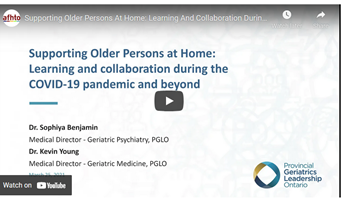
    Supporting older persons at home title screenshot

    Supporting older persons at home slides and video

    On Mar. 25 Provincial Geriatrics Leadership Ontario discussed how to better support older persons in the community using lessons learned during the first year of the COVID-19 pandemic. Slides and video are now available.


    Canada’s Volunteer Awards National Advisory Committee
    Canada’s Volunteer Awards (CVA) will be accepting applications for the CVA National Advisory Committee (NAC) until April 8. Members of the National Advisory Committee play a leading role in the selection of Canada’s Volunteer Awards recipients by reviewing nominations and making recommendations to the Minister of Families, Children and Social Development. They will also support the promotion of the program throughout their term. To apply visit their site.


    AMS Healthcare research fellowships: provider mental health and wellbeing

    AMS Healthcare is offering one-year fellowships of up to $75,000 to early and mid-career academic researchers and scholars and academically trained regulated health care professionals to study and develop expertise/competence in the impact of digital technology/artificial intelligence on compassionate care. Some projects will have an additional focus on the wellbeing and mental health of healthcare providers, patients and caregivers to address the challenges of living and working through the COVID-19 pandemic. Letter of intent due Apr. 7. Visit their site for details.


    Foundations to QI (IDEAS) Program e-Learning Course, Mar. 31 & Apr. 1, 2021
    E-QIP is holding this comprehensive introductory QI course designed for the community mental health sector. You’ll be well versed in a common language and approach to QI with the aim of improving client care, experience and outcomes after this course.
    Find out more here.


    ECHO Managing COVID-19 in Primary Care, Starting Apr. 13, 2021
    UHN’s ECHO series is back- now with 12 parts. Join other primary care providers in this interactive online program.
    Find out more here.


    Building a Resilient Nonprofit Organization through Proactive Risk Management, Apr. 22, 2021
    Charity Village webinar with Risk Management Consultants Lilli Chiu and Isaac Monson from HUB International and insights on how to navigate uncertainty and prepare for the unexpected. Register here.


    Excellence through Quality Improvement (E-QIP) Conference, Apr. 13, 2021
    Hosted by CMHA Ontario, this one-day virtual conference is being offered for FREE.
    Visit their site.

  • The Primary Care Collaborative

    The Primary Care Collaborative

    Primary Care Collaborative logos


    COVID-19 shows the vital roles primary care providers play every day for community health and wellbeing and health system cooperation in Ontario


    Toronto, March 29, 2021 – During COVID-19, we see again and again across Ontario that communities – from people living in large urban centres to smaller cities to towns and rural areas – depend on their local family physicians, family health teams, community health centres, Indigenous primary health care teams, nurse practitioner-led clinics, and other primary care providers in a public health crisis. These providers and organizations are, quite literally, lifelines for the people they serve. The trusted relationships people have with their family doctors, nurse practitioners, healers, mental health professionals and other primary care providers are at the core of local COVID-19 responses, from testing and other direct COVID-19 care, to supports for food security and chronic disease management, to providing credible and culturally safe vaccination information, to knowing how to care for themselves and their loved ones. When the challenges have never been bigger, and the isolation unlike at any other time in our lives, your community providers are there.

    Today, we are announcing we’ve formed the Primary Care Collaborative (PCC), an alliance of comprehensive primary care organizations joined together by common purpose to build on the collaborative work of COVID-19 as we move towards recovery in a time of health system transformation.

    Together, our organizations represent more than 20,000 primary care providers and team members. As Ontario’s primary care providers continue to support their communities through trusted local relationships, partnerships with social services and other providers, and by working with decision makers, we’re committed to ensuring that health system policies and funding acknowledge primary care’s vital role and place in community health and wellbeing. Speaking with one voice, we will advance shared priorities in primary care such as expanded access to teams and better links to home care and mental health supports. The PCC knows that for health care integration and transformation to work for people – for those using the health system and those looking for services to stay well – primary care needs to be the foundation of Ontario’s health system. Robust and well-supported primary care is the heart of all world-class health systems, and people living in Ontario should expect no less. During COVID-19, this is a given. In recovery, when many echo effects of the pandemic will be felt for years to come, it will be of utmost importance.

    QUOTES FROM MEMBERS OF THE PRIMARY CARE COLLABORATIVE

    “The Indigenous Primary Health Care Council appreciates the importance of this collaborative opportunity to strengthen and unify the voice of primary care practitioners across the province. Primary care is the foundation for a high quality, sustainable and integrated system; evidence shows that jurisdictions with high performing primary care place it at the centre of health care delivery. The IPHCC is especially thankful to our partners in the PCC for recognizing that our community-driven Indigenous-governed interprofessional primary care models include Traditional healers and Cultural Service Providers. This is an integral part of promoting a wholistic approach to health and wellbeing for Indigenous people. Great things can happen when the right people come together, and I look forward to advancing our vision for a robust health care system that addresses not just the physical wellbeing of an individual but to the social, emotional, cultural and spiritual wellbeing of the whole community.” Caroline Lidstone-Jones, CEO, Indigenous Primary Health Care Council

    “The Alliance for Healthier Communities’ member centres provide community-based comprehensive primary health care across Ontario, and they are essential to addressing barriers to health and wellbeing that marginalized populations face. Health equity – that is, the idea that everyone deserves a chance to live their healthiest life, but that many people face barriers to doing so – is only achievable where trusted relationships can be built in and by the community. The Alliance is committed to working with our partners in the PCC to ensure the cornerstone of our health system – primary care – can continue to step up for the people in Ontario who face barriers. We have seen throughout the pandemic that we are stronger when we work together, and we look forward to continuing to work collaboratively to build a better future.” Sarah Hobbs, CEO, Alliance for Healthier Communities

    “The Nurse Practitioner-Led Clinic Association is proud to be working with this strong group of primary care association leaders. Often a person’s first point of contact with the health care system, primary care is integral for the health and wellbeing of not only patients, but also the communities in which they live. NPLCs have focused on whole person care since our inception, with nurse practitioner leadership at all levels of the organization. By coming together, this collaborative will provide a united voice for primary care and will allow for us to advocate for health care initiatives across the province.” Jennifer Clement, Past-President, Nurse Practitioner-Led Clinic Association

    “Across the world, cost-effective and high-performing health systems share a common characteristic – they are based on a foundation of comprehensive primary care, which is supported through a team. Primary care is the first point of contact into the health system; jurisdictions that commit to robust investments in primary care are able to move quicker into achieving the Quintuple Aim, ensuring there is a lens towards equitable and accessible care, close to home. AFHTO is pleased to be working with our comprehensive primary care partners to ensure there is a unified voice for primary care, especially as we move towards the daunting task of post-pandemic recovery. We know that this work can only be achieved if we truly work together and we look forward to our ongoing collaboration.” Kavita Mehta, CEO, Association of Family Health Teams of Ontario

    “Ontarians turn to primary care more often than any other part of the health system. Providing high-quality care is truly a team sport. The Ontario College of Family Physicians is pleased to be working together with our primary care partners to create a unified voice – as family physicians, nurse practitioners, interprofessional healthcare providers and team-based primary care. This collaboration will only strengthen our ability to achieve comprehensive, continuous, coordinated and equitable health care for all patients and families across Ontario as envisioned by the Patient’s Medical Home.” Leanne Clarke, CEO, Ontario College of Family Physicians

    “Primary care is foundational to a high performing healthcare system, and the sector is stronger when it is united. This is why the Ontario Medical Association Section on General & Family Practice (SGFP) is so pleased to be part of this newly formed Primary Care Collaborative (PCC) with our partners that also support comprehensive primary care. SGFP represents the 15,000 family doctors in Ontario in advocacy and negotiations and is dedicated to building a united vision for a more integrated, equitable and unified sector. We know that there are many challenges ahead for the healthcare system, and this past year has underscored that incredible things can happen when strong leaders come together in shared purpose. By working collaboratively during much of this pandemic, the PCC has been successful in collectively advocating for and advancing solutions that have made a positive impact on the sector and the health and wellbeing of Ontarians. SGFP is looking forward to continuing to work with PCC to bring out the best in care for Ontarians and to support primary care to thrive in our province.” Dr. David Schieck, Ontario Medical Association, Section on General & Family Practice

    Return to: Primary Care Collaborative Updates


    Media contact for interview requests, comments or inquiries:

    Paula Myers,

    Manager, Membership and Communications

    Association of Family Health Teams of Ontario

    Email: paula.myers@afhto.ca

    Phone: (647) 234-8605 extension 1200


  • Joint Letter on Vaccine dose intervals for Indigenous populations

    To:    Premier Doug Ford
    Christine Elliott, Deputy Premier, Minster of Health

    Cc:    Dr. Dirk Huyer, Coordinator, Provincial Outbreak Response
    Greg Rickford, Minister of Indigenous Affairs
    Dr. David Williams, Chief Medical Officer of Health (MOH)

    Re: Changes to dosing schedule for COVID-19 Vaccine Distribution to Urban Indigenous populations

    March 26, 2021

    Dear Premier Ford and Minister Elliott,

    We write to you today, urgently, with regards to the announcement made on March 18, 2021 that, while on-reserve First Nations people will receive their second vaccine doses within 21-28 days, those living in urban areas will have to wait up to four months for their second doses.

    Indigenous adults were prioritized within the vaccine framework with good reason; due to historical health barriers linked to colonialism and continued pervasive anti-Indigenous racism, Indigenous people living everywhere in Ontario – on reserve and in urban areas – face health vulnerabilities that others living in Ontario do not. For those living in urban areas, this includes higher rates of homelessness and transient housing, overcrowded housing, and poor health status, among other factors. In addition, there are still many Indigenous people living in urban areas who have yet to receive their first shots. This sudden change to the priority of Indigenous people undercuts the confidence and trust in the vaccines themselves, and in the system that is distributing them, as well as the providers tasked with reaching marginalized Indigenous people. This is, simply put, unacceptable, and frankly avoidable.

    We are standing in solidarity with the Indigenous Primary Health Care Council and asking that, at bare minimum, those Indigenous people living in urban areas who’ve already received their first doses of vaccines be grandfathered in, and permitted to receive their second doses within 21-28 days. This allows for continuity of care, and confidence in this process and the vaccine itself.

    Premier, Minister, there is already mistrust mounting in Indigenous communities because of this confusion. There are different approaches being taken across Public Health Units, further adding to the potential for miscommunication and misinterpreted guidance. These moments risk seeing the spread of COVID-19 into First Nations communities, and creating more challenges for all. Urban Indigenous vaccine strategies must be delivered consistently across the province to avoid these ambiguities and variances in the delivery of COVID-19 care for the Indigenous population.
     
    As many Alliance members serve urban Indigenous populations across the province, alongside the members of the Indigenous Primary Health Care Council, we look forward to working with you to ensure that the clearest possible plan and strategies can be enabled to ensure the safety of all Indigenous communities in the province.

    Sincerely,

    Sarah Hobbs, CEO, Alliance for Healthier Communities
    Kavita Mehta, CEO, Association of Family Health Teams of Ontario Leanne Clarke, CEO, Ontario College of Family Physicians

    cc.:
    Shawn Batise, Deputy Minister, Indigenous Affairs
    Nadia Surani, Acting Director, Primary Care Branch, Ministry of Health

    See the pdf version here.

  • Overview of the 2021 Ontario Government Budget

    2021 Ontario Budget – Ontario’s Action Plan: Protecting People’s Health and Our Economy
    An overview of the Ontario government’s budget

    March 25, 2021

    Overview
    Yesterday, March 24, the government released the 2021 Ontario Budget entitled “Ontario’s Action Plan: Protecting People’s Health and Our Economy.” This budget builds on the investments announced last March in “Ontario’s Action Plan: Responding to COVID-19” and on the 2020 budget that was introduced last November. It has two major areas of focus:

    • Protecting People’s Health: An allocation of $16.3B to protect people’s health, including more than $1B to support the administration, distribution, and roll-out of the COVID-19 vaccine and $2.3B in 2021-22 for a comprehensive testing strategy.
    • Protecting Our Economy: An investment of $23.3B to support families, workers, and small businesses impacted by the public health measures put in place to manage the spread of the virus.

    The $16.3B for health care and $23.3B for the economy, makes total direct support $39.6B. An additional $11.3B was announced to improve cash flow for people and businesses. This makes the total supports committed by the government to be $51B over four years.

    AFHTO is disappointed that there were no funding announcements made to support primary care or team-based primary care. Post-pandemic recovery cannot happen without investments in the community and within primary care, and the sector needs help to improve the health and well-being of all Ontarians.

    There were also no investments in paid sicks days for people who can’t afford to stay home when sick. There were some mental health and vulnerable populations supports although they were not significant, and none flow directly to primary care.

    We will continue to work with our partners and to advocate for the importance of primary care in the pandemic response and the integral role the sector plays in supporting the most vulnerable populations. We thank you for all the work you do, day in and day out, to support your patients and your communities.   

    Here is an overview of the budget:

    Protecting People’s Health

    • Defeating COVID-19
      • $1B for a province-wide vaccination plan.
      • $2.3B for testing and contact tracing.
      • $1.4B for PPE, including more than 315 million masks and 1.2 billion gloves.
      • An additional $5.1B has been invested in hospitals since the pandemic began, including $1.8B announced for 2021-22 to continue providing care for COVID-19, to address surgical backlog, and to address current patient needs.
      • $3.7 million in 2021–22 to help remove transportation barriers for persons with disabilities and older adults with limited mobility to travel to their vaccination appointments.
      •  $50 million to support community‐led vaccination efforts in First Nations and urban Indigenous communities.
      • Ontario has invested over $100 million in IPAC funding and, building on this investment, is investing $50 million in 2021–22 to ensure IPAC resources and expertise are available across the health system, including hospitals and public health units.
    • Fixing long-term care
      • $933M over four years, for a total of $2.6B, to support building 30,000 new long-term care beds.
      • $246M over the next four years to improve living conditions in existing homes, including providing air conditioning.
      • $4.9B over four years to increase average direct daily care to four hours a day and to hire more than 27,000 providers, including PSWs and nurses.
      • Expanding the Community Paramedicine for Long-term Care Program by investing $160M over three years to support 33 communities.
    • Caring for People
      • An additional $175M for 2021-22 for people struggling with mental health and addiction problems. This is a part of the already announced $3.8B over 10 years.
      • There will be an additional $2.1M over three years to support victims of crime, such as domestic violence and human trafficking.
      • $12.5M over three years to enhance mental health services available to OPP staff.
      • Four new mobile mental health clinics across the province.
      • $8.4M over three years in a crisis call diversion program to provide supports, which may include diversion to appropriate mental health services. Mental health workers will be embedded in OPP communications centres.
      • $1.6M over two years to support the Anti-Racism and Anti-Hate Group program.

    Protecting Our Economy

    • Supporting workers and families
      • Ontario Jobs Training Tax Credit for 2021 of up to $2,000 per recipient for a total of roughly $260M.
      • Supporting parents with a child benefit through a third round of payments, totaling $1.8B since last March. The payment will be $400 per child and $500 for each child with special needs.
      • To support parents with childcare and getting back to work, a 20% enhancement of the CARE tax credit is proposed for 2021.
      • A Seniors’ Home Safety Tax Credit for 2021 to provide an estimated $30M in support for about 27,000 seniors.
    • Supporting jobs:
      • A second round of the Ontario Small Business Support Grant payments, from which approximately 120,000 small businesses will benefit from an additional $1.7B in relief.
      • $400M over three years to the tourism, hospitality, and culture industries.
      • Ontario is investing $2.8 billion in broadband, bringing the province’s total investment to nearly $4 billion over six years, beginning in 2019-20.
      • Temporarily enhancing the Regional Opportunities Investment Tax Credit with an additional $61M.
    • Supporting communities:
      • To support faith-based and cultural organizations, Ontario will be making up to $50M available for grants to eligible organizations.
      • To support Ontario’s municipalities, the government is providing almost $1B in additional financial relief in 2021 to help preserve public services and support economic recovery.

    You can find full details of the “Ontario’s Action Plan: Protecting People’s Health and Our Economy” online, including the province’s economic and fiscal outlook, and borrowing and debt management.


  • Bits & Pieces: phase 2 guidance, cancer screening rock stars needed and more

    Bits & Pieces: phase 2 guidance, cancer screening rock stars needed and more

    Your Weekly News & Updates


    In This Issue  
    • Cancer screening rockstars needed
    • Reminder- Supporting Older Persons at Home, March 25
    • COVID-19 vaccine roll-out & hesitancy in Indigenous communities
    • Guidance on phase 2 prioritization for COVID-19 vaccination and more
    • National Newcomer Navigation Network – N4
    • Virtual health care for patients with developmental disabilities- study
    • Excellence through Quality Improvement (E-QIP) Conference
    • Upcoming events including Wise Practices for COVID Vaccinators and more


    Cancer screening rockstars needed

    Don’t leave your team’s stories untold!
    In a recent Bits & Pieces, you may have seen Ontario Health (Cancer Care Ontario)’s guidance for resuming breast, cervical and colorectal cancer screening. In collaboration with our primary care partners and Ontario Health (Cancer Care Ontario), we will host a webinar to further explore this document and share stories from teams resuming cancer screening.

    If your team has initiated a cancer screening program to resume and catch up on screening, please fill this member initiative webform to let us know! If you are interested in sharing your story during our webinar, please email Sandeep Gill sandeep.gill@afhto.ca by this Friday, Mar. 26.

    Questions? Email us at improve@afhto.ca 


    Reminder- Supporting Older Persons at Home, March 25

    COVID-19 highlighted numerous barriers and challenges to providing integrated care for older persons living in the community.

    Join Provincial Geriatrics Leadership Ontario in a discussion on how to better support older persons in the community using lessons learned during the first year of the COVID-19 pandemic.

    We will discuss needs in primary care – focusing on the role of interprofessional teams – and offer some resources and tools to better support team-based care for older persons.

    We will also discuss how specialized geriatric service programs in your area can provide support to primary care clinicians.


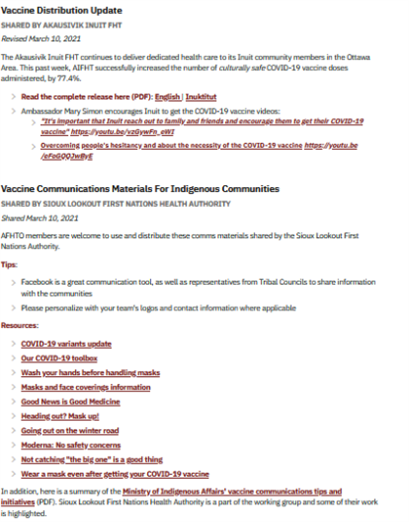
    Indigenous vaccine page screenshot


    COVID-19 vaccine roll-out & hesitancy in Indigenous communities
    Indigenous communities are prioritized for the COVID-19 vaccine rollout, but the historic reasons for that prioritization-including systemic racism- may also contribute to vaccine hesitancy within the communities.

    In response we have compiled resources from Akausivik Inuit FHT and Sioux Lookout First Nations Health Authority to help combat it. Visit our site for the full list.


    Guidance on phase 2 prioritization for COVID-19 vaccination and more

    Recent updates include:

    We continue to update several pages on our site with resources and news:


    National Newcomer Navigation Network – N4

    N4 is a national network for professionals from Canada’s Healthcare and Social Service sectors to connect, learn and collaborate in their work with newcomers (immigrants and refugees).

    While newcomers make up over 20% of Canadians and face many barriers to receiving care or services, they are often overlooked as needing help to navigate our systems.

    N4 provides a one-stop platform for professional development, education, virtual discussions, networking, and the sharing of data and resources. N4 promotes inter-sectoral collaboration to encourage sharing of expertise, economies of effort, and promotion of leading and best practices in the field of newcomer navigation.

    Membership is free thanks to funding from Immigration, Refugees and Citizenship Canada (IRCC). You can become a member here.


    Virtual health care for patients with developmental disabilities- study

    A University of Toronto PhD candidate is currently recruiting for a study on virtual primary care for adults with developmental disabilities. This work is being conducted together with the Azrieli Adult Neurodevelopmental Centre at CAMH.

    The goal is to learn how to deliver high quality virtual care to patients with developmental disabilities, when virtual care is not appropriate, and what supports are needed to be successful. As part of this study they are interviewing primary care providers.

    See the flyer here.

    If anyone is interested in learning more about the study you can contact  avra.selick@camh.ca or 416-535-8501 x30127.


    Save the date april 13, 2021 E-QIP QI Innovations: Understand-Pivot-Change 2021 virtual conference


    Excellence through Quality Improvement (E-QIP) Conference

    The Excellence through Quality Improvement Project (E-QIP), Quality Improvement Innovations: Understand-Pivot-Change 2021 Conference will be on Tuesday, April 13, 2021. Hosted by CMHA Ontario, this one-day virtual conference is being offered for FREE.

    It will bring together Ontario’s leading quality improvement experts in the mental health and addiction sector. Visit their site.


    Wise Practices for COVID Vaccinators, Mar. 23, 2021
    Learn how to actively design and deliver vaccination services to support high quality, safe experiences for Indigenous patients. You’ll walk away with wise practices & strategies for working in a culturally safe & respectful way.
    Find out more here.


    BounceBack refresher webinar, Mar. 25, 2021

    The BounceBack communications and marketing team invites you to a 30-minute refresher presentation on BounceBack, a free CBT skill-building program designed to help individuals 15+ manage low mood, mild to moderate anxiety or depression, stress or worry.


    OHT Virtual Engagement Series Second Session (RISE OHT Webinar), Mar. 25, 2021
    Join the Ministry as they discuss the details around the core components of the OHT Performance Measurement Framework. They’ll be identifying Cohort 1 OHT-selected indicators and OHT evaluation approaches to help you understand OHT evaluation and key measurement supports.
    Learn more here.


    Foundations to QI (IDEAS) Program e-Learning Course, Mar. 31 & Apr. 1, 2021
    E-QIP is holding this comprehensive introductory QI course designed for the community mental health sector. You’ll be well versed in a common language and approach to QI with the aim of improving client care, experience and outcomes after this course.
    Find out more here.


    Lessons from vaccine pilots, evolving guidance, and more, Mar 26, 2021
    The COVID-19 CoP, held by the OCFP and the University of Toronto DFCM, will be discussing lessons learned and new guidance around COVID-19 vaccines and rollout.
    Learn more here.


    ECHO Managing COVID-19 in Primary Care, Starting Apr. 13, 2021
    UHN’s ECHO series is back- now with 12 parts. Join other primary care providers in this interactive online program.
    Find out more here.