In this Issue:
- Caregiver Well-Being and Achieving Better Health Outcomes
- Engaging and Supporting Caregivers in Primary Care Teams
- Transforming Primary Care for Older Canadians Living with Frailty
- Ontario Fall Prevention Collaborative
- Upcoming Events
Caregiver Well-Being and Achieving Better Health Outcomes
Content below developed by the Ontario Caregiver Organization
Four million caregivers across Ontario provide an estimated 75% of the care in the system, caring for family, friends, and neighbours. Caregivers are critical to our healthcare system. Reducing the risk of caregiver burn-out and supporting caregiver well-being is crucial now, more than ever. In Ontario, Covid-19 has increased caregiver burn-out, and 61% of caregivers find caregiving stressful overall, up from 49% the year before1.
As Ontario Health Teams strive to transform health care in the province, it is critical that plans for enhanced care delivery include strategies to ensure that caregivers are recognized, included and supported in care delivery.
There is growing evidence that caregiver well-being is an important factor in achieving the Quadruple Aim of better healthcare outcomes, better patient/caregiver experience, better staff/provider experience, and improved value/efficiencies. Well-supported caregivers are more likely to provider better care.2 Evidence shows that caregiver distress can impact patient clinical and mental health outcomes and that caregiver burnout can lead to patients requiring greater hospital usage.3
Caregiver distress impacts the health outcomes of caregivers themselves, with evidence pointing to higher rates of stress and depression among caregivers, greater loneliness and caregivers being 16% more likely than non-caregivers to live with 2 or more long-term health conditions.4,5 Organizations and front-line providers are well positioned to engage and partner with caregivers and connect them to support for their own well-being.
For more information about the impact of COVID-19 on caregivers in Ontario, read the OCO’s Spotlight Report
________
1 Spotlight Report – The Impact of Covid-19 on Caregivers, Ontario Caregiver Organization, November 2021. https://ontariocaregiver.ca/publications/oco-spotlight-report/
2 Canada, a Caring Society: Action Table on Family Caregivers Informed dialogue, leading to concrete action for all Canadians NOV 2013 http://www.ccanceraction.ca/wp-content/uploads/2014/12/Family-Caregivers-Meeting-Report.pdf
3 Shin, J. Y., & Choi, S. W. (2020). Online interventions geared toward increasing resilience and reducing distress in family caregivers. Current opinion in supportive and palliative care, 14(1), 60–66. https://doi.org/10.1097/SPC.0000000000000481
4 Claire K. Ankuda MD, MPH,Donovan T. Maust MD, MS,Mohammed U. Kabeto MS,Ryan J. McCammon MA,Kenneth M. Langa MD, PhD,Deborah A. Levine MD, MPH (August 2017). Association Between Spousal Caregiver Well-Being and Care Recipient Healthcare Expenditures. https://doi.org/10.1111/jgs.15039
5 Public Health England. (March 2021) Caring as a social determinant of health Findings from a rapid review of reviews and analysis of the GP Patient Survey. https://assets.publishing.service.gov.uk/government/uploads/system/uploads/attachment_data/file/971115/Caring_as_a_social_determinant_report.pdf
Engaging and Supporting Caregivers in Primary Care Teams
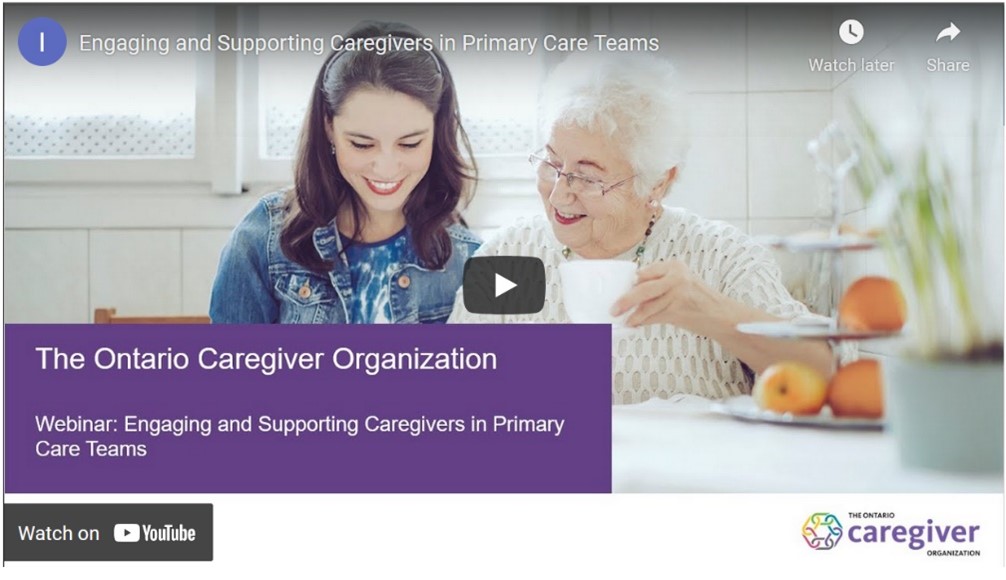
Last February we cohosted a webinar with OCO, “Engaging and Supporting Caregivers in Primary Care Teams: Working together to improve outcomes and enhance the patient, caregiver, and family experience”. Visit our site for the video and slide deck.
Transforming Primary Care for Older Canadians Living with Frailty
Content below developed by the Geriatric Health Systems Research Group
Members of the Geriatric Health Systems Research Group (University of Waterloo) collaborated with investigators across Canada to submit a grant to the Canadian Frailty Network. The grant focused on supporting primary care through the implementation of tools to enhance risk screening, shared decision-making, and care coordination for older adults. Situated as the patient’s medical ‘Home’, and supporting older adults throughout the whole care journey, primary care is well positioned to address frailty in a proactive, preventive, coordinated and integrated manner, reaching the most people, as early as possible.
A key output of this grant is an implementation guide, which supports interested primary care practices with implementation at their site. See here for more information, and the step-by-step implementation guide.
Correspondence to Dr Paul Stolee: stolee@uwaterloo.ca
Ontario Fall Prevention Collaborative
Content below developed by the Ontario Fall Prevention Collaborative
The Ontario Fall Prevention Collaborative is a diverse group of health and social service practitioners and clinicians from across Ontario who come together to share information, analyze trends, and respond collectively to the need for change and innovation in fall prevention among older adults.
In Ontario, fall prevention initiatives for older adults vary in their scope, approach, implementation, and measurement of outcomes. The heterogeneous, fragmented nature of fall prevention efforts make it difficult to ascertain what interventions are working, how interventions can be improved and where a greater investment of resources or an increased level of co-ordination and collaboration between key stakeholders is required to maximize impact (Dr. Brian Hyndman, 2018).
The Collaborative advances excellence in fall prevention practice by carrying out applied research and practice development activities that individual practitioners do not have the time/ capacity to address on their own. The work of the Collaborative aligns with the vision for health care in Ontario by prioritizing fall prevention among older adults and emphasizing integrated approaches.
Current Work:
The Collaborative completed the second phase of its work by contributing to a prioritized list of falls indicators led by Public Health Ontario as well as a review of clinical practice guidelines for falls risk screening and assessment including recommendations for action in 2022-2023. This report should be coming in the next few weeks and will be posted on the Public Health Ontario website.
See here for Environmental Scan of Older Adult Fall Prevention Indicators.
See here for Screening and Assessment Tools for Falls in Older Adults in Ontario.
Upcoming Events
Practical Technologies that can Enable Ageing in Place
May 19 from 9:00-10:00 am
Dr. Samir Sinha, Director of Geriatrics at Sinai Health, and University Health Network (UHN) and Director of Health Policy Research at the National Institute on Ageing (NIA) will be presenting on Practical Technologies that can Enable Ageing in Place on May 19, from 9:00 – 10:00am EDT. This webinar is presented by Sinai Health, in partnership with the NIA, UHN, and the Primary Care Collaborative.
The webinar will aim to give health care professionals a better understanding of:
- The risks and impacts of at-home medical emergencies
- Why older Canadians want to age in place, now more than ever
- Practical technologies that can enable ageing in place
This program has been accredited by the College of Family Physicians of Canada (CFPC) for 1 Mainpro+ credit for those who are interested.
Register here.
Transforming Primary Care for Older Adults Living with Frailty
June 1 from 12:00-1:00 pm
Investigators from the CFN funded study, “Transforming primary care for older adults living with frailty”, will share key highlights, reflections and developed resources from their implementation work in team-based primary care sites. This national project aimed to improve care for at-risk older adults across Ontario, Quebec and Alberta. The project was designed to address the following areas: consistent risk screening and assessment; care coordination and system navigation; and patient/caregiver engagement and shared decision making.
Register here.
In Case You Missed It: Check out eBulletin #116 or other back issues here!
Questions? Comments? Contact us at improve@afhto.ca.