This page contains resources for the following:
AFHTO is making it easier to access resources on the Members Only resources website – content has been re-organized into five broad categories to improve navigation. As you browse you’ll find that each sub-category includes a description of the type of content to be found there:
This is a first step in an overall strategy to make the website more useful to members. We will be simplifying access to Members Only and support browsing with smartphones and tablets. Stay tuned for more information as these changes come into effect.


Updates, education opportunities and resources for FHTs and NPLCs. Click below for more information:
Health Quality Ontario (HQO) released “Experiencing Integrated Care: Ontarians’ views of health care coordination and communication”, a report on patients’ experiences of their transitions between their primary health care doctor, specialists and hospitals. In primary care, however, we know care coordination also involves collaboration spanning a wider array of health and social services and is a fundamental role of primary care. To read more on our response to the report please visit our site.
Two Rivers FHT has graduated from the three-year pre-designation program to become a Best Practice Spotlight Organization (BPSO) designate. Since 2012, Two Rivers FHT has been implementing and evaluating the Registered Nurses’ Association of Ontario (RNAO)’s best practice guidelines in order to improve patient, staff and administrative outcomes. BPSOs are health-care and academic organizations selected through a request for proposals process. More information about this process is on the BPSO webpage.
The IDEAS program (Improving & Driving Excellence Across Sectors) has opened applications for the 2015/16 accredited Advanced Learning Program. It includes nine days of classroom instruction and group-learning activity spread over five months focused on quality improvement in healthcare, plus support from an advisor to apply the learning to a project. Tuition is covered by IDEAS. Deadline to apply is June 1. Information and how to apply is available at www.ideasontario.ca.
The College of Family Physicians of Canada (CFPC) is replacing MAINPRO, its program designed to support professional development for family physicians, with MAINPRO+ this year. Changes include new reporting categories to earn credit for more practice activities and increased accessibility through smartphones and tablets. Click here or watch this video to find out more.
The Low Back Pain course offered by the Centre for Effective Practice (CEP) has been re-accredited and is available until October 7, 2015 through funding received from the Ministry of Health and Long-Term Care (MOHLTC). The online course is available to providers across Canada in both English and French.
The Chief Medical Officer of Health (CMOH) issued a revised Directive for primary care settings to provide instructions on control measures related to Ebola virus disease (EVD) on April 13. The primary revision in the Directive is with the person protective equipment required for staff in primary care settings who are at risk of exposure to a suspect case of EVD or that case’s environment or waste. If you have any questions or concerns you can contact the Health Care Provider Hotline by phone at 1-866-212-2272 or by email at emergencymanagement.moh@ontario.ca.
The MOHLTC has engaged CEP in partnership with the OCFP to develop clinical tools and health information for primary care providers. The first in a series is a Preconception Health Care Tool to improve maternal and infant health outcomes in your practice by guiding discussions of health promotion and illness prevention strategies with patients of reproductive age.
The Ontario Health Study is setting up temporary study centres in communities across Ontario to sign up new participants and collect blood samples, which will enable researchers to better understand what affects health and quality of life. Primary care providers are asked to share information about the study and the local study centres with patients and facilitate participation if appropriate. To learn more about the study and how you can help, click here. Contact the Ontario Health Study at 1-866-606-0686 or info@ontariohealthstudy.ca.
The province is launching consultations to update their Long-Term Affordable Housing Strategy. Given the need for affordable housing and its potential impact on patient health, primary care providers may invite their patients to provide input as well as doing so themselves. The Consultation Discussion Guide outlines the progress of the current strategy, future goals and areas where more input from partners is needed. Participants can submit their views to the government online, by telephone or in writing by July 3, 2015.
Updates, education opportunities and resources for FHTs and NPLCs. Click below for more information:
Health Quality Ontario (HQO) released “Experiencing Integrated Care: Ontarians’ views of health care coordination and communication”, a report on patients’ experiences of their transitions between their primary health care doctor, specialists and hospitals. In primary care, however, we know care coordination also involves collaboration spanning a wider array of health and social services and is a fundamental role of primary care. To read more on our response to the report please visit our site.
Two Rivers FHT has graduated from the three-year pre-designation program to become a Best Practice Spotlight Organization (BPSO) designate. Since 2012, Two Rivers FHT has been implementing and evaluating the Registered Nurses’ Association of Ontario (RNAO)’s best practice guidelines in order to improve patient, staff and administrative outcomes. BPSOs are health-care and academic organizations selected through a request for proposals process. More information about this process is on the BPSO webpage.
The IDEAS program (Improving & Driving Excellence Across Sectors) has opened applications for the 2015/16 accredited Advanced Learning Program. It includes nine days of classroom instruction and group-learning activity spread over five months focused on quality improvement in healthcare, plus support from an advisor to apply the learning to a project. Tuition is covered by IDEAS. Deadline to apply is June 1. Information and how to apply is available at www.ideasontario.ca.
The College of Family Physicians of Canada (CFPC) is replacing MAINPRO, its program designed to support professional development for family physicians, with MAINPRO+ this year. Changes include new reporting categories to earn credit for more practice activities and increased accessibility through smartphones and tablets. Click here or watch this video to find out more.
The Low Back Pain course offered by the Centre for Effective Practice (CEP) has been re-accredited and is available until October 7, 2015 through funding received from the Ministry of Health and Long-Term Care (MOHLTC). The online course is available to providers across Canada in both English and French.
The Chief Medical Officer of Health (CMOH) issued a revised Directive for primary care settings to provide instructions on control measures related to Ebola virus disease (EVD) on April 13. The primary revision in the Directive is with the person protective equipment required for staff in primary care settings who are at risk of exposure to a suspect case of EVD or that case’s environment or waste. If you have any questions or concerns you can contact the Health Care Provider Hotline by phone at 1-866-212-2272 or by email at emergencymanagement.moh@ontario.ca.
The MOHLTC has engaged CEP in partnership with the OCFP to develop clinical tools and health information for primary care providers. The first in a series is a Preconception Health Care Tool to improve maternal and infant health outcomes in your practice by guiding discussions of health promotion and illness prevention strategies with patients of reproductive age.
The Ontario Health Study is setting up temporary study centres in communities across Ontario to sign up new participants and collect blood samples, which will enable researchers to better understand what affects health and quality of life. Primary care providers are asked to share information about the study and the local study centres with patients and facilitate participation if appropriate. To learn more about the study and how you can help, click here. Contact the Ontario Health Study at 1-866-606-0686 or info@ontariohealthstudy.ca.
The province is launching consultations to update their Long-Term Affordable Housing Strategy. Given the need for affordable housing and its potential impact on patient health, primary care providers may invite their patients to provide input as well as doing so themselves. The Consultation Discussion Guide outlines the progress of the current strategy, future goals and areas where more input from partners is needed. Participants can submit their views to the government online, by telephone or in writing by July 3, 2015.
REMINDER: The deadline to request ICES data is April 21, 2015. A signed version of the form is required. Please scan and email to improve@afhto.ca or fax to (416) 920-6556 attention Denise Pinto. Requesting this data does not mean you are automatically contributing to D2D 2.0. It just means you will have it on file, in case you DO decide to contribute later. For more information about ICES data click here. Sign up for D2D 2.0: Regardless of whether you request ICES data, please sign up for D2D 2.0 if you are intending to contribute ANY data. This will ensure that we can support you through the data submission process. On that note, there are now more teams signed up than for D2D 1.0 – nearly 36% of AFHTO members and counting! For more information contact Carol Mulder. NPLC Participation in D2D 2.0: NPLCs will be able to submit data for any indicators that are NOT based on OHIP billing (ICES data). AFHTO is working with the Association of Ontario Health Centres (AOHC) and ICES to make billing data-based indicators more available for NPLCs for future iterations of D2D. For D2D 2.0 please check out the data dictionary for the indicators that you are able to submit. Video: Why D2D Matters: This new 4 minute video tells a story about why D2D matters from the perspective of a family doctor. We hope it might start or boost conversations about what D2D might do for your team.
AFHTO puts patients first in measuring performance: The nation-wide Patient-Doctor Relationship Survey is now complete with a GREAT response from over 200 patients! The results will be used to calculate the quality “roll-up” indicator in the D2D 2.0 report. Contact Puja Ahluwalia for more details. Build a COPD registry: Interest in the EMR query built by your QIDSS to generate a COPD registry is growing. The query is currently available for Telus PS and Accuro EMRs and an OSCAR query will be released shortly. Steps on how to use the query can be found here. Want to know more? Contact Greg Mitchell.
AFHTO 2015 Conference call for abstracts: Share your successes, processes and tools that strengthen Team-based Primary Care: The Foundation of a Sustainable Health System by submitting an abstract for the AFHTO Conference. Submissions are being collected for presentations and posters in 7 core streams. Deadline to submit is May 11 at 9:00 AM. What do you think? We hope you find value in the D2D eBulletin and will continue to subscribe to this newsletter. Other members of your team can sign up by clicking here. Once they complete the sign-up form a confirmation e-mail will be sent within 24 hours. In the meantime, if you have any comments or questions about the eBulletin, please let us know by e-mail to improve@afhto.ca. What is D2D? Data to Decisions (D2D) is a member-wide summary of performance on indicators that are both possible for members to measure and that are meaningful to members. See the D2D page on AFHTO’s website for more information.
April 16 – Two Rivers FHT honoured at Registered Nurses’ Association of Ontario (RNAO)’s Annual General Meeting 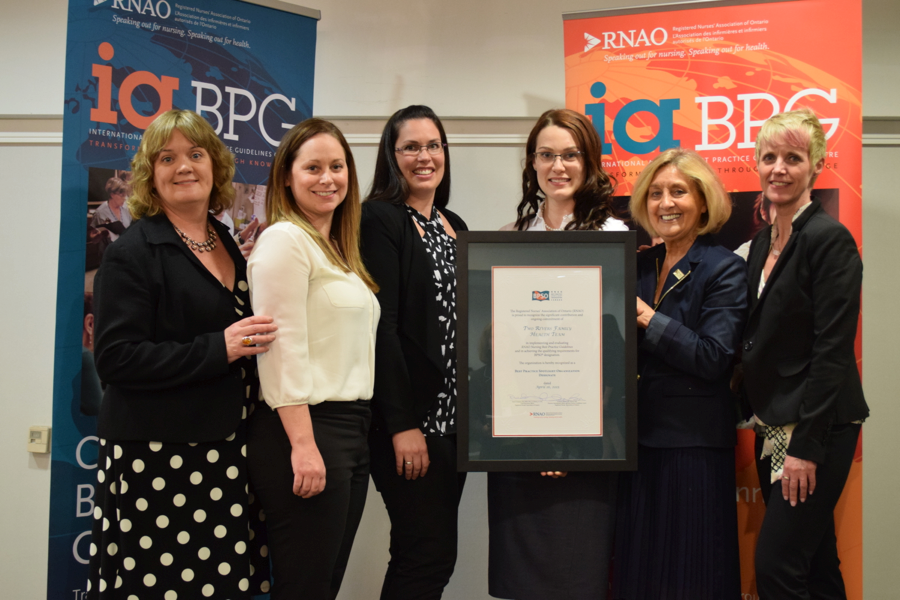 Left to Right: Heather McConnell (RNAO Associate Director, Guideline Implementation and Knowledge Transfer), Lesley Roberts (Two Rivers RPN), Jennifer Veens (Two Rivers RN), Jessie Rumble (Two Rivers BPSO Lead, RN), Dr. Irmajean Bajnok (RNAO Director of International Affairs and Best Practice Guidelines Centre), and Karen Reynard (Two Rivers RN) Two Rivers FHT has graduated from the three-year pre-designation program to become a Best Practice Spotlight Organization (BPSO) designate. Since 2012, Two Rivers FHT has been implementing and evaluating the RNAO’s best practice guidelines in order to improve patient, staff and administrative outcomes. BPSOs are health-care and academic organizations selected through a request for proposals process. More information about this process is on the BPSO webpage.
Sign up to participate in Data to Decisions (D2D) 2.0. If your team is still considering participating, see the video below to help your team see the value. Teams participating in D2D 2.0 can choose to submit data for one or more indicators, based on your team’s readiness to contribute data. The list and sources of data are outlined in the data dictionary. Some of these indicators require OHIP data from ICES, to access this data fill out the online ICES data request form and submit by April 21, 2015. Why participate: This video was created by your peers to help all team members and decision makers understand how D2D may impact care. Teams may choose to participate in D2D for a variety of reasons. Begin the conversation with your Board and colleagues to see how D2D can benefit your team. Scroll down to see what your peers have to say about their experience with D2D. For more information about the video click here. Next steps: A detailed timeline for participating in D2D 2.0 is available on the AFHTO website along with the D2D 2.0 data dictionary. The most important next steps are:
For more information contact your QIDS Specialist, the QIDS provincial program or go to the D2D webpage. Additional AFHTO members have shared their experiences participating in D2D:
“I see D2D 2.0 as a unique reflection of interdisciplinary care. Reporting how we are doing as teams can help those of us in the trenches measure, improve and ultimately advocate for team-based care across Ontario” Cathy Faulds, lead physician, London FHT
“I see D2D 2.0 as a way to make measurement more reflective of how I work every day with my team and with my patients. I like the idea of having input into what those measures are. D2D 2.0 gives me a way to do that” Rob Annis, family physician, Board member North Perth FHT (Listowel) and AFHTO
“D2D 2.0 lets me see how our team stacks up against other teams like us so we can see where the gaps are locally as well as across the province. This gives me a sense of pride in what we have already been able to achieve — and helps me focus my energy on what is most important” Kavita Mehta, Executive Director of South East Toronto FHT, AFHTO board member
“D2D moves quality improvement to the next level. Optimizing the patient experience happens when we measure the things that are truly meaningful to both patients and their healthcare providers.” Dave Courtemanche, Executive Director, City of Lakes FHT (Sudbury), QIDSS host team
“AFHTO members are delivering great value – D2D 2.0 gives us a way to demonstrate that in a way that we and our partners can see and act on it!” Randy Belair, Executive Director Sunset Country FHT, QIDSS host team, AFHTO president
April 15- AFHTO welcomes the release of “Experiencing Integrated Care: Ontarians’ views of health care coordination and communication”, Health Quality Ontario’s (HQO) report on patients’ experiences of their transitions between health care providers and the associated care coordination and communication. The report focuses mainly on patients’ experiences of transitions and communication between doctors, specialists and hospitals. In primary care, however, we know care coordination also involves collaboration spanning a wider array of health and social services. Care coordination is a fundamental role of primary care. This is why the Ontario Primary Care Council (OPCC), of which AFHTO is a founding member, defined a set of principles of care coordination:
AFHTO members are working to connect patients with the care and support they need. Here are two examples from past AFHTO conferences: McMaster Family Health Team- the System Navigator– Compromised patients are required to navigate an increasingly complex health care system as well as various government and social/community systems. Acknowledging the challenges presented by the social determinants of health to the delivery of care, the McMaster FHT applied for and received funding for the position of a Case Manager/System Navigator. This unique role was developed in recognition of the many issues, medical and non-medical, a patient faces that affect their health and well-being. Rural Wellington Shared Governance Across Health Care Partners – Nine health provider agencies – four family health teams (East Wellington FHT, Minto-Mapleton FHT, Mount Forest FHT, Upper Grand FHT) , two rural hospitals with three sites, CCAC, Community Mental Health and a mental health and addictions hospital- work together to create integrated and responsive care for patients. Effective care coordination benefits patients and their families by creating more seamless transitions of care, facilitating access, reducing duplication and increasing quality of care. HQO’s report acknowledges this is an exploratory study and states further studies are being considered. Given the importance of primary care for effective care coordination, such studies, reflecting the broader reality of Ontario’s health system, would be welcome.
The Chief Medical Officer of Health (CMOH) issued a revised Directive for primary care settings to provide instructions on control measures related to Ebola virus disease (EVD) on April 13. The primary revision in the Directive is with the person protective equipment required for staff in primary care settings who are at risk of exposure to a suspect case of EVD or that case’s environment or waste. If you have any questions or concerns you can contact the Health Care Provider Hotline by phone at 1-866-212-2272 or by email at emergencymanagement.moh@ontario.ca.
The presentation slide decks for the Effective Governance for Quality in Primary Care Workshops held last in March of 2015 are now available. This workshop is an evidence-based training program for FHT and NPLC Boards of Directors, Executive Directors and Medical Leads and is delivered to them by peer leaders. Effective Governance for Quality in Primary Care was created by the Canadian Patient Safety Institute (CPSI). To support the quality agenda in primary care, the MOHLTC partnered with CPSI and the Association of Family Health Teams of Ontario (AFHTO), the Association of Ontario Health Centres (AOHC), the Nurse Practitioner’s Association of Ontario (NPAO) to customize the program to Ontario’s primary care organizations. Each workshop contains information to help Board members, Executive Directors and Medical Leads guide their organization in delivering quality primary care through good governance. Presentations from the session guide participants through exercises, case studies and best practices on how to lead, govern and improve organizations focused on quality. To access the slides in English, click on the following links:
To access the slides in French, click on the following links:
* Slides for P7 – Strategy and Meaningful Measurement are a new addition to the March 2015 workshops and are not currently available in french.