Category: Uncategorized

  • Getting started with a registry for patients with depression

    Get even better at tracking how well your patients with depression are doing.

    You can use the EMR tools shown below to get even better at tracking how well your patients with depression are doing.

    Why do we need to do better?

    Depression affects about 5% of adults in Canada each year and double that (i.e., 12%) at some point in their lives[i].  ALL Canadians are affected by depression, even they don’t have the disease themselves. This is because depression costs the Canadian economy at least $32.3 billion each year[ii]. In spite of this, people still have real fears of what people around them (families, friends, people at work, etc.) would think of them if they asked for help with depression. This keeps many people from asking for this help. This is where primary care teams come in. They have long term relationships with patients and can work with them to find the best ways to help them with their health.

    What can we do to get better?

    We can start by making sure we know which patients have depression. If you have a list of all patients that have depression, it will be easier to make sure all the right people are invited to the programs, with less risk of people falling through the cracks. The search tools below can help you find which patients in your EMR are likely to have depression.

    What if I already know which patients have depression?

    You might not need to use this tool if you already have a good list of patients who have depression in your EMR. The search is meant for teams that do not yet have a list of patients with depression and do not have a way to check the records of all their patients to come up with such a list.

    How good is this search tool?

    The search tool was based on the case definition from CPCSSN and the input from experts in depression at Hamilton FHT and St Michaels’ Hospital. The tool has been tested with the help of the eHealth Centre of Excellence EMR environment. The search gives few false negatives but does give some false positives. For every 100 patients that the search finds in your EMR, 62 patients will actually have depression but 38 might not. That means you will have to check the list of patients found in your EMR to be sure that they really do have depression. For a team with 10000 patients, you would likely have 500 patients to review. This is better than looking at all 10,000 patients – or not looking at any at all.

    Which EMRs does the search work on?

    Searches are available for TELUS PS, OSCAR, and Accuro EMRs.

    How much data cleaning do I need to do first?

    You do not need to clean your EMR data before you use the tool.  The testing was done on EMR data as they are right now, for better or worse, so you can be sure there is a good chance it will help you too.   You can just load it into your EMR and run it – ie it is plug-and-play. [i] 5% of Canadians 15 years or over affected by depression any given year.  12% of Canadians affected by depression over their lifetime.  Statistics Canada’s 2012 CCHS. [ii] The Conference Board of Canada: Annual costs of depression due to lost productivity.

    Technical details of the Query Criteria

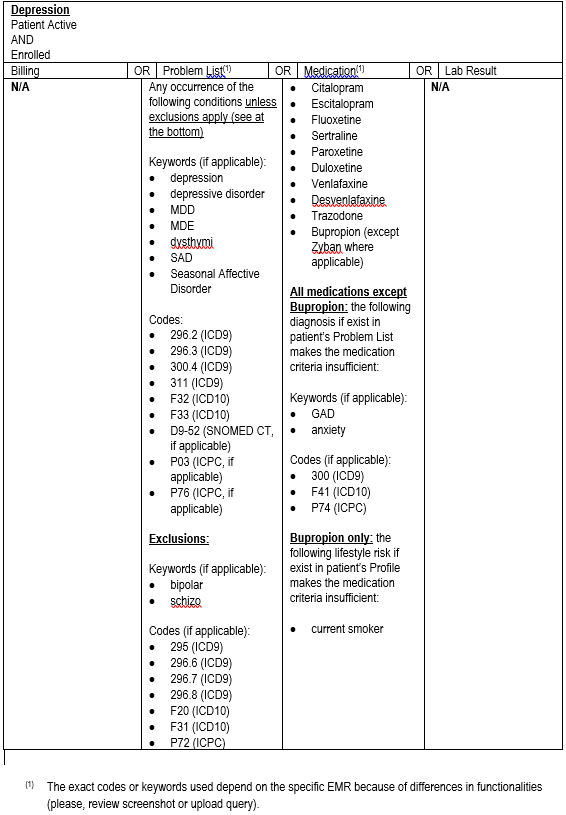
    (click image to see larger version) depression-case-definition-20161027 The Depression query is intended for teams that do not yet have a reliable list of patients with depression and don’t have the time or resources to start from scratch in reviewing all their patients to generate such a list. Right now, it is also only for teams with PSS or Accuro although work is continuing to expand the standardized query to OSCAR and Nightingale. The following steps will help your team use the query to generate a list of CHF patients, starting from your EMR.
    Step 1Estimate how many patients you think this will affect.  Multiply the number of patients your team serves by 0.05 (the average rate of depression in Ontario) to get a rough idea of how many of your patients likely have depression. If you still think this is a big enough group of patients for you to generate a registry for, carry on to step 2.

    Step 2Import the query into your EMR.  Right now, you can only do this if you have either Telus PSS or QHR Technologies Accuro EMRs. You will likely need the help of your QIDSS, IT staff or other person who usually works with your EMR to do this.

    • For PSS, import the PSS SRX file into your EMR
      • This guide provides instructions on how to import the searches into your EMR.
      • Screenshots of the query can be found here
    • For Accuro, download the query “AFHTO Depression Frontend Search”from their publisher.
      • This document provides the query case definition information 
      • Here you can find a guide on how to download the query
    • For OSCAR, please click here to download the numerator and denominator queries 

    Step 3.  Run the query in your EMR. Again, you might need the help of your QIDSS, IT staff or other person who usually runs queries in your EMR. Running the query will produce a list of patients with depression. The list will not be perfect – probably 38% of the patients identified by the query will NOT have depression. The query gets you STARTED in building the depression registry but doesn’t do the whole job for you.

    Step 4Find the patients who might not have depression. Review the list of patients generated by the query to separate out those patients that are clearly already coded as having depression. What’s left will the list of patients who MIGHT have depression based on other data in the EMR besides formal coding.

    Step 5. Prepare your physicians to review the list  Subdivide the list of possible patients with depression into separate, shorter lists for each physician. Work with your physicians to find out if they would prefer a list on paper or electronically and how they might like it sorted (i.e. by name or most recent visit or some other parameter).

    Step 6.  Invite each physician to review their list of patients.  They know their patients best and can likely quickly confirm which ones do or do not have depression, even though that information might not be easy for others to find in the EMR.

    Step 7.  Clean up your EMR data.  Add depression codes to the EMR for each patient that the physician confirms as having depression. This so-called “data cleaning” work is a great job for a student.  AFHTO has created a toolkit to assist members in recruiting and using students for data clean-up. Click here for the toolkit.

    Step 8.  Re-run the query. After you have corrected the EMR, re-run the query to generate a list of patients with depression. This is your new depression patient registry. Going forward, you can run the query anytime you need to generate a list of patients with depression.  You can use the list to invite patients to a depression program, track progress with outcomes on these patients or any other purpose.

    Step 9: Recruit patients to your depression programs.  We will soon be posting resources in setting up a care program for patients with depression.

    Step 10: Measure progress with patient prognosis, management, and overall care. Here are some example outcome measures:

    • % of patients who show an improvement in PHQ-9 score.
    • % of patients who show improvement on CES-D.
    • % of patients hospitalized.
    • % of patients with action plans.
    • % of patients self-identifying as satisfied after a group session.

    This query was produced by and for QIDSS with assistance from eHealth Centre of Excellence in support of all AFHTO members. If you have any questions, please contact improve@afhto.ca.  

  • AFHTO CEO to step down toward year end; Search for next CEO is launched

    To the leaders of AFHTO’s member organizations: As AFHTO’s President, I’m writing to let you know our board of directors is launching the search for its next CEO. With a combination of sadness and support for her decision, the board received notice from Angie Heydon, AFHTO’s first ED/CEO, that she would like to retire from this role at an appropriate point after the 2016 AFHTO Conference in October and before the end of the fiscal year in March 2017. Angie started with AFHTO in August 2010 as our association’s first employee. In her first year she worked tirelessly to engage virtually all FHTs in the AFHTO membership. Two years later she helped AFHTO to welcome NPLCs and any other interested interprofessional primary care organization into this association. Under her leadership, we have seen AFHTO grow its engagement with FHTs and NPLCs, the support services it offers to members, and the influence it exerts in the health system. With last week’s introduction of the Patients First Act, AFHTO members are heading into significant change. I can assure you that Angie and the AFHTO board have carefully worked through steps to ensure a smooth transition and continuing strength in our collective ability to lead and shape the direction for primary care. We see plenty of evidence of that strength, from AFHTO’s influence on government’s direction in the Act, growing interest and strong support for our work to advance measurement, governance, leadership and improvement, and the tangible support shown through government’s commitment to increased funding for compensation in primary care teams. As the Act moves through the legislative process to what we expect will be enactment on April 1, the next AFHTO CEO will be ready to fully take up the role. Angie will continue to provide support on these key files as long as needed. Our CEO search is now underway. Tony Woolgar, Legacy Partners Executive Search, has been contracted to assist. As a first step the search notice has been posted on AFHTO’s website. With Tony’s expert leadership and guidance, the board anticipates it will find the ideal candidate to become AFHTO’s next CEO. We are aiming to conclude the search by end of September so we can introduce the next CEO at the AFHTO 2016 conference. We hope to see you there to meet the new CEO, and to join in a thank you to Angie for her service to our membership and wish her well in the next stage of her life. Sean Blaine MD Family Physician, Stratford, Ontario Clinical Lead, STAR Family Health Team President, Association of Family Health Teams of Ontario (AFHTO)

  • Health Link Leaders: Forming a Link (May 26)

    AFHTO’s Health Link Community of Practice met on May 26th. This communique provides an overview and highlights key items discussed:

    Update from the Ministry

    Ben King (Program Manager – Primary Health Care Branch) provided a brief overview on the status of health links. Key topics included:

    Funding

    Current focus for health links includes preparing 2016/17 funding packages and finalizing funding allocations; working with LHINs to improve clarity and consistency re. terms of funding; and building sustainability by enabling local leadership to grow successes achieved to date.

    Patients First

    The Government has now taken a key step to move forward with its proposal for health care – the Patients First Act was tabled in the legislature on June 2nd. The Ministry indicated that once funding allocations are completed they will turn attention to how health links will need to evolve and the critical role health links will play in the context of Patients First and the establishment of sub-LHIN regions.

    Performance

    The ministry is mindful of the need for a long term shift to more outcome based metrics – to give a better sense of how health links are performing and the value they are providing. Performance data will be a critical component of the future, while streamlining and minimizing unreasonable reporting burdens.

    Care Planning

    Coordinated care plans (CCP) that define how providers, patients and their families work together to coordinate and deliver care for complex patients, has been a prominent facet of Health Links. However, the approach and intent of designing CCPs has varied across the province. The ministry recognizes that care plans do ensure some measure of accountability and volume of patients; however, the focus should not be solely on the “# of care plans” achieved but the value they are providing. The ministry encourages conversations with your LHINs to improve long term metrics and the approach to target stetting to maximize the intended benefits of care plans.

    Mental Health & Addiction

    Developing collaborative and integrated service delivery of primary care and mental health and addiction services remains a top priority for the Ministry; they continue to seek advice on how to decrease the gaps in service and coordination of care, and to build the interface with primary care.

    Care Coordination Tool (CCT)

    The care coordination tool was deployed in 17 sites as an initial release and proof of concept phase is now complete. Orion will be the authorizing platform for the CCT. A very intensive evaluation has been provided to the Ministry regarding usability and functionality with a number of recommendations to consider before widespread implementation across the province occurs. AFHTO staff will follow up with AFHTO members who participated in this proof of concept, to collect feedback and develop recommendations for the Ministry and LHINs.

    A reminder that ETHEeL has completed a legal review and comments from the lawyer are available for use by any Health Link that will be using the CCT tool. If you would like more information, please contact Kavita Mehta (Kavita.mehta@setfht.on.ca).

    If teams are using PSS as their EMR and are interested in a customized data entry tool please contact Jennifer.Mackie@guelphfht.com.

    Integrating Care Planning into a FHT

    Through discussion led by Dr. Dale Guenter (McMaster Academic FHT + Hamilton Central Health Link), members of the CoP shared their experiences and approach to the development of care plans. Highlights include:

    • Relationships are critical. Relations between Primary Care, the LHIN, CCAC, hospital and other health service providers are the most important aspect of developing a successful Health Link. If any teams are experiencing challenges in their relationship with the LHIN as related to Health Links, please contact AFHTO to discuss help or advice that can be offered: Hamilton@afhto.ca
    • Access to data, through hospital reports or LHINs, remains the number one enabler (or in some cases the biggest barrier) to the successful identification of complex patients. Once identified, the next step is to determine the need and value of developing a care plan. This approach still varies significantly across the province.
    • Understanding the typology of the heavy users and reoccurring ER patients (i.e. palliative vs. acute crises ongoing medical crises, etc.) may help to standardize the approach to care plan development. There is interest amongst the CoP members to further understand this subset of users – if any members would like to be more involved in initiating research please contact: guentd@mcmaster.ca
    • Physicians must be engaged for health links to succeed. Showing FHT physicians their list of ‘high user’ patients, and bringing the allied team together to discuss the levers of improving care coordination via health links can be an invaluable approach to getting physicians on board. (Reaching out to non-FHT physicians still remains a challenge in many areas).

    Advanced Care Planning

    East Toronto Health Link is offering a free Advance Care Planning E-Learning Module. Click here to register. Anyone can sign-up!

    Help us Build a Repository of Support for Health Links

    AFHTO has created a section on our website to share tools, resources and updates for Health Link leaders to support knowledge translation and promote a culture of continuous learning. We ask that you submit any health link related materials you are willing to share to support the members of the Community of Practice; please send these to Bryn.Hamilton@afhto.ca.

    Looking for a new Health Link CoP Chair

    The Health Link CoP is looking for a new leader! If you are interested in chairing the CoP, please contact AFHTO (Bryn.Hamilton@afhto.ca). We ask that you are from a lead/host organization health link.

  • AFHTO 2016 Conference: Presentation notifications sent out

    Thank you to everyone who submitted an abstract for concurrent session and poster presentations at the AFHTO 2016 Conference. The working groups have now reviewed all submissions and a notification e-mail has been sent to each contact person. If you are part of a group that has prepared an abstract, please ensure your group contact has received an email including the words “AFHTO 2016 Conference” in the subject on June 3rd 2016. If your contact person has NOT received this notification, please contact info@afhto.ca before Friday, June 10, 2016. The notification e-mail is your assurance that your abstract has been reviewed by a working group for presentation at the conference and a decision made. The program with all concurrent session descriptions will be announced when registration opens in late June 2016.

    We look forward to seeing you at the AFHTO 2016 Conference! Leading primary care to strengthen a population-focused health system October 17 & 18, 2016 Westin Harbour Castle, One Harbour Square, Toronto

  • Processes of patient-centred care in Family Health Teams: a qualitative study

    Authors: Judith Belle Brown, PhD, Bridget L. Ryan, PhD, Cathy Thorpe, MA Published in CMAJ Open, click here for the full article.

    Abstract:

    Background: Patient-centred care, access to care, and continuity of and coordination of care are core processes in primary health care delivery. Our objective was to evaluate how these processes are enacted by 1 primary care model, Family Health Teams, in Ontario. Methods: Our study used grounded theory methodology to examine these 4 processes of care from the perspective of health care providers. Twenty Family Health Team practice sites in Ontario were selected to represent maximum variation (e.g., location, year of Family Health Team approval). Semi-structured interviews were conducted with each participant. A constant comparative approach was used to analyze the data. Results: Our final sample population involved 110 participants from 20 Family Health Teams. Participants described how their Family Health Team strived to provide patient-centred care, to ensure access, and to pursue continuity and coordination in their delivery of care. Patient-centred care was provided through a variety of means forging the links among the other processes of care. Participants from all teams articulated a commitment to timely access, spontaneously expressing the importance of access to mental health services. Continuity of care was linked to both access and patient-centred care. Coordination of care by the team was perceived to reduce unnecessary walk-in clinic and emergency department visits, and facilitated a smoother transition from hospital to home. Interpretation: These 4 processes of patient care were inextricably linked. Patient-centred care was the focal point, and these processes in turn served to enhance the delivery of patient-centred care. To continue reading, go to the full article on CMAJ Open.

  • Patients First Act: Opportunity to strengthen primary care

    Government has taken a key step to move forward with its proposal for health care – the Patients First Act has been tabled in the legislature today. This legislation brings together all of the key health system players at a local level to focus on the unique health needs of people in communities across the province. Local Health Integration Networks (LHINs), working with primary care, home and community care, public health and hospitals, will be better able to strengthen communication within the “circle of care” for patients. They’ll also be better positioned to distribute resources and monitor health system performance to ensure people get the appropriate care and support they need where and when they need it. AFHTO sees the potential enabled by this legislation. It creates the opportunity for much closer ties between primary care, home care and community services – a serious gap highlighted in a recent report from Health Quality Ontario. To really work, Patients First will have to go further to expand comprehensive team-based primary care. Evidence is increasingly showing that these primary care teams can provide the highest quality of care and reduce overall health system costs. Yet only 25% of Ontarians have access to these enhanced teams. This is not fair nor is it equitable. There is much work ahead to ensure implementation achieves optimal outcomes for Ontarians – patients, the underserved, and health providers. This work will also reinforce the need – and potentially reveal mechanisms – for investment to expand team-based primary care. For more information:

  • Government tables Patients First Act in legislature

    Government has taken a key step to move forward with its proposal for health care – the Patients First Act has been tabled in the legislature today.

    If passed into legislation, the Act would:

    • Add FHTs, NPLCs and AHACs (excluding physician component) to the list of health service providers (HSPs) that LHINs are allowed to fund and have accountability relationships
    • Require LHINs to establish sub-regions
    • Wind down CCACs
    • Give Ministry authority to set standards for LHINs and HSPs, and to issue directives, investigate or supervise LHINs
    • Give LHINs authority to issue directives, investigate or supervise HSPs (with some limitations for hospitals and long-term care)

    There is more:

    Implementation details

    AFHTO participated in briefings with the Minister’s Office and with the Deputy Minister and other senior staff. Here’s what we understand so far:

    Timing

    Expect LHINs to get going right away to establish subLHINs and build relationship with primary care. They don’t need legislative change to move ahead with this.

    Legislative process is anticipated to be completed in late fall, aiming for structural items to be in place by April 1, 2017. It will take 3-5 years for implementation.

    FHT/NPLC/AHAC funding and accountability

    The legislation enables LHIN funding – which will make it much easier for primary care teams to receive Health Link funding directly, and likewise for other local LHIN-funded initiatives.

    AFHTO has emphasized that, before LHINs are allowed to take any greater role in funding and accountability of primary care, the Ministry must assess and ensure each LHIN’s capacity to understand and fulfill their role. AFHTO has compared this to the “readiness assessment process” each FHT has been required to complete successfully in order to be given greater authority over their budgets. Ministry understands this need.

    Ministry will be working with AFHTO (and other stakeholders where appropriate) to put in place new FHT contract templates by April 1, 2017. These contracts will be with the Ministry; the legislation would allow the Ministry to transfer the contracts to LHINs at some future point in time.

    No change to board governance

    Health care organizations remain intact. An expanded LHIN board (3 extra people) will govern; no new governance layer is to be added for subLHINs. LHIN staff would be assigned to convene providers in each subLHIN. Expect subLHINs to have populations sizes ranging from under 50k to close to 500K, with most being between 100k – 200k.

    Physicians/clinicians

    Physician funding and contract negotiations remain with Ministry. Legislation would give LHINs ability to act on behalf of the Minister to monitor and manage (but not negotiate) contracts with physicians. It would also require LHIN planning to include physician resources, and to this end, require physicians to notify LHINs of upcoming practice changes.

    The Act would also set up an “Integrated Clinical Council” under Health Quality Ontario to develop standards. AFHTO has cautioned about the limitations of a “disease and body part approach”, stating that standards set for primary care will need to be relevant to “whole people”.

    Care coordination in primary care

    The legislation would allow the Ministry to begin the transfer of CCAC employees and assets to LHINs, and once completed, dissolve the CCACs. AFHTO, together with OPCC colleagues, continues to press the need for care coordinators to be embedded in primary care. We believe we will see a gradual change in their placement over time.

    As seen in yesterday’s report on care coordination from Health Quality Ontario, primary care providers in Ontario face the biggest challenges compared to other provinces and countries. AFHTO has just released a new case study – Effectively Embedding Care Coordinators within Primary Care – to help AFHTO members learn from colleagues who have already embedded CCAC care coordinators in their operations.

    Investment in primary care

    Team-based primary care is already making a HUGE contribution in moving toward the vision expressed in Patients First. AFHTO is continually pressing this case – our membership’s vision is that all Ontarians will have access to high-quality, comprehensive, interprofessional primary care.  We think the reforms introduced in the Patients First Act bring much greater attention to the role and importance of primary care, and with that, the potential for greater investment.

    Public health connection

    The legislation is a starting point that sets the expectation for LHINs and boards of health to do joint health services planning.  An expert panel on public health will be established to explore deeper partnerships between LHINs and Boards of Health.

    Indigenous health

    The Patients First discussion document acknowledged the need to identify changes to ensure health services address the unique needs of First Nations, Inuit and Métis peoples. While there is no change presented in the current legislation, government has announced a First Nations Health Action Plan. AFHTO’s Aboriginal and Inuit FHTs have been invited to join with AOHC’s AHACs and Aboriginal CHCs to examine options towards improving health for Indigenous peoples.

    AFHTO position on the Patients First Act

    We see the potential enabled by this legislation, and we see the work ahead to ensure implementation achieves optimal outcomes for Ontarians – patients, the underserved, and health providers. It also reinforces the need – and creates possible mechanisms – for investment to expand team-based primary care.

  • Data to Decisions eBulletin #35: Member input refines next D2D

    Member input on next D2D: Based on the HUGE turnout in the recent survey (more than 240 people from at least 75 teams), D2D 4.0 will feature one new indicator, expansion of two previous indicators, and 14 indicators which remain the same from previous versions. Click for details on follow-up after hospitalization and diabetes management indicators, and other updates for D2D 4.0. Watch for these in the D2D Data Dictionary coming out soon. Cheat sheet for tracking phone encounters: This tool has been created to help EDs  support their teams’ efforts to track phone encounters with patients. Not only does this provide better insight into the whole team’s contribution to care, it’s a crucial component to being able to report on “follow-up after hospitalization” in a way that better reflects how teams are doing this. Add your patients’ voice to the clinical trial of a patient-reported outcomes tool. Patient-reported outcomes are increasingly recognized as a major indicator of quality in health care. An Electronic Patient Reported Outcomes (ePRO) Tool is being developed and the research team is looking for you and your patients’ input in a pilot study. Join a webinar on June 2nd, at noon or contact improve@afhto.ca for more information. Team Level Primary Care Practice Report sent to EDs May 31: The new report contains refreshed data to May 2015. If you haven’t signed up for your team-level report, register by June 30th 2016, to get your data in time for D2D 4.0. Health Quality Ontario (HQO) wants to hear from you:

  • Case Study: Embedding Care Coordinators in your team

    AFHTO, in partnership with the Osborne Group, has prepared a case study for AFHTO members which looks at how five Family Health Teams (Mount Forest FHT, Sunnybrook Academic FHT, City of Lakes FHT, Guelph FHT,* and South East Toronto FHT) have effectively embedded the Care Coordinator role within primary care. Their advice to other primary care teams, and the lessons they have learned in the process, include the following:

    • Having a care coordinator as part of the team has a significant impact on quality and effectiveness of care.
    • Pay attention to the principles of change management as new models of service delivery are rolled out. Change may be difficult, and it may take some time to build relationships and trust.
    • With increased system coordination and collaboration there is a learning curve; it may take time but effective relationships are important to success.
    • Learn from other FHTs and primary care teams about their approaches so that you can build on their experience to build a collaborative model that fits the profile of your team and leverages your strengths.
    • Define the role broadly giving the Care Coordinator access to a broad array of providers and services.
    • Have a home base for the Care Coordinator at your site, or dedicated on-site time when inter-professional providers can see and talk to them. This improves efficiency and builds a sense of collaboration and teamwork.
    • Enable access to your EMR for the Care Coordinator.
    • A quality improvement perspective will contribute to a broad understanding of the role.

    *Please note: The case study on Guelph FHT, which was completed in 2016, no longer reflects the current state of care coordination in the Waterloo Wellington LHIN region. The LHIN has opted for a different approach and is not embedding care coordination in primary care. AFHTO asserts the role of primary care providers to lead care coordination. Primary care providers work to ensure access to interprofessional care for patients and identify a single point of contact to help patients and families navigate and access programs and services. The Ministry’s Patients First proposal speaks to deploying care coordinators in primary care. A number of teams have already done this and their experience can help other primary care teams as well.

    Learning from your peers: additional case studies

    AFHO has developed a series of case studies for our members to share the experience of colleagues on topics identified as being important to you:


  • Care coordination in primary care: new HQO report and AFHTO case study

    “Coordinating patient care is a fundamental role of primary care, which is the foundation of Ontario’s complex health system… However, patients do not always move through the system as smoothly as they could.”

    Health Quality Ontario’s (HQO) new report Connecting the Dots for Patients: Family Doctors’ Views on Coordinating Patient Care in Ontario’s Health System, released today, shows that family doctors are experiencing systemic barriers when coordinating care for their patients. The report highlights some of the experiences of family doctors including Dr. Thuy-Nga Pham, South East Toronto FHT (on pg. 13); Dr. Harry O’Halloran, Georgian Bay FHT (on pg. 28); and the CMHA Durham NPLC (p.15) in strengthening care coordination within their communities.

    This report adds to the growing body of evidence to support AFHTO and the Ontario Primary Care Council’s (OPCC) position statement on the role of primary care providers to lead care coordination. Care coordination in primary care has the potential to significantly:

    • Reduce the duplication and role conflict that currently exists in our health system;
    • Improve patient outcomes through much greater continuity and coordination of person-centred care.

    Click to read AFHTO’s position statement: Transitioning care coordination resources to primary care.

    Primary care providers work to ensure access to interprofessional care for patients and identify a single point of contact to help patients and families navigate and access programs and services. The Ministry’s Patients First proposal speaks to deploying care coordinators in primary care. A number of teams have already done this and their experience can help other primary care teams as well.

    NEW Case StudyEffectively Embedding Care Coordinators within Primary Care”* for AFHTO Members explores teams that currently have CCAC care coordinators embedded within their teams and the success factors and principles for establishing effective working relations. The case study explores lessons learned along the way and their advice to other teams. *Please note: The case study on Guelph FHT, which was completed in 2016, no longer reflects the current state of care coordination in the Waterloo Wellington LHIN region. The LHIN has opted for a different approach and is not embedding care coordination in primary care.