Category: Uncategorized

  • AFHTO 2016 Conference: Early-bird registration closes Sep 19. Additional speakers confirmed.

    Ontario’s healthcare system is undergoing significant transformation and primary care providers – interprofessional staff, physicians, board members and more – need to understand its impact as well as their own potential role.

    Help your team navigate these changes by registering them for the AFHTO 2016 Conference. Registration and room rates increase after Sep. 19.

    Join over 900 interprofessional primary care providers, patients and community partners as they explore their role in Leading primary care to strengthen a population-focused health system.

     Getting to the conference


    Additional speakers confirmed

    Confirmed speakers for “Primary care leadership: what must we do to strengthen a population-focused health system?” include:

    • Nancy Naylor, Associate Deputy Minister, Ministry of Health and Long-Term Care NEW
    • Susan Fitzpatrick, CEO, Toronto Central LHIN NEW
    • Dr. Sean Blaine, President of AFHTO, Clinical Lead & Family Physician at STAR FHT
    • Dr. Sarah-Lynn Newbery, President of Ontario College of Family Physicians, Chief of Staff at Wilson Memorial General Hospital, & Family Physician at Marathon FHT

    Other conference highlights:

    Extend your learning experience!

    Starting immediately after the conference on October 18, join the Ontario College of Family Physicians (OCFP) clinical education workshops. And this year, learn even more with two free days of education sessions. Working in collaboration with AFHTO, Health Quality Ontario has developed some primary care- specific programming for the following conferences:

    We look forward to seeing you at the AFHTO 2016 Conference!


  • Reminder: Last week to do D2D! Data submission closes on September 13th

    There is only one week left to submit your data. The submission platform will close at the end of the day on Tuesday, September 13th, 2016.

    The D2D 4.0 planning and preparation page guides you through the entire process. As always, participation in D2D is not an all-or-nothing affair. Submit as much (or as little) data as is manageable and meaningful for your team.

    You already have everything you need to get started and to submit your data. D2D data includes:

    • Your team’s EMR and Patient Experience Surveys, and
    • Your team’s external reports: HQO Primary Care Practice Report, CCO Screening Activity Report, and the MOHLTC Data Branch Portal

    If your team is already well underway with your submission, that’s great! If, on the other hand, you want help or have questions, please contact Greg Mitchell.

    What’s next after I submit my data?

    • Join us for an orientation webinar when the D2D 4.0 report goes live on September 29.
    • Watch for the next QI Capacity survey coming September 13th, 2016. This survey helps us answer important questions that we first started asking with D2D 2.0. For example,
      • What do teams with the best outcomes do differently in terms of team dynamics, EMR use, and/or board structure?
      • What is having the greatest impact on team engagement and participation in QI?
      • How much better are we becoming at using EMR data to drive improvement, even if the EMRs themselves haven’t changed much?

    The survey is anonymous, but we’ll share a summary of what we learn with all AFHTO members and with external stakeholders as we demonstrate and advocate for the value of team-based primary care.

    D2D WEBSITE ADMIN UPDATE: The D2D 3.0 interactive report will be unavailable from September 13-29, while we get the D2D 4.0 display platform ready

  • Introducing our new Strategic Plan!

    AFHTO is pleased to share its 2017-2020 Strategic Plan. This plan builds on our experience which shows that team-based comprehensive primary care is delivering better health and better value to patients.

    In the last few years AFHTO and its members have worked hard in supporting, measuring, and promoting the value of well-integrated interprofessional primary care, and advocating for its expansion so that more Ontarians can access high-quality comprehensive care. This Strategic Plan will serve as a blueprint for AFHTO to continue this very important work and assume a leadership role in the ongoing health care transformation agenda in Ontario.

    In the development of the plan, we looked at environmental trends to guide our thinking about what the future may bring and how these trends may affect the provision of primary health care. Taking on a very extensive consultative approach we spoke with our members, our stakeholders and our system partners to arrive at a plan that focuses on three strategic directions:

    • Be a Leader in Primary Health Care Transformation,

    • Demonstrate the Value of Team-Based Care and

    • Advocate for the Tools, Resources, and Conditions to Support an Effective Primary Health Care System.

    And with these strategic directions, we have a new vision that will guide our work –  High quality, sustainable, team-based primary health care.

    We would like to extend our sincerest gratitude to our members whose support has been invaluable in furthering AFHTO’s commitment to be an advocate, champion, network and resource to support FHTs, NPLCs and other interprofessional models of care.

    Our sincerest gratitude also to our partners and stakeholders who have been supportive and collaborative as we collectively work to support primary care teams to continue to deliver on the excellent care that they provide.

    We look forward to continually working with you as we strive to promote and encourage system change and ensure primary care be strengthened to truly become the foundation of a health system that truly puts patients first.

  • Volunteers needed for Health Quality Standards Advisory Committees

    Health Quality Ontario (HQO) is seeking volunteers interested in joining one of three Quality Standards Advisory Committees. Quality standards are concise sets of evidence-based recommendations designed to drive positive change within a particular area of health care. HQO has  begun work on a number of new quality standards and are looking for members that will provide advice to support the development of standards of care in Ontario.  They are looking for patients, family members, informal caregivers, health care professionals, administrators and researchers from across Ontario who have lived experience in the following areas:

    • Opioid Use Disorder
    • Opioid Prescribing for Pain
    • Schizophrenia Care in the Community

    Visit this page to learn more and apply. Health Quality Ontario will be accepting applications until September 26th, 2016. If you have any questions, please contact QualityStandards@HQOntario.ca.

  • Data to Decisions eBulletin #42: D2D 4.0 Submission Platform Closes September 13

    The D2D 4.0 submission platform closes September 13.

    D2D is the first leg of a journey, not the destination. The following improvement initiatives and activities will help you move from measurement to improvement:

    • Making Schedule A make more sense: A refreshed  catalogue of indicators is in the works to make program planning easier and Schedule A more meaningful.  We’re presenting about this process at the HQO conference.

    D2D 4.0 Timeline

    2016-09-01 D2D timeline

    Help spread the word about D2D – invite others to sign up for the eBulletin online. 

  • Getting started on a CHF registry

    AFHTO has developed a standardized query to help you build a chronic disease registry for patients with Congestive Heart Failure (CHF) in your EMR. A chronic disease registry is an important step towards identifying – and ultimately correcting – gaps in care. The instructions below will help you get started.

    Why CHF?

    Congestive heart failure is the leading cause of hospitalization among older Canadians.  It also is the most common cause of re-admissions to hospital.  Being able to identify CHF patients can help you help them stay healthier and out of hospital as much as possible.  This is good for patients and for the healthcare system, which spends nearly half a billion dollars on CHF care every year. The CHF query is intended for teams that do not yet have a reliable list of CHF patients.  It will help you identify these patients if you don’t have the time or resources to start from scratch in reviewing all your patients   Right now, the query is only available for teams with PSS or Accuro.  (Work is continuing to expand the standardized query to OSCAR and Nightingale). Our CHF search tool has been built from the ICES EMRALD case definition, and then tested, revised, and validated using the eHealth Centre of Excellence EMR environment. This search does not require any data cleaning prior to use. The search process is reasonably accurate in that if it identifies 100 patients, 74 of those patients will actually have  CHF.  In a typical primary care practice of about 2000 patients, the search will likely identify 60.  You will still have to review these 60 patient charts to be 100% sure (vs. 74% sure) which ones actually have CHF.  However, this is much less work than reviewing all 2000 patients!

    Query Criteria
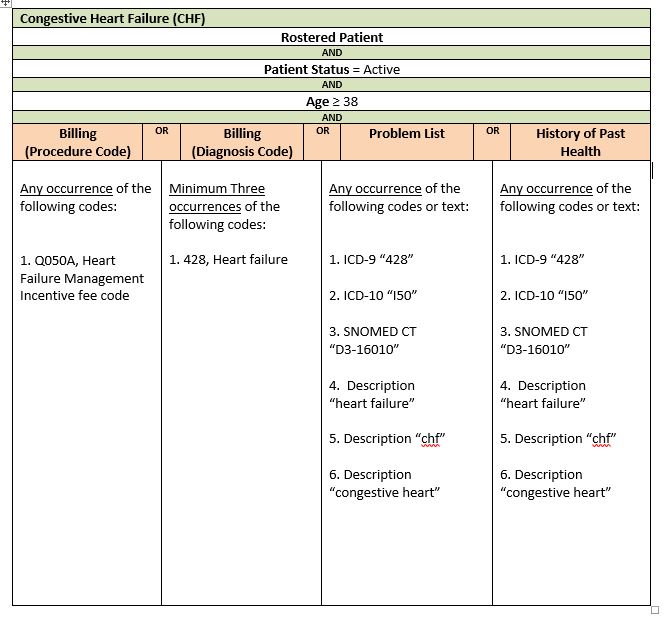
    members

    Steps to complete your query

    The following steps will help your team use the query to generate a list of CHF patients, starting from your EMR.

    Step 1. Estimate how many patients you think this will affect.  Multiply the number of patients your team serves by 0.03 (the estimated rate of CHF prevalence in Ontario) to get a rough idea of how many of your patients likely have CHF.  If the resulting estimate is a manageable and meaningful number of patients for your team to build a registry of, carry on to step 2.

    Step 2Import the query into your EMR.  Right now, you can only do this if have either Telus PSS,  QHR Technologies Accuro or OSCAR EMRs.  You will likely need the help of your QIDSS, IT staff or other person who usually works with your EMR to do this.

    • For PSS, click here to import the PSS SRX file into your EMR
    • For Accuro, download the query “AFHTO CHF Frontend Search from their publisher.

    Step 3.  Run the query in your EMR. Again, you might need the help of your QIDSS, IT staff or other person who usually runs queries in your EMR.  Running the query will produce a list of patients with CHF.  The list will not be perfect – probably 25% of the patients identified by the query will NOT have CHF.  The query gets you STARTED in building the CHF registry but doesn’t do the whole job for you.

    Step 4. Find the patients who might not have CHF. Review the list of patients generated by the query to separate out those patients that are clearly already coded as having CHF.  What’s left will the list of patients who MIGHT have CHF based on other data in the EMR besides formal coding.

    Step 5. Prepare your physicians to review the list. Subdivide the list of possible CHF patients into separate, shorter lists for each physician.  Work with your physicians to find out if they would prefer a list on paper or electronically and how they might like it sorted (i.e., by name, most recent visit, some other parameter).

    Step 6.  Invite each physician to review their list of patients.  They know their patients best and can likely quickly confirm which ones do or do not have CHF, even though that information might not be easy for others to find in the EMR.

    Step 7.  Clean up your EMR data.  Add CHF codes to the EMR for each patient that the physician confirms as having CHF.  This so-called “data cleaning” work is a great job for a student.  AFHTO has created a toolkit to assist members in recruiting and using students for data clean-up.  Click here for the toolkit.

    Step 8.  Re-run the query.  After you have corrected the EMR, re-run the query to generate a list of patients with CHF.  This is your new CHF patient registry. Going forward, you can run the query anytime you need to generate a list of CHF patients.  You can use the list to invite patients to a lung health program, track progress with outcomes on these patients once you have started such a program or any other purpose. Once you have identified them, recruit patients to your CHF program to improve patient prognosis, management, and overall care. Here are some example outcome measures to apply for these identified patients:

    • % of patients with CHF identified have action plans completed
    • % of patients with CHF identified are seen once a year to complete flowsheet
    • % of patients with CHF identified who’ve been hospitalized
    • % of patients with CHF identified who’ve been readmitted to hospital

    For assistance and resources in setting up a care program for patients with CHF contact Karen Harkness at the Cardiac Care Network. This query was developed by QIDSS with assistance from eHealth Centre of Excellence, in support of all AFHTO members. 

    If you have any questions, please contact improve@afhto.ca.

  • NPLC Leadership Council – Members and Contact List

    Names and contact information for the AFHTO NPLC Leadership Council members:

    Organization Name

    First Name

    Surname

    Name

    Role

    E-mail

    Belleville NPLC

    Karen

    Clayton-Roberts

    Karen Clayton-Roberts

    Clinical Lead

    kclayton-roberts@cogeco.net

    Georgina NPLC

    Beth

    Cowper-Fung

    Beth  Cowper-Fung

    Clinical Lead

    beth.cowperfung@gnplc.ca

    Ingersoll NPLC

    Sue

    Tobin

    Sue Tobin

    Clinical Lead

    stobin@ingersollnplc.ca

    VON NPLC – Lakeshore

    Lisa

    Ekblad

    Lisa  Ekblad

    Clinical Lead

    lisa.ekblad@von.ca

    Belleville NPLC

    Ann Marie  

    Manlow

    Ann Marie Manlow

    Admin Lead

    ammanlow@cogeco.net

    Essex County NPLC

    Pauline

    Gemmell

    Pauline Gemmell

    Admin Lead

    p.gemmell@ecnplc.com

    VON NPLC – Lakeshore

    Andrew

    Ward

    Andrew Ward

    Admin Lead

    andrew.ward@von.ca

    Essex County NPLC

    Kate

    Bolohan

    Kate Bolohan

    Clinical Lead

    k.bolohan@ecnplc.com

    Ingersoll NPLC

    Stephanie

    Nevins

    Stephanie Nevins

    Clinic Manager

    snevins@ingersollnplc.ca

    VON NPLC – Lakeshore

    Sharon

    Bevington

    Sharon Bevington

    Executive Assistant

    sharon.bevington@von.ca

    Georgina NPLC

    Lisa

    Joyce

    Lisa Joyce

    Admin Lead

    lisa.joyce@gnplc.ca


  • AFHTO measurement efforts capture widespread attention

    People across Ontario and North America are keen to learn about the ground-breaking advances AFHTO members are making to meaningfully measure primary care. AFHTO submitted nine abstracts to four major conferences, and all were accepted. See the slides and posters linked within the descriptions below.

    Presentations on AFHTO members’ approach to the Starfield Principles:

    • Ontario data support Starfield’s theory on primary care quality and cost Evidence shows that quality can be measured according to what matters to patients, and higher quality in primary care is associated with lower costs to the health care system.
    • Making composite measures of primary care quality useful for front line providers A practical discussion about the use of composite measures by front line providers in primary care, informed by AFHTO members’ experience in using the quality roll-up indicator.

    Presentations on approaching measurement that is meaningful to providers and patients:

    • Impact of a ground-up voluntary performance measurement initiative on the use of data for QI in primary care An exploration of how D2D has changed conversations around using performance data by framing measurement as a means to improving quality, not an end in itself.
    • Developing a more meaningful way to measure performance in primary care:the impact of getting started
    • Getting started with involving patients in improving quality Through evaluation of QI workshops involving patients and QIDS Specialists, barriers and enablers to patient engagement were identified and subsequently validated by care providers.
    • What do interprofessional healthcare providers need and want to get better at what they do? Interprofessional health care providers told us what support they need for quality improvement, identifying interprofessional collaboration and patient engagement as important enablers for quality in primary care.
    • Building a Mosaic: Using locally-gathered data to develop a province-wide program planning tool This presentation describes how, through the Schedule A Indicator Catalogue, AFHTO members have compiled and disseminated locally-developed innovations and evaluation indicators in order to drive evidence-based quality improvement initiatives which balance the need for local relevance with the need to demonstrate collective value and system-wide impact.
      • Poster presented at Health Quality Ontario’s Health Quality Transformation conference.

    Presentations on optimizing the use of EMRs for quality improvement:

    • Reduce, reuse, recycle: digging for gold in EMR data This presentation outlines standardized EMR queries developed by AFHTO’s QIDS Specialists and shows how they can help us move from “garbage in, garbage out” to “reduce, reuse, recycle.”
    • Feasibility and impact of using EMR to trigger automated patient experience surveying An observational study of 8 primary care teams who used an automated patient contact management system to survey patients by phone or email.
    • Moving the needle on diabetes care This presentation describes the AFHTO member-built Diabetes Care Composite Indicator, which employs standardized EMR queries to identify patients with diabetes and quantify the quality of care they receive according to a small number of evidence-based measures. With this tool, teams can evaluate their progress in a more accurate way that reflects the contribution of the entire team. This presentation was awarded Abstract of Distinction at Health Quality Transformation.
  • Primary care recruitment and retention strategy for Ontario

    Evidence from around the world, and Ontario, demonstrates that the introduction of primary care teams is providing patients with better care, at the best value. But one of interprofessional primary care’s biggest barriers is to attract and keep skilled providers. The key issue? Inability to offer competitive compensation to the non-physician health professionals and administrative staff who work in our community health centres, family health teams, nurse practitioner-led clinics and aboriginal health access centres. Funding for these positions has not changed in well over 7 years.

    Minister Hoskins commits $85 million over three years to interprofessional primary care

    “To ensure these clinics (CHCs, NPLCs, FHTs, AHACs and nursing stations) can effectively recruit and retain qualified interprofessional staff in primary care settings, Ontario will invest an additional $85 million over three years.”  – 2016 Ontario Budget.

    Effective April 1, 2016, this investment will certainly help CHCs, FHTs, NPLCs and AHACs retain staff so as to better serve their patients and communities. We are pleased to have this financial commitment in place and look forward to working quickly through the implementation details; however, the AFHTO-AOHC-NPAO proposal as summarised below remains our goal.

    Compensation Structure for Ontario’s Interprofessional Primary Care Organizations

    In June 2013, the three associations that jointly represent all interprofessional primary care organizations in Ontario – the Association of Family Health Teams of Ontario (AFHTO), the Association of Ontario Health Centres (AOHC) and the Nurse Practitioners Association of Ontario (NPAO) – released their joint report to the Ministry of Health and Long-Term Care. It presented indisputable evidence that:

    • Compensation levels in primary care are below market – averaging 15.6% for all non-physician positions, and ranging up to 30% below market.
    • The gap between market and actual compensation is growing – it has increased by an average of 4.9% from 2009 to 2012.
    • Lack of pensions is a key barrier to labour mobility – primary care organizations cannot provide both the HOOPP plan and a reasonable benefits package within the imposed financial limit of 20% of salary.
    • Pay equity challenges are a real risk – two types of positions (registered dietitians and nurse practitioners) have been consistently found to be funded at a salary grade below that of comparable health professions. These positions also post the highest vacancy rates in primary care – 19% and 14% respectively. Health promoters were also found to be in the wrong band.

    Rigorous market study conducted by the Hay Group established a recommended salary structure. It placed all positions into 13 pay bands, with 3 market exceptions. Each band has a recommended salary range and steps for proceeding from minimum to maximum within the range. Full implementation across all of the interprofessional primary care organizations would require a funding increase estimated at just over $120 million. Recognizing the need to phase in such an increase, the three associations recommended:

    • An immediate increase of 2.5% in benefits funding to enable all to participate in HOOPP;
    • Funding that would place all professions in their appropriate salary band; and
    • Funding to reduce the gap between the current and recommended salary rates in steps over four years.

    We continue to advocate to achieve the 2012 recommended salary rates for all staff (IHP and admin) in primary care teams, to be implemented over 4 years. The Ministry recognizes this $85 million commitment is the first step in a process and is committed to working with us to achieve our overall goal. Two years from now, the opportunity for further increases is likely to open up. The Government is committed to eliminating the deficit by the end of 2017-18 and some of the compensation constraints may be lifted for the following fiscal year. This will provide opportunities to address the remaining gaps.

    Relevant Links:

  • Data to Decisions eBulletin #41: It’s Time to Do D2D!

    The time has come to submit your data! The D2D 4.0 submission platform opened August 10 and will remain open until September 13. As always, this is a come-as-you-are party; you can submit as much (or as little) data as is manageable and meaningful for your team. NEW to D2D 4.0: You can now enter your LHIN region as a descriptive indicator. This will give you more options when doing peer-group comparisons. While we are unable to add the option of submitting sub-team data to D2D 4.0, you can use the Data Input Toolkit to gather sub-team data for your own records. Need help getting started? Watch a recording of last week’s launch webinar for an orientation and walk-through. Then visit our D2D Planning and Preparation page for tools and tips. Did you know? The Schedule A indicator catalogue can help you design evidence-based programs and drive improvement in your team. Tell us how it’s working and how we can improve it.

    D2D 4.0 Timeline

    d2d timeline pic - 2016-08-18

    Help spread the word about D2D – invite others to sign up for the eBulletin online.