Category: Uncategorized

  • Public Health within an Integrated Health System – Primary Care & Public Health Collaboration

    Expert Panel Report: Public Health Within an Integrated Health System

    Patients First legislation includes a requirement for the public health sector and the province’s local health integration networks (LHINs) to work together to reduce health disparities and improve access to health care services. The Government of Ontario established the Expert Panel on Public Health (“Expert Panel”) in January 2017. Their report, “Public Health within an Integrated Health System” was released on July 20, 2017.

    Primary Care & Public Health Collaboration Toolkit

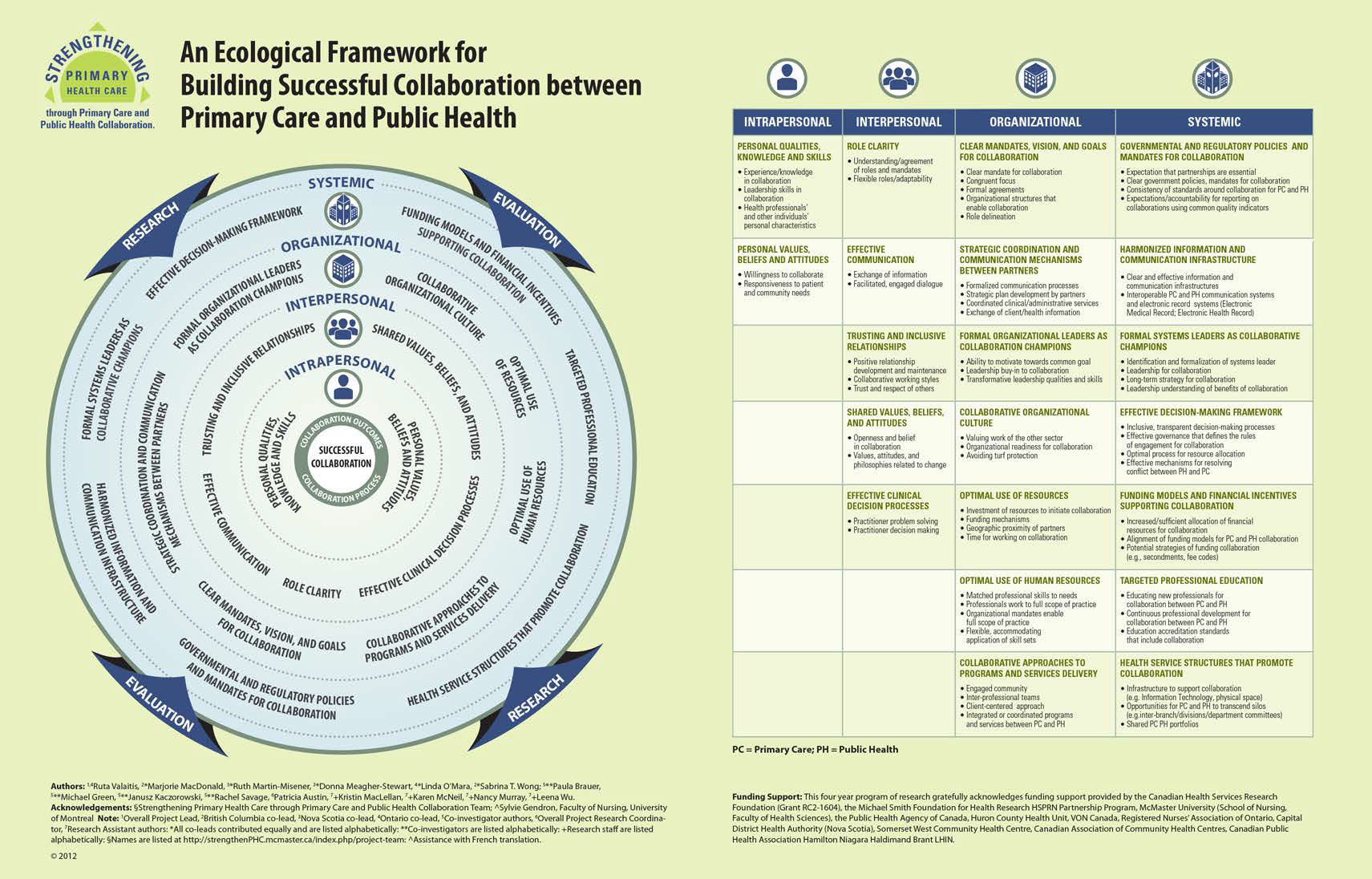
    To help primary care and public health organizations collaborate effectively, researchers from McMaster and other universities have compiled Primary Care & Public Health Collaboration Toolkit  for practitioners, managers, policy makers, and students working in the public health and primary care sectors. The toolkit is intended to develop knowledge, skills, and attitudes that support collaboration between public health and primary care. It is structured around an evidence-based Ecological Framework  for Building Successful Collaboration between Public Health and Primary Care.

    Click for full size (opens in a new tab).
     

  • Translating Information to Action

    What is Information to Action?
    Information to Action is a basket of resources and tools teams can use to make progress in primary care quality. Information to Action will provide dedicated support to teams interested in building on their momentum in measurement to improve their performance. It is also meant to teach us what really works for all AFHTO members, to translate Information to Action. The overall goal is to achieve continuously increasing performance among primary care teams in future iterations of D2D.

    Who is Information to Action for?
    All teams are invited to assess how ready they are to be part of Information to Action. Just like with D2D, not all teams will be ready to make this move right away. And just like D2D, teams can start slowly, taking advantage of only those parts of Information to Action that work for them right now.

    How will teams translate Information to Action?
    Information to Action consists of a menu of activities and supports that interested teams can choose to participate in. For the most part, teams may choose to participate in whichever activities they are ready for. The exception is for some of the more intense supports, which come with some “strings attached.”

    What’s next?
    The next steps for teams interested in moving from Information to Action are as follows:

    Want to know more?
    For more details, see frequently asked questions. You can also reach out to Laura Belsito, Clinical Knowledge Translation & Exchange Specialist or Carol Mulder, Provincial Lead for the Quality Improvement Decision Support Program.

  • Patients Struggling with Opioid Addictions Should Be Treated in Primary Care Settings

    CTV News Article published July 19, 2017. Article in full pasted below. Sheryl Ubelacker, The Canadian Press TORONTO – A small proportion of Ontario doctors who treat people battling opioid addictions prescribe the majority of the medications used to treat the disorder, a study has found, raising concerns about the quality of patient care and access to therapy. Most of these physicians work in addiction treatment centres located in urban areas and see dozens of patients each day, say researchers, whose study was published Wednesday in the journal Drug & Alcohol Dependence. The top 10 per cent of methadone providers – 57 physicians – wrote prescriptions for 56 per cent of the total patient days of methadone dispensed, the study found. For buprenorphine, known by the brand name Suboxone, the 64 highest-volume providers were responsible for prescribing 61 per cent of the total days of the drug given to patients. This extreme clustering of services among a small group of physicians creates a vulnerable opioid maintenance therapy system, said senior author Tara Gomes, a scientist at St. Michael’s Hospital and the Institute for Clinical Evaluative Sciences (ICES) in Toronto. “It can be challenging to find physicians interested in treating this population, and any changes to this group of physicians may affect a large number of patients who are currently seeking treatment for their opioid addiction.” Gomes said little was known about prescribing patterns among doctors who provide opioid addiction treatment in Ontario, despite the growing number of people who have become dependent on such drugs as hydromorphone, oxycodone and heroin. Patients receiving this therapy are often prescribed a longer-acting but less euphoria-inducing opioid such as methadone or buprenorphine, which are taken under close medical supervision. Using ICES health-care data, Gomes’ team identified 893 doctors who provided methadone or Suboxone more than once in 2014 to people eligible for the Ontario Drug Benefit Program, stratifying them into low-, moderate- and high-volume prescribers. Most were family practitioners. On average, each high-volume methadone prescriber treated 435 patients who were eligible for coverage of the drug under the program over the one-year study period. The patients had an average of 43 office visits that year, 43 urine drug screens and 190 days of methadone treatment. Gomes said that translated into an office visit and urine drug test – given to detect the presence of non-treatment opioids like oxycodone – every four to five days. These high-volume methadone providers billed the Ontario Health Insurance Plan (OHIP) for a daily average of 97 patients, approximately half of whom engaged directly with the prescribing physician. On average, doctors billed $648,352 to OHIP for all services provided to methadone patients in 2014; almost 46 per cent of the payment was to cover the cost of urine drug tests. Patterns among high-volume buprenorphine prescribers were different, with doctors treating 64 patients with the drug in 2014 and billing 22 urine drug screens per patient. Patient volume was lower among these prescribers, with physicians billing an average for 51 patients daily, of whom six were treated with buprenorphine. Total OHIP billings were lower than for high-volume methadone providers due to a smaller patient population. But similar to methadone, almost 41 per cent of the total cost was due to urine drug tests. Gomes said the large number of patients seen by high-volume methadone prescribers raises concerns about the quality of care patients receive, particularly when coupled with frequent clinic visits for urine drug screens. While regular urine testing is considered beneficial in the first few months of treatment, there is no evidence that ongoing weekly clinic visits and urine drug screens are linked to reduced opioid abuse. “There’s such a high degree of burden on the individuals when they are seeking treatment for their opioid abuse disorder to have regular visits with their physician … (and) also having to go to the pharmacy every day for their daily dose,” Gomes said. Spending several hours a week travelling to and from clinics, waiting to see the doctor and providing urine samples may interfere with a patient’s ability to meet his or her family and work responsibilities, she added. “So you can imagine there’s a huge amount of burden on them in the system and if they have to come in every four or five days for a urine drug screen, that can lead to a lot of people leaving addiction programs because it’s just too much for them to take on.” Study co-author Dr. Mel Kahan, medical director of the substance use service at Women’s College Hospital in Toronto, said ideally patients trying to get off opioids who have been stabilized on either methadone or Suboxone should be looked after in primary-care settings, such as a community health centre or by a family health team. “They don’t need to be looked after in a specialized clinic, and the problem is that if all the patients are looked after in specialized clinics, then the clinics get jammed up. … And the quality of care would be better in a primary-care setting,” Kahan said Tuesday. Patients struggling with an opioid addiction should be able to access Suboxone, in particular, because it is safer than methadone, carrying little risk of overdose, he said. The medication also is easier for primary-care physicians to provide, as it requires no complex training or special licensing to prescribe, as is the case with methadone. Click here to access the CTV News article. Relevant Links

  • Central Lambton FHT and Partners Expand Funding for Inwood Kids Program

    The Petrolia Topic article published July 18, 2017. Article in full pasted below. Melissa Shilz, Postmedia Network This summer marks the fifth year of the Inwood Kids Program, a rural summer camp run through the Central Lambton Family Health Team and other partners like the Oil Heritage District Community Centre. The program has something for all ages, and children as young as one and up to the age of 15 can attend. Sarah Milner, Executive Director of CLFHT, grew up in the small community and knew something was needed for the youth living there once school was out. With no public transport system in place and limited resources, they developed a plan to offer youth a program that would encourage healthy and active lifestyles, but she said the program runs deeper than just giving kids something fun to do. “Initially it was kind of a way to start outreach and to form that relationship here in a more informal way,” she said. “We want to help people get the services they need – counseling or health…it’s as much about the parents as it is the kids.” Since they began the program, they’ve seen the number of kids attending increase. A report by the Family Health Team also found that 22 per cent of the kids had no other summer activities that they participated in. “For some of these kids, this is their big thing for their summer,” she said. Milner said with Inwood being such a rural area, the program aims to prevent isolation, keep youth active and offer them activities for development. For those kids living in smaller towns, it gives them a chance to socialize without the worry of traveling to a bigger town. It also gives parents an opportunity to engage with healthcare practitioners and ask questions. While in previous years the program has ran for three weeks in the afternoons, this year it has been expanded to five weeks after the Alvinston Optimists gave a donation of $1000. Each year they’ve had different sponsors backing the program, including the County of Lambton, but the Optimists are planning on making it a permanent fixture in their budget. Optimist President Marjorie Cumming said she only wish they knew about the program sooner – they would have given funding from the start. “Now we’ve got them on the list for every year,” she said. Optimist Tom Park said when they heard about the program, they jumped on board to help right away. He said they support a number of programs in the area, and even offer scholarships to Brooke-Alvinston students heading off to college or university. “We do whatever we can to support our youth and youth programs,” he said. “It’s what we do…we give things to the community that the kids can use.” mschilz@postmedia.com Click here to access The Petrolia Topic article.

  • Data to Decisions eBulletin #63: Continuous measurement, continuous improvement

    It’s almost time to “do” D2D again! D2D is about continuous measurement for continuous improvement. Once is not enough. Think about starting conversations about D2D 5.0 now and begin compiling your data. The Data Dictionary, Step-by-Step Guide, and Data Input Toolkit have all been updated for D2D 5.0. Speaking of continuous improvement, find out what’s new with D2D 5.0! Check out these posts on follow-up after hospitalization and individualized HbA1C targets. Find information about how and why you might want to  “unmask” your data to your peers, complete a team profile questionnaire, and submit site or FHO-specific data. Want to know the trick to improvement? Who doesn’t??! Please consider volunteering to be part of AFHTO’s QI enablers study to help us all understand what makes it easier for teams to improve. Save the date: Interprofessional Medication Management workshop. Mark your calendar for November 17th, 2017 for a full-day session showing how everyone (clinicians, QIDSS, patients) can contribute to managing (and maybe even eliminating the need for) medications. It’s for all team members —not just prescribers and pharmacists. Watch this space for more information. Quarterly Reporting got you down? You may have to live with that for this year but next year, think about using the Program Performance Measures Catalogue. It will help you find indicators that make more sense to you and are easier to collect. You can help yourself even more by sending us your completed Schedule A template now. In Case You Missed It: Check out eBulletin #62 for more about D2D 5.0. Or check out other eBulletin back issues here!

    D2D 5.0 Timeline

    Help spread the word about D2D – invite others to sign up for the eBulletin online. 

  • AFHTO Bright Lights Awards: just one week left to nominate your team or colleague!

    • Are you proud of what your team has accomplished?

    • Do you want your colleagues to be recognized for the amazing work they do?

    • Do you think it would be great to see your initiative spread across the province?

    If you’ve said yes to any of the above, submit a Bright Lights nomination! They’ve started to pour in so don’t be left out- send in your nominations and supporting documents before the deadline, Wednesday, July 26.

    Small, rural and Northern teams are encouraged to apply. You can watch this webinar or view the slides if you’ve never submitted a nomination before. To complete your nomination:

    While preparing your nomination, consider applying for a 2017 Minister’s Medal as well. Nominations for the Minister’s Medal close on August 8, 2017. Register for the Bright Lights awards ceremony and reception at this year’s AFHTO conference to see who the awards recipients are! Winners will be announced at the ceremony on October 25, 2017 (and not before!). If you have any questions or concerns, please contact us and we’ll be happy to assist.

  • Apply now for the 2017 Minister’s Medal – Deadline to apply August 8

    The Ministry of Health and Long-Term Care (ministry) has announced the launch of the fifth annual Minister’s Medal Honouring Excellence in Health Quality and Safety. This award program showcases system champions who place the patient at the centre of the circle of care and have demonstrated exceptional work in collaboration and achieved sustainable results, while promoting system value and quality in the health care system.

    The program recognizes programs/initiatives that align Patients First: Action Plan for Health Care. This year’s theme is Patients as Partners, which focuses on the importance of collaborating with individuals with lived experience in healthcare decision-making at all levels.

    Why apply for the Minister’s Medal?

    The Minister’s Medal is a prestigious and competitive recognition program that aims to highlight the successes of Ontario’s health system partners in providing excellent, high-quality, and patient-centred care. It provides a platform to honour and showcase achievements of health system partners, and allows for sharing of these successes across the system.

    Benefits of being recognized through the Minister’s Medal include:

    • Participation in the award presentation at Health Quality Transformation, Canada’s largest conference on health care quality.
    • A short video showcasing the successes of the winners and the impact their work has had on the lives of patients.
    • Increased profile across the province and beyond, increasing potential for additional partnerships and collaboration.
    • Recognition and increased engagement of front-line staff dedicated to delivering high-quality care to patients.

    “Winning the Minister’s Medal was an honour and a privilege. It was a seal of approval, demonstrating that our program achieved a high mark of distinction in quality and safety” – Dr. Linda Lee, 2014 Minister’s Medal winner (individual champion)

    “We have been able to use winning the Minister’s Medal as a stepping stone to scale our program at a provincial and national level” – Dr. Nathalie Fleming, 2013 Minister’s Medal winner (individual champion)

    New for 2017 – Expanded Patient/Caregiver Stream

    This year, the ministry is recognizing the important contributions of patients, families, and caregivers who deserve to be highlighted for their patient engagement in their communities. The ministry is encouraging nomination of patients, family members, and caregivers by their colleagues, peers, or by healthcare collaborators from whom they receive care.

    Application templates are now available for download from the Minister’s Medal webpage. Applications are due to your Local Health Integration Network office via email by 5:00pm on August 8, 2017. The awards will be presented at Health Quality Transformation 2017 on October 24, 2017. More information on the program, including profiles of previous years’ winners and honourees, is available on the Minister’s Medal webpage.

    AFHTO members have been recognized before at the 2014 awards presentations and at the 2016 awards presentations. Consider submitting a nomination on behalf of your team.

    For any questions related to the Minister’s Medal program, please contact: ECFAA@ontario.ca

  • Participate in the QI Enablers Study

    Five iterations of D2D data show that some teams tend to improve more over time compared to others. AFHTO members want to know what some of the “tricks of the improvement trade” are so they can try them out in their own teams. This QI enablers study is aimed at learning more about what makes it easier or harder to improve so that all teams can take advantage of the wisdom from the field.

    What is the study about, and why? How will the study be done? When will the study happen?
    What we want to talk with teams about What we won’t ask teams about Frequently Asked Questions


    What is the study about and why?

    The QI Enablers study will be based on in-person interviews with teams. It will provide a snapshot of how teams think and work to get better at what they do. We will ask teams “what works and why” when they try to get better at what they do. Details on the interview process are outlined below. The study will describe what is happening with teams at a single point in time – ie it is not ongoing, the way that D2D is. The data from the interviews (which will mostly be in the form of stories) will be compared to D2D performance. This will point out any patterns between the stories of how teams work and their D2D scores which will provide hints regarding what works best to move beyond measurement to improvement. The key is to have teams from ALL stages of the QI journey so we can compare and contrast. We will share the stories first with the participating teams to confirm that we have heard them right. Then we will be sharing the collective wisdom from the stories with all members and also with external partners, so that everyone (AFHTO members and beyond) can learn together. The stories will be shared anonymously – unless a team is keen to see their name in lights, in which case we would happily oblige!

    How will the study be done?

    The team visits and interviews will be done by Carol Mulder, Provincial Lead for Quality Improvement and Decision Support and Laura Belsito, Clinical Knowledge Translation and Exchange Specialist, supported by any graduate students we are able to recruit and the QIDS program staff at AFHTO. We will spend about 4 hours at each team site, talking to whoever the team wants us to talk to.  We have put together a “straw dog” schedule to give teams a sense of who might be included. However, it is totally up to the team to decide who will meet with us to tell their story.  In addition, the conversations can take place in any order the team wants – ie Hour 1 doesn’t have to be the first hour if that doesn’t work for the team.

    • Hour 1: ED, Medical Lead and Board Chair
    • Hour 2 (2 groups): Separate conversations with QI staff (QIDSS and others?) and patients
    • Hour 3: IHPs and physicians together
    • Hour 4 (2 groups): Separate conversations with clerical staff (including physician staff, if different from FHT clerical staff) and possibly LHIN performance staff

    When will the study happen?

    Visits to teams will be scheduled starting September 2017. See below for draft timeline.  Note that this study will be taking place at the same time as patient focus groups to learn more about patient priorities for primary care measurement (see the patient priorities survey information on the AFHTO web site for more information). Interested teams may choose to volunteer for both the QI enablers visits and a patient focus group if they choose.

    Activity Start End
    Invite teams to participate NOW! July 31, 2017
    Schedule interviews August 4, 2017 September 26, 2017
    Conduct interviews September 27, 2017 ongoing
    Summarize input October 30, 2017 January 31, 2018
    Reflection with participants and QSC February 15, 2018 February 22, 2018
    Take action NOW!  April 30, 2018

    What we want to talk with teams about

    We will visit teams and ask them “what works and why” when they try to get better at what they do. This approach is loosely grounded in theories of “appreciative inquiry”, “solutions focus” and “positive deviance.” In keeping with these theories, the interview questions will follow the stories of the people we are talking to. That means the questions won’t be the same for each person or team we talk to.  However, the stories we are looking for are the same for all teams. They include:

    • Stories about your attempts to get better at something: How did you know you needed to get better? Who decided? What happened when you tried to change things? Who worked on it? How do you know if it worked or not? Who was happy about it? Who wasn’t? Why?
    • Stories about learning from what you tried in the past: How do you feel now about being able to make something else better? What makes you feel that way?
    • Stories about the “perfect storm” for improvement: When did it last happen for you? What does it look like? Who is there? What made the storm? Who likes the storm?
    • Stories about your special skills/people/processes (ie superpowers) for improvement or good primary care: What are they? How did you get them? What do you use them for?

    When we are hearing the stories, we will be looking for some particular ideas in the data (see below). Even if they are not there, that might mean something. For example, if nobody talks about how many people need to be on board for improvement to work, that might be as interesting as finding out that teams agree on a certain minimum number.

    • Drivers for quality improvement
    • Triggers for improvement
    • Confidence and appetite for change in the team (improvement = change)
    • Culture of innovation/tendency to try new things FIRST vs wait for tried/tested solutions
    • Minimum critical mass of staff to enable improvement (if any)
    • Role of leadership and/or intentional planning in successful improvement
    • Absolute requirements for successful improvement (if any)
    • Role of EMR functionality and data
    • QI as an approach to work vs a separate project
    • Significant team events (eg Change in ED) that might affect QI activity

    What we won’t ask teams about

    Teams will not be asked why they are doing better (or worse) than others in making things better over time. This is partly because they might not know – and partly because it doesn’t matter that much. For example, maybe all (or no?) teams feel they have superpowers. Yet some teams may find it easier to get better than other teams, even if they all have the same superpower.  This might mean that superpowers matter for other reasons but might not be the answer we thought they were in terms of making things better.

    Frequently Asked Questions


    Is this a formal research study? Yes. This is an observational, qualitative cross-sectional study. AFHTO will be getting approval from the Research Ethics Board for it. Why do this as a formal research study? AFHTO Board has recently affirmed its commitment to playing a leadership role in primary care and, more broadly, in the Ontario healthcare sector. AFHTO needs to be able to tell the story of its leadership in a wide variety of forums to demonstrate that leadership. A formal research study (with formal ethical approval) makes it possible to share the collective wisdom of AFHTO members in credible and high profile way to support leadership activity. Do members HAVE to participate? Practically everything AFHTO does is voluntary and intended to serve the members. Members can choose not to be interviewed simply by not volunteering. Nobody but they themselves will ever know that. Can I tell my story to AFHTO but not be in the research study? We will only include the stories of teams who agree to be part of the published study but we will listen to and share ALL the stories among the members for their own use. And all the stories will be anonymous unless a team is keen to have their name in lights, in which case we would happily oblige! What if our team is really struggling to improve? You are so not alone! And your story is really important. You may be doing everything “right” and still be in the place you are. That is the kind of story that will help us all see what actually is important on the ground (vs in theory). If we only talk to teams who are making good progress, we will not get useful information for those who are in the trenches, pulling out all the stops and still frustrated. You (all of you!) really are the answer! Who should be part of the interviews? Bring whoever you want to the table. We have a hunch about some roles that tend to be important in a team’s efforts to get better – see our list above. You may have different ideas. It is your call. What is the risk for our team? All of your stories will be masked (i.e., “Team X”) unless you want to see your team’s name in lights. No team’s story will be shared without their consent with any external group (Eg MOHLTC) except in an anonymous way as part of the collected stories from the study. Why don’t we just go to the literature to find out what the enablers of Quality improvement are? We would love to. If you have suggestions of studies we should look at, please tell us! So far, most studies about “high performing teams” describe the way teams work but don’t compare that to a measure of performance. Teams are identified as high performers mostly by self-report or nomination by peers. Teams that self-report as high performers may or may not be the same as those with high performance on measures of quality such as those in D2D. Other studies identify high performers on the basis of administrative data (eg cancer screening rates, readmissions etc). These indicators do not reflect the overall quality of care provided nor the contribution of the team, which is problematic, given the interest in high performing teams. This study addresses those gaps by comparing team characteristics (such as those examined in other studies) with demonstrated ability to improve over several iterations of D2D (which we define as “high performance”). What is a “high performing” team? This study focuses on enablers for improvement. That means high performance is defined as “demonstrated improvement in D2D indicators over time”. D2D indicators reflect the patient perspective (patient experience survey indicators), the provider perspective (eg cancer screening etc) and the system perspective (e.g., readmissions). This is not a perfect definition of performance. It is, however, the most broad, current and ongoing source of primary care performance data available to describe the performance of primary care teams.  
  • Board Governance: Board Structure & Development

    Please share your resources to help build our library.


    Role of the Board

    Return to the Library of Organizational Policies and Procedures


    Board Development and Self-Assessment

    Return to the Library of Organizational Policies and Procedures


    Board Skills Matrices


    Succession Plan


    Board Recruitment Tools

    Return to the Library of Organizational Policies and Procedures


    Board Committees

    Return to the Library of Organizational Policies and Procedures