Category: Uncategorized

  • D2D Submission Platform is Now Open – Submit Your Data by September 11

    The submission platform for D2D 5.0 is open. The Interactive report will be launched  October 4th, 2017.

    Data to Decisions (D2D) is a membership-wide report on performance in primary care. This tool allows you to enter and review your own data and compare it to data from your peers. As always, D2D is a come-as-you-are party; you can enter data for as many (or as few) indicators as are manageable and meaningful to your team.

    What’s new in D2D 5.0?

    We’ve made some changes to D2D to help our members get a clearer picture of what enables success in quality improvement:

    Additionally, we’ve included follow-up after hospitalization as a core D2D indicator, and we’ve got a new exploratory indicator that asks whether your patients with diabetes have individualized HbA1C targets recorded in the EMR. We’ve also added some new components to the EMR Data Quality composite indicator.

    Check out What’s New in D2D 5.0? for more information about the above changes.

    Ways to make D2D submission easier:

     D2D data is your data, and it tells your story. Data about individual teams is never shared externally.

    Questions? Comments? We’d love to hear from you!

  • Data to Decisions eBulletin #65 – On Your Mark, Get Set…

    D2D opens Monday! Submit your data for D2D 5.0 from Monday, August 21st through Friday, September 8th. Find everything you need on the Planning & Preparation page. Read up here to learn about new and revised indicators. Ready to reveal your secret identity? This time around, you’ll have the option to unmask yourself to your peers, to enable better peer-to-peer comparison. You are here: D2D now allows you to report your LHIN sub-region. Not sure which one you’re in? Look it up here, or contact us for help. What makes your team “tick”? By answering the team profile questions in D2D 5.0, you’ll get a clearer picture of what you can do to make your team’s quality improvement efforts more successful. Are you ready to move beyond measurement? This online self-assessment of readiness will help you figure out if your team is ready to take the next step towards translating Information to Action. In Case You Missed It: Check out eBulletin #64 or peruse other eBulletin back issues here!

    D2D 5.0 Timeline

    Help spread the word about D2D – invite others to sign up for the eBulletin online. 

  • EMR queries for D2D – EMR Data Quality: Coded Diagnosis – Depression

    The EMR queries below were developed by QIDSS and the EMR Communities of Practice to help you extract data for submission to D2D.

    Telus PS Accuro Nightingale OSCAR P&P


    NOTE: All queries are tested and validated prior to release. However, changes that take place after the queries are released may affect how accurate they are.  Such changes could include EMR software updates, new medications, and changes to standard clinical definitions. They may result in false positives, that is, patients being flagged who do not have the specified condition. They may also result in false negatives, that is, patients not being flagged who do have the condition. Queries are also limited by the quality of your EMR data. 

    Telus PS

    The D2D EMR Data Quality Depression Coded v1 searches (.srx files) will extract data necessary to calculate the percent of patients with depression whose diagnosis is recorded with a code in the appropriate place in the EMR. Save these searches to your desktop and import into your EMR. You might need the help of your QIDSS, IT staff or other person who usually run queries in your EMR. This guide provides instructions on how to import the searches into your EMR. Screenshots of the query can be found here. Share you challenges and successes with improve@afhto.ca.

    Accuro 

    Please find the D2D EMR Data Quality Depression Coded v1 numerator and denominator queries on Publisher. You might need the help of your QIDSS, IT staff or any other person who usually run queries in your EMR. Share you challenges and successes with us.

    Nightingale 

    The D2D EMR Data Quality Depression Coded query has not been developed for Nightingale.

    OSCAR 

    Download the D2D EMR Data Quality DepressionCoded v2 queries to your computer and import into your EMR. You might need the help of your QIDSS, IT staff or any other person who usually run queries in your EMR. Share your challenges and successes with improve@afhto.ca.

    P&P 

    The D2D EMR Data Quality Depression Coded query has not been developed for P&P. Please contact improve@afhto.ca if you have a query for P&P that you’d like to share or if you have any suggestions for this work.

  • EMR queries for D2D – EMR Data Quality: Coded Diagnosis – COPD

    The EMR queries below were developed by QIDSS and the EMR Communities of Practice to help you extract data for submission to D2D.

    Telus PS Accuro Nightingale OSCAR P&P


    NOTE: All queries are tested and validated prior to release. However, changes that take place after the queries are released may affect how accurate they are.  Such changes could include EMR software updates, new medications, and changes to standard clinical definitions. They may result in false positives, that is, patients being flagged who do not have the specified condition. They may also result in false negatives, that is, patients not being flagged who do have the condition. Queries are also limited by the quality of your EMR data. 

    Telus PS 

    The D2D EMR Data Quality COPD Coded v1 searches (.srx files) will extract data neccessary to calculate the percent of patients with diabetes whose diagnosis is recorded with a code in the appropriate place in the EMR. Save these searches to your desktop and import into your EMR. You might need the help of your QIDSS, IT staff or other person who usually run queries in your EMR. This guide provides screenshots of the searches along with instructions on how to import the searches into your EMR. Share you challenges and successes with the Telus PS CoP or contact us.

    Accuro 

    Please find the D2D EMR Data Quality COPD Coded v1 numerator and denominator queries on Publisher. You might need the help of your QIDSS, IT staff or any other person who usually run queries in your EMR. Share you challenges and successes with the Accuro CoP or contact us.

    Nightingale 

    The D2D EMR Data Quality COPD has not been developed. Please contact us if you have a query for P&P that you’d like to share or if you have any suggestions for this work.

    OSCAR 

    Download the D2D EMR Data Quality COPD Coded v1 queries to your computer and import into your EMR. You might need the help of your QIDSS, IT staff or any other person who usually run queries in your EMR. Share your challenges and successes with the OSCAR CoP or contact us.

    P&P 

    The D2D EMR Data Quality COPD has not been developed. Please contact us if you have a query for P&P that you’d like to share or if you have any suggestions for this work.

  • Focus Groups: Patient Priorities for Improving Healthcare Quality

    From the Patient Priorities Questionnaire, we learned a lot about what matters most to patients when it comes to their relationships and their primary care providers, but we want to dig deeper. We also want to hear from them about how we should find out, because we know many of them found the survey lengthy and tedious. Getting better at asking patients what they want will help us get better at measuring quality in a patient-centered way – and that in turn will lead to higher-quality patient care. In order to do this, we want to partner with you, our members, to hold a series of patient focus groups around the province from September through December. If you provide the people and the space, we’ll bring the snacks and the questions. This is a formal research study, and we are in the process of obtaining Research Ethics Board (REB) approval for it from the University of Toronto.

    Objectives

    These focus groups have four primary objectives:

    • Engage with AFHTO members who did not feel comfortable sharing the Patient Priorities Questionnaire with their patients.
    • Get input from different demographics.
    • Receive advice on how to best get measurable estimates of patient priorities from a broad range of patients.
    • Seek advice regarding other ways to increase engagement in general.

    What YOU can do

    Ready to get started? Here are your next steps:

    • Check out the Frequently Asked Questions
    • Contact us for more information
    • We’ll send you a package of customizable recruitment tools, including posters for your waiting room and an information announcement for your website.
    • We’ll work with you to find a time and a date.
    • Refer participants to AFHTO, then sit back and relax. We’ll take care of the rest.

    Good to know

    All participation is voluntary. We’ll obtain informed consent from participants, and they can withdraw at any time. Focus group discussions will be kept anonymous, so patients’ care will not be compromised in any way (that means no providers in the room – sorry).

  • AFHTO 2017 Conference: new and updated sessions. André Picard & Deputy Minister Bob Bell confirmed speakers

    We’ve been taking advantage of the long summer days to make the AFHTO 2017 Conference even better for you. Now featuring new and updated sessions including:

    Register for “Improving Primary Care Together” today!

    And let’s not forget all the other opportunities to network and learn with over 850 colleagues from across Ontario:

    For general information, you can visit our conference page.

    We look forward to seeing you at the AFHTO 2017 Conference!

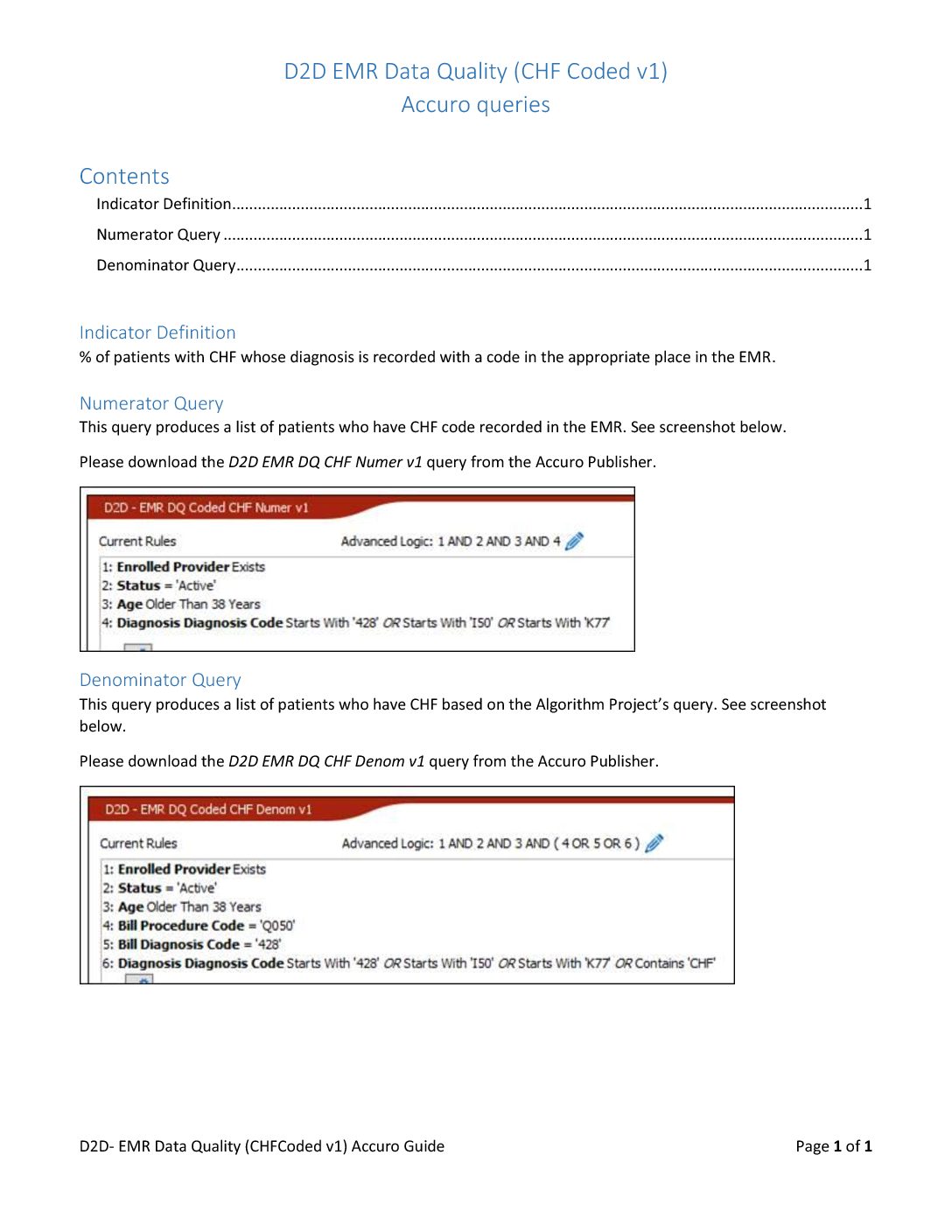
  • EMR queries for D2D – EMR Data Quality: Coded Diagnosis – CHF

    The EMR queries below were developed by QIDSS and the EMR Communities of Practiceto help you extract data for submission to D2D.

    Telus PS Accuro Nightingale OSCAR P&P


    NOTE: All queries are tested and validated prior to release. However, changes that take place after the queries are released may affect how accurate they are.  Such changes could include EMR software updates, new medications, and changes to standard clinical definitions. They may result in false positives, that is, patients being flagged who do not have the specified condition. They may also result in false negatives, that is, patients not being flagged who do have the condition. Queries are also limited by the quality of your EMR data.

    Telus PS 

    The D2D EMR Data Quality CHF Coded v1 searches (.srx files) will extract data necessary to calculate the percent of patients with diabetes whose diagnosis is recorded with a code in the appropriate place in the EMR. Save these searches to your desktop and import into your EMR. You might need the help of your QIDSS, IT staff or other person who usually run queries in your EMR. This guide provides screenshots of the searches along with instructions on how to import the searches into your EMR. Share you challenges and successes with the Telus PS CoP or contact improve@afhto.ca.

    Accuro 

    Please find the D2D EMR Data Quality CHF Coded v1 numerator and denominator queries on Publisher. You might need the help of your QIDSS, IT staff or any other person who usually run queries in your EMR. Share you challenges and successes with the Accuro CoP or contact us.

    Nightingale 

    The D2D EMR data quality CHF coded denominator query has not been developed. Please contact us if you have a query for Nightingale that you’d like to share or if you have any suggestions for this work.

    OSCAR 

    Download the D2D EMR Data Quality CHF Coded v1 queries to your computer and import into your EMR. You might need the help of your QIDSS, IT staff or any other person who usually run queries in your EMR. Share your challenges and successes with the OSCAR CoP or contact improve@afhto.ca.

    P&P 

    The D2D EMR Data Quality Diabetes Coded query has not been developed. Please contact us if you have a query for P&P that you’d like to share or if you have any suggestions for this work.

  • Welland McMaster FHT Guides Healing through Forest Therapy

    St. Catharines Standard article published August 9, 2017. Article in full pasted below. Cheryl Clock, St. Catharines Standard The women follow a narrow dirt path into a community of towering white pine trees. The pin-straight trunks, bare lower to the ground, erupt like green fireworks exploding into a blue sky. The group is slow, deliberate, quiet. A few minutes ago, they noticed a mother deer and her fawn, peering motionless, ears tall, at them from not too far away. Their footsteps are hushed by years and years of fallen browned needles. They stop. Melissa Bollinger Seiling, their forest therapy guide, explains the first of several exercises – called invitations — that they will participate in tonight to calm the busyness of their thoughts and soothe the general chaos that is life. All the everyday stuff that barrages our minds much like being pelted with hail. Work. Kids. Family. Bills. The list is long. They will practice being mindful. Being present. Their thoughts will remain here, grounded in the woods. Forest therapy has its roots in Japan, where back in 1982 the country’s Ministry of Agriculture, Forestry and Fisheries called it Shinrin-yoku, or forest bathing. It’s not hiking but more about taking in the atmosphere of the forest. In general, forest bathing is said to have many health benefits: a lower heart rate and blood pressure, improved immune system, less stress hormones and overall feeling well. The practice has spread worldwide. Training was introduced to Canada last year by the California-based Association of Nature and Forest Therapy Guides and Programs. The organization provides an eight-day training course followed by a six-month apprenticeship where beginners are mentored as they guide groups of people. It has trained 25 guides in Canada, 100 worldwide in 15 countries. Bollinger Seiling is a registered social worker who counsels people in her clinical practice at the Welland McMaster Family Health Team. She also takes some patients into the woods, in small groups. They might be living with mild anxiety and depression. Grief and loss. Stress. Many are overwhelmed by the unrelenting, inescapable connectedness of life with technology. The forest is part of their healing journey. Other times, like tonight, she offers private sessions to small groups of people intrigued by the idea of being mindful under a canopy of trees. In the woods, Bollinger Seiling is not a counsellor. “The forest is the therapist,” she says. “The guide is the door.” She asks the group, paused in the heart of the pines, to be aware of their senses. To listen, turn to face another direction, then listen more. To smell. Even, to taste the air. In her words: “To really bathe in your senses.” Their eyes are closed. She suggests to the women: “Pretend it’s the very first time you open your eyes here.” Afterwards, they sit in a circle and pass around a stick, signifying whose turn it is to talk about the experience. The only rule: speak and listen from the heart. “I don’t think I’ve ever felt the air like that,” says one woman. “The breeze was calming.” Another woman thought about the trees. How many other people have walked under their branches. LeeAnn Pocknell, a 46-year-old registered nurse, talks about hearing sounds that she otherwise would not have noticed. The wind, trees, birds, and hum of cars. “At a different time, I would have experienced silence,” she says. He thoughts would have been too loud. Too distracting. “It was like an awakening. It was awesome.” They will be in the woods at Short Hills Provincial Park for three hours. Sunlight will fade to dusk. A few lingering mosquitoes will dance in the breeze. Unlike the world beyond, there are no goals that must be achieved in the woods. No success or failure. No target destination. They will end their journey by sitting on the rocky shoreline of a creek, sipping tea infused with cedar and spruce needles in small glass cups, and talking about the experience. They discuss how they feel safe in the forest. Even vulnerable, but in a good way. “We’re all on the same journey,” says Tina Lanzillotta, 40. “In the forest, we bond together.” Melissa Bollinger Seiling has been wandering through the woods since she was a young girl growing up on a farm in Minnesota. Her playground was a state forest that backed onto a neighbour’s farm. “It went on and on and on,” she says. She could head off in the morning with a peanut butter and jelly sandwich, water and a granola bar — maybe with a girl friend or maybe by herself — and spend the day amongst the trees with no specific destination. She climbed over rocks. Discovered new streams. Followed trails made by cows and deer. It was about being free and adventurous. Sometimes she pretended that she and her friend were the last two people left on Earth. In the winter, she hooked up a sled to her Norwegian Elkhounds and journeyed across the expanse of snow-covered field, imagining she was on the Arctic tundra. Her family hiked trails at the nearby Whitewater State Park, where the river cut deep ravines into the bedrock and created stunning bluffs of limestone. As a teenager, she found peace wandering the trails. “It’s where I felt at home. Where I felt myself,” she says. “Being outdoors has always been my touchstone.” Near the farm, there was an old walnut tree with a hollow in its trunk. In it, she left hand-written notes. The tree was her natural therapist, a friend who listened, without offering advice, and who held on to her teenage musings so she could feel free. Lightened. One spring, she discovered a robin family had made its nest in the hollow. Always a poetic, admittedly dramatic girl (she is laughing at herself as she tells this story), she immediately imagined a profound symbolism. “New things can be built on top of pain and secrets,” she says. Indeed, she has always felt a special kinship with trees. And yet, there was a time in her life without trees. After university, she lived in Manhatten, then in the Bronx with her husband. “We felt like trapped animals,” she says. Desperate to escape, they’d ride the train north to Bear Mountain State Park and other spaces with open sky and trees. She has hiked and canoed backcountry, in places like Algonquin, Killarney and Boundary Waters in northern Minnesota. It was after a stay in Germany, returning to Canada, that her need to connect with nature deepened. By chance, she had learned about forest therapy and enrolled in the program. Last year, she introduced it to her social work practice in Welland. Indeed, studies have shown that forest bathing is good medicine. In one study done by researchers from Chiba University in Japan, 280 people had turns walking in and viewing both a forest and city scape. The results were clear. The forest environments lowered cortisol in their saliva, an indicator of reduced stress. Pulse rate and blood pressure was also lower in the forests. There was greater parasympathetic nerve activity which regulates everyday body processes such as digestion. And lower sympathetic nerve activity, which activates our fight or flight response in times of crisis. In the forest, people have a different relationship with their brain, she says. Rumination – repeatedly cycling through negative and worrying thoughts – stops or diminishes. People have described it as having a “vacation” from their brains. There is also great symbolism that can give meaning and explanation to different experiences in people’s lives. One woman in another group had been unable to grieve the death of her husband until she found two trees, one living and one dead, together in the woods. Seeing life and death together, as so often happens in the woods, she was able to cry in a good way. And heal. “Taking in what is reflected in nature is very healing,” she says. “It reflects back if we’re open to it, what’s going on internally in us.” A tree clinging to the side of a rock might help a person find inner strength. A woman from another group sat by a stream and watched a bubble flow away and disappear. She was able to let go of something troubling her in life. Sometimes watching a leaf flow downstream helps in the same way, says Bollinger Seiling. During one exercise, the women meander down a path, through the woods, noticing everything that moves around them. In another, Bollinger Seiling asks them to find a tree, introduce themselves and listen in case it has something important to say. It might sound silly, she says. But it has often been a moving, powerful experience for people. Some people have had conversations with their tree that they could only have with a close friend. People have cried with their tree. Touched its bark. Felt its strength. LeeAnn’s tree clings to the side of an embankment by the creek. She noticed it’s enormity and appreciated how its exposed tangle of moss-covered roots kept it secured to the earth. “I feel like I was breathing in the life of the tree,” she says. She wrapped her arms as far as she could around it’s truck and pressed her cheek to its bark. “I could feel my body breathe in and out. “It was spectacular. “I was breathing in the tree. Like I was absolutely, 100 per cent connected to something else just as alive as I am.” Cclock@postmedia.com  Niagara Nature and Forest Therapy For more information on forest therapy and Melissa Bollinger Seiling, visit her website at www.nnft.ca Click here to access the St. Catharines Standard article.

  • Member news: Change Day Ontario, mapping primary care models and more

    Below are relevant updates and items for AFHTO members, some with fast-approaching deadlines:

    AFHTO News

    • Change Day is coming to Ontario: AFHTO is pleased to support Change Day, a growing global movement rooted in improving the health system, an initiative that is co-sponsored by Health Quality Ontario and Associated Medical Services.
    • Welcome Yulia! Yulia Biberberg is the Policy and Strategic Communications Associate and our newest employee. She comes to us from Oakmed FHT. Learn more about Yulia here.
    • UpToDate Survey: AFHTO is exploring the possibility of offering a group discounted subscription rate of UpToDate for our members. Please fill in this short survey to help us identify if there is interest in a subscription by your FHT or NPLC.

    Members in the Media & Success Stories


    Evidence of Value


    News Relevant to Primary Care

    • Mentoring, Education, and Clinical Tools for Addiction: Primary Care-Hospital Integration (META:PHI): this program’s rapid-access clinics have spread to seven additional communities across Ontario,  thanks to the Adopting Research to Improve Care (ARTIC) grant program. Learn more here.


    • Ontario Drug Benefit Act Amendments regarding Nurse Practitioners: amendments as of July 1, 2017 were made to make it easier for ODB recipients to be covered for more prescriptions written by their nurse practitioners. For the authoritative text of the consolidated Act, please visit the e-Laws website.
    • Primary Care & Public Health Collaboration: The Minister’s Expert Panel on Public Health recently released its report and a toolkit has been developed by researchers to help support collaboration between primary care and public health. Learn more here.


    Resources and Reports


    Conferences and Events

    • HQO Quality Rounds Ontario: Technology and Compassionate Care, September 6, 2017: register now
    • EMR: Every Step Conference, September 28, 2017: register now
    • 12th Annual Dietitians of Canada Ontario FHT RD Conference, September 28-29, 2017: register now
    • Free Patient Education Session on Leukemia and Lymphoma, September 22, 2017: register now
    ·        

  • Access to family physicians varies widely across the province according to ICES report

    According to a recently released report by the Institute for Clinical Evaluative Sciences (ICES), there is an uneven distribution of family physicians across the province that’s impacting Ontarians’ access to health care. The report, Geographic Variation in the Supply and Distribution of Comprehensive Primary Care Physicians in Ontario, “uses specialized techniques to produce maps without traditional boundaries like Local Health Integration Networks (LHIN) catchment areas and census subdivisions. Doctors and patients do not function within predetermined boundaries so this report provides important insight into the actual supply and distribution of family doctors,” says Dr. Michael Green, author of the report and senior adjunct scientist at ICES Queens. Most family physician concentration occurs in the densely populated urban areas of the Greater Toronto Area (GTA) and elsewhere in south western and south eastern Ontario. However, some rural settings, such as the Muskoka region, have great access to family physicians, and some urban settings, including Hamilton, Cobourg, Thunder Bay and Sault Ste. Marie, have lower access. The report also highlights the distribution of different primary care models, including family health teams, compared to patient populations. Relevant Links