Author: sitesuper

  • Clinical consultation process for Strategic D2D indicators

    D2D 4.0: Follow-Up after Hospitalization and Support for Tracking Phone Encounters

    The membership vote is in, and the Follow-Up after hospitalization Indicator has been recommended for inclusion in D2D 4.0 as new indicator with the following definition: %  of patients for whom timely (within 48 hours) discharge notification was received (any condition) and had a follow up (by any mode, any clinician) within 7 days of discharge.

    As noted below, follow-up can be done remotely — e.g., by phone — and by any clinician on the team. These tips will help you support your team in recording phone encounters in your EMR.

    May 12, 2016

    7-Day Follow-Up: Evidence of Impact

    Finally! Evidence about the impact of primary care follow-up after hospitalization!  Recent analysis is showing that follow-up by primary care physician within 7 days of discharge from hospital is associated with 68 fewer readmissions per 1000 patients.  This analysis still only considers in-person visits to physicians (ie visits for which a claim was submitted by the physician).  However, it is a welcome contribution to the questions AFHTO members have been asking: “what is the evidence that follow-up within 7 days makes a difference?”.

    See analyses below for more details.


    March 17, 2016

    Update to 7-Day Follow-Up Indicator

    Teams reviewing their 7-day follow-up rate information on the Health Data Branch portal recently may have noticed a surprising 10-20% drop from previous years.  AFHTO has learned that the definition of this indicator has changed.  It is now based on selected HBAM Inpatient Grouper (HIG) conditions instead of Case Mix Groups (CMGs).  Said differently, the indicator is now based on a slightly different group of disease conditions and patients.  For example, some patients with heart attacks are now included in the denominator.  See below or visit https://secure.cihi.ca/free_products/Assigning-HIG-Weights-2014-EN.pdf for more information about HIGs and CMGs.

    “The HIG methodology uses Case Mix Group (CMG+) grouping methodology output and additional clinical information to assign each case to an HIG [….] In most cases, the HIG groups are identical to the CMG+ groups. As mentioned above, 88% of cases are assigned to HIG groups that are the same as the CMG+ group.”[i]

    To address this aspect of their QIP, teams are encouraged to consider the work that AFHTO is doing on behalf of members to advocate for a better way to measure follow-up after hospitalization.  Briefly, there is solid consensus among AFHTO members on the following:

    • Follow-up after hospitalization is an important role for primary care providers.
    • Follow-up can be done by any clinician, not just physicians.
    • Follow-up can be done remotely (g., by phone), not just through in-person visits.

    AFHTO is working to develop an alternative measure for follow-up which takes the wisdom of the field into account.  Substantial progress has already been made in developing and disseminating queries to track phone encounters in the EMR.  Work also continues to increase access of primary care teams to timely, useful hospitalization data.  A revised, EMR-based indicator is being proposed for D2D 4.0 (tentatively scheduled for fall 2016).

    Early input from MOHLTC suggests there may be openness to this revised indicator, partly because it is closer to what clinicians believe matters.  There is also a sense that an EMR-based definition would reduce the risk of masking improvements in team-based follow-up, as would happen with a physician-billing-based indicator.

    Members are encouraged to consider referencing these developments in the context of their QIP reports on follow-up.

    [i] Canadian Institute for Health Information, 2011. Assigning HIG Weights and ELOS Values to Ontario Inpatient DAD Cases 2011, Version 1.0. Page 5. < https://secure.cihi.ca/free_products/Technical_Document_en.pdf>


    February 1, 2016

    Results of Clinical Consultations for Strategic Indicators

    There is a need to increase the capacity of D2D to reflect team-based care.  Among the indicators being considered to help with this are avoidable ED visits and follow-up after hospitalizations.  In addition to being clinically meaningful, these two indicators are also of strategic interest, given the increasing attention of MOHLTC to these measures.  However, the existing indicators for these outcomes do not meet the needs of AFHTO members.

    Physician participation in quality improvement and performance measurement is critical.  AFHTO undertook a clinical consultation process to seek input from clinicians; this will be incorporated into decision-making about the definition of strategic D2D indicators in time for the release of the next iteration of the report, tentatively planned for January 2016.

    Read on to learn how input from clinicians was sought Please contact Carol Mulder for more information.


    October 16, 2015

    Develop Draft 1 of Proposal

    Develop initial proposals: For each of the indicators, AFHTO staff will compile available background information from sources such as published literature, advice from external experts and peer organizations, AFHTO member survey results, QIDSS guidance and other member input via informal channels.  Based on this, initial proposals for the definition of each indicator will be developed.

    Review of initial proposals by clinical working group: A small number of clinician volunteers will review the initial proposals and provide clinical insight to refine them and identify any further outstanding questions or risks to be explored.

    Additional targeted consultation with clinicians: The proposed definitions for the strategic indicators will be further refined based on input emerging from local team-based conversations (eg via QI committees, physician group meetings etc) and discussions at other clinical forums such as the D2D Advisory Panel, the Physician Leadership Council and IHP CoPs etc.

    Feasibility assessment: Ongoing throughout will be assessments of feasibility (ie access to data) for the various iterations of the indicators that emerge from the clinical consultation.  This will primarily be through consultation with QIDSS and EMR CoPs and will be managed through the EMR Data Management sub-committee.

    Draft 2 of Proposal

    Second draft of proposals: AFHTO staff will develop a second draft of proposals, based on the broad-ranging consultation above, including commentary on the feasibility of the draft proposals.

    Review of second draft by clinical working group: The clinical working group will consider revised proposals and responses to their suggestions for risk management (identified at initial meeting).  Changes will be incorporated into the proposals for consideration of the membership.

    Draft 3 of proposal: Indicators Working Group

    Membership-wide vote:  All AFHTO members will be invited to vote on the proposals emerging from the consultation process described above.

    Review of results of clinical consultation by Indicators Working Group: The results of the membership-wide vote will be considered along with recommendations from the EMR DM sub-committee regarding feasibility in preparation of a final draft of the definitions for the strategic indicators.

    Final Draft: Indictors Working Group

    Sign off by Clinical working group: The Clinical working group will consider the final versions of the definitions for the indicators (prepared by the Indicators Working Group based on consultation to date).  They will comment on whether the consultation has been successful in generating a clinically useful definition for each indicator.

    Membership wide announcement

    Recommendations for implementation of strategic indicators: The QIDS steering committee will consider the recommendations of the Indicators Working Group and commentary from the Clinical working group to make decisions about incorporating each of the strategic indicators in subsequent iterations of D2D.

    Board consideration of strategic indicators: The Board of AFHTO will consider recommendations from the QIDS steering committee and make decisions about the indicators prior to release of D2D 3.0, planned for Jan 2016.

    Membership-wide announcement: The definitions for the strategic indicators will be released at the launch of D2D 3.0 to give members as much time as possible to incorporate these indicators into the subsequent iteration of D2D.


    August 27, 2015

    The following describes the process and progress to date with consultation with clinicians about the definition of strategic D2D indicators in time for the release of D2D 3.0, tentatively planned for Jan 2016.  Please contact Carol Mulder for more information about the process and focus of the consultation.

    See below for:

    • Background information on the strategic indicators
    • Process & Timeline for the consultation
    • Learnings to date
    • How to join the conversation

    Background information on the strategic indicators

    • Emergency department (ED) visits: Ontario (and Canada) have high ED visit rates.  A large part of the rationale for investment in primary care, and primary care teams in particular, is to reduce ED visits.  In addition, the MOHLTC has signalled an intent to include ED visits as an indicator to monitor primary care performance in the future.  There are several approaches to tracking unnecessary Emergency Department visits including “ED visits Best Managed Elsewhere”, “less urgent ED visits – CTAS 4-5” and patient self-report of ED visits.  For various reasons, none of these definitions are believed to generate a useful estimate of the number of patients for whom primary care providers could provide an alternative to ED care.
    • Follow-up after hospitalization (exploratory in D2D 2.0): Follow-up of patients by primary care providers after hospital or ER department visits is a valuable way to improve patient outcomes.  However, lack of access to data in primary care settings about hospital events makes it difficult to both measure and improve follow-up care.  The available data is currently too old and excludes too many important concepts (i.e. follow-up by non-physicians, follow-up by phone etc.) to be useful to support measurement and improvement by local primary care providers.
    • Time spent delivering primary care (capacity): A measure of human resource complement in the team allows estimation of capacity of team to serve a population of patients.  Access to comprehensive primary care for ALL Ontarians remains a priority of AFHTO and increasingly so for the MOHLTC.  A measure of the human resources available and the extent to which they are reaching their capacity to deliver care is needed to inform decisions related to extending the reach of health teams beyond their current rosters in a way that optimizes efficiency and avoids staff burnout.

    Process

    See Figure 1 for the timeline of the consultation process. Please note that all dates are approximate, with the exception of the red flags indicating meetings that have already been confirmed. For more details about each draft click here.
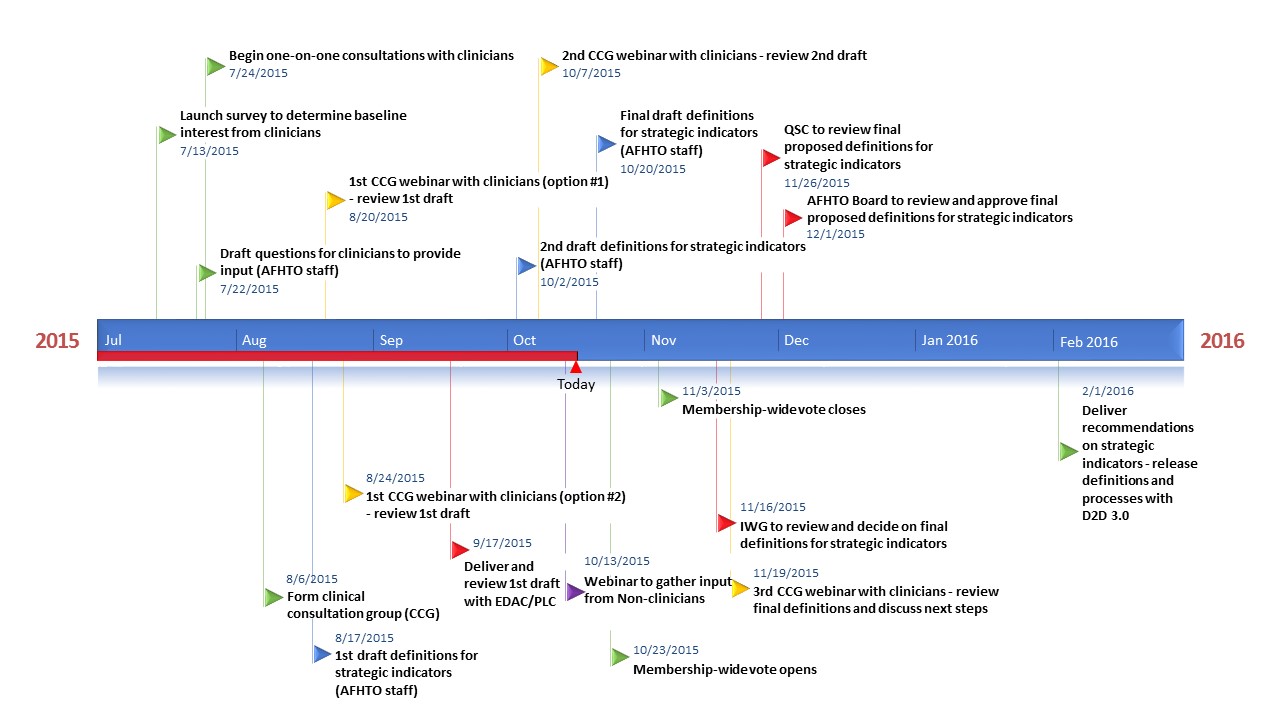
    Timeline CCG work 2015-10-16

    Figure 1: Timeline for consultation on strategic D2D indicators

    Last updated Oct 16, 2015

    Learnings to date

    1)   ED visits:

    • Purpose: help providers measure and thus reduce avoidable ED visits
    • Definition considerations:
      • Should include CTAS 4/5 visits and should focus on ‘avoidable’ visits.  However, no consensus on definition of avoidable yet
    • Outstanding information
      • Summary of the most common reasons/diagnoses for CTAS 4/5 visits
      • Possibility of sorting CTAS 4/5 visits according to time of day
      • Input from ED physicians regarding “avoidable”
      • Possibility of applying evidence based algorithm (the NY algorithm) to existing ED data to identify “avoidable” visits

    2)   Follow-up after hospitalization

    • Purpose: help providers measure and thus improve follow-up; reduce chance of people “falling through the cracks”
    • Definition considerations:
      • Should include multiple modes of follow-up (i.e. phone, home-visit etc. as well as in person office visit) by any clinician (i.e. not limited to physician) and probably center on common chronic conditions already the focus of the MOHLTC version of the indicator.
      • Timeframe should be evidence-based.
      • Denominator should exclude patients for whom hospitalization data was not communicated to primary care team.
    • Outstanding information
      • Strategies to more effectively communicate hospitalization data to primary care team
      • Technical process for consistently recording and extracting data about phone-based follow-up in EMRs

    3)   Time spent delivering primary care (capacity):

    • Purpose: document capacity of the clinical team to deliver primary care services for purposes of identifying appropriate patient volumes and supporting argument for recruitment and retention in primary care teams
    • Definition considerations
      • Include time spent by all clinicians (physicians and IHPs)
      • Include any and all activities related to the care of a specific patient including time spent seeing patients in person, phone/email communication, completing documentation/updating EMR
    • Outstanding information
      • Input from broader range of clinicians (consultation on this topic not as advanced as previous topics)
      • Approaches used in partner organizations (E.g. RNAO, AOHC, OCFP, others)

    Join the Conversations

    As illustrated in the timeline (see above), draft definitions and outstanding questions will be considered by the Executive Director Advisory Council (EDAC) and Physician Leadership Council (PLC) joint meeting on September 17, 2015. We would like to know your thoughts about what these definitions and considerations should be.

    If you are a clinician:

    Please let us know which one(s) of the following activities you might be able to undertake

    1. Provide input through a 10-15 minute “corner consult” by telephone with Carol Mulder, provincial lead of the QIDS program at AFHTO
    2. Discuss the above information with your QI committee or physician group and e-mail responses, questions, or suggestions to Carol Mulder.
    3. Participate in a working group meeting via teleconference with other interested clinicians (2-3 times between now and December 2015).

    Please send your responses to Carol Mulder, Provincial Lead for the QIDS program

    If you are not a clinician:

    Option 1: help gather input from clinicians
    Please let us know which one(s) of the following activities you might be able to undertake to get more input from clinicians within your teams

    1. I will forward contact information for one or more clinicians who might be interested in providing input on these indicators
    2. I will discuss the aforementioned considerations with my QI committee and send in notes of the discussion
    3. I will discuss the aforementioned considerations with my physician group(s) and send in notes of the discussion

    Option 2: provide your own input

    1. Talk to an ED who will be attending the EDAC/PLC meeting on September 17, 2015 and ask them to share your input with the group
    2. Participate in a discussion with other non-clinicians via webinar (late September – TBA)
    3. Provide input on the aforementioned considerations via e-mail

    Please send your responses to Carol Mulder, Provincial Lead for the QIDS program.

  • Patient Stories Wanted for HQO 2016 Annual Report

    Health Quality Ontario is seeking patient stories for inclusion in Measuring Up 2016, their annual report. This would be a great opportunity to profile your team’s work for key stakeholders through your patients’ experiences.

    Areas of interest include:

    • A patient with 1 or more risk behaviours (smoking, obesity, not enough fruits/vegetables)
    • A patient with multiple chronic conditions
    • A patient without prescription medication insurance but who needs medication to treat or prevent a health condition.
    • A patient who has experienced frustration with getting a same day/next day, or after hours, appointment with family doctor or other primary care provider, resulting in having to visit emergency dept. and/or walk-in clinic.

    Patient stories from communities across Ontario are welcome and interviews would need to be completed by mid-July. Any team who’d like to contribute can contact:

    Heather Angus-Lee
    Writer & Editor, Health System Performance
    Health Quality Ontario
    Heather.Angus-Lee@hqontario.ca
    905-308-0038

  • Webinar – Introducing the Electronic Patient Reported Outcomes (ePRO) Tool.

    Researchers from the Bridgepoint Collaboratory for Research and Innovation presented a webinar to introduce the Electronic Patient Reported Outcomes (ePRO) Tool to AFHTO members. This tool allows patients and providers to set outcome goals together, after which patients are able to track and report on their progress towards these goals using an app on their mobile device (tablet or phone). The researchers are hoping to recruit 22 sites for a clinical trial scheduled to begin in January 2017. Drs. Carolyn Steele-Gray, Walter Wodchis, and Pauline Boeckxstaens presented the tool and some information about the planned clinical trial. Slides from the webinar  and a video recording of the webinar (see below – length 1:03:53) can help you determine whether your team might be suited to participate in the trial.  More information about the tool, including some short videos, can be found here. If you have any questions, please contact catherine.macdonald@afhto.ca.

    About the project:

    Patient reported outcomes (PRO) are increasingly recognized as a major indicator of quality in health care. PROs can provide insight into the impact of treatments and interventions on a person’s health that go beyond traditional provider chosen outcomes. They may include vital signs, disease specific symptoms, functionality, pain, general well-being, among other measures in high risk patients. Patients themselves have identified the health of their informal caregiver (often the spouse of a senior patient) to be a significant metric in terms of assessing whether their own current treatment/management strategy was effective.

  • Primary care quality improvement: Is data the future?

    Healthy Debate article published May 19, 2016. Article in full pasted below.
    Authors: Vanessa Milne, Christopher Doig & Jill Konkin

    Alberta’s Chinook Primary Care Network serves more than 170,000 residents, bringing together health-care groups that include 140 physicians, as well as nurse practitioners and dietitians. But it also includes some more surprising positions: a director of evaluation, three senior quality analysts, and an information management lead.

    What kind of group needs five full-time data analysts? One that believes in the importance of regular feedback and metrics. The primary care network (PCN) has been measuring performance indicators for a decade, and it offers customized reports on demand to its physician leadership board as well as individual doctors.

    For example, knowing that diabetes increases the risk of cardiovascular disease, they often look at how many diabetes patients are on a statin. They further break that information down by age, sex, BMI and tobacco use. And they can track how often diabetes patients are seeing their care providers – including who hasn’t been seen within the past year, and might need to be called in for an appointment. (Click here to see a sample report.)

    “One doctor who had just taken over another doctor’s panel of patients asked me, ‘Proportionally, how many of my diabetic patients are on a statin?’ I said about 40%, and he was really alarmed,” says Charles Cook, director of evaluation at the PCN. “This allows us to provide that bird’s eye view.”

    This kind of data-driven analysis is now available to family doctors in both Ontario and Alberta province-wide. Known as audit and feedback, it offers doctors – and teams of doctors – the chance to have their information analyzed and submitted to them as a report. (Such reports have also been used in Canadian hospitals, but this article focuses on its use in primary care teams.)

    Audit and feedback compares their performance on key indicators, like the use of lab tests or of cancer screening against those of other practitioners in the region. For now, those reports are most often presented quarterly or once a year. But we’re moving towards faster feedback. Some health care workers in the Chinook network can access current reports on a private website, which will evolve into a continually updating hub – like a Google Analytics page for clinical care. “Our plan over the next couple years is to get it as close to real time as we can,” says Cook.

    The idea of audits doesn’t resonate with everyone, however. A 2011 mixed-methods study looked at how seven Ontario family health teams responded to having their performance measured. It found that, on the whole, physicians were supportive of the idea, but some also had concerns. “It can be threatening to someone who has done stuff the same way for 25 years, to be told that people can measure this now and they can tell you whether you are effective or not, and their records are completely accessible for analysis,” one physician told the researchers.

    “Some doctors who haven’t used this before are anxious about having people looking at their data – or are even anxious about looking at their own data,” echoes Lara Cooke, associate dean of Continuing Medical Education and Professional Development at the University of Calgary and co-leader of the Alberta Physician Learning Program. “It’s a culture shift.”

    The effectiveness of audits also varies greatly with the quality of implementation – with poorly executed audit and feedback having no impact at all on quality. And of course, it’s not possible to measure everything that’s important. “There are limitations,” says Noah Ivers, a family physician and scientist focusing on quality in primary care. “But there is also incredible potential.”

    Alberta and Ontario’s data-driven primary care improvements

    Audit and feedback systems are seen as a way to ensure more accountability and to shape continuing professional development. Worldwide, it has been tied to public accountability and physicians’ pay, but in Canada, many audit and feedback programs are framed as part of quality improvement and professional development, and therefore are voluntary and not publicly available.

    Alberta offers multiple audit and feedback programs, including the Physician Learning Program (PLP). The PLP is “basically thought of as a service to the members of the [Alberta Medical Association],” says Cooke. It offers tailored reports – a key component of successful audit and feedback, in addition to providing general reports. “Doctors or groups of doctors might come to us with questions about some specific clinical thing – how are we doing with management of condition X – and we sit down with them and figure out how to tailor the report to them,” she says.

    None of us is terribly good at knowing what our actual performance is…but the data tells the tale, and brings out the gaps.”

    Last year, they created 300 reports across the province, which combine charts and data with structured feedback, including looking at evidence-based guidelines and identifying barriers to success. In primary care, she says, they’ve often focused on Choosing Wisely recommendations, such as increasing the likelihood these recommendations are followed for cervical cancer screening. They follow up with another audit on the same data six months or a year later, so doctors can see their progress. And they’re working with other groups on a “dashboard” model that would update key figures in real time.

    Ontario also has a handful of organizations working on primary care audit and feedback, including Health Quality Ontario’s Primary Care Practice Reports. Since its launch in 2014, hundreds of doctors, Family Health Teams and Community Health Centres have volunteered to have their practice analyzed.


    Screen Shot 2016-05-18 at 8.54.02 PM

    An example of a chart from a Primary Care Practice Report. Click here to see a full sample report


    It compares the practice with other similar types of practices in the province, reporting on, for example, how many patients are up to date on cancer screening and diabetes management testing, or examines rates of emergency department visits.

    “For health care utilization data, [like ED visits and readmissions] we present risk-adjusted data to account for differences in the populations different practices are serving,” explains Anna Greenberg, vice president of health system performance at HQO. “On the other hand, we present raw, unadjusted data for cancer screening or diabetes management indicators, so that practices can understand the true rates of uptake.”

    HQO also offers tips for improvement and encourages doctors to set goals for themselves. The team is currently working with Ivers and the Ontario SPOR Support Unit to study the impact of these reports, but that information is not yet available.

    Physicians can get another report in a year’s time, though HQO is working towards providing faster results. “There’s a lot more data in primary care than there was when this started,”Greenberg says.

    Nonetheless, creating these reports isn’t easy, as accessing and analyzing the data can be labour intensive. There can be long turnaround times to get the information – typically, a year long in Ontario – and it can be time consuming to anonymize it. The data for the PCP reports comes from institutions like OHIP, the Ontario Cancer Registry and the Ontario Diabetes Database, while Alberta’s PLP pulls from sources like Alberta Health and Alberta Health Services.

    It’s difficult to get information on prescriptions for people under 65, and for other team members like nurse practitioners. And some of the data simply isn’t appropriate. “It’s not collected with this kind of work in mind,” explains Cooke. “Its purpose is for billing and data quality can be an issue. If [doctors] don’t know all the billing codes, and have some go-to ones…garbage in, garbage out.”

    The evidence behind its effectiveness

    So is it worth the effort? Audit and feedback has been analyzed for its effect in both primary care and for specialists. Audit and feedback is generally effective, “but there’s a huge variation in that effectiveness,” says Ivers, author of the Cochrane Review that investigated its impact. It looked at 140 studies and found that audit and feedback “generally leads to small but potentially important improvements” in performance, with a median of 4% improvement in the outcomes the feedback was trying to address. But one quarter of the interventions had larger effects (up to 16% absolute improvement), and one quarter had no effect.

    The review found audit and feedback was more effective when it was given both verbally and in writing by a supervisor or colleague, when it included an action plan and targets, and when it was offered more than once. It also worked best on health care workers who had been doing worse than average on the outcomes being measured.

    Well aware of the importance of execution, the Primary Care Practice Reports are working with the Canadian Institutes of Health Research (CIHR) to modify their reports and test their effectiveness. A recent ICES report by Richard Glazier points to key evidence-backed ways that Ontario’s reports can improve, including adding both explicit targets and tools that help physicians create an action plan.

    “We kind of see this work as a bit of a laboratory and a learning system; we work with researchers to continually look at how we optimize the report,” says Greenberg.

    Ivers also cautions against “pretending that all the things that are important are readily measurable. We need to try to measure what matters, and right now we’re frequently measuring what’s easy to measure,” he says. For example, what patients feel is important – including wait time to see their doctors, and whether they had enough time with them at their appointment – is often not available in the data that doctors collect. (Some programs, like the Association of Family Health Teams of Ontario’s Data to Decisions feedback, does incorporate patient experience data, however.)

    But despite its limitations, audit and feedback is superior to other professional development measures, says Ivers. “We have evidence that humans tend to seek continuing learning in things they know a lot about and are already doing good at. It kind of defeats the whole purpose,” he says. “[Using data] to drive continuing professional development means it’s about what our patients and communities need, not what we’re interested in.”

  • Patients First Updates & Advice from Member Leaders

    Sent to: Board Chairs, Executive Directors and Lead MDs/NPs in AFHTO-member FHTs and NPLCs

    On May 12, forty AFHTO members from around the province – Physician Leadership Council (PLC),
    ED Advisory Council (EDAC) and the NPLC Council – received updates on the Ministry’s plans for Patients First, and then  strategized on how to ensure each LHIN moves in a direction that will strengthen primary care to be the foundation of the health system. Additional updates were provided, e.g. roll-out of compensation increases, development of new FHT contract templates, and more.

    Top 3 messages from the meeting overall

  • While we don’t yet know when legislative changes will be introduced to implement many aspects of Patients First, nor how the LHIN relationship with primary care will evolve, we do know that government remains committed to the overarching principles of Patients First – i.e. population health and integration at the local level, with particular attention to primary care, home and community care, and public health.
  • We DO know there remains great opportunity for primary care organizations to shape what this future will look like. FHTs and NPLCs can – and are – further developing their relationships with their LHINs, primary care colleagues and other providers to identify and respond to population health needs in the community.  The Ministry is looking to our membership to identify change leaders, and for input into an ‘implementation work plan’ and ‘collective to-do list’.
  • AFHTO is here to help members with information exchange and advocacy support as you work within your LHINs and sub-LHIN Please do not hesitate to contact Bryn.Hamilton@afhto.ca or Angie.Heydon@afhto.ca for advice and/or to pass on updates from your LHIN.

What we heard from the Ministry

Nancy Naylor (Associate Deputy Minister), Tim Hadwen (Assistant Deputy Minister), Phil Graham (PHC Branch Director), and Alison Blair (newly appointed Director for LHIN renewal) made a presentation on key themes emerging from Patients First consultations and next steps.

Key points from their presentation and response to questions:

  • Content and date for government to introduce legislative amendments to implement Patients First is not yet known. As a result, many of the questions members were asking do not yet have answers.
    • At the Ministry’s invitation, AFHTO is sending them these unanswered questions to include in theworkplan, as they prepare for when government gives direction.
  • In the meantime, the Ministry continues to encourage primary care teams to:
    • Work with the LHINs in identifying sub-LHIN regions;
    • Take a population-based approach to assess the health needs of your local sub-LHIN communities;
    • Look at ways to enhance access to interprofessional team-based care to those who need it.
  • Health Links have laid important ground work for collaboration and will be strong predictors for developing sub-LHIN boundaries.
  • Governance structures and models may need to be further examined with additional stakeholder input.
    • Together with our colleagues in the Ontario Primary Care Council, AFHTO is calling for sub-LHINs to adopt a collaborative approach to bring together multiple players, and avoid introducing an additional governance layer.
    • Meanwhile, members report that at least 5 of the LHINs are at varying stages of considering merging organizations under a single governance.
  • The Rural Health Hub concept is one of these single-governance approaches being considered in some sub-LHIN areas. When asked about it, the Ministry indicated they have not made any decisions about broad implementation of this approach. They believe the concept makes sense in some areas, especially in remote regions. The Ministry indicated that it will not necessarily prescribe what agencies take a lead role on this. How this moves forward will need to be sensitive to local need, capacity and contribution of all the players that exist.
  • There is recognition that implementation must proceed carefully.
  • The Ministry recognized the influential leadership of AFHTO and its members and shared their willingness to work together as we move towards the implementation phase. They specifically noted the recommendations in AFHTO’s Patients First response and our joint submission of the Ontario Primary Care Council.

What we’ve been learning about LHINs

Following meetings with members and LHIN leaders in 12 of the 14 regions, updates from members covering all LHINs, and polling feedback received during the May 12 web conference, the following picture emerges:

  • To date, Health Links appear to have been the key driver for FHTs/NPLCs to have developed relationships with LHIN.
    • 15% of members on the call reported their LHIN has been speaking about Health Links as the foundation for building their primary care strategy.
  • Patients First opened doors with LHINs that may have been closed before for primary care teams. For the most part LHINs are looking at improving their structures for engaging primary care.
    • 63% of members on the call reported their LHIN recognizes and support primary care as the strong foundation for the health system.
    • Unfortunately, 23% have no confidence their LHIN will do what’s needed to strengthen primary care.
  • LHINs are already taking on the new role of reporting on and fostering improvement in primary care. Almost all LHINs recently published their fourth Integrated Health Service Plans, for 2016-19. All have goals related to access to primary care, and some identify “measures directly attributable to primary care system improvement opportunities.”
    • AFHTO and its members are working very hard to demonstrate that meaningful measurement for primary care must be grounded in comprehensive care and the patient-provider relationship, as reflected in Data to Decisions (D2D) and guided by the Starfield Principles.

EDAC/PLC/NPLC advice for AFHTO members

Members strategized on ways to advance the concepts within Patients First, while influencing direction and proactively preparing for any legislative changes.  Summary of advice to all members included:

  • Distributed leadership will be key to successful implementation. Identify leaders at the sub-LHIN level, build the network of engaged primary care leaders in the field to promote the collective primary care voice.
  • Get involved in your local Health Link as a starting point to connect with other health service providers and as a platform for building the coordination of services around patient need.
  • Continue building relationships and self organizing within your sub-LHIN regions.
  • Don’t let the LHIN re-create the wheel when it comes to measurement in primary care. Highlight the work AFHTO is doing, demonstrate the value of meaningful measurement, stress the need to partner together and show the LHIN how our data sets and outcomes can help them reach their performance goals.

Additional updates from AFHTO

Implementation of compensation increase: Our best guess is that funding packages will be out by early summer. AFHTO will be working with AOHC and NPAO to develop supports to help develop and implement compensation plans.   Ministry direction is clear that this funding can only be used for compensation for approved staff positions – and can not be used for any other purposes.

Development of FHT-MOHLTC contract templates: AFHTO CEO has discussed approach and timing for consultation process to inform the development of new FHT-MOHLTC contract templates for March 2017.  We anticipate the consultation across the AFHTO membership (and other key stakeholders) will take place over June to September. Key issues that emerge will be brought to AFHTO’s annual Leadership Session (immediately before the AFHTO conference) for more in-depth discussion and resolution.  The consultation and implementation processes will be supported by close to $110,000 members voluntarily contributed to the Legal and Consulting Fund.

D2D 4.0 indicator survey is open until May 18th: D2D 4.0 will be released in September 2016. As usual, we need input from you regarding the indicators and definitions to ensure it is manageable and meaningful for members. Please respond to the membership wide survey.

AFHTO: advocate, network and resource centre

Whether it’s developing background materials, advocacy work, structuring messages to stakeholders, building LHIN relations, or simply asking advice, members are reminded AFHTO is here to support YOU.

Let us know what we can do to help: info@afhto.ca.

AFHTO will continue to track Patients First implementation progress across the LHINs and help to build upon relationships where required.

  • Cancer Screening – Resources for Primary Care

    Cancer Care Ontario (CCO) Cancer Screening Resources for Primary Care

    Quality Improvement Toolkit

    Breast Screening

    Cervical Screening

    Colorectal Screening

    Prostate Screening Position Statement and Supporting Documents

  • Patient Decision Aids

    Patient decision aids are tools that help people become involved in decision making by making explicit the decision that needs to be made, providing information about the options and outcomes, and by clarifying personal values. They are designed to complement, rather than replace, counseling from a health practitioner. The Ottawa Hospital Research Institute has developed a resource library and website of Patient Decision Aids for clinicians to use with patients.

    How can I find decision aids?

    Where are the online tutorials?

    What’s the evidence?

  • Data to Decisions eBulletin #34: Tracking new evidence in follow-up, give your input to refine D2D indicator in survey

    D2D refinement survey: D2D is AFHTO’s way of influencing primary care reporting on your behalf.  Please tell us what you want D2D to include so it can best reflect your team and your association. Please complete the survey before May 18. Evidence about the impact of follow-up after hospitalization! VERY new analysis provides long-awaited evidence of the impact of follow-up after hospitalization. Among other things, it provides hints about the optimal number of days after discharge in which follow-up should happen. Tracking phone encounters in your EMR to measure follow-up by the TEAM: AFHTO members have said follow-up is NOT just about physicians.  AFHTO is changing the follow-up indicator accordingly, and we have tools to help your team track phone encounters by ALL clinicians to better reflect follow-up by teams. “Improving diabetes care; improving diabetes outcomes”: The upcoming event on June 16 was sold out within 48 hours. (AFHTO’s version of the “same/next day” indicator!)  We still have room for patients though, please see the FAQ for suggestions on how to invite them and/or check with Catherine regarding the waitlist. Join the Diabetes Care CoP: Do you have a passion for diabetes care in your team? Join the fledgling interprofessional Community of Practice to make audacious improvements in the health of patients with diabetes.

    Help spread the word about D2D – invite others to sign up for the e-Bulletin online. 

  • Vascular Health Assessment Support Tool: An Ontario Stroke Network Briefing

    Update May 27, 2016 As of April 1, 2016, the Ontario Stroke Network (OSN) and Cardiac Care Network of Ontario (CCN) have come together as a single entity to ensure a comprehensive and integrated approach to cardiac, stroke and vascular care in Ontario. Below is a copy of PowerPoint presentation that occurred on May 9th, 2016. AFHTO-QIDSS Next Generation VHAST Session May 9 2016 AFHTO, in partnership with the Ontario Stroke Network, and the Cardiac Care Network, will present a webinar to introduce the next-phase prototype of Ontario Stroke Network’s Vascular Health Assessment Support Tool (VHAST). VHAST is an EMR-based platform designed to be used at point of care for a wide array of vascular conditions including Hypertension, Diabetes, Dyslipidemia, PAD, MI/Angina, CKD, CHF, and Stroke/TIA. By allowing clinical data to be compared against best practice guidelines, the tool will support care decisions, quality improvement, and program planning.

    • The initial (alpha-version) prototype was developed within OSCAR EMR. Future development prototypes aim to function in all certified EMRs.
    • The tool will be available free of charge upon release.

    Presenters: Christopher Beaudoin of the Cardiac Care Network and Colleen Murphy, Regional Stroke Best Practice Coordinator with the Cardiac Care Network. Audience:  The VHAST tool is designed for all who are involved, directly or indirectly, in the care and program development for patients with vascular disease, including nursing professionals, Allied Health Professionals (Pharm., RD, CDE, SW, etc.), QIDSS and any other primary care staff who may support the team’s chronic disease programs.