Author: sitesuper

  • AFHTO’s 2019 Pre-Budget Submission

    AFHTO submitted its recommendations to the Standing Committee on Finance and Economic Affairs as part of the 2019 Ontario Pre-Budget Consultations in January. Our key recommendations are:

    1. We need a health system that is truly integrated, one where patients don’t have to move from one part of the system to another part to get their care, especially care for mental health and addictions – primary care and mental health care providers need to work together to ensure that mental health and addictions investments are integrated in primary care.
    2. The relationship between primary care and home and community care can be strengthened by transitioning the function and associated resources of care coordination to primary care. This will bring greater efficiency and patient-centredness to care. Care will be integrated, allowing for seamless transitions of care for patients.
    3. Support expansion of interprofessional team-based care across Ontario. This can start with communities that don’t have a team at all and then expand to all Ontarians who wish for it. Allow for local-level innovation but ensure that primary care providers are involved in the co-design on what would work best for them in their communities and for their patients.
    4. Look at existing models of performance measurement in primary care and facilitate and fund a strategy that spreads it across the system. This strategy must measure outcomes that matter to patients and providers while assisting in lower system costs. To support this, there needs to be further investments in quality improvement practice facilitators to help support front line providers.

    Relevant Links:

  • AFHTO’s 2019 Pre-Budget Submission

    AFHTO submitted its recommendations to the Standing Committee on Finance and Economic Affairs as part of the 2019 Ontario Pre-Budget Consultations in January. Our key recommendations are:

    1. We need a health system that is truly integrated, one where patients don’t have to move from one part of the system to another part to get their care, especially care for mental health and addictions – primary care and mental health care providers need to work together to ensure that mental health and addictions investments are integrated in primary care.
    2. The relationship between primary care and home and community care can be strengthened by transitioning the function and associated resources of care coordination to primary care. This will bring greater efficiency and patient-centredness to care. Care will be integrated, allowing for seamless transitions of care for patients.
    3. Support expansion of interprofessional team-based care across Ontario. This can start with communities that don’t have a team at all and then expand to all Ontarians who wish for it. Allow for local-level innovation but ensure that primary care providers are involved in the co-design on what would work best for them in their communities and for their patients.
    4. Look at existing models of performance measurement in primary care and facilitate and fund a strategy that spreads it across the system. This strategy must measure outcomes that matter to patients and providers while assisting in lower system costs. To support this, there needs to be further investments in quality improvement practice facilitators to help support front line providers.

    Relevant Links:

  • Data to Decisions eBulletin #83: More tools for continuous improvement

    In this issue

    • Transitions in Tilbury
    • Help with patient surveys and QIPs
    • Developing a tool to help manage patients with dementia
    • More tools to help you keep getting better

    Transitions in Tilbury

    Last month, we shared the resources from Focus on Follow-Up, which included lots of innovative projects from our teams in the North East. But great things are happening all over! In case you missed Tilbury’s conference presentation, you can check out the slide deck here. In a hurry? Watch the trailer below. Want evidence that timely follow-up saves lives and makes our health system more sustainable?

    Help with patient surveys and QIPs

    Just in time for QIP season: A new tool that can automate your patient surveys and help you build your 2019-20 Quality Improvement Plan. We know that patient experience surveys are a great source of data, but we also know that distributing them and gathering the data can be time-consuming and difficult. HQI is a brand-new patient engagement & quality improvement tool from Cliniconex that uses your EMR to automate the process. It sends out patient experience surveys after they visit your team, then gathers and analyzes the data for you. Its dashboard function lets you track your performance over time and compare your aggregate results with your peers. HQI can also help you move from measurement to improvement. It allows you to spend less time gathering and formatting your survey data and more time developing QI initiatives. As you look at your data, it takes you step-by-step through the process of recording your insights, goals, and change ideas, and it turns these into a quality improvement plan (QIP) using Health Quality Ontario’s QIP template.

    • Want to know more? Check out this sneak peek of HQI that was shared with “the Q” – QIDSS, QIIMS, Data & Quality Coaches, and QIDSS-like folks – on a webinar back in December.
    • Want to see if your team fits the profile? Schedule a follow-up session for your team. Email sales@cliniconex.com or call 1-844-891-8492.

    Developing a tool to help manage patients with dementia

    Are you a family physician who assesses patients with dementia? Maybe you wish you had better tools to support you in this work, or you have ideas about what would make such a tool great. Here’s a chance for you to share these ideas and help create some tools that will make it easier for clinicians like you to make good assessments! Researchers at Queen’s and Ryerson Universities and Bridgepoint Active Healthcare are developing an eLearning platform for dementia assessment and management. To help them get it right, they’re conducting focus group sessions with clinicians from January through March. You’ll only need to attend one session, no longer than two hours, and you’ll receive an honorarium to offset the costs of travel and taking time away from work. There’s also an opportunity to participate remotely if travelling to Toronto or Kingston would present a barrier. Want to learn more? Ready to sign up? Email Lorraine Pirrie or Carolyn Steele-Gray. Or call Carolyn at 416-461-8252 x 2908.

    More tools to help you keep getting better

    Our partners at the Excellence through Quality Improvement Project (E-QIP) are presenting a series of webinars to support your team’s QI efforts. See below for times, dates, and links to register.

    In Case You Missed It: Check out eBulletin #82 or other back issues here!

    Questions? Comments? Connect with the QIDS team at improve@afhto.ca.

  • Supports Available for Management of Chronic Pain and Addictions

    Originally posted January 9, 2019. Last updated November 5, 2019. 

    HQO is convening a large set of partner organizations, including AFHTO, to compile a coordinated program of supports to help clinicians manage their patients’ pain, including appropriate use of opioids. An overview of the “partnered supports” process can be found here. On March 8th, 2018, HQO presented a webinar outlining these supports; the slide deck from that webinar is available here. More detail on some of these resources are presented below. This list is presented as a menu, from which primary care providers can choose based on what’s right for their patients and their team. To help you identify the patients who would benefit from this kind of care, consider using a QIDSS-developed EMR query to create a list of patients who use opioids.


    Buprenorphine-Naloxone Treatment for Opioid Use Disorder (Centre for Addiction and Mental Health)

    The Centre for Addiction and Mental Health (CAMH) is offering a course on Buprenorphine-Naloxone Treatment for Opioid Use Disorder for frontline providers who provide treatment for opioid use disorder. This course presents a framework for providing maintenance treatment for opioid use disorder with buprenorphine/naloxone, including its use in a primary care setting. The course walks the learner through the key elements of selecting, preparing, initiating and maintaining a patient with opioid use disorder on buprenorphine/naloxone treatment.


    FREE: Opioids Clinical Primer (MacHealth; Women’s College Hospital; University of Toronto Department of Family and Community Medicine)

    This primer is a series of six free, accredited online courses targeted at primary care providers (physicians and non-physicians). Key topics include: Diagnosing and Managing Opioid Use Disorder; Initiating Buprenorphine; Strategies for Prescribing Opioids and Managing Patients on Opioids; Addressing the Connections Between Substance Use Disorder and Mental Health; Managing Patients with Chronic Pain – Beyond Opioids. Courses are available through MacHealth; you will be required to sign up (for free) with your email address.  The first course was released in December 2018. Three courses are currently available, and three more are coming soon.


    Team-Based Approaches to Chronic pain management: Opioid Stewardship 

    This presentation, delivered by Dr. Jennifer Wyman, will introduce you to some of the principles of safe pain management and opioid stewardship, as well as the Opioids Clinical Primer. Click here to access the slides.


    Collaborative Mentoring Networks for Addictions and Pain (OCFP)

    The Ontario College of Family Physicians (OCFP) Collaborative Mentoring Networks now include Medical Mentoring for Addictions and Pain (MMAP). This program supports physicians with relevant expertise to mentor family physicians interested in chronic pain and addictions. The Collaborative Mentoring Networks are certified under Mainpro+.


    Management of Chronic Non-Cancer Pain (CNCP) Tool, Opioid Manager, and Opioid Tapering Template (Centre for Effective Practice)

    Through a multidisciplinary and multidimensional approach, the Centre for Effective Practice (CEP) has designed a Management of Chronic Non-Cancer Pain (CNCP) Tool. This tool will assist family physicians and primary care nurse practitioners develop and implement a management plan for adult patients living with pain.

    Developed under the clinical leadership of Dr. Arun Radhakrishnan, Dr. Jose Silveira, and Dr. Andrea Furlan, the updated Opioid Manager (2017) and Opioid Tapering Template (2018) are designed to support health care providers prescribe and manage opioids for patients with CNCP. As an update of the original Opioid Manager (2011), the new Opioid Manager includes feedback from end users and recommendations from the 2017 Canadian Guideline for Opioids for Chronic Non-Cancer Pain.

    In addition to the Management of CNCP Tool and the Opioid Manager, the CEP will be offering an academic detailing service to primary care providers, beginning in Winter 2018. Watch this space for more information.


    Opioid Use Disorder Tool (Centre for Effective Practice)

    This tool, launched in December 2018, was developed by CEP to support primary care providers in screening, diagnosing, and implementing opioid agonist therapy (OAT) for patients who have problems with opioid use. It emphasizes a stigma-free and empathetic approach and provides talking tips to help navigate difficult conversations about opioid misuse. Clinical leadership was provided by Arun Radhakrishnan and Jennifer Wyman. You can access it here.


    EMR Support for Opioid Use Management (OntarioMD)

    Through their EMR Practice Enhancement Program (EPEP), OntarioMD provides customized, CME-accredited support, including access to Peer Leaders, for physicians who wish to optimize their EMR use –  including using the EMR for safer opioid prescribing. OntarioMD is working closely with AFHTO and EMR vendors to develop more EMR tools to help with management of opioid use, including development of an EMR dashboard. Watch this space and our weekly newsletter for updates.


    EMR Tool for CNCP (eHealth Centre of Excellence)

    The eHealth Centre of Excellence has developed an EMR tool in partnership with the Centre for Effective Practice (CEP), which incorporates the Management of Chronic Non-Cancer Pain (CNCP) Tool (see above). It is currently available for TELUS PS Suite and OSCAR EMR, and an Accuro version will be developed. The tool is divided into the following sections: Baseline Assessment, Ongoing Assessment, Non-Pharmacological Therapy, Non-Opioid Medications, Opioid Medications and Intervention Management and Referral. This approach allows clinicians to conduct a complete assessment and provide a tailored management plan that incorporates the patient’s goals, while adhering to current best practices in providing improved CNCP management overall.


    Opioid Use Toolbar (East Wellington FHT, Guelph FHT, and TELUS Health)

    East Wellington FHT, Guelph FHT, and TELUS Health developed this toolbar to support opioid tapering in the TELUS PS EMR. It was informed by content from the 2017 Canadian Guidelines for Opioids in Chronic Non-Cancer Pain and the EMR tool developed by the Centre for Effective Practice (described above). Kevin Samson, who leads the TELUS Community of Practice and supports AFHTO’s EMR Data Management Subcommittee, was involved in its development and has posted information about it here.


    Opioid prescribing profiles (Health Quality Ontario)

    The most recent iteration of the MyPractice report gives information to individual physicians about their opioid prescribing patterns.


    ECHO Ontario Chronic Pain & Opioids

    To learn more about ECHO (Extensions for Healthcare Outcomes) you can check out their webinar presented to AFHTO members on January 30th, 2018. Their webinar from November 19, 2018, on opioid tapering and tools for use in clinical practice with Dr. Andrea Furlan can also be seen here.


    Making the Choice, Making it Work: Treatment for Opioid Addiction

    This is a book from the Centre for Addiction and Mental Health (CAMH) and is available as a PDF on their website. It describes a variety of approaches and is particularly focused on opioid agonist therapy.


    Reducing Harm from opioids in primary care (St.Michael’s Hospital Academic FHT)

    The inter-professional team following interviews with staff physicians, patients and analysis of data has created a multifaceted strategy to reduce the harm from opioids within their neighbourhood. Further information about their initiative can be found in the poster presentation here. 

    Opioid Stewardship: Implementing Pharmacist Led Assessments for Patients Co-Prescribed Opioids and Benzodiazepines at an Academic Family Health Team

    To learn more about how a pharmacist can help your team reduce patients’ mean daily opioid and benzodiazepine doses, you can check out a poster presentation here. 

    Online opioid self-assessment programopioid 

    The Online Opioid Self-Assessment Program is a FREE course developed with funding from Health Canada to improve opioid prescribing. It’s highly interactive and uses assessment as a technique for knowledge exchange and guideline implementation. In order to facilitate active

    learning, a variety of techniques are employed, including videos, case presentations and an assortment of question types to keep you engaged and apply it in practice.


    Dr. Andrea D. Furlan MD PhD, ECHO Ontario Co-Chair, developed this interactive course with other colleagues in physiatry, family medicine and addictions medicine. This course is based on the updated 2017 Canadian Opioid Guideline.


    Other Resources

    Take advantage of the wisdom of the field: Several AFHTO members have successfully developed tools and programs to support opioid stewardship and pain management. See below for examples and links to resources you can adapt for your own patients.

    Chronic Pain and Addictions Management in a Family Health Team (Marathon FHT)

    The Marathon Family Health Team has had a Chronic Pain & Addictions program since 2014. Now called the High-yield approach to Risk Mitigation and Safety (HARMS) program, it has two streams tailored to different degrees of risk. As a part of these programs, patients being prescribed opioids sign a contract with their prescribing practitioner and agree to urine drug screens (UDS). You can see an overview of the program here [PDF].  Supporting documents, including the patient information handout, contracts, and UDS protocol are available to AFHTO members here.

    Pain Management With Less (or no) Medication (Belleville NPLC)

    AFHTO teams have demonstrated that there are ways to manage pain without the use of opioids or other medications. Belleville NPLC, an AFHTO-member team, collaborated with musculoskeletal experts to participate in a low back pain management project. Although it started as a pilot, they have expanded the project by collaborating with local partners. Patients report that they rely less on medications, including opioids, to help manage their back pain. Belleville NPLC won a 2017 Bright Lights award for their implementation and expansion of this program. You may wish to consider adopting a similar program in your team and reaching out to your peers at the Belleville NPLC to learn more about what they did and what they have learned from it.

    Get some context: The Ontario Drug Policy Research Network and the Institute for Clinical Evaluative Sciences (ICES) have developed an online, interactive tool called Indicators of Opioid Prescribing in OntarioThis tool allows you to access data about rates of opioid prescribing and opioid agonist therapy (OAT) use in Ontario by age, sex, region, and drug type. Want to see patient stories about how opioid use disorder affected them, and how they benefited from treatment? 


  • Bits & Pieces: Welland McMaster FHT reduces ED visits, LeaderShift update & more

    Your Weekly News & Updates

    Welland McMaster FHT reduces ED visits with Mental Health and Addictions Response Team Since its inception in July 2018, Welland McMaster FHT’s 2018 Bright Lights-nominated program – Mental Health and Addictions Response Team (MHART) – has responded to 101 emergency calls for low acuity mental health and addictions patients with only 9 of those callers needing transport to the ED. The program has already seen a 5% reduction in mental health transports by ambulance to the ED compared to the same time period prior to MHART launch and they aim to reduce ED visits by 10% by January 2019. Find out how here. In this Issue: Welland McMaster FHT reduces ED visits with Mental Health and Addictions Response Team Opioid Use Disorder Tool LeaderShift update St. John Ambulance first aid training discount RN prescribing: seeking feedback on proposed regulation changes Upcoming events regarding strategic planning and more          
    Opioid Use Disorder Tool The Centre for Effective Practice has launched the Opioid Use Disorder Tool. It was developed to support primary care providers in screening, diagnosing and implementing opioid agonist therapy (OAT) for patients who have problems with opioid use. It emphasizes a stigma-free and empathetic approach and provides talking tips to help navigate difficult conversations about opioid misuse. Access it here.
    LeaderShift update LeaderShift has engaged OPTIMUS | SBR to help increase the leadership capacity in the sector by identifying different leadership career pathways through different primary research and engagement activities. The team will identify opportunities and barriers to enhancing leadership capacity and develop recommendations to build upon strengths while addressing issues and gaps. At the end of the project they hope to achieve the following:

    • An increased understanding of the career pathways and compensation levels of community and primary healthcare leaders (in-sector, cross-sector, out of sector)
    • Actionable recommendations to enhance the retention of leaders in the sector
    • Actionable recommendations to operationalize key lessons, capabilities, and capacity built through the Leadershift program
    • Identification of opportunities to increase the leadership profile of the sector

    There will be opportunities for leaders to provide input through several engagement activities; they will be reaching out to organize these sessions over the coming weeks. They’d like to ask each organization to identify one HR Lead/Manager to provide input and support the collection of data and documents from member organizations. Please identify your HR Lead/Manager via the survey link. If you are a small organization with an ED that manages the HR please also indicate that in the survey. Please try to complete the survey by the end of this week to help facilitate the set-up of engagement events this month. Rachel Steger, the project manager at OPTIMUS | SBR, would be happy to answer any questions or provide any further detail on the project and can be reached at rachel.steger@optimussbr.com. Thank you for your continued support and your participation in this project.

    St. John Ambulance first aid training discount St. John Ambulance in Burlington would like to extend the offer of a 25% discount for those professionals seeking to renew any of their required qualification in cardio pulmonary resuscitation (CPR) from Jan 1st to Feb. 28, 2019 at their branch location. Please feel free to call the branch to book your course and quote CPR201902.         RN prescribing: seeking feedback on proposed regulation changes The College of Nurses of Ontario’s (CNO’s) Council is seeking feedback on draft regulations that will:

    • permit RNs to prescribe certain medication and communicate diagnoses for the purpose of prescribing; and
    • impact nursing practice related to dispensing and administering medications.

    Visit their consultation page for more information, including the draft regulation. You can submit your feedback to regulations@cnomail.org or complete the online survey by Feb. 18, 2019.

    Governance Webcast Series: Strategic Planning, Jan. 15, 2019 Learn how strategic planning can bring your organization growth and success. Register now! Asthma Action Plans: From Research to Real World Usage, Jan. 10, 2019 Attend this webcast on Asthma Action Plans, hosted by The Lung Association. Learn more here.
    Asthma Action Plans: From Research to Real World Usage, Jan. 10, 2019 Attend this webcast on Asthma Action Plans, hosted by The Lung Association. Learn more here. Changing CARE: Made-in-Ontario approaches to improving the caregiver experience: Jan. 28, 2019, Toronto Registration is required for this free event by the Change Foundation. Learn more here.


  • Welland McMaster FHT reduces ED visits with Mental Health and Addictions Response Team

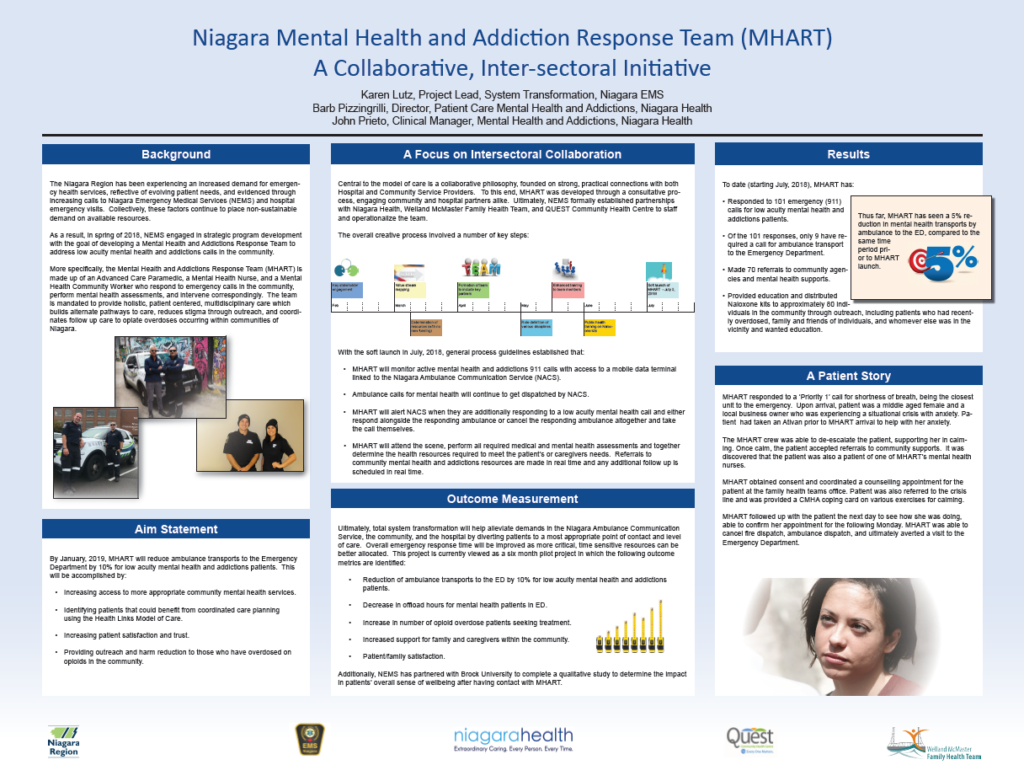
    The Niagara Region has been experiencing an increased demand for emergen­cy health services, which places non-sustainable demand on available resources. Niagara Emergency Medical Services (NEMS) engaged in strategic program development to address low acuity mental health and addictions calls in the community. This resulted in Welland McMaster FHT’s 2018 Bright Lights-nominated program – Mental Health and Addictions Response Team (MHART). Made up by an Advanced Care Paramedic, a Mental Health Nurse and a Mental Health Community Worker, since its inception in July 2018, MHART has responded to 101 emergency calls for low acuity mental health and addictions patients with only 9 of those callers needing transport to the ED. They have also made 70 referrals to community agencies and mental health supports. The program has already seen a 5% reduction in mental health transports by ambulance to the ED compared to the same time period prior to MHART launch and they aim to reduce ED visits by 10% by January 2019. To learn more, click on the poster image below.

    Niagara Mental Health and Addiction Response Team (MHART): A Collaborative, Inter-sectoral Initiative[/caption] Relevant Links:

  • Farewell Carol Mulder

    A Fond Farewell to Carol Mulder

    Provincial Lead, Quality Improvement and Decision Support

    Dear AFHTO Members:

    I am writing to let you know that Carol Mulder is leaving AFHTO at the end of December 2018.  Carol will be taking a contract with OntarioMD to further the partnership AFHTO has enjoyed with OntarioMD dating back to even before OntarioMD produced the very first Data to Decisions report, D2D 1.0, in October 2014.  She will also be taking on a role with the Center for Studies in Primary Care at Queens University in Kingston.

    Since it began in October 2013, Carol has led the Quality Improvement Decision Support program at AFHTO for over 5 years.  Over that time, the community of practice around quality improvement in primary care has blossomed.  Through this community, AFHTO members have developed a robust culture of measurement exemplified by the high level of sustained voluntary participation in D2D and numerous other measurement and improvement efforts.

    While Carol and AFHTO members alike find it difficult to part at such an exciting point in our collective improvement journeys, it is nice to know that Carol is not going far.  She will continue to contribute to the quality of primary care in Ontario through her new roles at OntarioMD and the Centre for Studies in Primary Care at Queens and AFHTO and our members will continue to benefit from her passion in ensuring team based primary care continue with its improvement efforts while they provide the best quality of care possible for our patients.  Please join me in wishing her well in her new roles right here in our own neighbourhood!

    If you have any questions about the QIDS Program please connect with Catherine Macdonald, Project Coordinator (catherine.macdonald@afhto.ca) or Laura Belsito, Clinical Knowledge Translation and Exchange Specialist (laura.belsito@afhto.ca).

    Thank you and have a wonderful holiday season.

    Kavita Mehta

    Chief Executive Officer

  • Bits & Pieces: time to advocate for team-based care, 2018 tools, resources & more

    Your Weekly News & Updates

    Time to advocate for team-based care Join Hill+Knowlton Strategies, our government relations firm, on Friday, January 18, 2019 from 12 p.m. to 1:30 p.m. to hear about the new government’s priorities, to discuss how to work with your MPP, an to review the prepared key messages that will resonate. It’s important that MPPs are champions for team-based care as the government reviews primary care in the province and how it’s delivered. Learn how to effectively communicate with yours! Register here.     In this Issue: Time to advocate for team-based care Perkopolis perks for AFHTO members AFHTO 2018 Events- videos and slides included 2018 tools and resources 2018 Leadership development and training Opioid De-Implementation Initiative Ontario Neurotrauma Foundation (ONF) seeking input for webinar on post-concussion care Upcoming events regarding strategic planning and more
    Perkopolis perks for AFHTO members We have had an extremely busy and productive year in 2018, so below are highlights of tools, resources and events we’ve been privileged to develop for you. And to usher in the new year, we have perks! AFHTO has partnered up with Perkopolis, an employee perk program that allows members access to great savings on entertainment, travel, attractions, shopping, health & wellness and more! Last week we sent EDs instructions on how to join and the deadline is Jan. 11. If EDs are interested in adding your team or have any questions, please email info@afhto.ca. perkopolis
    AFHTO 2018 events- videos and slides included
    Checking out the posters at the 2018 conference


    2018 tools and resources

    2018 Leadership development and training

    • LeaderShift
    • LEADS LITE
    • Partnership with Joule’s Physician Leadership Institute for physician leadership training
    leads lite
    Opioid De-Implementation Initiative CAMH’s Opioid De-Implementation Initiative aims to promote evidence-based practices for treating pain and addiction in primary health care. They’re currently offering:

    • Opioid De-Implementation in Primary Care: Please join an interactive webinar on January 8, 2019 presented by project lead Dr. Peter Selby. Topics of discussion will include a systematic approach to identifying risk of opioid overdose and/or dependence, tapering opioids, and treating addiction, pain or both. Please register online here.
    • Buprenorphine-Naloxone Treatment for Opioid Use Disorder: A free online course open to any primary care clinician who is involved in providing treatment for opioid use disorder. To enroll, please click here.
    • Making the Choice, Making It Work: An easy-to-read resource that’s ideal for individuals who are interested in learning about opioid agonist therapy. To order a free hardcopy, please email opioid.project@camh.ca.
    Ontario Neurotrauma Foundation (ONF) seeking input for webinar on post-concussion care The Ontario Neurotrauma Foundation (ONF) will be hosting a webinar on post-concussion care and they need your help. Primary care teams are the frontline for concussion diagnosis and treatment which means management of persistent concussion symptoms is an important issue for AFHTO members. ONF has developed evidence-based guidelines and standards that help address concussion management issues, that they’d like to showcase to AFHTO members in the form of a webinar. To maximize its value, they’d like to highlight clinically-relevant issues teams face when managing patients after concussion. To do this, they’re looking to partner with an AFHTO member who can help focus the webinar content to ensure it is clinically relevant and practical for primary care teams. They’d also like to jointly present the webinar with this member. ONF will support the development of the webinar content to limit the impact on resources and time. If you’re interested in this opportunity or would like more information, please contact Chad Debison-Larabie, Program and Stakeholder Engagement Coordinator, ABI at (416) 422-2228 x. 207 or chad@onf.org.
    Governance Webcast Series: Strategic Planning, Jan. 15, 2019 Learn how strategic planning can bring your organization growth and success. Register now! HQO Webinar: Overview of QIP Priorities, Dec. 19, 2018 Attend for information and overview of changes about the 2019/2020 QIP priorities. Learn more here.
    Governance Webcast Series: Public Complaints, Feb. 20, 2019 Learn requirements and tips on how to address public complaints. Register now! Changing CARE: Made-in-Ontario approaches to improving the caregiver experience: Jan. 28, 2019, Toronto Registration is required for this free event by the Change Foundation. Learn more here.


  • “Transitions”: Inspiration to get you focused on follow-up

    AFHTO members have identified follow-up after hospitalization as a key area of focus for better patient outcomes. Delivering timely, team-based follow-up is also an important way to demonstrate the value of primary care teams to Ontario’s health system. It’s been an indicator in D2D  since the second iteration. Now, transitions in care have surfaced as a province-wide improvement priority for the 2019-20 Quality Improvement Plans (QIPS). Looking for inspiration? Your peers have it! We know that providing timely follow-up is challenging. But we also know that our teams are up to the challenge! Some of your peers in AFHTO have shared their innovations in this area at the last few AFHTO conferences as well as at Focus on Follow-Up, a recent workshop by and for teams in the North East LHIN region. Check out what your peers have done here:

    AFHTO teams are already making great strides in improving transitions and follow-up.   View the slide deck here.