Author: sitesuper

  • Announcing AFHTO 2012 Bright Light Award Winners!

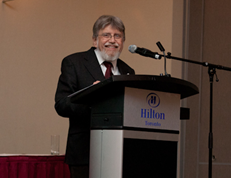
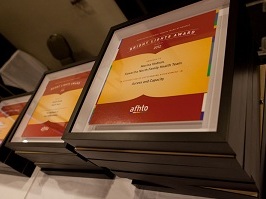
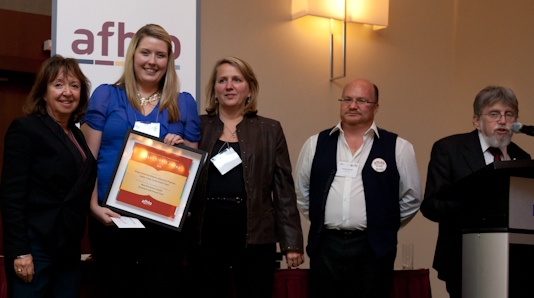
    Demonstrating and Celebrating the Value of Family Health Teams – this is the focal point of the AFHTO 2012 Conference, and the reason for launching the AFHTO Bright Lights Awards program.  These awards recognize the leadership, outstanding work and significant progress being made to improve the value delivered by family health teams. Bright Lights MCThe conference was built around eleven theme areas that, in combination, advance the value delivered by family health teams. Teams were invited to submit nominations for Bright Light recognition in these categories.  The submissions included descriptions and objective evidence of the scope and impact of the achievement, and action taken by the FHT to spread the achievement more broadly. An Awards Committee reviewed and rated all submissions to determine the recipients. Bright Lights AwardsThe Bright Lights Awards were presented at the conference dinner tonight, attended by over 200 people from family health teams and senior representatives from government, the Ministry of Health and Long-Term Care, the LHIN Collaborative and some of the associations who, along with AFHTO, work together as the Ontario Primary Care Council. The Bright Lights Award recipients are listed below.  Click on the links in the names below to read a summary of their achievements. Access and Capacity
    Getting Data and Using it to Improve Care

    Improving Care for People Living with Mental Health Challenges

    Improving Patient’s Experience of Care

    Leveraging Technology to Improve Quality and Efficiency of Care

    Meeting Needs of Special Populations

    Strengthening FHT Leadership and Governance

    Strengthening the FHT Team

    System Integration: Building the Team Beyond the FHT

    The Triple Aim in FHTs – Better Care, Better Quality, Better Value

    Four Awards for Best Practices in Health Promotion and Chronic Care Each of these winners has received a grant of $3000 Boehringer Ingelheim to be used by the FHT to send one team member to the 14th Annual International Summit on Improving Patient Care in the Office Practice & the Community, hosted by the Institute for Healthcare Improvement (IHI). April 7-9, 2013, in Scottsdale, Arizona

    Megan Omstead, Diabetes Education Program, Taddle Creek Family Health Team

  • Potential impact of proposed wage restraint legislation on FHTs

    DRAFT legislation – the Protecting Public Service Act, 2012 – has been released for public consultation. It is very important to note that this proposed legislation has NOT YET been tabled for first reading. Government has not yet indicated how long it will hold open this consultation phase, but for comparison, the consultation period for the legislation affecting collective agreements for teachers lasted 11 days. Key points for Family Health Teams:

    • Over half of all FHTs would be affected by this proposed legislation, since it covers all not for profit organizations that have received at least $1 million from Government in 2011-12. (Organizations may be prescribed by regulation, so it’s conceivable this could possibly affect all FHTs.)
    • The bill could affect all employees. Schedule 1 sets compensation rules for non-bargaining employees.  Schedule 2 creates a new framework for provincial control of the collective bargaining process, e.g. establishing enforceable bargaining mandates and a standing power to impose a collective agreement.
    • For non-bargaining staff, the bill would impose a two-year freeze on pay and no movement up an established salary grid.
    • With very limited exceptions, there may be no increases to an affected employee’s existing benefits, perquisites or other payments and no new or additional benefits, perquisites or payments for two years.
    • Renewal of an employment contract would not permit a compensation increase during this wage restraint period.
    • This Act would prevail over any compensation plan.
    • The Minister of Finance would be permitted to issue directives requiring compliance reports to be filed.

    AFHTO continues to work in collaboration with the Association of Ontario Health Centres and the Nurse Practitioners’ Association in research and advocacy on the issue of recruitment and retention of staff in interprofessional primary care organizations.  Drawing from the facts and issues presented in our joint report – Toward a Primary Care Recruitment and Retention Strategy for Ontario (https://www.afhto.ca/news-events/news/toward-a-primary-care-recruitment-retention-strategy-for-ontario/) – our three associations will develop a joint response to this legislation.  Ontario’s Action Plan for Health Care calls for “Family Health Care at the Centre of the System”; developing the primary care sector requires the ability to attract and retain staff in a competitive environment. We’ll keep you posted as we hear more.  Please keep us informed as well if you hear any developments. For more information and analysis on the proposed Protecting Public Service Act, 2012, go to:

  • Report from quarterly meeting with MOHLTC FHT Unit, September 20, 2012

    Representatives from AFHTO’s Operational Issues Working Group and the AOHC’s CFHT Executive met with the MOHLTC FHT Unit on September 20.The main objectives were to receive updates from the FHT Unit on budgets and other operational matters and to highlight “good news” from FHTs.  The following is a summary of the discussions. a) Recovery of unspent funds

    • Recovery of unspent funds currently applies only to vacant position salaries and benefits. The focus is currently on surplus HR funding from the Q1 time period.
    • Background: a significant amount of surplus funds are recovered each year from FHTs.  Due to the timing of audited statements, these funds have been recovered in the following fiscal year.  By reconciling on a quarterly basis, it provides more in-year flexibility, either to re-invest funds or to contribute to the government’s deficit reduction commitments.
    • Process: based on review of hiring reports and Q1 financials, FHT Unit and FHT will come to agreement on amount to be recovered; following monthly payments will be adjusted accordingly.  Amount recovered is salary + 20% for benefits. This will have no impact on the approved budget for the FHT.
    • FHT Unit is open to discussions about re-profiling positions that remain vacant for long periods (as long as the interdisciplinary nature of the team remains intact and the re-profiling is revenue neutral) or addressing in-year pressures. These issues need to be discussed with ministry contact.

    b) Plans for funding existing/new Physician Assistants (PAs)

    • Existing PAs (funding ends Mar 2013): Health Human Resources Strategy Division manages the PA program, but work is underway on a long-term strategy to support the integration of PAs into targeted areas of Ontario’s health care system.
    • Regarding FHTs specifically, although PAs are not currently included in the list of approved interdisciplinary health providers in FHTs, there appears to be a strong case for making this happen. The permanent integration of PAs into FHT’s is one of the areas of focus for the long-term work currently underway.
    • The FHT unit is currently working with the Health Human Resources Strategy Division on how this could work. The goal is to communicate this before March 2013.
    • It was noted that support from the MOHLTC for a FHT-PA Community of Practice would be appreciated.
    • Approvals to hire New PAs: Deadline for hiring is Oct 31. The FHT Unit is in process of finalizing approvals for recruitment.  FHTs should be notified in the next couple of weeks about the status of their application.

    ACTION: FHT Unit to send AFHTO & AOHC list of FHTs with existing Physician Assistants. c) Funding for Relief positions

    • Lack of relief funding, in particular for reception and RNs, continues to pose significant problems for some FHTs, including patient services, impacting workload and health and safety of providers when an absence creates a scenario where someone is left to work alone.
    • Smaller FHTs, rural/remote, and community FHTs may be more greatly impacted by this.
    • The FHT Unit will consider a number of options for addressing this issue, including a standard percentage increase for relief funding on a per-request basis, reallocation of unspent salary dollars or 3rd party revenue to offset cost of relief.  FHTs are encouraged to discuss this problem with their primary consultant.
    • Any change in relief funding would not be in effect until 2013/14 fiscal year.
    • The question of BSM physician job-sharing was raised. The FHT Unit identifies this as an issue for FHT management to address/implement as appropriate.

    d) Association Membership Fees

    • The group thanked the FHT Unit for support for association membership fees.
    • The FHT Unit confirmed that these funds are specifically earmarked for association fees, and cannot be reallocated if not used for that purpose.
    • The expense needs to be reported as a separate line item under general overhead and will be monitored to ensure it is going towards AOHC or AFHTO dues.

    e) Preparing for next budget cycle / annual planning

    • The earlier start to the budget cycle was noted as a positive change for FHTs.  FHT Unit would like to start 2013/14 budgeting process even earlier.
    • FHT Unit analyzed 2012/13 annual plans and will be issuing a provincial snapshot in the next FHT To Print newsletter.  FHT Unit will follow up with each FHT individually about how they compare with other FHTs in their LHINs.
    • FHT Unit is reviewing reporting requirements with the eye to streamlining and reducing the burden of reporting.  May include new quality improvement measurements (see (f) Quality  Improvement Planning in FHTs)
    • Process: FHT Unit will aim to have a draft revised annual plan template by end of Nov 2012, for input from a small working group of FHTs gathered by AOHC and AFHTO.  The goal is to have the revised plans to FHTs by mid-Dec 2012, with a submission deadline of Feb 28, 2013.
    • A request was noted that the measurements related to HealthCare Connect be reviewed with feedback from FHTs, with an eye to improving program processes and related measurements.

    ACTION: AFHTO & AOHC to identify working group for Annual Plan review. f) Quality Improvement Planning in FHTs

    • Primary care has been identified as the next sector to which the principles of the government’s Excellent Care for All strategy will apply. Family Health Teams will feature strongly in this.
    • Although work is underway, this at a minimum will include a requirement for FHTs to undertake quality improvement processes, including the development and implementation of a Quality Improvement Plan.
    • The Quality Improvement Plan for primary care is likely to include the following three Quality attributes: Accessible, Integrated and Patient-Centred. The specific quality indicators are currently under development.
    • Planning is underway to ensure supports are in place for an enhanced focus on quality improvement, including templates, guidance documents, governance training and other assistance provided by the ministry and Health Quality Ontario.
    • The details of the roll-out are still in the planning phase, but more details will be communicated through AFHTO and AOHC shortly.
    • Work is underway by the ministry to streamline the reporting burden on FHTs in anticipation of new expectations for quality improvement. The ministry’s intent is to reduce administrative reporting on a quarterly and annual basis so as to free-up capacity to focus on quality improvement planning and implementation.
    • The first year of implementation will be a transition year to support FHTs in embedding quality improvement in their on-going activities, with the intent to progressively advance the program in out-years.

    ACTIONS

    • Kavita Mehta and Ruth Kitson to send FHT Unit sample patient satisfaction surveys.
    • AFHTO & AOHC to identify working group for review of draft QI plans.

    g) Data Management Support in  FHTs

    • The need for data management/analysis support in FHTs was reiterated, especially given the planning for QI.
    • FHT Unit is investigating the possibility of implementing a regional data support model. This may be feasible to implement under the umbrella of NPAR (see (k) NPAR: update on evaluation and roll-out plans for more information).

    h) Update on plans to integrate primary care with LHINs

    • The MOHLTC continues to assess a number of proposals/models that were submitted on restructuring primary care.
    • There are legislative barriers that may prevent moving primary care into the LHINs, and other alternative models are being considered that do not require legislative reform.
    • In the meantime, FHTs should continue fostering and building local partnerships to enhance service integration and collaboration.

    i) Compensation

    • The AOHC/AFHTO/NPAO compensation review being developed by the Hay group is scheduled for release at the end of October.
    • The FHT Unit regrets that with continued austerity measures in place, there is no news on addressing funding inequities within FHTs and lack of parity across FHTs for similar positions funded through different funding streams.

    j) Adding Physicians to Existing FHTs (Patient Enrollment Models)

    • There has been managed registration of new physicians in certain patient enrolment models (including those eligible to affiliate with FHTs) to 25/month while a review of the registration process takes place.
    • The current interim process is to register 25/month through a needs-based assessment and consultation with LHINs.
    • The ministry will consult with relevant stakeholders before finalizing the process.

    k) NPAR: update on evaluation and roll-out plans

    • The MOHLTC has committed to removing the $1 per service encounter. In order to do this a consent form will be developed to allow interdisciplinary health providers (IHPs) and FHTs to share service-level information with the ministry.
    • FHT Unit is looking at options to roll out NPAR to other IHPs.  This will take time, as support for additional NPAR licenses was also identified as a need if it is rolled out to other IHPs.
    • Included in this work will be options to re-profile the $1/encounter allocation to support data management and analysis support.
    • It was emphasized that different skill sets are required for data entry and data management/analysis.
    • FHT Unit will issue a communication to FHTs on the status and evaluation of the program in the next few weeks.

    l) Point of Care Testing

    • The group shared how point of care testing (eg INR) can be done more cost-efficiently through FHTs than by other providers in the system, such as hospitals or labs, using existing provider resources in the FHT. While the FHT Unit has already approved the one-time equipment costs, there is an ongoing funding need to cover the cost of additional supplies.
    • This is an innovative way of reallocating health system funds to enhance services to clients and client experience.
    • The FHT Unit affirmed that FHTs can use General Overhead funds to cover the cost of supplies.  Requests for additional funding for supplies will be considered, but individual FHTs need to first demonstrate or estimate the volume of testing being / that will be performed, and the financial need, before additional funding will be approved.
    • The FHT Unit will also consider requests to reallocate unspent operating line items (outside of General Overhead) to cover these costs.

    m) FHT Good News Stories: areas of priority to showcase

    • AFHTO will be issuing awards to 16 FHTs at their upcoming conference, and will share details with the FHT Unit after the event.
    • For FHT to Print, the FHT Unit is particularly interested in stories pertaining to quality, access, integration, peer modelling, and the patient experience.

    Meeting participants

    • MOHLTC: Phil Graham, Acting Manager of the FHT Unit and Richard Yampolsky, Program Manager, FHT Implementation.
    • FHT EDs: Randy Belair (Sunset Country FHT in Kenora), Mark Ferrari (Windsor FHT), Ruth Kitson (Community & Primary Health Care FHT, Lanark, Leeds & Grenville) Kavita Mehta (South East Toronto FHT).
    • Association staff: Sophie Bart (Association of Ontario Health Centres) and Angie Heydon (Association of Family Health Teams of Ontario).

    Do you have input on operational issues for the next quarterly meeting? Please contact:

    • For FHT EDs in LHINs 1-4 and 12 (Erie St. Clair, South West, Waterloo Wellington, Hamilton Niagara Haldimand Brant,North Simcoe Muskoka) and all CFHTs across the province:
    • For FHT EDs in LHINs 5-8 (Mississauga Halton, Central West, Toronto Central, Central)
    • For FHT EDs in LHINs 9-11 (Central East, South East, Champlain):
    • For FHT EDs in LHINs 13-14 (North East,North West)
      • Randy Belair, ED Sunset Country FHT,  AFHTO Secretary
      • E-mail:  rbelair@kfht.ca
    • For FHT Clinical Leads:
      • John McDonald, Lead Physician PrimaCare Community FHT, AFHTO Past President
      • E-mail:  john.mcd1@sympatico.ca
  • AFHTO 2012 Conference: Breakfast & registration open at 7:30 Oct. 16 & 17

    The AFHTO 2012 Conference takes place Tuesday, October 16 and Wednesday, October 17 at the Hilton Toronto, 145 Richmond Street. With over 650 participants registered for each day, AFHTO Conference registration is closed. When you arrive at the conference:

    • Registration opens at 7:30 AM on both October 16 & 17
    • Breakfast will be served from 7:30 AM until 9:00 AM
      • October 16: Coffee, tea and juice served with a choice of muffin and fruit salad, or yogurt and bircher muesli
      • October 17: Coffee, tea and juice served with a buffet of sliced fresh fruit, farm fresh scrambled eggs, bacon, chicken apple sausage, home-fried new potatoes, bread, butter, breakfast preserves, marmalade and honey
    • The first sessions for the day will begin by 8:45 AM.

    Click here to see all conference details

    We look forward to seeing you!

  • AFHTO 2012 Conference: Hotel Room Rates for Attendees

    Group booking at Hilton Toronto is now full.

    Rooms are available at regular rates.  (OMA members may ask for OMA discount.) Address: 145 Richmond Street West, Toronto, ON

    Hilton Garden Inn                                                 Group rate: $155 – 199 per night

    Distance from conference: 0.8 km (10 min walk) Address: 92 Peter Street, Toronto, On Room block dates: October 15 – 17 2012 Reservations: Book a room online or by phone: 416-593-9200. Refer to the AFHTO Conference or group booking code: AHO.

    • Cut off for each reservation is TUESDAY SEPTEMBER 25, 2012.
    • Cancellation of one or more rooms after cut-off will result in a charge of the first night’s stay.
  • MOHLTC rolling out Provincial Low Back Pain Strategy

    In order to improve the quality and efficiency of treatment for low-back pain, the province of Ontario is launching a Provincial Low-Back Pain Strategy to:

    • Decrease wait times for medically-necessary diagnostic imaging, and
    • Improve outcomes for patients suffering from low back pain.

    The strategy has three components:

    1. Evidence-based amendments to the Schedule of Benefits. Effective April 1, 2012. This change applies to all referring providers and specialists.
    2. Educational resources (e.g. a toolkit and continuing education) for primary care providers. These tools will help you better help your patients in managing low back pain.
      1. Phase one: Online tools in November 2012
      2. Phase two: Online and in-person continuing education training starting February 2013.
    3. A provincial pilot of ‘rapid assessment and education centres’ for low back pain. Launching November 2012.

    INFOBulletin updates released by the ministry:

    • Bulletin # 11048 distributed August 28, 2012: Provincial Strategy for X-Ray, Computed Tomography (CT) and/or Magnetic Resonance Imaging (MRI) for Low Back Pain
    • Bulletin # 4561 distributed May 8, 2012: Amendments to the Schedule of Benefits for Physician Services – Effective April 1, 2012
    • Bulletin # 4563 distributed June 4, 2012: Computed Tomography (CT) and/or Magnetic  Resonance Imaging (MRI) for Chronic Low Back Pain
  • AFHTO 2012 Conference: Increase corporate visibility as a sponsor or exhibitor

    On October 16-17, 2012, over 500 executive directors, board members, physicians, staff, stakeholder associations and government representatives will attend the AFHTO 2012 Conference.

    AFHTO invites Family Health Team partners and stakeholders to consider the sponsorship and exhibitor opportunities at the upcoming conference.

    See the 2012 Sponsorship and Exhibitor Prospectus for opportunity details and all relevant conference information.

    Sponsorship allows you to:

    • Reach the decision makers within Family Health Teams.
    • Obtain valuable exposure with current and potential clients.
    • Deepen your insight into the needs and requirements of Family Health Teams in order to better serve them.
    • Demonstrate your support for Family Health Teams in delivering value and quality care to patients.

    AFHTO 2012 Conference Details The conference has been extended to a full 2 days; sponsorship and exhibitor opportunities will be available throughout. The conference program is built around 12 core themes that “Demonstrate and Celebrate the Value of Family Health Teams”. Please contact Sal Abdolzahraei by e-mail (info@afhto.ca) or by phone (647-234-8605) if you have any questions or for further information.


  • Colorectal Cancer Survivorship Program: North York FHT

    A collaboration between North York Family Health Team and North York General Hospital with funding from Cancer Care Ontario, North York Family Health Team and North York General Hospital have created a new survivorship program for patients with colorectal cancer.

    The CCSP is a new model of cancer survivorship care that transfers the monitoring of patients, who have finished active treatment, to primary care from oncologists and surgeons. This innovative program centralizes follow-up care for patients and will alleviate wait times for newly diagnosed patients needing to see a cancer specialist.

    The survivorship program follows the latest best practices and includes three important components: nurse practitioner provision of care, stoma care when needed, and connection to community resources when needed. The Colorectal Cancer Association of Canada runs a local support group and NYGH psychiatrists who support the Hospital’s cancer care program continue to support patients during their survivorship period.

    Located in the community, the CCSP provides care from North York Family Health Team’s central clinic.

    The presence of both allied health providers and electronic medical record systems have made it possible to create a robust program that translates evidence-based care into clinical best practices.

    Together, North York Family Health Team and North York General Hospital are improving access to cancer care in Ontario. They are also striving to have all clinicians work to full scope in roles that are engaging, challenging, and satisfying.