Author: sitesuper

  • D2D Data Dictionary – Current and Previous Editions

    The links below will direct you to the data dictionaries for the current and previous iterations of Data to Decisions (D2D).

  • The Starfield model: Measuring comprehensive primary care for system benefit

    AFHTO’s approach to primary care measurement focuses on the relationship with our patients and our ability to deliver the care patients value. Its objective is to optimize quality, access and total health system cost of care for patients, using indicators from Health Quality Ontario’s Primary Care Performance Measurement Framework. An article describing the model and a case study of its implementation was published in Healthcare Management Forum – The Starfield model: Measuring comprehensive primary care for system benefit.

    Authors:

    • Angie Heydon, MBA, Executive Director, The Association of Family Health Teams of Ontario
    • George Southey, MD, CCFP, FCFP, Dorval Medical Family Health Team

    Abstract:

    Comprehensive primary care describes the long-term relationship between patient and provider in which medical services, support for self-care, and care coordination are the foundation. Research has associated comprehensive primary care with better system quality, equity, and efficiency. A performance measurement method is needed to enable teams delivering such care to optimize their performance and to evaluate the benefits over time. This article describes “The Starfield Model”—an approach to measuring quality, capacity, and total cost of care at this scope of service—and the results achieved by a small family health team in implementing this model. This experience suggests that real benefits arise from meaningful feedback to providers. The model has the potential to work in any payment system of primary care, thereby providing insight into all types of comprehensive primary care practices. Click here to access the full article.

  • Register for Effective Governance for Quality in Primary Care Workshop, October 14

    Click here to register for the Effective Governance for Quality in Primary Care Workshop, Tuesday, October 14, 2014, 10:30 am to 4:30 pm, Westin Harbour Castle, One Harbour Square, Toronto, Ontario. Click here for more information about this program. This session is FREE for board chairs/members, executive directors and lead MD/NPs of AFHTO member organizations.

  • Register for QIDS Professional Development Workshop, October 14

    Click here to register for the QIDS Professional Development Workshop, Tuesday, October 14, 2014, 10:30 am to 7:00 pm, Westin Harbour Castle, One Harbour Square, Toronto, Ontario. Click here for more information about this program. AFHTO has requested funding from the Ministry to cover some or all of the costs of this learning program.  Remaining costs will be covered through registration fees that could be FREE or to UP TO a maximum of $250 per person. AFHTO will contact registered participants to confirm the fee once the Ministry funding letter is received.

     
  • AFHTO Conference Registration Discounts

    All Conference Attendees: Register before the early-bird deadline, September 15, 2014 to save $75 on your registration. Click here for more information on conference fees and refund policies.

    AFHTO Members

    Contact your administrator to receive the discount code for the membership rate. Members who have paid their 2014-15 membership dues have received their discount code; all others will receive their code once payment is received.

    Discounts for Conference Contributors

    $50 discount provided to all concurrent session presenters (max 2 per session), concurrent session working group members, registration desk volunteers and awards review committee members. The discount can be combined for those who contribute in more than one capacity (e.g. a presenter who also serves on the awards review committee could receive a $100 discount).

    Concurrent Session Presenters: discount codes will be sent by June 25, 2014 to the contact person for your presentation. Each presentation will receive a single code that can be used for a maximum of two registrations.

    Conference Working Group Members: discount codes will be sent by June 25, 2014 to individual members who have completed their commitment to their working group.

    Other: Discount codes will be sent to registration desk volunteers and awards review committee members.

    Click here to return to the conference webpage.
  • Request for data from ICES for D2D 1.0

    The deadline for the original D2D 1.0 request is past. However you can prepare to request this data for D2D 2.0 by reviewing the permissions required below.  Please copy and paste the following text into an email after you have inserted your team’s information in the bold italics area and send it to Rick.glazier@ices.on.ca with copy to improve@afhto.ca. Prior to submitting this request, ensure that all physicians in the FHNs and FHOs in your health team are aware of the request and that none object to it.  In response to this request, ICES will forward data at the FHN, FHO and FHT level for the indicators mentioned in the request.  Individual physician data will NOT be provided through this request.  However, individual physicians can access their own data through their Primary Care Practice (PCR) Report from HQO. When they receive the data from ICES for these indicators, teams may choose to contribute the FHT level data to D2D 1.0 or just retain the data for their own internal use.  Refer to the data submission template for instructions on how to contribute FHT-level data.  Note that FHN and FHO level data cannot be submitted to D2D 1.0. +++++++++++++++++++++++++++++++++++++++++++++++++++++++++++++++++++++++++++++++++ Dear Dr Glazier, Senior Scientist and Program Lead, Primary Care and Population Health,Institute for Clinical Evaluative Sciences (ICES) Please consider this a request for data from ICES for our FHT for the following indicators: Regular primary care provider, readmissions within 30 days, cost per patient, colorectal and cervical cancer screening and SAMI score.  The specific definitions of each of the indicators are as discussed in the D2D 1.0 documents produced by AFHTO. Please provide data for the physician groups listed in the table below.  All physicians in each of the groups listed are aware of this request and none have objected to it.

    Physician payment group FHN or FHO
    [health team insert 4-digit alpha code] [health team indicate whether code refers to a FHN or a FHO]


    Please forward the data to [Medical lead]. Signed on behalf of the [health team to insert name of FHT] Executive Director [typed full name is sufficient for email – please forward scanned image of signed document to AFHTO improve@afhto.ca] Medical Lead [typed full name is sufficient for email – please forward scanned image of signed document to AFHTO: improve@afhto.ca]

  • D2D 1.0 Data Submission Template

    **This template will be made available by June 16, 2014** Please check here for further updates.

  • Ontario election update: responses from the political parties

    As promised, we are sharing with you the response we received from each of the three main political parties to the questions we had posed (see below). Click on the links to see responses (listed in the order they were received) from the:

    Please make sure to vote! Angie Heydon Executive Director, AFHTO

    1. For a summary of where each of the three main parties stands on health issues see below.
    2. By June 10, AFHTO will share responses received from the parties on 5 questions about interprofessional primary care. Scroll down to see the questions.
    3. Thank you to AFHTO members for raising awareness among candidates of the value interprofessional primary care delivers to patients and the health system and the need to support recruitment and retention of staff to deliver this care. Scroll down for more information.

    1. PARTY PLATFORMS:

    Libhttp://ontarioliberalplan.ca/#plan;

    Liberals have pledged to “Guarantee that every Ontarian has access to a primary care provider.” Details on this pledge were released this morning; it includes the statement – “Improve the recruitment and retention of community-based primary care teams.”  Read more at http://kathleenwynne.ca/guaranteeing-primary-care-ontarians/ Other details about their health platform is found at – http://ontarioliberalplan.ca/wp-content/uploads/2014/05/Access-to-the-Right-Health-Care-at-the-Right-Time-in-the-Right-Place.pdf .

    • Reduce wait times for referrals to specialists
    • Advocate for national drug insurance
    • Increase funding to our Mental Health and Addictions Strategy
    • Provide access to free vaccinations and newborn screening
    • Develop Community Hubs for community-driven programs that focus on health and wellness
    • Create 36 more Health Links to help those with multiple, complex conditions
    • Provide culturally appropriate care
    • Provide Ontarians with better information about chemicals linked with cancer
    • Increase funding for the seniors activity and community grants program

    PChttp://ontariopc.com/millionjobsplan/plan.pdf

    The plan largely builds on the vision advanced through the earlier PC party white papers on health care. The major health care commitments in the plan are as follows:

    • Local Health Integrated Networks (LHINs) will be eliminated and replaced by Health Hubs (which would bring together hospitals and community providers). These hubs will be run by front-line local health experts.
    • To help manage chronic conditions, the PCs would increase home care and create Chronic Care Centres. Doctors and nurses would work together to develop comprehensive care plans. Patients with the highest needs would be assigned a dedicated care navigator to ensure care is received right when they need it. This person will be a frontline caregiver such as a nurse, not a bureaucrat.
    • Home care and long-term care would be expanded.
    • The scope of practice would be updated for pharmacists, nurse practitioners and other professionals, to allow treatment where it is most convenient and beneficial for patients, particularly seniors.
    • Introduce a self-directed model of home care that would allow patients to select their services.
    • Encourage more competitive contracts for companies that provide health care services.
    • The role of modern, specialty clinics to provide more services such as dialysis and routine surgeries would be expanded.
    • Mental health services would be integrated to address the fragmented service delivery experienced by most patients today.
    • Children’s physical activity would be increased to 45 minutes per day, through school-based activities and after-school sports.
    • A secure health care database that will allow doctors and nurses to study real-world feedback on what treatments work best to help them determine the best care path for future patients would be created.

    NDP http://ourplan.ontariondp.ca/?source=homepage

    The major health care commitments outlined in the plan are as follows: YEAR 1:

    • Open 50 new 24-hour Family Health Clinics with the capacity to serve 250,000 people, reducing the number of Ontarians without primary care access by 25 per cent.
    • Hire 250 more nurse practitioners in the Emergency Room in an effort to cut wait times in half.
    • Create 1,400 new Long-Term care beds with the goal of eliminating the waitlists for acute long-term.
    • Eliminate home care wait times for seniors with a Five Day Home Care guarantee. Clients would receive approximately two nursing visits and 7.5 hours of personal support per month.

    YEAR 2:

    • A Caregiver Tax Credit of $1, 275 per year to families caring for the ill or elderly.
    • Student debt forgiveness for doctors who choose to practice in rural, underserviced areas. The plan targets participation by 250 physicians, forgiving $20, 000 of debt per service.

    2. AFHTO’S QUESTIONS FOR PARTIES:

    Answers to the following questions have been requested by June 6. Response received will be sent to AFHTO members no later than June 10:

    1. Evidence shows that a very sick patient without high quality care can cost the province $30,000/year but the same patient with access to interprofessional family care only costs the province $12,000/year. Will your party support strengthening our family care teams and enhancing our capacity to care for more patients?
    2. Despite having family care teams in 206 communities across Ontario, 3 out of 4 Ontarians still do not have access to the benefits of interprofessional family care. If elected, what will you do to expand this care model to ALL Ontarians?
    3. Interprofessional family care teams are committed to optimizing health outcomes for patients and populations, meeting patient and public expectations, and supporting a sustainable health system.  What will your party do to advance the capacity of family care teams to capture and track the information they need to achieve these goals?
    4. Interprofessional care teams struggle to retain health professionals due to higher salaries being paid in hospitals, community care access centres, public health units and other settings. How will your party help interprofessional care teams recruit and retain more health care professionals in order to expand better care to more Ontarians?
    5. Final question is specific to each party’s platform:
      1. Lib: In your 2014 campaign platform you state that part of your 10-year plan is to support family health by guaranteeing everyone in Ontario has access to a primary care provider. How do you plan to use interprofessional family care teams to fulfill this promise?
      2. NDP: In your 2014 campaign platform, you state that you will add 50 new 24-hour Family Health Clinics. How will this commitment affect the current care model we have in place? Will it have a positive or negative effect on interprofessional family care teams
      3. PC: In your 2014 campaign platform, you state that you will help manage chronic care by increasing home care and creating Chronic Care Centres where doctors and nurses will collaborate to develop comprehensive care plans. Will this commitment compliment the current care model we have in place or have a negative effect on interprofessional family care teams?

    3. AFHTO MEMBERS RAISING AWARENESS:

    While AFHTO’s President and ED have been working at the provincial leadership level, AFHTO members have been active in their ridings and on social media.  Among those attending a recent meeting of the ED Advisory Council, about one-quarter had met with their MPPs and about one-third intended to contact candidates. Materials to help you spread the word on the value of continuing investment in team-based primary care are posted on the AFHTO members-only website:

  • Tungasuvvingat Inuit FHT wins Innovation in Public Health and Primary Health Care Award

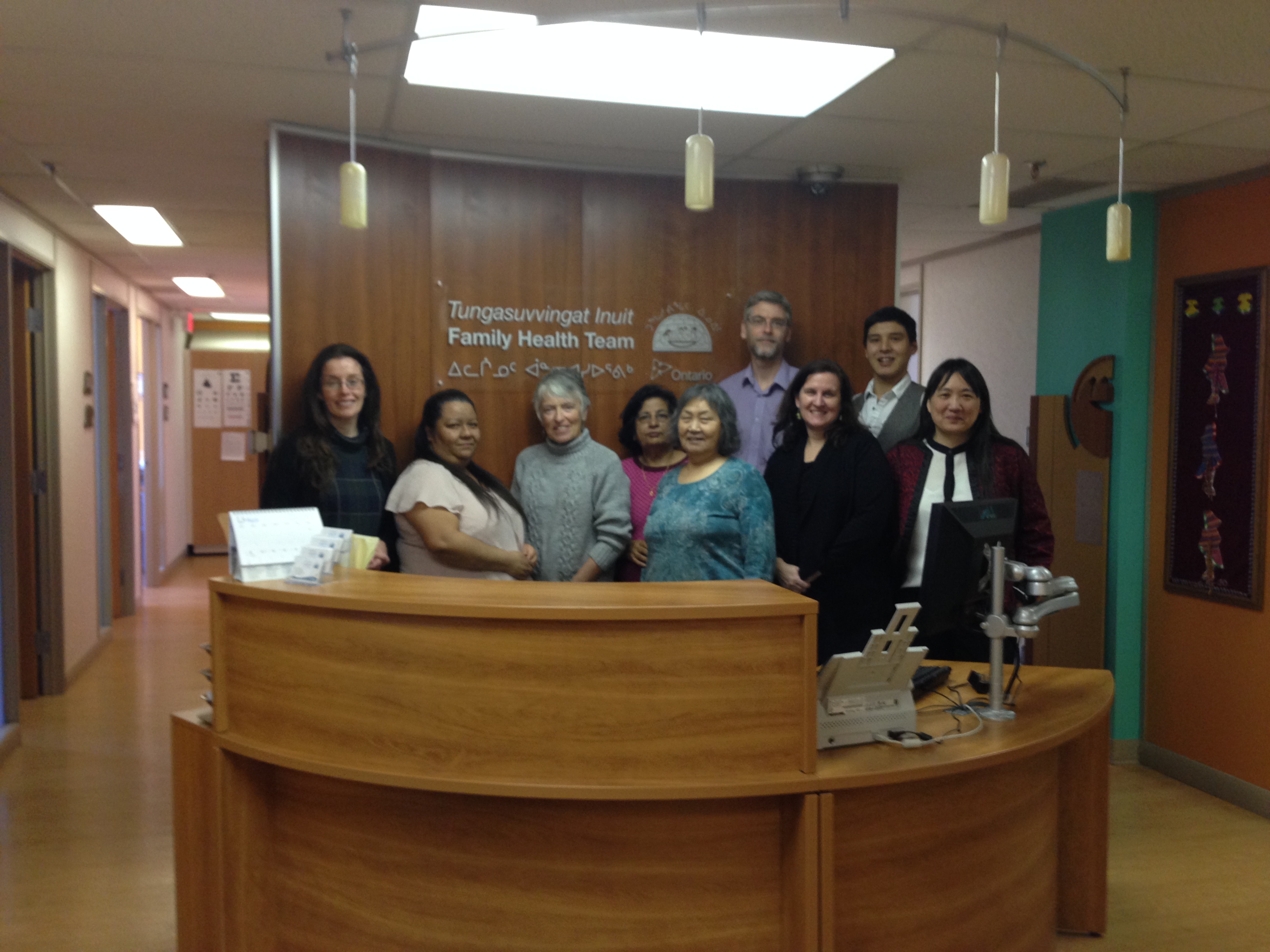
    The Tungasuvvingat Inuit Family Health Team (TIFHT) was honoured with this award at a the “Prevent More to Treat Less” conference, jointly sponsored by the Association of Ontario Health Centres and the Association of Local Public Health Agencies, together with a range of partners including AFHTO. Since March 2011 TIFHT has provided Primary Health care services to Ottawa’s Inuit population. Nominated by Ottawa Public Health,  the team was described as providing “innovative, holistic model of culturally safe, community-based primary care with interdisciplinary services that incorporate an understanding of the determinants of health and a respect for Inuit diversity, values, culture, language, knowledge and self-determination.” To enhance health equity, efficiency and effectiveness, TIFHT and Ottawa have developed a powerful partnership — a partnership that has ensured many more people from Ottawa’s Inuit community can access culturally appropriate services that address the communities most pressing health needs. photoTIFHT has facilitated community engagement, informed needs assessments, adapted health education resources, and influenced public health approaches to collectively identify priority health concerns. This has been accomplished through ongoing dialogue, sharing promising practices, community consultations, and Elder participation in service and program planning. This integration of public health into primary care services has meant clients who might otherwise avoid mainstream health services get the supports they need. Both Ottawa Public Health and the Tungasuvvingat Inuit Family Health Team are focused on controlling communicable diseases.  Working together they have enhanced access to testing, treatment and vaccines.  They also have designated liaisons, and developed collaborative case management. Both organizations also want to improve the oral health of the Inuit Community in Ottawa. They are working together they run a  monthly dental screening clinic, located at the Family Health Team’s site.  And now this dynamic partnership is in the process of developing joint activities related to smoking cessation and suicide prevention. This is an excellent example of how working together Public Health and Primary Health Care providers can promote population health and advance health equity for a population that is vulnerable to poor health.

  • Nominations to the AFHTO Board of Directors are open until July 14

    Dear fellow AFHTO members: Are you interested in serving on the AFHTO board of directors? The Governance Committee of AFHTO’s board invites anyone who works within an AFHTO member organization to apply. Please share this call for nominations with all who work in your team. FIVE people are to be elected for a 3-year term on the 14-member AFHTO board. The AFHTO by-laws call for balanced representation on the board to include the various forms of governance, the regions of the province, and the mix of the professions working within FHTs, NPLCs and other interprofessional models. In reviewing the composition of nine continuing board members, priority for the five directors to be elected will be given to candidates who are:

    • Interprofessional health providers or physicians
    • From AFHTO members located in NE Ontario and the Toronto area
    • From community-governed FHTs and NPLCs

    To apply:

    • Click here to read AFHTO’s Nominations and Elections policy.
    • Click here for information on the role and requirements of AFHTO board members.

    The Governance Committee of the AFHTO board will review all applications to assist the AFHTO board to determine the slate of candidates to recommend to the AFHTO membership for election at the AFHTO annual general meeting.

    • Nominees will be informed of their status by September 12.
    • Nominees who are not recommended for the slate will have until September 22 to determine whether they wish to proceed with having their name go forward on the election ballot.
    • The election will take place at the Annual General Meeting in conjunction with the AFHTO annual conference.  This year it will be held:

    Wednesday October 15, 2014 9:00 AM – 10:00 AM The Westin Harbour Castle 1 Harbour Square Toronto, Ontario M5J 1A6

    Sincerely, Jennifer Kennedy Chair, Governance Committee AFHTO Board of Directors Executive Director, North Renfrew Family Health Team