Improving your community through effective partnerships and programs?
Providing truly integrated care and embodying the patient medical home?
Then your peers across the province want to hear from you! Don’t wait to impart your tips and lessons learned to colleagues from all across the province under 6 core themes. Your experience is invaluable.
Now more than ever we want to ensure our sessions reflect the ever-changing health care environment and are relevant to primary health care today. This means we want to hear what’s worked for you. The deadline to submit abstracts for concurrent sessions and posters is April 24, 2019 at 5:00 PM (EDT).
All are welcome. Please pass this along to your peers, colleagues and network including those from other healthcare sectors, non-profits, and the academic and research communities.
Not sure if your work is a good fit? Feel free to ask us! Email info@afhto.ca or call 647-234-8605x 200. We’d be happy to help.
Reduced registration fee for concurrent session presenters: For each approved concurrent session, up to 2 presenters will each be granted a $50 discount off the conference registration fee. Additional discounts apply for patients presenting at the conference. (Discount doesn’t apply for poster displays.)
Conference key dates:
April 24, 2019 Deadline to submit concurrent session and poster abstract
AFHTO submission on Bill 74: The People’s Health Care Act
Financial webinar series starting Apr. 17
Primary Care Virtual Community meeting Apr 25
OHIP+ update
Hospice Palliative Care Ontario seeking regional champions
Going beyond imitation: how do your benefit programs & compensation compare?
Upcoming events regarding chronic pain and more
Call for Ontario Health Teams
The government sent out the guidance document and additional materials for Ontario Health Teams on April 3.
While it’s not mandatory that FHTs or NPLCs be part of OHTs, we encourage teams be working with local providers and, most importantly, with one another to discuss collaboration. The long-term goal is for all Ontarians to receive their care through an OHT.
The deadline for the first readiness assessment is May 15, but the Ministry will continue to accept, assess and evaluate groups interested in becoming an Ontario Health Team on an ongoing basis. Read more on our site.
AFHTO submission on Bill 74: The People’s Health Care Act
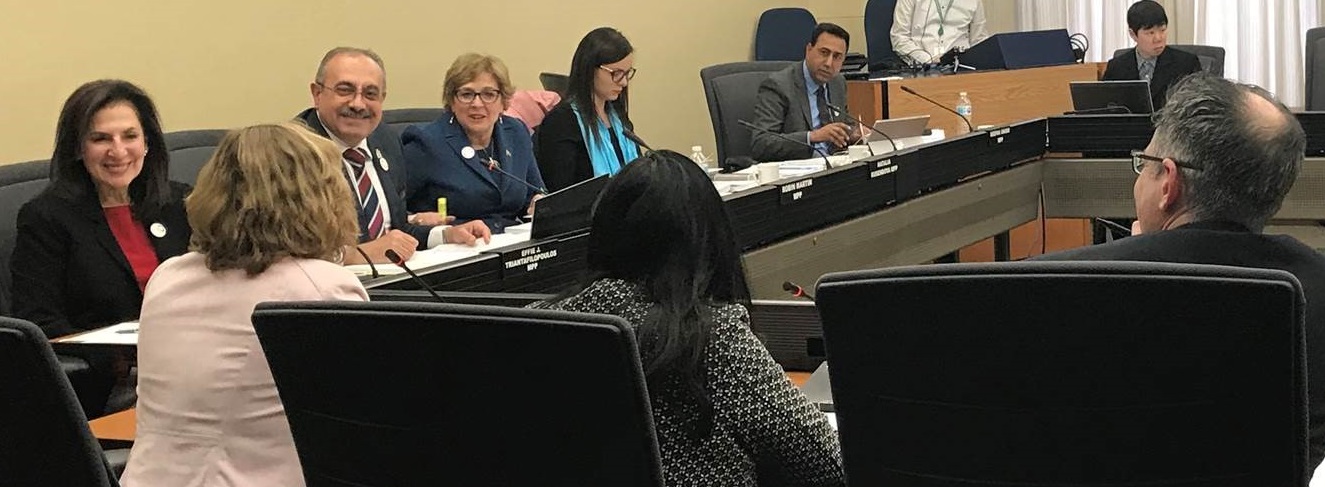
AFHTO’s President and Chair Beth Cowper-Fung, Treasurer Dr. Allan Grill and CEO Kavita Mehta had the opportunity to present our submission on The People’s Health Care Act to the Standing Committee on Social Policy at the Ontario Legislature on April 2, which was well received. Read the highlights and full submission here.
Financial webinar series starting Apr. 17
<em>Lindsay Royston, CPA, CA, Manager, Grant Thornton LLP</em>
AFHTO is pleased to be presenting a financial webinar series for health care non-profits, members and non-members alike. We’ll be tackling topics from fraud to cyber-security. Register for 1 session or all 6!
Board members are also encouraged to attend this webinar as they have been charged with fiduciary and duty of care responsibilities.
Mark your calendars for the inaugural primary care virtual community meeting on April 25th.
The virtual community will bring together those in primary care that are interested in leading in their context and supporting meaningful system change within the Ontario healthcare system. With the changes coming through the development of Ontario Health Teams, positioning supporting primary care clinicians to lead in their settings will be important in order to truly integrate patient-centred care to improve the patient experience and outcomes, and to improve the experience of those delivering care too.
Join the first virtual conversation with special guest, Dr. Robert Varnam, GP and Head of General Practice Development at NHS England, as he shares learning from the journey that the UK underwent in health system transformation where primary care was at the centre of reforms, and how we might use that learning in Ontario. AFHTO is pleased to be supporting this primary care virtual network with our OCFP and Change Foundation partners.
OHIP+ update
The Ministry is hosting weekly webinars to provide an overview of the redesigned OHIP+ and to answer questions regarding changes to Ontario Drug Benefit program coverage for children and youth aged 24 years and under. The next webinar is on Wed. Apr. 10, 2019 from 12:15-1:00 pm.
Hospice Palliative Care Ontario seeking regional champions
Hospice Palliative Care Ontario is currently seeking additional Regional Champions to fill vacancies in the Health Care Consent Advance Care Planning Community of Practice across multiple LHIN regions. Details available here.Deadline May 6, 4:00 p.m.
Going beyond imitation: how do your benefit programs & compensation compare?
As the landscape surrounding employee engagement, retention and attraction evolves, it’s important to know where your employee’s total rewards programs stack up.
CHOGIP is pleased to offer AFHTO members complimentary access to Gallagher’s 2019 National Benefits Strategy Benchmark and Compensation Survey. To participate, register through the link for your personalized login details. Deadline Friday April 19, 2019.
For those who participated in 2018, you can request your data be prepopulated in the 2019 survey to reduce your work-load!
If you have any questions, contact Susan Healey, Senior Consultant, Gallagher, at susan_healey@ajg.com or (519) 340-1121.
Big White Wall and BounceBack: Free Psychotherapy Services for Adults And Youth With Mild To Moderate Depression And Anxiety, Apr. 4 & 11, 2019
Attend this accredited webinar to learn more about these free mental health services. Register here.
A Successful Nurse-Led Program in Primary Care for Patients with Chronic Pain, Apr. 18, 2019
Learn about the feasible, evidence-based and cost-effective program based on self-management support for chronic non-cancer pain. Find out more here.
CommunityConnect 2019 conference, Oct. 23-24, 2019
Hosted by the Ontario Community Support Association, the call for abstracts is open until April 18, 2019. Learn more here.
LeaderShift Conference, July 11, 2019
Join other leaders in the community and primary care for this leadership conference delivered by LEADS Canada. Registration and call for projects are now open. Find out more here.
This document is detailed guidance on the process involved in becoming an Ontario Health Team. There will be a continuous readiness assessment process that will begin with providers’ self-assessment, followed by an application and an in-person visit.
More information and resources are here, including rough timelines on the assessment process and details on a webinar for this Friday, April 5, at 2 PM.
There is also a tele-town hall with Minister Elliott at 4 PM today, which we encourage you call in to, if possible on such short notice:
1. That Bill 74 require primary care to be part of an Ontario Health Team (OHT). It is also recommended that primary care teams be the lead of an OHT in areas with highly functioning teams who can continue to be leaders in delivering truly integrated care. Primary care is the entry point to the health care system. These are the health care providers who know the patients and their families the best.
2. That Bill 74 (Part IV – Definitions) be strengthened by including the vision of the Patient’s Medical Home when speaking about the Integrated Care Delivery Systems, with specific notation made to the Minister’s Patient and Family Advisory Council Patient Declaration of Values. While there is notation in the preamble about the importance of the patient in the development of Bill 74, it is important that there also be a strong vision for this health system restructuring, especially with the creation of the local level Ontario Health Teams. The Patient Medical Home encompasses that vision – it puts the patient and the family in the center of care while also recognizing the importance of the Quadruple Aim through its pillars.
3. That there be an addition in Part IV of the Bill under Integrated Care Delivery Systems that specifically outlines governance of integration, including principles of collaborative governance and what the requirements will be of the Boards of the HSPs that are coming together to change the way care is being delivered in their community. For integrated health care systems, it is truly placing the patient at the center of care – not the organization where the care is being delivered. And that, for many, will require a tremendous amount of change management support. Health care organizations have been funded in siloes for decades with targets and indicators that are very specific to their funding. A move towards a shared budget will require a shift in thinking, new partnership building and, fundamentally, trust.
4. a) As Ontario Health starts becoming operational, we recommend it stay true to Part II (The Agency) Objects and General Powers and support the health service providers in the sector as outlined in the Bill and NOT be involved in direct service delivery, including in the area of home and community care.
b) We ask that the relationship between primary care and home and community care be strengthened by transitioning the function and associated resources of care coordination to primary care.
c) It should also be noted that in any application for an OHT, there should be concerted effort made to ensure that primary care and mental health and addictions supports are integrated and it is our recommendation that this is a priority for each integrated care delivery system in the province.
AFHTO is pleased to see the government’s commitment towards truly integrated patient-centred care. Health care providers in interprofessional team-based primary care have been working in integrated systems of care for years but have felt that there is still fragmentation in the care they are able to provide, mainly because of the disconnect between the siloes of care, from acute to home care, from mental health and addictions to long-term care. Primary care is the entry point to the health system and for many patients in the province, the relationship they have with their family physician or nurse practitioner is everlasting and built on trust. A truly effective, high quality health care system needs to be coordinated, integrated and foundationally built in primary care, which will ensure we are delivering a sustainable health system for the future.
Team-based primary care is popular with its 3.5 million patients because it provides a better patient experience, helping people avoid long and confusing waits for referrals and getting lost navigating our complex system. We need to expand this experience so that every Ontarian can get access to the care they need when they need it. We look forward to working with the government as it starts the journey on implementing this very important health restructuring plan and creating a new integrated system of care that is focused around the patient.
The Guelph Community Health Centre (CHC) has been given the green light to continue to operate its supervised consumption site.
The provincial government announced on Friday 15 sites were approved across Ontario “in areas with the greatest need.”
Guelph CHC first opened its site in May 2018, in partnership with the Guelph Family Health Team and HIV/AIDS Resources and Community Health (ARCH).
The service was established under the previous Liberal government’s overdose prevention site model.
In October 2018, the current Progressive Conservative government announced that model would be replaced by the new Consumption and Treatment Services (CTS) program, which would cap the number of sites at 21.
Existing sites had to reapply under the new program if they wished to stay open. Guelph CHC submitted its application in December after public consultations and approval from city council.
Executive director Raechelle Devereaux said it was a relief to finally hear back from the province and learn that they would be able to continue to offer “life-saving services” to the community.
“We had been through three health alerts, with spikes in fentanyl in our community since we applied,” she said. “Certainly we are seeing rising numbers of clients coming to our site.”
Devereaux said the funding from the CTS program will also allow Guelph CHC to hire more staff, including a social worker and a registered practical nurse, to help connect people with wraparound services in the community.
Currently the staff includes a registered nurse, who works in the consumption room, and an individual with lived experience of mental health and addiction, who helps with ongoing monitoring in the post-use room.
While Guelph CHC’s application was approved, one site in Ottawa learned its application was turned down.
Three sites in Toronto were also not approved, however two were given last-minute exemptions to continue operating under the federal government’s supervised consumption site program.
Friday’s announcement did not include the Region of Waterloo, which has also applied to open one or more sites under the provincial program.
In an email to CBC Kitchener-Waterloo, a spokesperson for the Ministry of Health and Long-Term Care said the province will continue to accept applications from interested organizations, but did not indicate a timeline for responding to the region’s request.
Speaking at today’s public hearing on Bill 74: The People’s Health Care Act
AFHTO 2019 Conference: submit your presentation & poster abstracts
Webinars on governance, NPs & more- videos and slides
Primary health care articles
OHIP+ update
Save The Date – DC FHT RD Conference
Upcoming events regarding free psychotherapy and more
Speaking at today’s public hearing on Bill 74: The People’s Health Care Act
Later today our President and Chair Beth Cowper-Fung, Treasurer Dr. Allan Grill and CEO Kavita Mehta are presenting our submission on The People’s Health Care Act to the Standing Committee on Social Policy at the Ontario Legislature.
One of only 30 invited presenters from more than 1400 submissions, they will emphasise the importance of team-based primary health care in these sweeping changes to Ontario’s healthcare system.
We will post the submission later this week and include it in next week’s Bits & Pieces.
AFHTO 2019 Conference: submit your presentation & poster abstracts
What if that little program you’re quietly doing, reducing trips to the ER, relieving patients of unnecessary complications, could spread? It can, if you submit an abstract to present a concurrent session or poster in 6 core themes at the AFHTO 2019 Conference on September 19 & 20, 2019. Find out more here. Deadline Apr. 24, 2019.
Webinars on governance, NPs & more- videos and slides
If you missed recent webinars, slides, videos and other materials for the following are now available:
OHIP+ update
The Ministry is hosting weekly webinars to provide an overview of the redesigned OHIP+ and to answer questions regarding changes to Ontario Drug Benefit program coverage for children and youth aged 24 years and under. The next webinar is on Wed. Apr. 3, 2019 from 12:15-1:00 pm.
Save The Date – DC FHT RD Conference
The 14th Annual Dietitians of Canada FHT RD Conference & RD Research Day will be held Oct. 17-18, 2019 in St. Catharine’s, ON. More details to come soon.
Big White Wall and BounceBack: Free Psychotherapy Services for Adults And Youth With Mild To Moderate Depression And Anxiety, Apr. 4 & 11, 2019
Attend this accredited webinar to learn more about these free mental health services. Register here.
A Successful Nurse-Led Program in Primary Care for Patients with Chronic Pain, Apr. 18, 2019
Learn about the feasible, evidence-based and cost-effective program based on self-management support for chronic non-cancer pain. Find out more here.
Stroke and TIA Management Updated for Primary Care Providers in Windsor-Essex & Chatham Kent, May 1, 2019
Join the afternoon session in Windsor to learn about updates to stroke and TIA management—aimed at NPs and physicians. Find out more here.
NEDIC Body Image And Self-Esteem Conference, May 9-10, 2019
Take part in NEDIC’s biennial body image and self esteem conference under the theme Radical Unlearning. Find out more here.
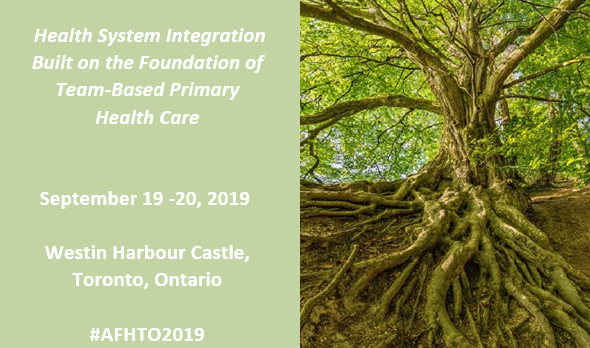
Health System Integration Built
on the Foundation of Team-Based Primary Health Care
‘Integration’ may be the word of the day, but primary care teams already embody it. Interprofessional comprehensive care creates a patient medical home that is the foundation for a high-performing health care system.
With The People’s Health Care Act, and the introduction of Ontario Health Teams, team-based primary health care needs to demonstrate how much we truly provide patient-centred care. To do this we need to ask…what if?
What if that little program you’re quietly doing, reducing trips to the ER, relieving patients of unnecessary complications, could spread?
What if your peers in other small towns could learn more from your trial and error and go straight to better outcomes? What if this happened all across Ontario?
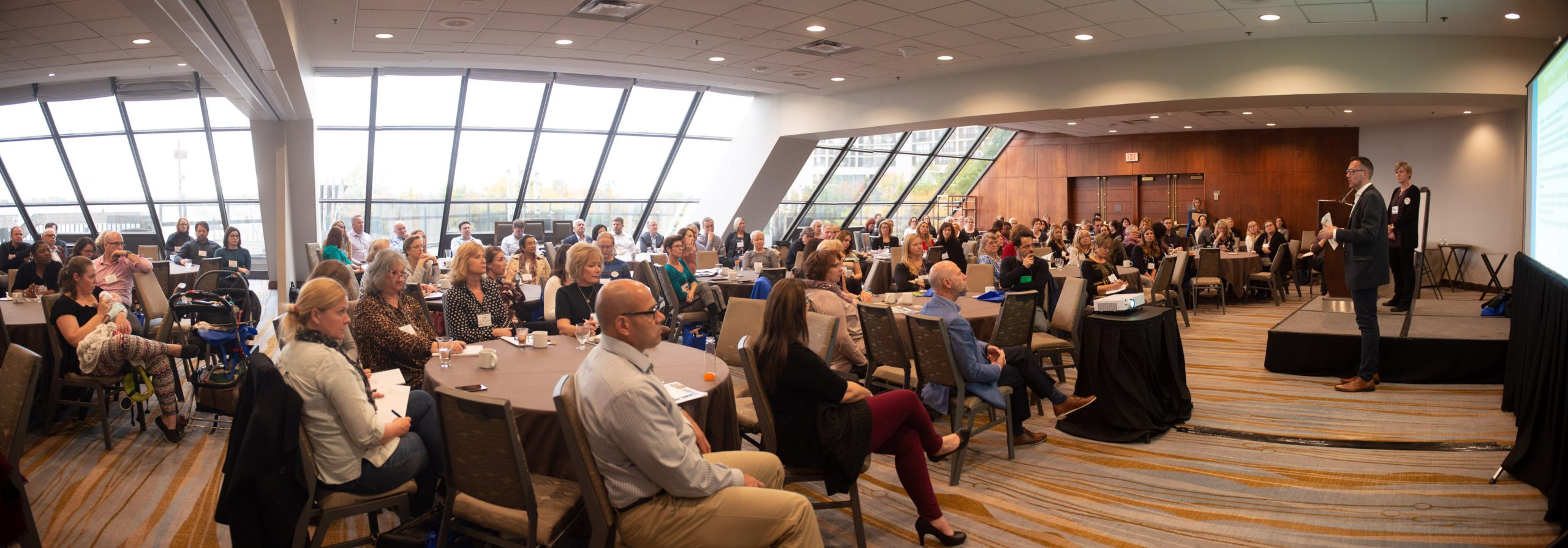
It can, if you submit an abstract to present a concurrent session or poster in 6 core themes at the AFHTO 2019 Conference on September 19 & 20, 2019.
The deadline to submit abstracts for concurrent sessions and posters is April 24, 2019 at 5:00 PM (EDT)
Reduced registration fee for concurrent session presenters: For each approved concurrent session, up to 2 presenters will each be granted a $50 discount off the conference registration fee. Additional discounts apply for patients presenting at the conference. (Discount doesn’t apply for poster displays.)
Conference key dates:
March 27, 2019 Applications for concurrent session and poster abstracts open
April 24, 2019 Deadline to submit concurrent session and poster abstract
June 2019 Conference registration opens
Sep 19 & 20, 2019 AFHTO 2019 Conference
Do you know anyone with interesting and innovative initiatives to share? Please forward this email to your colleagues, community partners and stakeholders to make sure everyone has an opportunity to present their initiatives.
And don’t forget, the deadline to join a working group is now this Friday, March 29. Come behind the scene and become among the first to learn about new developments in the field, influence conference programming and discover the innovators in your areas of interest.
For more information, you can contact us by phone (647-234-8605) or e-mail (info@afhto.ca).
The Kincardine hospital’s outpatient lab services will be moved to the Kincardine Family Health Team beginning on Thursday.
Patients requiring blood work are being asked to attend the Hawthorne Community Clinic, which is located on the same property as the hospital. The move is part of the South Bruce Grey Health Centre’s Budget Recovery Action Plan, which was released in late January.
Earlier this year, the SBGHC released the plan, designed to address a projected $1.9-million deficit, by moving some services between sites, shifting some testing to outside labs and some reduction in staff.
The hospital does not receive funding for outpatient laboratory testing, so the decision was made to move the testing to the private community laboratory which is funded by the Ministry of Health and Long-Term Care. Laboratory testing for inpatients and emergency patients will remain in the hospital, it said in a news release from SBGHC.
The change will allow laboratory staff to continue to collect samples from patients at the clinic, making for a relatively seamless transition for patients, the news release said.
The collected samples will be sent to Life Labs for processing, allowing patients to access their own lab results online through Life Labs.
Beginning Monday, outpatient collections will be available at the clinic 7:30 a.m. to 3 p.m. Monday to Friday, with hours extended to 3:30 p.m. after April 1.
The Kincardine hospital is the first SBGHC site to make the transition, with transition dates for the Chesley, Durham and Walkerton hospital sites to be finalized in the coming weeks, the news release said.
Primary care leaders in health system restructuring
Lots of MPPs and lots of meetings!
AFHTO 2019 working groups deadline now Mar. 29
Financial webinars starting Apr. 17
Caregiver support modules
Ministry updates including Erythromycin ophthalmic ointment shortage
Upcoming events regarding risk management and more
Primary care leaders in health system restructuring
There’s a lot of uncertainty about the changes coming to the health care system, and the role primary care teams could play in the restructuring. The expressions of interest for the first wave of Ontario Health Teams is expected soon, with likely a small number selected to start. Local conversations will continue, and teams can be collaborating with providers in their regions about the importance of team-based primary care in Ontario Health Teams. There is an opportunity for teams to be leaders.
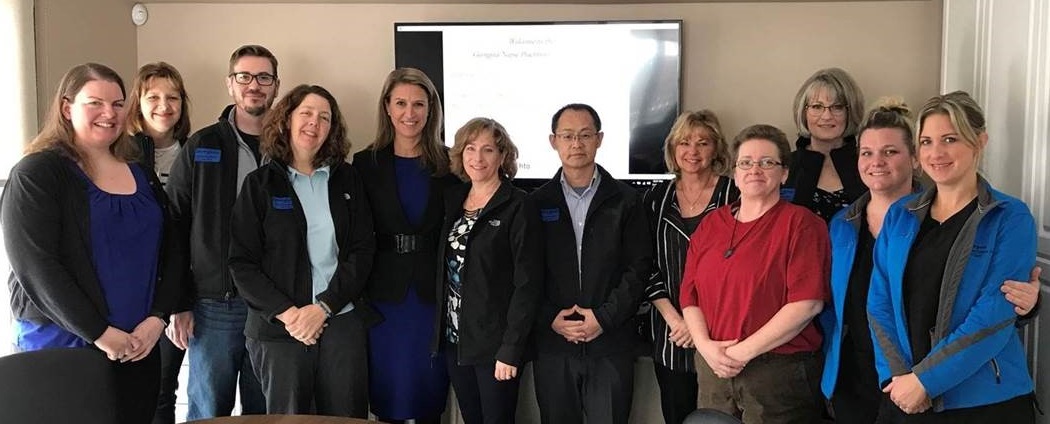
<em>AFHTO president and board chair Beth Cowper-Fung, her team and a patient at the Georgina NPLC recently met with their MPP, the Hon. Caroline Mulroney</em>
Teams continue to meet with their MPPs to share the value of team-based primary care in the community and the importance of it being key in the development of all Ontario Health Teams. Check out tools and key messages to communicate here.
Financial webinars starting Apr. 17
AFHTO will be hosting a financial webinar series starting April 17, 2019. These webinars will be presented by the financial experts at Grant Thornton LLP and are open to:
Board members who may be interested in learning more about their fiduciary responsibilities related to financial management of their primary care organization
Physicians and Nurse Practitioners in leadership positions and who are also board members
Clinic Directors and Executive Directors who want a refresher or update on current trends in financial and risk management
Admin Leads and Finance Managers who want to stay on top of current trends in financial and risk management
As Ontario’s primary health care system undergoes transformation, AFHTO members are being positioned through these financial webinars to continue to efficiently manage their primary care organizations. You can register for all six webinars or opt to select only topics of interest. All webinars will be recorded and made available to registered participants.
Caregiver support modules
Hospice Palliative Care Ontario has launched a comprehensive set of Caregiver Modules to provide informal caregivers with support, resources, and information they need. Topics include learning how to deal with their own emotions, learning how to make tough decisions, and being able to meet the appropriate physical, spiritual and cultural needs for the individual they’re taking care of.
Anyone wishing to access the modules can do so by visiting the webpage, downloading the PDFs, or even listening along to the transcribed audio clips. The modules are free to access and available in English, French and First Nations.
Ministry updates
Erythromycin ophthalmic ointment shortage: memo from the Chief Medical Officer of Health is now available, along with relevant documentation.
OHIP+: The Ministry is hosting weekly webinars to provide an overview of the redesigned OHIP+ and to answer questions regarding changes to Ontario Drug Benefit program coverage for children and youth aged 24 years and under. The next webinar is on Wed. March 27, 2019 from 12:15-1:00 pm.
Governance Webcast Series: Risk Management, Mar. 27, 2019
Join us to discuss risk management and the board’s role and leading practices in this. Register here.
Big White Wall and BounceBack: Free Psychotherapy Services for Adults And Youth With Mild To Moderate Depression And Anxiety, Apr. 4 & 11, 2019
Attend this accredited webinar to learn more about these free mental health services. Register here.
A Successful Nurse-Led Program in Primary Care for Patients with Chronic Pain, Apr. 18, 2019
Learn about the feasible, evidence-based and cost-effective program based on self-management support for chronic non-cancer pain. Find out more here.
Stroke and TIA Management Updated for Primary Care Providers in Windsor-Essex & Chatham Kent, May 1, 2019
Join the afternoon session in Windsor to learn about updates to stroke and TIA management—aimed at NPs and physicians. Find out more here.
Medicine’s history is tied to the pursuit of a fix. If someone is ailing, they may seek to feel better, but almost always prefer a cure. And maybe now, more than ever, we all expect that cure to happen immediately.
Our health system was designed to combat sickness, mostly in the hospital setting, and not to prevent sickness or support the relationships needed to thrive outside a clinic. This has built up serious pressure, and in some ways, this has always been primary care’s major challenge — our first point of contact with a family doctor, nurse practitioner or any other primary care provider, is grounded in treating an array of conditions, from back pain to dizziness, while also having to manage our long-term risks. Much of this work involves screening patients for things like high blood pressure or cancer, where the consequences of inaction may feel invisible.
And the wins of primary care aren’t usually silver bullets or swift procedures, either. They might involve creating safe spaces and having tough conversations to better get at behaviour change. Or catching a worrying pattern of lab results early on to avoid a worse health outcome.
Yet, in this era of Big Data that seeks tangible performance metrics, how do we measure things like the benefits of a relationship between a family doctor and patient? Or even begin to capture primary care’s secret ingredient: trust?
There is a growing body of evidence that primary care can do a lot of good. Take for instance the idea of developing a lasting relationship with your primary care provider over time. It’s something the health care industry calls continuity — being able to see the same primary care provider regularly and hopefully build a deeper understanding of your individual health risks and needs.
A recent study in the British Medical Journal showed that patients who were more closely followed by the same family physician fared better on serious matters, such as having to return to the hospital and the chance of dying altogether.
Another study in JAMA, showed that regions with a greater number of primary care physicians were associated with lower death rates overall. In fact, areas that saw a specific increase in primary care doctors demonstrated greater population health benefits for diseases related to the heart or cancer.
And why might this be? Interestingly enough — another study in the same medical journal this year — found that patients attached to a primary care provider were more likely to receive high value care and report better care experiences than those patients going without.
This evidence from other jurisdictions can help us sharpen our focus here at home on potential solutions. But there are a few concerns that warrant close attention.
Just this past year, a significant number of family medicine resident spots in Ontario went unmatched. Whether this is a harbinger for waning interest in the profession or just a blip is hard to say. However, dedicated investment in training a sufficient number of family doctors is much needed, while also ensuring they are able to serve communities in multidisciplinary settings. Simply put: high functioning primary care happens in teams. And they should look to integrate the needs of a community in whichever way possible to best deliver care.
This coming week should see the launch of Ontario Health Teams — a proposal by the provincial government to integrate care for designated populations. As the details unfold, this direction could help bolster primary care as the bedrock of a high performing health system.
Integration — whatever it is defined as — must be experienced by the patient. Nobody wants to feel like they’re falling through the cracks, especially when sick. Such a future could mean better co-ordinating care across a range of specialties, or even connecting patients to a bundle of social services involving food security or safe housing to ensure a healthier population.
Currently, some of our sickest and most socially disadvantaged patients are not getting access to the benefits of team-based primary care. With a renewed population focus for Ontario Health Teams, innovative payment models that align social needs with high quality primary care could help bridge some of the gaps in our current system.
The solution to Ontario’s hallway medicine will not be simple or quick, but may require the same hallmarks of good primary care — an upstream focus and incremental wins.
Dr. Andrew Boozary (@drandrewb) is a family physician and assistant professor of policy innovation at the University of Toronto. Dr. Michael Kidd (@MichaelKidd5) is a family physician and the chair of the department of family and community medicine at the University of Toronto. Dr. Aisha Lofters (@AKLofters) is a family physician and clinician scientist at the University of Toronto department of family and community medicine.