Author: admin

  • Temagami FHT hosts successful COVID-19 vaccine clinic

    The Star article published April 7, 2021

    By Jamie Mountain, Local Journalism Initiative Reporter

    TEMAGAMI – Temagami’s seniors aged 70 and up and priority healthcare workers were some of the latest to receive their first Moderna COVID-19 immunizations.

    The Temagami Family Health Team, in conjunction with the Timiskaming Health Unit, hosted a one-day vaccine clinic on March 31 at the Temagami arena.

    “The word is it went well,” said Temagami Emergency Control Group member and councillor Barret Leudke.

    “The municipality has taken direction from the (Timiskaming) Health Unit. So they’ve asked us to provide a venue and that’s what we did,” he noted in a telephone interview.

    Municipalities, he noted, have been “hosting the clinics in arenas, so that worked out well that we had that type of facility. It went relatively smooth from a tactical standpoint.”

    Leudke noted that the arena had the space, the floor plan from the health unit “on how to lay everything out,” and Temagami did its best to make certain that everything was in place to host the clinic.

    Read the full article here

  • Haliburton Highlands FHT vaccination clinic provides relief to elders: ‘overwhelmed and so thankful’

    Minden Times article published April 7, 2021

    By Sue Tiffin

    In just eight days, over about 40 hours, a team of people made up of physicians, nurses, paramedics, administrators, roads crew, volunteers and spouses of those team members vaccinated 1,946 people in Haliburton County.

    “It was a very successful few days,” said Kimberley Robinson, executive director and manager, Haliburton Highlands Family Health Team/Haliburton Family Medical Centre.

    The last clinic at the Haliburton Family Medical Centre was held March 30, as mass vaccination clinics are prepared to open in the upcoming weeks.
    The site was one that occasionally saw tears – not for the jab of the needle, but for the relief felt by our community’s older population – some born in the early 1930s – as some of the first Ontario residents to receive the COVID-19 vaccine one year into the pandemic.
    “They were simply overwhelmed and so thankful to be receiving the vaccine,” said Robinson. “Many people were relieved and excited. We heard from so many, how they are now one step closer to seeing their grandchildren, children, sister/brother. People commented that the clinic was not only efficient, but that every person they had contact with was so pleasant and kind. There were many kudos to the team.”

    To manage distributing leftover shots – vials of vaccine must be used in full or risk being wasted – Robinson said if leftovers were likely, the team first called patients who were booked the next day in the clinic to see if they might be able to come a day early; then searched the HFMC database to see if patients born in 1946 or earlier had been booked for a vaccination or had already received one and call them in if not; and if additional older residents could not be found, health care workers supporting the vaccination clinic who hadn’t received their first dose were vaccinated.

    The clinic required much support to run as efficiently as it did, and Robinson said that came together right from the entrance, with Dysart et al municipality supporting the event by providing paid parking passes for those attending the clinics, and members of the roads crew and park and rec directing traffic and handing out consent forms as people arrived.
    “All participants that I spoke with were honoured to be part of the COVID vaccine roll-out locally – including me,” said Robinson.

    Volunteers from Lakeside Church, spouses of other team members and county administrators screened and greeted patients, who were then coordinated by nurses. Medics in the observation area assisted with the checkout process and an administrator or clinician stood by in case of an adverse event. Staff from Haliburton Family Medical Centre, Haliburton Highlands Family Health Team and the Haliburton Highlands Health Services covered check-in, check-out, immunizing and observation. A nurse with Haliburton Highlands Health Services immunized each person – almost 2,000 participants, most people who were born prior to 1946.

    “I was overwhelmed by the gratitude,” said Robinson. “I was also overwhelmed by the support of my colleagues, our community partners, and others. Team members of the HHFHT and HFMC put aside their daily roles and responsibilities to work in the vaccination clinics, which meant long days and late nights. We had administrators with the County of Haliburton, roads crew, Haliburton County Paramedic Service medics and administrators, retired physicians, spouses of our team members, members of the Lakeside Church community, HHHS and Community Support Services. They just got it done. I am so proud to be part of such a spectacular team.”

    Locally, mass vaccination clinics will be held at the S.G. Nesbitt arena in Minden beginning April 6, and the A.J. LaRue arena in Haliburton beginning April 12.

    Read the full article here

  • Stay-At-Home Order Welcome But More Needed

    Stay-At-Home Order Welcome But More Needed

    Shared by the Primary Care Collaborative

    Primary Care Collaborative logos

    April 7, 2021 – The Primary Care Collaborative welcomes the Ontario Government’s announcement of new provincial measures to stop the alarming spread of COVID-19. While the vaccine rollout continues across the province, we are in a race against the variants, and bold action was needed to protect all Ontarians, particularly those most marginalized. We recognize the collective exhaustion with COVID-19 restrictions, including among primary care providers, yet the stay-at-home order is necessary if we are to turn the tide on the pandemic.

    A further step needed to slow the spread and halt the devastation of COVID-19 is provincial support for paid sick days, which would support staying home when ill. As well, we echo the Ontario Medical Association in urging those who are able to support their local restaurants and other small businesses by ordering food and other goods through delivery or curbside pickup. 
     
    This pandemic has shown time and again that COVID-19 will affect the most vulnerable among us. Primary care will continue to step up by providing care, staffing assessment centres, and now integrally involved in the vaccine rollout. We will do our part to ensure equity is front and centre in our response and we will work together with the Ontario Government and Public Health to end COVID-19. 

    Relevant links:


    About the Primary Care Collaborative (PCC):
    We are a coalition of primary care organizations collectively representing 14,000 family doctors, 1,000+ primary care nurse practitioners, 286 primary care teams, 28 Indigenous primary care teams, including northern, rural, and remote teams. This alliance of comprehensive primary care organizations joined together by common purpose to build on the collaborative work during the COVID-19 pandemic as we move towards recovery in a time of health system transformation. The PCC provides a collective and cohesive voice with the purpose of advancing equitable person-centred primary care in Ontario and is focused on influencing policy by creating a unified voice towards resolving barriers or challenges that prevent comprehensive primary care from being the foundation of the health system.

  • Bits & Pieces: respiratory care during COVID-19, Stay-at-Home order and more

    Bits & Pieces: respiratory care during COVID-19, Stay-at-Home order and more

    Your Weekly News & Updates


    In This Issue  
    • Respiratory care during COVID-19: what have we learned one year later, Apr. 21
    • Ontario needs a Stay-at-Home order
    • Member stories
    • Lessons learned from KFLA Moderna community vaccination clinics and more
    • UpToDate discount reminder
    • Evaluation and performance improvement for OHTs CoP and webinar
    • Upcoming events including improving the population health of people at risk or living with diabetic foot complications and more


    Respiratory care during COVID-19: what have we learned one year later, Apr. 21

    The COVID-19 pandemic has required healthcare professionals to change the way care is delivered and has allowed for the development of innovative practices and partnerships for the continued provision of quality care.

    On April 21 this webinar, co-hosted with the Lung Health Foundation, will highlight practice changes and considerations for the diagnosis and management of chronic lung diseases such as COPD. This includes highlighting the challenges of respiratory diagnostics such as spirometry testing and policies and changes that were needed to provide a safe testing environment.

    Find out more and register here.


    Ontario needs a Stay-at-Home order

    Ontario needs a Stay-at-Home order, community vaccination plans, and paid sick leave for ALL workers to stop spread of COVID-19 variants, reduce the burden on health care.

    Today the Primary Care Collaborative (PCC) issued a statement urging the government to do more to suppress the transmission of COVID-19, including these 5 vital actions:

    1. Move the province from a shutdown to a stay-at-home order
    2. Ensure vaccines are reaching those who are most at risk for infection and who need them the most
    3. Prioritize vaccination of teachers, educators and school staff
    4. Create a broad education and communications campaign to address vaccine hesitancy
    5. Implement paid sick leave for all essential workers now.

    Read the full statement here.


    Member stories

    Dr. Allan Grill on CTV

    Markham FHTour president and chair Dr. Allan Grill on CTV on protecting schools from outbreaks and more

    Multiple members- our Twitter thread highlighting members’ vaccine efforts. One tweet already has nearly 20,000 views!


    Lessons learned from KFLA Moderna community vaccination clinics and more

    Recent updates include:

    We continue to update several pages on our site with resources and news:


    UpToDate discount reminder

    Thanks to our partnership with Wolters Kluwer, AFHTO members have access to special benefits on UpToDate®. Physicians, residents, NPs, pharmacists, and PAs are all eligible.  For more details, please contact your ED or Admin Lead.

    EDs and Admin Leads, if you have any questions, please email us at info@afhto.ca.


    Evaluation and performance improvement for OHTs CoP and webinar

    HSPN is hosting a new community for those working on evaluation and performance improvement in OHTs. You can join here.

    The next OHT Evaluation Webinar will be OHT Improvement Measures for Focus Populations on April 27. Register here


    Your role in improving the population health of people at risk or living with diabetic foot complications, April 15, 2021
    Co-hosted with Wounds Canada, this interactive webinar will provide an overview of your role to improve the population health of people at risk or living with diabetic foot complications across the full continuum of care settings to improve patient experience, outcomes and costs. Register here.


    Together We Care Virtual Conference, April 20-22, 2021
    Join the OLTCA & ORCA as they connect the LTC and retirement community sector to help shape the future of senior’s care.
    Find out more here.


    Building vaccine confidence in the Black community, evolving guidance, and more, Apr. 9, 2021

    The OCFP’s COVID-19 COP will focus on building vaccine confidence in the Black community.
    Find out more here.


    A Deep Dive into Co-Designing Care Models for your Priority Populations, May 6, 2021
    The RISE OHT webcasts will show how your OHT can re-design care for patients in your priority populations, and help every patient in those populations experience coordinated transitions between providers.
    Learn more here.

  • Ontario needs a Stay-at-Home order

    Ontario needs a Stay-at-Home order

    Primary Care Collaborative logos


    Ontario needs a Stay-at-Home order, community vaccination plans, and paid sick leave for ALL workers to stop spread of COVID-19 variants, reduce the burden on health care

    TORONTO – April 6, 2021 – Amid an alarming rise in COVID-19 cases and hospitalizations, the Primary Care Collaborative shares concerns expressed by the Ontario Hospital Association, Ontario Medical Association, Registered Nurses Association of Ontario and other health care providers that the province needs stronger measures to curb the growing spread of the virus. Ontario’s Science Table has confirmed how dangerous the variants of concerns are, including an increased risks of serious illness and death. As the number of cases and hospitalizations increase daily, it is vitally important that Ontario enforce stricter public health measures and roll out policy initiatives to curb the spread of these deadly variants of the COVID-19 virus.

    We implore the government to listen to Ontario’s experts and those front-line health care workers seeing the devastation of COVID-19 in hospitals and communities first-hand.

    Instead of an emergency brake, which does little to stop the spread, we need a full stop now to suppress transmission of the virus and preserve the tenuous capacity of our ICUs in hospitals. Now is the time to intensify all efforts and employ an equity-lens to protect those most vulnerable and at risk from the virus. That is the clearest path through the toughest part of this pandemic. To do so, we strongly support and urge the government to take the following vital actions:

    1. Move the province from a shutdown to a stay-at-home order with people only leaving their homes for medical/health appointments, essential grocery shopping, outdoor exercise and essential work;
    2. Ensure vaccines are reaching those who are most at risk for infection and who need them the most; we need to prioritize essential workers, those with limited mobility/homebound and others with approaches that will get more vaccines in arms (in their communities, in their workplaces, in their homes); employ community-based, tailored approaches that focus vaccination efforts on communities that have been disproportionately impacted by the pandemic;
    3. Prioritize vaccination of teachers, educators and school staff to ensure we have #SafeSchools – use the upcoming spring break to vaccinate the education sector;
    4. Create a broad education and communications campaign to address vaccine hesitancy, using culturally sensitive and straight-forward messages to encourage vaccine confidence and directly address myths and misinformation;   
    5. Implement paid sick leave for all essential workers now. This is essential to ensuring businesses that remain open, such as warehouses, retail and others, can remain open safely for all workers while offering curbside pick-up and continuing essential work.

    Family Physicians, Nurse Practitioners and primary care providers continue to educate, collaborate, communicate, vaccinate and support the people we serve. But like their acute and home care colleagues, getting a handle on cases that are out of control in the community is not within their grasp. We need government leadership to support our ongoing work to protect the health of everyone in Ontario, and we need it urgently, because many health care providers are at a breaking point and our health system’s sustainability is at risk. In order to provide even a glimmer of hope in combatting this wave, we need to employ stricter public health measures now and protect all the citizens of Ontario, especially those most vulnerable. 

    Media contact for interview requests, comments or inquiries:      
    Paula Myers
    Manager, Membership and Communications
    Association of Family Health Teams of Ontario
    Email: paula.myers@afhto.ca
    Phone: (647) 234-8605 extension 1200

    About the Primary Care Collaborative (PCC):
    We are a coalition of primary care organizations collectively representing 14,000 family doctors, 1,000+ primary care nurse practitioners, 286 primary care teams, 28 Indigenous primary care teams, including northern, rural, and remote teams. This alliance of comprehensive primary care organizations joined together by common purpose to build on the collaborative work during the COVID-19 pandemic as we move towards recovery in a time of health system transformation. The PCC provides a collective and cohesive voice with the purpose of advancing equitable person-centred primary care in Ontario and is focused on influencing policy by creating a unified voice towards resolving barriers or challenges that prevent comprehensive primary care from being the foundation of the health system.

    Relevant Links:

  • Bancroft Community FHT physician raises awareness about COVID-19

    Bancroft This Week article published April 6, 2021

    By Nate Smelle

    Since the pandemic first appeared in Ontario, Dr. Carolyn Brown of the Bancroft Community Family Health Team has been on the front-lines of the local fight to prevent the spread of COVID-19. With the third wave of the pandemic now setting records in terms of the number of new cases in Hastings and Prince Edward counties, on March 31 the health unit stepped up its efforts to protect the public’s health. To learn more about what is being done locally to keep people safe and healthy during the pandemic, The Bancroft Times sent Dr. Brown a series of questions. The following are Dr. Brown’s responses to those questions.

    The Bancroft Times: With the COVID-19 vaccine rollout well underway, what would you say to people who might still have reservations or worries about the vaccine being developed too quickly, and/or it possibly being ineffective, or even detrimental to people’s health?

    Dr. Brown: Coronavirus infections have been predicted for some time. Bill Gates did a talk several years ago saying he was worried about a coronavirus epidemic. The scientists have been working on this for 20 years. They were told what the virus looked like and then the world came together to make a vaccine. The companies, the competitors and the regulators have all shared information to get a fast and effective vaccine. Imagine if Ford, Volkswagon and Mercedes-Benz all worked on the same type of car. Also at the same time, the safety regulators reviewed the crash results. The car would get to market very quickly and work well.

    The scientists have worked on the COVID-19 vaccine all day, every day, 24/7. They have also done everything at the same time instead of one test at a time. (That cut out years.) Countries have built factories to make the vaccine. If the vaccine had not worked, they would have lost a lot of money. The Canadian regulators have made sure all the information that is needed to decide if a medicine or vaccination can be used in Canada was given. They have approved the vaccines. They are the experts. I feel these vaccines are safe and effective.

    The Bancroft Times: How are things going with the vaccine rollout here in North Hastings? Will the vaccine be available to a larger portion of the local population any time soon?

    Dr. Brown: The Manor and staff and their primary support people have all been vaccinated. High risk medical staff have had their first vaccination as well as people over 80-years-old. The people 75-years-old and up are now able to register. The Health Unit, hospital and the Bancroft Family Health Team have teamed up and are giving about 600 vaccinations a week at the Legion. We still need to get the vaccine to people who cannot leave their home. So far the local vaccines have been Pfizer and Moderna.

    The Bancroft Times: What should those under the age 75 in North Hastings do while waiting to become eligible to receive the vaccine?

    Dr. Brown: The Ontario government made a province-wide sign up. They are stressing you should not try to sign up until you are in the age category listed. How will you know? Listen to the radio, newspapers, websites and talk to your friends and family. The health unit is trying to monitor COVID-19 positive people and contacts. They are also involved with the clinics. Try to avoid calling them unless you need them. Over the next weeks the “age to sign up” will gradually come down to 70, then 65 and 60-years-old.

    The Bancroft Times: Anti-mask/anti-lockdown protesters claim that the pandemic’s death toll is inaccurate because it includes the number of deaths “from” COVID-19, as well as the number of people who die of other causes who have COVID-19. How does the medical community decide if a person died of COVID-19?

    Dr. Brown: We have had a lot of experience with people dying of influenza. Most young healthy people get “the flu” and recover, but a few will die from the illness. Most people who have influenza have COPD or chronic lung disease or angina (heart not getting enough oxygen) or have cancer or other illnesses. Many people have all of these diseases. In the fall, when the influenza season hits, many more people are admitted to hospital and die after they get sick with influenza. COVID-19 is the same. COVID-19 tips your stable medical problems into severe sickness and you can die. Older people die more often because the immune system does not work as well. The hospitals and health providers get prepared for the influenza season. We know the “normal” death rate and that this increases in the fall and winter when patients test positive for influenza.

    We have lived with COVID-19 for over one year. The death rates can be compared. For example, if normally 10 people in 1,000 die and now 20 people in 1,000 die, we need to look at why more people are dying. The only difference is COVID-19. The age and health problems are compared to make sure the groups are the same. Only a few people die with no other medical problems. There was recently a 31-year-old man who died in Peterborough.

    The Bancroft Times: What is PCR testing, and how effective is it in testing for COVID-19?

    Dr. Brown: PCR testing stands for “polymerase chain reaction.” It tests for the actual viral particle. Like all tests, it needs to be taken in “context.” The health unit will contact everyone with a positive nasal swab (PCR) test to review their situation and decide on a diagnosis. How could this test be wrong? It may be positive because you have a different coronavirus, not COVID-19. It is like mistaking two people because they are both wearing a red coat. It may be positive for months after you have COVID-19 as there are bits of viral particles in the nose. You also need to have “enough” viral particles in the nose. This is where the cycle times come in. The test might be negative because you don’t have enough of the virus in your nose. You may need to return in a few days to repeat the test to see if there is more virus then, The swab may have been contaminated. If it doesn’t make sense, you may need to repeat the test.

    Another medical example is when a person has their potassium too high (a salt in the body). This could be very important. The practitioner has to look at all the possibilities – machine error, blood cell break down, true test – and decide what to do. I may have to repeat the blood test to re-check the potassium.

    So, just like every medical test, the PCR test needs to be interpreted with the history or story of exposure and symptoms. You, the person who had the nasal swab, gets the positive or negative result, but, a lot of work has gone into deciding if this result is correct.

    The Bancroft Times: Recognizing that lockdowns can have a negative impact on some people’s mental health and financial well-being; and, that the majority of deaths from COVID-19 have occurred in long-term care homes, why does the rest of the population still need to abide by protective measures such as mask wearing, physical distancing, and lockdowns?

    Dr. Brown: There are some people who won’t use any medicine and won’t go to doctors. They want to let nature take its course. For one example, people will not treat blood pressure. Blood pressure is treated to prevent high pressure in your blood vessels or tubes. You could have a stroke where one of these tubes breaks. If we treat your blood pressure, there is much less chance of stroke. Some people won’t have surgery. They will die from childbirth or appendicitis. They won’t remove an abscess but let it turn into a blood infection. Some will not treat cancers. They would die from Hodgkin’s disease – a very curable cancer – or not treat prostate or breast cancer which are very controllable cancers.

    We could let nature take its course with COVID-19. Brazil is an example of a place where very little is being done to change what is happening with COVID-19. If you just let it happen, we will have more people die in seniors’ residences. There will be more people going to hospital with full intensive care units. Younger people will get sick and die. We cannot predict who will get sick and die. Brazil has three per cent of the world population but has one third of the daily deaths. The previous outbreaks in Italy and New York can be examples. Brazil has lots of COVID-19, and now has one of the new variants. The original COVID-19 and the new variant does not stay in Brazil but will move outside of its borders affecting other countries.

    In Brazil, they are filling up ICUs. They need to pick who will live and who will be palliated (be kept comfortable and allowed to die). This also happens in an influenza outbreak but now it is happening much more and the health system can’t cope. We know what happens “normally” and this is different. The scientist look at the difference and its COVID-19. If we don’t do anything, this will happen in Canada. We are a country where everyone has health care coverage. We believe that all our 30 million people have a right to see a health professional or get care in the hospital. We look after our friends, neighbours, and communities.

    The governments are trying to balance the risk of serious illness and death due to COVID-19, the risks of other health problems (delaying important tests and chance of other health problems like anxiety, depression and suicide) and the risk to the economy. There are some businesses who are doing really well and others who have closed. Will everyone agree with the choices that are made? No, it is unlikely that everyone is happy or agrees with these decisions. The scientists are giving their opinion and the businesses are giving theirs. The people have as varied an opinion as there are people. At the moment, our area is “green.” We have space to spread out. People are wearing masks inside. They are hand washing. In other areas in Ontario (ie. Peel) people are living in small apartments with no where to go. They have to go to work or not get paid. They are living with children, parents and grandparents in small spaces.

    The rules now say you need to hand wash or use hand sanitizer. You need to be six-feet away from other people. You also need to wear a mask over your nose and mouth to protect others.

    The Bancroft Times: What does the public need to know about the new COVID-19 variants and their presence locally? Is there anything different that people should be doing to protect themselves?

    Dr. Brown: When the virus duplicates, there are mistakes when the virus copies itself. Most of the mistakes are not good and the new virus dies. Some mistakes make the virus stronger or easier to spread. This has happened around the world and they are called the new variants.

    We are now in the third wave. The number of people with COVID-19 is going up again. A lot are the new variants. They are B117 (British) B.1.351 (South African) CAL.20C (California) and P.1 (Brazil). I thought that the new variants would be less lethal (meaning less people would die) but this is not the case. The variants are more contagious and they are infecting younger people under the age of 60-years-old. Peterborough recently had an outbreak and a 31-year-old man died. The hospitals and ICUs are seeing more and more young people. There is a suggestion now that people should double mask or use a better mask. Why? In general, the mask is to prevent your droplets/viral particles from infecting someone else. You have less chance of breathing in the viral particles if you double mask. The virus has to spread from person to person to spread. The N95 medical mask, when properly fitted, stops you from breathing in the virus. If you get the virus on your hand and wipe your nose without cleaning, you may give yourself the virus.

    Soon, the new cases will be the new strains or variants. The vaccines still seem to be effective for the new strains but this is being watched closely.

    Read the full article here
  • Bancroft FHT Vaccinates Over 1000 People from COVID-19

    My Bancroft Now article published March 26, 2021

    By Trevor Smith-Miller, My Bancroft Now

    Over one thousand people have been vaccinated in North Hastings today.

    The Bancroft Family Health Team, in partnership with the Health Unit and QHC, says they have vaccinated 1040 people at their clinics at QHC North Hastings and the Legion.

    However, they say issues still persist with the booking system for Bancroft Clinic.  They say to not worry about being unsuccessful as there are many clinics planned throughout April, and urge people to book at their local clinic and not travel out of town. Clinics are set to take place every Tuesday and Friday of the month. They say the upcoming clinics for the last week of March are already fully booked.

    They also stress that you should not contact the Family Health Team or QHC North to book an appointment, instead to do it through the Province. Those without a stable internet connection can call the Provincial Vaccine Booking Line at 1-888-999-6488, from 8AM to 8PM.

    Read the full article here

  • Provincial AstraZeneca Primary Care Pilot launches amongst Dufferin County, Wellington & Guelph FHTs

    Yahoo News article published March 18, 2021

    By Paula Brown, Shelburne Free Press

    Residents in Dufferin County, Wellington, and Guelph between the ages of 60 and 64 will now have access to the AstraZeneca-Oxford COVID-19 vaccine through their family doctor.

    Wellington-Dufferin-Guelph (WDG) Public Health announced in a press release on Tuesday (March 16) that they has been added to the list of regions participating in the provincial AstraZeneca Primary Care Pilot. The Ontario government announced the pilot on March 10, allowing pharmacies and primary care settings in three public health units: Toronto, Windsor-Essex, and Kingston, Frontenac, Lennox and Addington to administer the vaccine.

    “This is another key tool in our fight against COVID-19,” said Dr. Nicola Mercer, Medical Officer of Health and CEO of WDG Public Health. “I thank each Family Health Team and each physician for their commitment to helping end the pandemic in our region.”

    WDG Public Health said the public should not contact their primary care provider as participating physicians will contact eligible patients to book a vaccine.

    Local family health care teams participating in the pilot include: Dufferin Area Family Health Team, East Wellington Family Health Team, Guelph Family Health Team, Minto Mapleton Family Health Team, Mount Forest Family Health Team, and Upper Grand Family Health Team.

    For more information on COVID-19 vaccines go to www.wdgpublichealth.ca/vaccine

    Read the full article here

  • April 5th Update on COVID-19 Vaccination Roll Out

    In This Issue:

    • Vaccinating in Primary Care
    • COVaxON
    • Primary Care Community of Practice
    • COVID@Home Monitoring for Primary Care
    • Provincial Antigen Screening Program
    • COVID-19 Vaccine Eligibility EMR Searches
    • COVID-19 Learning Opportunities
    • New Resources
    • Relevant Ministry Guidance Documents for Primary Care

    Dear Members,
    We are writing to provide you with an update from our united Primary Care COVID-19 Vaccination Collaborative (PC-VAC*). March 26th key messages we shared with vaccine decision-makers can be found here.  

    The April 1st Update on COVID-19 Projections from the Science Table paints a very grim picture for the upcoming month. The third wave is here, and it is being driven by the Variants of Concern (VOC) where we are seeing younger Ontarians ending up in hospitals, with ICU beds at full capacity. The update also highlights that the vaccine rollout has not reached the highest risk communities where there are high rates of COVID-19.

    The Primary Care Collaborative had an opportunity to speak about the rollout challenges at the Associate Minister’s Collaboration Table with a deliberate ask – please employ an equity lens NOW and make sure vaccines are going to those who need it the most, in the communities where they live. Ensure primary care is front and center in that rollout to get more #NeedlesInArms.

    Vaccinating in Primary Care
    Ontario is expanding pharmacy and primary care locations for COVID-19 vaccinations. Approximately 120,000 doses of the AstraZeneca vaccine have been allocated to public health and primary care practices in the 34 regions. The clinics have already heard or will hear directly from their public health units about when to expect the vaccines in their practices.

    We are currently working with government to ensure that all thirty-four public health units also allocate Moderna and other vaccines to primary care settings soon, learning from regions like Kingston, Frontenac, Lenox & Addington (KFLA) and Lambton where utilization of Moderna is part of the norm.

    COVaxON
    If you will be vaccinating in your clinic or are involved in future rollouts, please sign up for COVaxON training on the OntarioMD website. Training will be scheduled on an ongoing basis. OntarioMD is suggesting that each practice have one or more (depending on the size of practice) member of their staff trained on the ‘End to End Training’ module.

    Primary Care Community of Practice
    Ontario Health (OH) and your primary care associations have collected resources and lessons learned through a series of Community of Practice meetings with the primary care pilot participants. Please join the Primary Care Vaccination Pilot CoP online forum for resources. If you have trouble signing up for Quorum, please message janine.theben@ontarioehealth.ca for assistance.

    COVID@Home Monitoring for Primary Care
    Ontario Health is providing tools and resources for COVID@Home to help primary care providers who wish to remotely monitor people who have mild to moderate COVID-19 in the community. For further guidance on the implementation of this initiative at a site level, please refer to the Ontario Health resource toolkit COVID@Home Monitoring for Primary Care, which includes clinical pathways as well as instructions for the use and proper handling in collecting and disinfecting the monitors for use by the next patient.

    To request oxygen saturation monitors for the COVID@Home initiative, please complete the Oxygen Saturation Monitor Eligibility and Intake Form. Requests will then be reviewed for eligibility purposes by Ontario Health, prior to fulfilling requests. Please note that the Ministry of Health reserves the right to limit quantities as needed.

    Provincial Antigen Screening Program
    The Provincial Antigen Screening Program allows employers in priority settings to add an additional safety measure in high-risk and essential workplaces, to help reduce the spread of COVID-19. Through the program, rapid antigen point-of-care tests (POCTs) can be distributed to primary care settings to enhance existing routine screening measures for asymptomatic employees and other identified groups.

    Rapid antigen POCTs may allow for workplaces to proactively identify cases of COVID-19 that may have otherwise been missed, supporting employee safety and business continuity in a variety of workplaces. In addition, primary care practices are also eligible to access the diagnostic point-of-care rapid testing with ID Now that can be used to diagnose COVID-19 in symptomatic patients. Please click here for more information or contact Heather Nichol if you have any questions.

    COVID-19 Vaccine Eligibility EMR Searches
    The eHealth Centre of Excellence has updated the COVID-19 Vaccine Eligibility EMR Searches for Telus PSS EMR. The COVID-19 Vaccine Eligibility EMR Searches version 2.0 was built to service Phase 2 in the Ontario COVID-19 vaccination plan. You can find more information on this phase here, and can download the latest tool version here.

    If you are interested in further training or a review of the upgraded version, you can schedule a Coaching Session to answer any questions. All Coaching Sessions are free of charge and are accredited by CFPC for Mainpro+ CPD credits.
    COVID-19 Learning Opportunities

    Updated COVID-19 vaccination e-learning series

    • The COVID-19 vaccination e-learning series has been updated with a new module called “Emerging Topics”. The new module includes information on the impact of variants on vaccination, transmission post-vaccination, the four-month dosing interval, and the latest information about AstraZeneca and VIPIT. It is free to access following a short registration here.

    The COVID-19 Vaccine: Building vaccine confidence in the Black community, evolving guidance, and more
    The next Ontario College of Family Physicians (OCFP) Community of Practice will be on Friday, April 9, 2021 at 8:00-9:00am (ET). They will be continuing our discussion on COVID-19 vaccines, this time focusing on building vaccine confidence in the Black community. As usual, the panelists will also be speaking about the latest changes in guidance and policy and answering the questions you have. Register here.

    New Resources:

    Relevant Ministry Guidance Documents for Primary Care:
    Below are the reference and guidance documents developed by the Ministry of Health that are relevant to primary care for your reference.

    Vaccine Prioritization Resources:

    1. Guidance for Prioritizing Health Care Workers for COVID-19 Vaccination
    2. Phase 2 Prioritization for COVID-19 Vaccination

     Health Care Provider Education Documents:

    1. COVID-19 Vaccine Approval Process and Safety
    2. About COVID-19 Vaccines
    3. COVID-19 Vaccine Availability and Rollout
    4. COVID-19 Vaccine Information Sheet
    5. Extension of the Second Dose Interval Memo

     General Immunization Documents for Patients:

    1. What you need to know about your COVID-19 vaccine appointment
    2. After Your COVID-19 Vaccine
    3. COVID-19 What you need to know V2.0

    General Immunization Documents for Immunizers and Vaccine Clinics:

    1. COVID-19 Vaccine Clinic Operations Planning Checklist
    2. Vaccine Storage and Handling Guidance- Pfizer-BioNTech and Moderna COVID-19 Vaccines
    3. Administration of Pfizer-BioNTech COVID-19 Vaccine
    4. Administration of Moderna COVID-19 Vaccine
    5. Administration of AstraZeneca COVID-19/COVISHIELD Vaccine
    6. COVID-19 Vaccination Recommendations for Special Populations
    7. COVID-19 Vaccination: Allergy Form

    Consent for COVID-19 Vaccination Documents:

    1. Pre-Screening Assessment Tool for Health Care Providers
    2. COVID-19 Vaccine Consent Form

    Find resources from previous weeks here.

    We look forward to continually updating you on the provincial vaccination strategy. Please do not hesitate to contact us if you have any questions or ideas.

    Yours in good health,

    The AFHTO Team

    *Ontario Primary Care COVID-19 Vaccination Collaborative Partners 

    • Alliance for Healthier Communities
    • Association of Family Health Teams of Ontario
    • Indigenous Primary Health Care Council
    • Nurse Practitioner-Led Clinic Association/Nurse Practitioners’ Association of Ontario
    • Ontario College of Family Physicians
    • Ontario Medical Association Section on General and Family Practice
    • Ontario’s Academic Chairs of Family Medicine
  • Bits & Pieces: oxygen saturation monitors for COVID@Home, Primary Care Collaborative and more

    Bits & Pieces: oxygen saturation monitors for COVID@Home, Primary Care Collaborative and more

    Your Weekly News & Updates


    In This Issue  
    • Oxygen saturation of COVID home monitoring
    • Announcing the Primary Care Collaborative
    • Your role in improving the population health of people at risk or living with diabetic foot complications
    • Member stories
    • Joint letter on vaccine dose intervals for indigenous populations
    • Patient-facing document updates, Gen. Hillier memo and more
    • Supporting older persons at home slides and video
    • Canada’s Volunteer Awards National Advisory Committee
    • AMS Healthcare research fellowships: provider mental health and wellbeing
    • Upcoming events including Building a Resilient Nonprofit Organization through Proactive Risk Management and more

    Oxygen saturation of COVID home monitoring

    COVID-19 pandemic has led to unexpected surges in demand on the provincial healthcare system, and healthcare settings across the province face patient capacity constraints, potentially affecting care for all patients. To help ease these constraints, Ontario Health is providing tools and resources for COVID@Home to help primary care providers who wish to remotely monitor people who have mild to moderate COVID-19 in the community.

    Oxygen saturation monitors are now available to be ordered by primary care physician offices and interprofessional primary care team offices through the provincial pandemic stockpile. Find out more about the initiative and how to order here.


    Announcing the Primary Care Collaborative

    COVID-19 shows the vital roles primary care providers play every day for community health and wellbeing and health system cooperation in Ontario.

    On March 29 we announced the launch of the Primary Care Collaborative with five other partners, including Alliance for Healthier Communities, IPHCC, NPLCA, OCFP and SGFP. Visit our site for the full release.

    Working more collaboratively together, we hope a unified primary care sector can help advance the important role that primary care will play towards recovery from this pandemic.


    Your role in improving the population health of people at risk or living with diabetic foot complications

    Co-hosted with Wounds Canada, this interactive webinar on April 15 will provide an overview of your role to improve the population health of people at risk or living with diabetic foot complications across the full continuum of care settings to improve patient experience, outcomes and costs.

    By the end of the webinar participants will:

    • Discuss prevention and management approaches based on risk stratification of people at risk or living with diabetic foot complications
    • Explore ways to leverage telehealth / virtual care assessments to support patients at risk or living with diabetic foot complications
    • Leverage Wounds Canada resources to optimize your practice

    Register here.


    Member stories
    Bancroft FHTBancroft FHT vaccinates over 1000 people from COVID-19

    Central Lambton and Rapids FHTsFamily doctors join vaccine rollout in Sarnia-Lambton

    Georgian Bay FHTvideo tour of the Collingwood and Wasaga drive-thru vaccine clinics

    Queen Square FHTOntario family physicians seek clarity on when they can administer COVID-19 vaccines in office


    Joint letter on vaccine dose intervals for indigenous populations
    On March 26 we sent a joint letter to Premier Ford and Minister Elliott on changes to the vaccine dosing schedule for Indigenous populations.

    “We are standing in solidarity with the Indigenous Primary Health Care Council and asking that, at bare minimum, those Indigenous people living in urban areas who’ve already received their first doses of vaccines be grandfathered in, and permitted to receive their second doses within 21-28 days. This allows for continuity of care, and confidence in this process and the vaccine itself.”

    Read the full letter on our site.


    Patient-facing document updates, Gen. Hillier memo and more

    Recent updates include:

    We continue to update several pages on our site with resources and news:


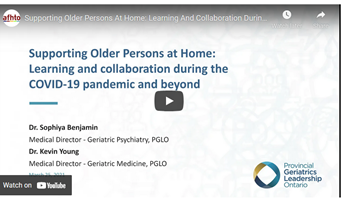
    Supporting older persons at home title screenshot

    Supporting older persons at home slides and video

    On Mar. 25 Provincial Geriatrics Leadership Ontario discussed how to better support older persons in the community using lessons learned during the first year of the COVID-19 pandemic. Slides and video are now available.


    Canada’s Volunteer Awards National Advisory Committee
    Canada’s Volunteer Awards (CVA) will be accepting applications for the CVA National Advisory Committee (NAC) until April 8. Members of the National Advisory Committee play a leading role in the selection of Canada’s Volunteer Awards recipients by reviewing nominations and making recommendations to the Minister of Families, Children and Social Development. They will also support the promotion of the program throughout their term. To apply visit their site.


    AMS Healthcare research fellowships: provider mental health and wellbeing

    AMS Healthcare is offering one-year fellowships of up to $75,000 to early and mid-career academic researchers and scholars and academically trained regulated health care professionals to study and develop expertise/competence in the impact of digital technology/artificial intelligence on compassionate care. Some projects will have an additional focus on the wellbeing and mental health of healthcare providers, patients and caregivers to address the challenges of living and working through the COVID-19 pandemic. Letter of intent due Apr. 7. Visit their site for details.


    Foundations to QI (IDEAS) Program e-Learning Course, Mar. 31 & Apr. 1, 2021
    E-QIP is holding this comprehensive introductory QI course designed for the community mental health sector. You’ll be well versed in a common language and approach to QI with the aim of improving client care, experience and outcomes after this course.
    Find out more here.


    ECHO Managing COVID-19 in Primary Care, Starting Apr. 13, 2021
    UHN’s ECHO series is back- now with 12 parts. Join other primary care providers in this interactive online program.
    Find out more here.


    Building a Resilient Nonprofit Organization through Proactive Risk Management, Apr. 22, 2021
    Charity Village webinar with Risk Management Consultants Lilli Chiu and Isaac Monson from HUB International and insights on how to navigate uncertainty and prepare for the unexpected. Register here.


    Excellence through Quality Improvement (E-QIP) Conference, Apr. 13, 2021
    Hosted by CMHA Ontario, this one-day virtual conference is being offered for FREE.
    Visit their site.