Author: admin

  • PCC calls for more supports for essential workers and workplaces, more robust community vaccination rollout & isolation supports

    PCC calls for more supports for essential workers and workplaces, more robust community vaccination rollout & isolation supports

    Shared by the Primary Care Collaborative
    Primary Care Collaborative logos

    Toronto – April 17, 2021 – The organizations of the Primary Care Collaborative echo the alarms being sounded by our healthcare and public health colleagues since Friday. There was no doubt given the modelling from the Ontario COVID-19 Science Table Advisory Board on Friday afternoon that additional measures were and are necessary to help slow the spread of the virus in our province, particularly the spread of the more contagious and deadly Variants of Concern. Some of the measures taken by the Ontario government yesterday – notably limiting non-essential travel, extending the stay at home order, and expanding the number of vaccines available to hotspot areas – will indeed help reduce transmission and ultimately lower the burden on our health system.
    However, we are deeply concerned that these measures are not nearly enough to stop outbreaks from happening in the highest risk environments – essential workplaces and congregate settings. We are seeking immediate action on the following:

    • robust paid sick day supports; the temporary, retroactive federal sickness benefit maxes out at $450 a week after tax and cannot be used immediately by a worker who may be experiencing COVID symptoms; we need emergency sick day supports that allow anyone who is experiencing symptoms to stay home without fear of losing their job; 
    • access to adequate PPE, including N95 masks for all congregate settings and essential workplaces, including long-term care and retirement homes;
    • expansion of rapid testing, and connections to local community supports for people who test positive and need to isolate immediately;
    • defining “essential” workplaces more narrowly, including high risk workplaces that continue to be sources of outbreaks.

    Without these decisive actions, more lives will be lost. Also, our healthcare workers and the health system will continue toward catastrophic scenarios. Collectively, primary care providers will continue to step up and do what we can to keep essential services in place, to encourage cancer screening, to keep people healthy and out of hospitals, and to continue vaccinating, but we need help. Primary care also continues to play key roles directly in COVID-19 supports, helping people isolate, get tested in community, and by rolling out the vaccination and vaccine information in hotspots and meeting people where they’re at. Support for us to continue doing this work and to scale it up across the province is essential to slowing the spread and flattening the curve of the third wave in every community.
    Workplace enforcement measures alone are not enough to keep people safe in essential workplaces. Paid time off must be in place so people can book and get vaccinated and stay home when not feeling well, minimizing the risk of spread. These are proven, evidence-based interventions that can help get us through this wave of the pandemic sooner, with less suffering. 

    Without every possible measure being taken to protect the people working in in essential workplaces – many of whom are marginalized and from racialized and newcomer communities – these places will also eventually be forced to close, as there is further spread and more and more people get sick and die from COVID-19. And workers will bring more spread back into their already devastated families and communities.
    We also remain deeply concerned that yesterday’s modelling has led to a closure of outdoor activities, and an emphasis on enforcement of the stay at home order through policing, “carding” and ticketing of people out in public. These are actions that are known to harm mental health of people while not measurably reducing the risk of COVID-19 spreading. These measures will also cause disproportionate harm to racialized and other marginalized communities. We need to approach people at the most risk with support, empathy and effective ways to stay safe. At a time when we need to further build trust to support our vaccination rollout, these enforcement measures, especially those taken heavy-handedly, will only push us further from where we need to be. It’s in that spirit that we acknowledge and support the enforcement agencies and police forces who’ve gone on the record saying they will not be stopping people in public.
    The voices of our hospitals and others on frontlines of care, and especially among the people and families facing the worst — the loss of loved ones to the virus – must be heard. The exhaustion, frustration and anger of our front-line health workers, our doctors, nurses, therapists and others who are desperately battling the virus 24/7, must be heeded. Half-measures will not get us out of this pandemic – the right decisions driven by the evidence will. As noted by Dr. Adalsteinn Brown on Friday: “There is little point to looking back at hypotheticals or what was or wasn’t done in the weeks and months past. We must notice what needs to be done now, and act swiftly to protect lives and our health system.”

    For press inquiries or to schedule an interview, please contact:

    Jason Rehel – jason.rehel@allianceon.org; cell: 416-817-9518

    Relevant links:


    About the Primary Care Collaborative (PCC):

    We are a coalition of primary care organizations collectively representing 14,000 family doctors, 1,000+ primary care nurse practitioners, 286 primary care teams, 28 Indigenous primary care teams, including northern, rural, and remote teams in Ontario. This alliance of comprehensive primary care organizations joined together by common purpose to build on the collaborative work during the COVID-19 pandemic as we move towards recovery in a time of health system transformation. The PCC provides a collective and cohesive voice with the purpose of advancing equitable person-centred primary care in Ontario and is focused on influencing policy by creating a unified voice towards resolving barriers or challenges that prevent comprehensive primary care from being the foundation of the health system.

  • East Wellington FHT purchases vaccination fridge with donation from Erin Rotary Club

    The Wellington Advertiser published April 14, 2021

    By Advertiser Staff

    ERIN – East Wellington Family Health Team (EWFHT) officials say they are very grateful to the Rotary Club of Erin for its generous donation of $4,000 for the purchase of a vaccine fridge for the Erin clinic.

    The donation allows the health clinic to protect valuable vaccines, using equipment that is more reliable, with more precise temperature control and supply safeguards, EWFHT officials say.

    Mary Cunningham, acting president of the Erin Rotary Club, also sits on the family health team board of directors.

    “I became aware of the need for funds to replace the existing 12-year-old, sub-par fridge used for vaccines,” Cunningham said.

    “I took that to Erin Rotary and they jumped on the chance to help with something so worthwhile and necessary.”

    Cunningham noted that last year Erin Rotary donated $10,000 to the foodbank run by East Wellington Community Services.

    “We are so fortunate to have service clubs in our community like the Rotary Club, who understand how important contributing to the wellness of our community is,” stated Kim Bell, executive director of EWFHT.

    “Members of Rotary Club, Erin, are leaders in our community. Thank you for all you do for EWFHT, but also other charities and initiatives that work to make our community a healthy place to live.”

    EWFHT clinics receive core funding from the Ontario Ministry of Health and Long-term Care, but the funding does not cover all clinic needs.

    In order to purchase specialty equipment such as the vaccine fridge and to support some of the community health programming, the EWFHT depends on donations from the community.

    Those wanting to make a donation to EWFHT can do so through its partnership with Canada Helps (follow the link through the “donate now” button at ewfht.ca).

    EWFHT is a registered charity and tax receipts will be provided via Canada Helps for all donations.

    Read the full article here

  • QI in Action eBulletin # 106: COVID-19 Vaccination Eligibility – EMR Searches for Primary Care

    QI in Action eBulletin # 106: COVID-19 Vaccination Eligibility – EMR Searches for Primary Care

    In this Issue:

    • EMR Searches for Primary Care
    • eConsult Specialty Groups
    • Share your COVID-19 Initiatives
    • Upcoming Webinars

    EMR Searches for Primary Care
    To support primary care with COVID-19 vaccination during Phase Two of Ontario’s roll out strategy, the team at the eHealth Centre of Excellence can provide EMR searches that enable clinicians to more efficiently identify and prioritize ambulatory patients from their roster who are in greatest need of the COVID-19 vaccination.

    Searches are now available for Telus PS Suite, Oscar and Accuro EMRs. Searches prioritize patients according to the eligibility criteria outlined in the Ministry of Health’s provincial Phase Two vaccination roll-out plan.

    The three searches created prioritise patients according to highest risk, high risk and at-risk populations.

    highest, high and at risk population search

    To download these searches, please join the community portal.

    eConsult Specialty Groups

    As a result of the current COVID-19 pandemic, OTN and the eConsult Centre of Excellence in partnership with Public Health, OMA, OntarioMD, Ontario Health and the MOH have created new specialty groups;

    • a COVID-19 BASETM managed eConsult specialty group. This group enables physicians and nurse practitioners to ask general clinical questions to infectious disease specialist electronically and receive a response within days. The COVID-19 BASE™ Managed Specialty Group is now available province-wide.
    • a COVID-19 – Allergy/Immunology BASE™ Managed Specialty Group. This group enables physicians and nurse practitioners to ask COVID-19 vaccine allergy related clinical questions to Allergy and Clinical Immunology specialists electronically and receive a response within days.
    • a COVID-19 and Pregnancy BASE™ Managed Specialty Group. This group enables physicians and nurse practitioners to ask COVID-19 and Pregnancy related clinical questions to Obstetrics specialists electronically and receive a response within days.
    • a COVID-19 and Autoimmune Disorders BASE™ Managed Specialty Group. This group enables physicians and nurse practitioners to ask COVID-19 and Autoimmune Disorders related clinical questions to Rheumatology specialists electronically and receive a response within days.

    These are the only group that allows for population-based, non-patient specific clinical questions. Specialists can answer both patient-specific and general questions about COVID-19.


    • For non-patient specific questions please enter the patient information as follows:
      • First Name: COVID19
      • Last Name: COVID19
      • Date of Birth: 1900-01-01
      • Select OHIP number not available
    • Please note: Patient screening for COVID-19 must still be done through Public Health Services. For more information on the COVID-19 vaccine in Ontario, visit Getting a COVID-19 vaccine in Ontario.
    • If you would like to sign up for eConsult, visit www.otnhub.ca or complete the Intake Form and someone can assist you.
    • If you need a refresher on how to submit an eConsult, you can watch the training video here.

    Tell us what COVID-19 initiatives you’re proud of!
    News is that COVID-19 has been rapidly evolving- and so are your teams!
    AFHTO is committed to advocating for your teams by amplifying stories of your team’s efforts, pandemic or not. Tell us what your team is doing to continue providing care to your patients, whether it’s:

    –    COVID-19 vaccination efforts
    –    Adaptations to your programs or clinic
    –    New programs emerging from newly recognized demands
    –    Stories of collaboration with other organizations or the community
    … or any other initiatives your team is proud of- we want to hear from you.

    Submit your COVID-19 stories & photos here, OR tag us on Facebook or Twitter
    … and we could be celebrating your team’s work next!

    Picture of first tweet in vaccine tweet thread


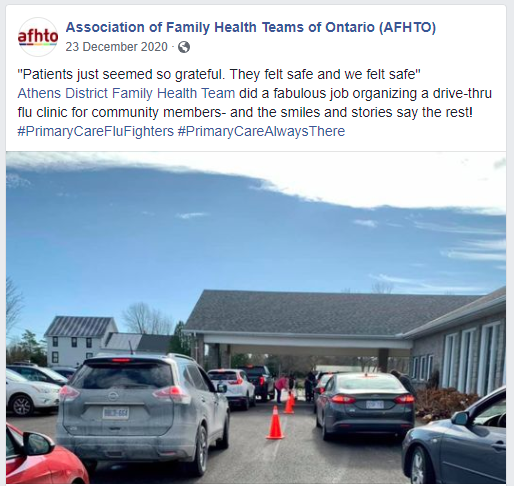
    Facebook post of Athens District vaccine drive through


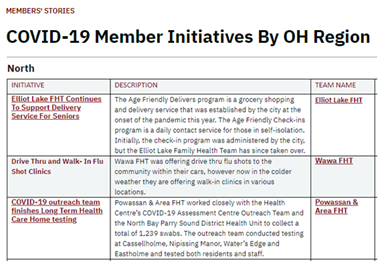
    COVID member initiatives table

    Upcoming Webinars:

    Respiratory Care During COVID-19: What Have We Learned One Year Later
    Wednesday, April 21, 2021, 12:00 PM – 1:00 PM | In collaboration with the LUNG HEALTH FOUNDATION

    This webinar will highlight practice changes and considerations for the diagnosis and management of chronic lung diseases such as COPD. This includes highlighting the challenges of respiratory diagnostics such as spirometry testing and policies and changes that were needed to provide a safe testing environment. Additionally, the webinar will highlight clinical resources and community support programs provided by the Lung Health Foundation to support primary care practices and their patients.
    For more info and to register, click here.


    In Case You Missed It: Check out eBulletin #105 or other back issues here!
    Questions? Comments? Contact us at improve@afhto.ca.

  • City of Lakes FHT part of Sudbury pilot project for AstraZeneca COVID-19 Vaccination Clinics

    CTV News Northern Ontario published April 15, 2021

    By Alana Everson, CTV News Northern Ontario VideoJournalist

    SUDBURY — There are some new options opening up for people to get the COVID-19 vaccine. In Sudbury, a family health team is part of a pilot project administering the AstraZeneca COVID-19 vaccine.

    The first vaccination clinic was Monday.

    “The province has made arrangements or has chosen the AstraZeneca vaccine, which is a vaccine which is able to stay in a refrigerator for pharmacy and primary care use,” said Dr. Tom Crichton, of the City of Lakes Family Health Team.

    During its first vaccination clinic, it took 100 people an average of 21 minutes to get their shot, including the mandatory 15 minutes post-vaccination.

    “The AstraZeneca vaccine is for patients 55 and older at the moment and because we know patients that are 60 and older can get access to the vaccine at other places right now, we targeted our patients from the age of 55 to 60,” said Dave Courtemanche, the executive director of the City of Lakes Family Health Team.

    A registered nurse who worked at the clinic and said patients expressed a sense of relief getting it with a team they were familiar with.

    “A lot of people that were a little bit hesitant, probably as soon as they found out the family health team was offering, they trust us, they have a relationship with us and if their doctor that they have been seeing for 20-30 years is offering the vaccine to them and asking them to come, they know it’s highly recommended and they are more likely to be a part,” said Sandy Tegel.

    City of Lakes plans to hold more vaccination clinics.

    “Absolutely happy to be a part of it,” said Crichton. “Looking forward to the hopeful event that there will more of the supply of this vaccine made available to us to run similar events or give these vaccines in other ways, but we are very happy to be participating in a real concrete direct way.”

    The clinics are dependent on vaccine availability and City of Lakes is urging anyone who is eligible to get it.

    “It’s almost the equivalent of, you know, you are on the Titanic and you are racing around the ship looking for the best lifeboat. This is a crisis,” said Courtemanche.

    Public Health Sudbury & Districts said there are currently six primary care settings offering the AstraZeneca vaccine and this is expected to be expanded to more sites as more of the vaccine is received.


    Read the full article here

  • Tilbury District FHT takes on the COVID-19 Vaccine Rollout

    Chatham Daily News published April 14, 2021

    By Mark Malone

    The Tilbury District Family Health Team began giving the AstraZeneca-made vaccine for COVID-19 to its 55-and-older patients this week.

    Its health team is one of two primary-care providers in Chatham-Kent administering doses as an extension of the province’s pharmacy vaccination program.

    More are scheduled to be added this week and next, said Jeff Moco, spokesperson for the Chatham-Kent public health unit.

    “The thinking is that primary care would be a good outlet to help support and reach those with chronic health conditions,” Moco said.

    The Tilbury District Family Health Team has locations in Tilbury and Chatham. Patients from both sites can make appointments, but the vaccine has been given only in Tilbury since the program began Monday.

    “We’re starting small and growing,” executive director Kelly Griffiths said.

    Approximately 30 doses had been administered as of Wednesday morning.

    “We have a limited supply and we’re going to be working with the public health unit when more supply comes in,” Griffiths said.

    “We’re really proud to be able to work with public health with the vaccination efforts in our community,” she added. “It’s pretty exciting.”

    Patients with the Tilbury District Family Health Team can call 519-682-2307 ext. 303 to book an appointment.

    “It’s going really well,” Griffiths said. “Patients are happy to be able to receive their vaccine in our office. … They have that comfort with being able to come to a primary-care provider’s office to receive it. They said they really appreciate that.”

    The public health unit provides the family health team with vaccine doses and will do the same with more doctors’ offices as the rollout expands.

    “Our role is in the receiving, distribution and education/support aspects of vaccine for those primary-care groups interested,” Moco said. “This has been the case for all of the other vaccines that one would normally get through their primary-care provider as we’ve been doing this for years.”

    A complete list of groups now eligible to receive the vaccine is available at https://ckphu.com/covid-19-vaccine/.

    Go to getyourshotck.ca to make an appointment at the mass vaccination clinic at the John D. Bradley Convention Centre in Chatham or at any future mobile clinics.


    Read the full article here

  • COVID@Home

    Shared by the Ministry of Health

    Last updated June 2, 2021

    COVID-19 pandemic has led to unexpected surges in demand on the provincial healthcare system, and healthcare settings across the province face patient capacity constraints, potentially affecting care for all patients. In an effort to ease these constraints on the healthcare system, Ontario Health is providing tools and resources for COVID@Home to help primary care providers who wish to remotely monitor people who have mild to moderate COVID-19 in the community.

    As part of the COVID@Home initiative, the Ministry of Health has procured a stockpile of oxygen saturation monitors to be distributed to primary care professionals and teams who wish to provide enhanced monitoring of their COVID-19 positive patients at home. 

    Resources


    Looking for more COVID-19 related resources?
  • Team-based primary care improved health behaviors among patients with multimorbidity

    Scaling Up Patient-Centered Interdisciplinary Care for Multimorbidity: A Pragmatic Mixed-Methods Randomized Controlled Trial, The Annals of Family Medicine March 2021, 19 (2) 126-134

    Abstract

    PURPOSE

    To measure the effectiveness of a 4-month interdisciplinary multifaceted intervention based on a change in care delivery for patients with multimorbidity in primary care practices.

    METHODS

    A pragmatic randomized controlled trial with a mixed-methods design in patients aged 18 to 80 years with 3 or more chronic conditions from 7 family medicine groups (FMGs) in Quebec, Canada. Health care professionals (nurses, nutritionists, kinesiologists) from the FMGs were trained to deliver the patient-centered intervention based on a motivational approach and self-management support. Primary outcomes: self-management (Health Education Impact Questionnaire); and self-efficacy. Secondary outcomes: health status, quality of life, and health behaviors. Quantitative analyses used multi-level mixed effects and generalized linear mixed models controlling for clustering within FMGs. We also conducted in-depth interviews with patients, family members, and health care professionals.

    RESULTS

    The trial randomized 284 patients (144 in intervention group, 140 in control group). The groups were comparable. After 4 months, the intervention showed a neutral effect for the primary outcomes. There was significant improvement in 2 health behaviors (healthy eating with odds ratios [OR] 4.36; P = .006, and physical activity with OR 3.43; P = .023). The descriptive qualitative evaluation revealed that the patients reinforced their self-efficacy and improved their self-management which was divergent from the quantitative results.

    CONCLUSIONS

    Quantitatively, this intervention showed a neutral effect on the primary outcomes and substantial improvement in 2 health behaviors as secondary outcomes. Qualitatively, the intervention was evaluated as positive. The combination of qualitative and quantitative designs proved to be a good design for evaluating this complex intervention.

    Authors– Martin Fortin, Moira Stewart, Patrice Ngangue, José Almirall, Mathieu Bélanger, Judith Belle Brown, Martine Couture, Frances Gallagher, Alan Katz, Christine Loignon, Bridget L. Ryan, Tara Sampalli, Sabrina T. Wong, Merrick Zwarenstei

    Relevant Links


  • Bits & Pieces: respiratory care during COVID-19, Stay-at-Home order and more

    Bits & Pieces: respiratory care during COVID-19, Stay-at-Home order and more

    Your Weekly News & Updates


    In This Issue  
    • Member stories
    • Reminder – Your role in improving the population health of people at risk or living with diabetic foot complications
    • Register now! A webinar on EMR/EHR auditing obligations
    • Revised Phase 2 vaccination plan, identifying vaccine-eligible patients and more
    • Data governance framework for health data collected from Black communities in Ontario
    • Resources for injectable opioid agonist treatment
    • Team-based primary care improved health behaviors among patients with multimorbidity
    • Insulin therapy and managing At-Risk Drinking and Alcohol Use Disorder (AUD) during COVID-19
    • Upcoming events including respiratory care during COVID-19and more


    Member stories
    Bancroft Community FHTBancroft Community FHT physician raises awareness about COVID-19

    Temagami FHTTemagami FHT hosts successful COVID-19 vaccine clinic

    Haliburton Highlands FHTvaccination clinic provides relief to elders

    You can share your own vaccination stories with our member initiative webform. If you have any questions, please email us at info@afhto.ca.


    Reminder – Your role in improving the population health of people at risk or living with diabetic foot complications, April 15, 2021

    Co-hosted with Wounds Canada, this interactive webinar on Thursday, April 15 will provide an overview of your role to improve the population health of people at risk or living with diabetic foot complications across the full continuum of care settings to improve patient experience, outcomes and costs. Register here.


    Register now! A webinar on EMR/EHR auditing obligations

    Teams are invited to join AFHTO and Kate Dewhirst (Kate Dewhirst Health Law) on Friday, May 7, from 12 PM to 1:30 PM to better understand obligations to audit electronic medical records (EMR) and electronic health records (EHR). Topics discussed will include why you have an audit, how often you should audit, and how to audit. More information and registration are here.


    Revised Phase 2 vaccination plan, identifying vaccine-eligible patients and more

    Recent updates include:

    We continue to update several pages on our site with resources and news:


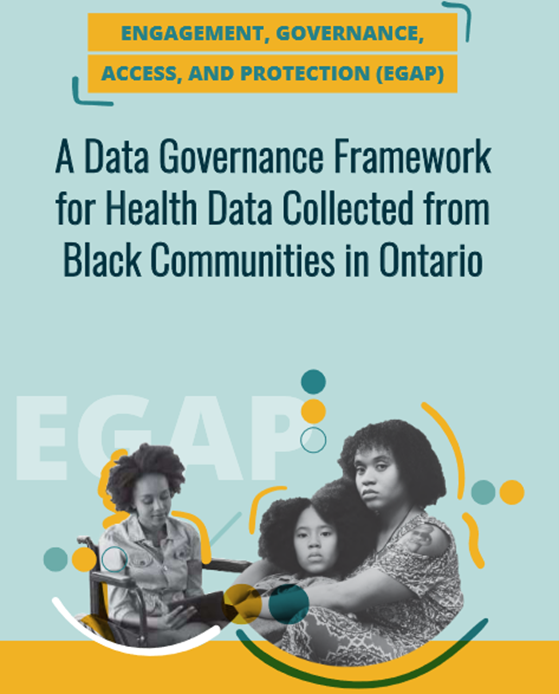
    Framework with black women- one in wheelchair and anotheer holding a black girl in her arms


    Data governance framework for health data collected from Black communities in Ontario

    The Black Health Equity Working Group has released the latest version of the Engagement, Governance, Access and Protection Framework (E-GAP), which is designed to guide the implementation of race and socio-demographic data collection strategies at the local and provincial levels in Ontario.

    • Download the report in English or French
    • Download the Consultation Summary Report in English or French

    You can contact the working group at info@blackhealthequity.ca


    Resources for injectable opioid agonist treatment
    Addictions and Mental Health Ontario (AMHO) has new resources to support increased access to injectable opioid agonist treatment (iOAT). iOAT is an evidence based and cost-effective medical intervention that is recommended for people with severe opioid dependence who have not responded to oral opioid agonist treatment or for whom oral opioid agonist treatment is not appropriate. More information and resources are here.


    Team-based primary care improved health behaviors among patients with multimorbidity
    Recently published in The Annals of Family Medicine, this research highlighted results when health care professionals (nurses, nutritionists, kinesiologists) were trained to deliver patient-centered intervention based on a motivational approach and self-management support. Read more here.


    Insulin therapy and managing At-Risk Drinking and Alcohol Use Disorder (AUD) during COVID-19

    Centre for Effective Practice recently launched new tools:


    Respiratory Care During COVID-19: What Have We Learned One Year Later, April 21, 2021

    Reflect on best practices & considerations for diagnosing and managing lung diseases during the pandemic. Co-hosted with the Lung Health Foundation
    Find out more here.


    Project ECHO (UHN), Starting April 2021
    Join ECHO Ontario (UHN) for their newly released programs starting this spring.
    For more information:

    To register, click here.


    COVID-19 CoP: Vaccination in primary care, evolving vaccine evidence, and more, April 23, 2021
    The OCFP & University of Toronto DFCM will be discussing evolving vaccine evidence and experience delivering vaccines as part of primary care pilots.
    Learn more here.


    Primary Care Vaccine QI Support Group Webinar Series, April 22- May 13, 2021

    Join Ontario Health to learn valuable lessons from pilot sites, gain access to resources, information and quality improvement tips to assist you in moving forward with your vaccine plans.

    Register here


    A Deep Dive into Co-Designing Care Models for your Priority Populations, May 6, 2021
    The RISE OHT webcasts will show how your OHT can re-design care for patients in your priority populations, and help every patient in those populations experience coordinated transitions between providers.
    Learn more here.

  • Mobilizing Primary Care to Support Hospitals with COVID@Home and Ramping up COVID-19 Vaccinations

    Dear triad members,

    Last night we received a memo from Matt Anderson, President and CEO of Ontario Health, that outlines the severity of the situation in hospitals due to the increase in COVID-19 cases.

    Ontario is facing a severe crisis with hospital capacity due to the surging number of cases. The positive COVID-19 cases announced today was over 4,200 – the second highest number since the pandemic began. The pressure on hospitals’ critical care capacity is extreme. As a result, Ontario Health has instructed hospitals to ramp down all elective surgeries and non-emergent/non-urgent activities to preserve critical care and human resource capacity as of Monday, April 12, at 12:01 AM. This does not currently apply to hospitals in the Northern Ontario Health Region or pediatric specialty hospitals.

    In the ADM memo we shared yesterday with the EDs and administrative leads, PHUs have been asked by the Ministry to utilise primary care to their full capacity in the mobile team vaccination efforts and in contacting eligible patients to encourage they vaccinate. This includes anyone aged 18 and older in high-risk communities, as announced on April 7.

    There will be pop-up and mobile clinics for those aged 18 and older in high-risk communities at essential workplaces, in community centres, and in public spaces. At this time, people aged 18 to 49 cannot book online; mass vaccination sites will be adhering to older age cut-offs and other eligibility criteria, as noted on the online booking page. Communication about this to patients will be critical.

    Teams are encouraged by the Ministry to work with their PHU to be clear on eligible patients and to optimise the use of primary care in delivering the vaccines.

    You will also soon receive a memo from the Ministry requesting that teams who are in identified hot spots (about 30+), where hospital capacity has reached its limits, help support the care of mild to moderate COVID-19 patients in their homes with the COVID@Home program. You may hear from your Senior Program Consultant, who will check to see what kind of capacity you have for this initiative, including extending support to patients of non-affiliated physicians in your community.

    As part of the COVID@Home initiative, the Ministry of Health has procured a stockpile of oxygen saturation monitors to be distributed to primary care professionals and teams to provide enhanced monitoring of their COVID-19 positive patients at home. To learn more, the Ontario College of Family Physicians has shared a webcast explaining COVID@Home with Dr. Dee Mangin from their most recent Family Medicine Summit.

    We have requested a meeting for teams early next week with the Ministry and/or Ontario Health to support teams who have questions. We will share that information as soon as we have it.

    For today, please reach out to your public health unit, if you have not already, to help support community-wide vaccination efforts. All needed care for your patients remains critical. However, as this is a dire situation that Ontario is facing, we encourage you assess your ability to support the vaccination efforts and to help relieve strain on the hospitals to the best of your capacity.

    We will continue to keep you posted as we learn more. These are incredibly challenging times, and primary care will be critical in ensuring we get through them.

    Thank you for the work you are doing. If you have any questions, please contact us at info@afhto.ca.

    Yours in good health,

    The AFHTO team

  • Ontario stay-at-home order and the Phase 2 COVID-19 vaccine distribution plan

    Dear Executive Directors and Administrative Leads,

    The third province-wide stay-at-home order took effect today at 12:01 AM.

    Under the stay-at-home order, primary care teams are encouraged to continue virtual care wherever possible but do not stop or delay in-person care. It remains at a clinician’s discretion to determine if a patient needs to be seen in person.
    While all teams have continued to deliver virtual care since the pandemic began, a reminder that the following are available as support tools in determining virtual vs. in-person care:

    In yesterday’s announcement, the provincial government did not address some of what we consider important to help control the spread, such as paid sick days. However, the pivot to go into high-risk communities and to vaccinate anyone there aged 18 and older is a step in the right direction.   

    These mobile teams – part of Phase Two in the COVID-19 vaccine distribution plan – are starting in the regions with the highest rates of transmission (ex. Toronto, Peel). This will expand to other hot spot regions based on established patterns of transmission, severe illness, and mortality. The news release can be read here.

    We received this memo today from ADM Patrick Dicerni regarding vaccination. On a related note, we encourage teams to work with public health regarding the mobile teams that will go to high-risk congregate settings, residential buildings, faith-based locations, and locations occupied by large employers in high-risk communities. Vaccinating is something primary care does best, and no one knows their communities better! If your team has the capacity, reach out to your public health unit as primary care can play a key role in getting these shots in arms.

    This is hopefully the final time we’ll see a stay-at-home order issued in Ontario for COVID-19.

    If you have any questions, please contact us at info@afhto.ca.

    Stay well,
    AFHTO

    Relevant Link: