In this Issue:
- AFHTO 2021 Conference Poster Highlights
- Your Role In Improving The Population Health Of People At Risk Or Living With Diabetic Foot Complications
- Query Supports: Identify your Target Population
- Ontario Health Updates
- Quality Standards
- Upcoming Webinars
AFHTO 2021 Conference Poster Highlights
At the AFHTO 2021 Conference, we hosted an exhibit of numerous posters highlighting evidence-based, impactful innovations by your colleagues. We encourage you to take a moment to check out these posters and reach out to teams to see how you can implement these innovations too!
Given November is Diabetes Awareness Month we would like to highlight a few innovations you can implement in your teams to improve diabetes care, all poster innovations presented at the AFHTO 2021 conference.
1) Proactive Diabetes Care
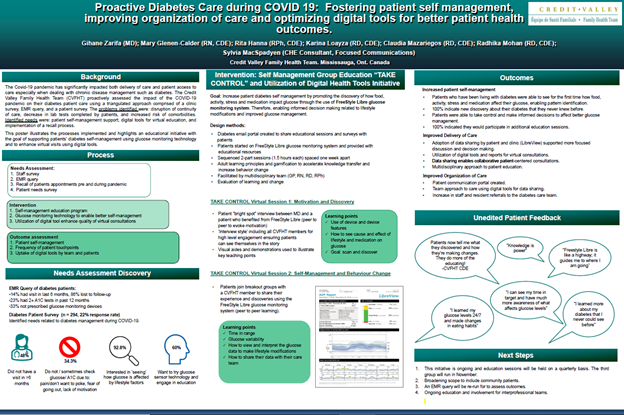
COVID-19 disrupted the continuity of care for patients and propagated deterioration of chronic conditions such as diabetes. Credit Valley Family Health Team (CVFHT) proactively assessed the impact of the pandemic on their diabetes patient care using a triangulated approach comprised of a clinic survey, EMR query, and a patient survey. CVFHT prioritized the needs, creating a Just in Time intervention which was a proactive virtual educational strategy designed to reduce deterioration of diabetes outcomes, foster patient engagement and improve patient self-management. The 2-part education intervention utilized a team-based approach and was grounded in principles of learning and behavioural psychology with the goal of promoting behaviour change. For more information, please contact: Dr. Zarifa, gihane.zarifa@thp.ca
2) Implement Self Management Tools for Patients
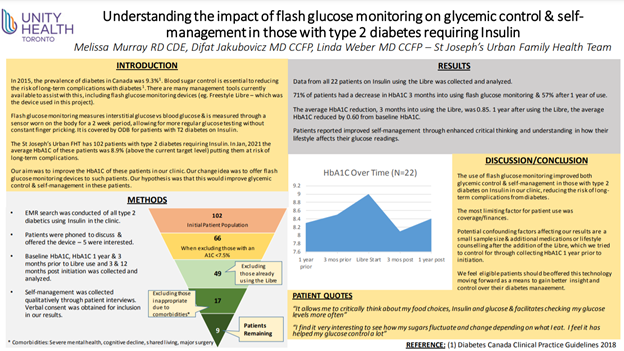
St. Joseph’s Urban Family Health Team’s initiative aims to improve the glycemic control of those with type 2 diabetes, reducing the risk of long-term complications. Their aim is to ensure all patients eligible, are offered flash glucose monitoring to monitor their glucose and provide them with more insight over lifestyle factors impacting their glycemic control. Their aim is that if this monitoring system does improve indices, that all patients requiring insulin therapy are offered this as an option, to improve their quality of life and reduce the risk of long-term complications. For more information, please contact: improve@afhto.ca
3) Dynamic Digital Engagement
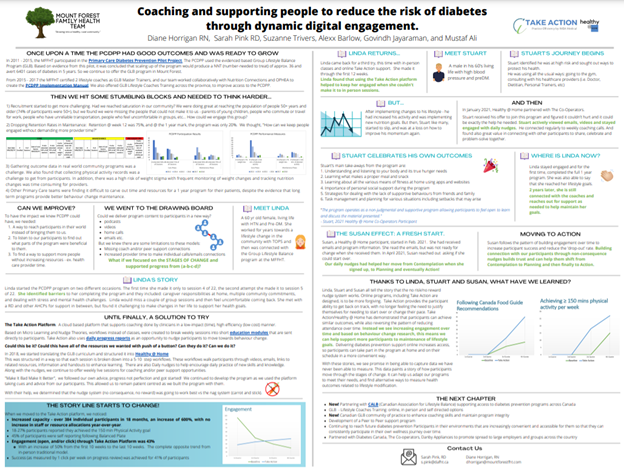
Mount Forest Family Health Team, in partnership with IMA Medical Group, demonstrated how Engagement and Success can be tracked differently within a virtual care model. They also included how engagement over time can be leveraged to build more personalized success experiences that enhance their ability to guide themselves from pre-contemplation to action. For more information, please contact: Sarah Pink, s.pink@dafht.ca and Diane Horrigan, dhorrigan@mountforestfht.com
4) Updating EMR tools for Accessible and Trackable Data
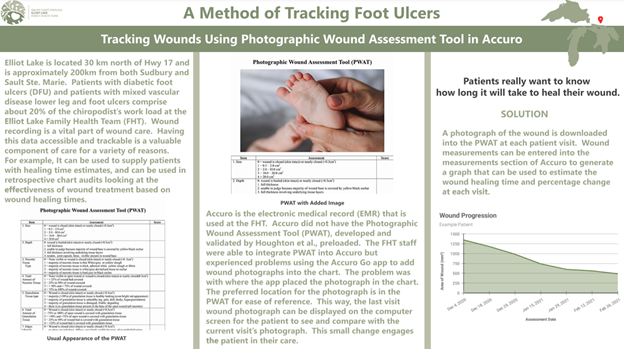
Wound documentation using a validated tracking tool in combination with proper wound care product selection is a best practice. When Elliot Lake Family Health Team heard from their patients, “Patients really want to know how long it will take to heal their wound” they implemented a tool within their electronic medical record (EMR) to give patients accessible and trackable data. Elliot Lake Family Health Team was able to track wounds and able to predict which wounds will heal and which wounds will be hard to heal. For more information, please contact: Mary Ellen Mitchell, M.Mitchell@elfht.ca

Your Role In Improving The Population Health Of People At Risk Or Living With Diabetic Foot Complications
Earlier this year, AFHTO, in collaboration with Wounds Canada hosted a webinar to provide an overview of your role to improve the population health of people at risk or living with diabetic foot complications across the full continuum of care settings to improve patient experience, outcomes and costs.
Click here for the recording and slides.
Query Supports: Identify your Target Population
MyPractice: Primary Care Report provides an update on the HbA1c Indicator: % of patients with diabetes who had 2 or more HbA1c tests within the past 12 months, approximately every 6 months. In order to assist you with retrieving data in real time from your EMR, the QI in PC Council has created a number of queries which can be found here. Please note, these queries will have to be adjusted per team, but they provide a reference point. In addition, eCE has created a Diabetes Manager.
On November 18th the QIPC council shared a process that worked well for London FHT that collaborated with ‘Partnering for Quality’ to develop and create comprehensive searches for guiding data supporting quality improvement initiatives on Diabetes, Congestive Heart Failure, and Chronic Obstructive Pulmonary Disease. Using the foundational approach of identifying suspects for coding patients, to then selecting targets to improve the patient level of care, and displaying the data in PowerBI analytical software, made quarterly reporting easier and initiated further discussion around what targets to select next.
If there is interest in learning more details about how this may work for you contact the Partnering for Quality team about the PFQ-ID Dashboard toolkit. A simple no cost solution for obtaining your EMR data and presenting it back in an efficient usable way for the team.
Ontario Health Updates: Upcoming events and programs in support of Diabetes Awareness month
Content below developed by Ontario Health (Health Quality Ontario)
November is Diabetes Awareness Month around the world. Did you know that this year also marks the 100th anniversary of the discovery of insulin? In Ontario, about one in ten people have some form of diabetes. See below for some upcoming events and resources that can support you in your practice related to care for diabetes:

Webinar | MyPractice: Primary Care Report: Using Data for Improvement | Monday November 22, 2021 • 12–1 p.m. Ontario Health is hosting a webinar for primary care providers on using the diabetes management indicators in the MyPractice: Primary Care report to drive improvements in patient care. Please register here to join the session. This is the first of an ongoing series that will focus on using data from the MyPractice: Primary Care report for quality improvement.
This program is part of a series that has been certified for up to 4 Mainpro+ credits.
Quality Standards
To address gaps in the health care that people with diabetes receive across Ontario, and improve their health outcomes, Ontario Health developed three quality standards:
- The Type 1 Diabetes quality standard addresses care for people of any age with a diagnosis of type 1 diabetes.
- The Prediabetes and Type 2 Diabetes quality standard addresses care for children and adults who are at risk of developing prediabetes or type 2 diabetes or who already have a diagnosis of either. It includes the assessment, diagnosis, and management of prediabetes and type 2 diabetes.
- The Diabetes in Pregnancy quality standard addresses care for people with type 1 and type 2 diabetes who become pregnant and people diagnosed with gestational diabetes. It includes preconception care as well as management of diabetes during pregnancy.
Included with each quality standard is a patient guide you can use to support your conversations when discussing diabetes care with your patients. Stay tuned for information on upcoming webinars related to diabetes.
Family physicians can now earn up to 5.5 Mainpro+® credits for reading the diabetes quality standards through the Understanding Quality Standards in Primary Care program. To enroll or to learn more, please contact UnderstandQS@ontariohealth.ca.
Upcoming Webinars:
Practical Approaches to Polypharmacy: The Gentle Art of Deprescribing
Dec 1, 2021 (12-1 pm EST) | Register here.
In this webinar we will explore approaches to the issues and problems around polypharmacy and deprescribing in primary care patients. We will discuss approaches to the integration of patients’ goals and priorities with evidence. In the second part of the webinar, we will demonstrate the TAPER tool (Team Approach to Polypharmacy Evaluation and Reduction), an integrated pathway designed for use in a primary care team-based approach as routine “prevention” in primary care patients with polypharmacy.
Using Electronic Medical Records to Choose Wisely: Push, Pull, Nudge
Dec 1, 2021 (12-1 pm EST) | Register here
Reducing inappropriate antibiotic prescriptions has been a long-standing challenge in primary care. With the increasing adoption of digital tools in primary care practices, how might we take advantage of features within EMRs to help improve antibiotic prescribing?
Choosing Wisely Talks on December 1 at 12 p.m. ET will explore efforts to work with EMR vendors to embed antibiotic stewardship tools into their digital workflows. Dr. Darren Larsen, family physician and expert in digital health, will share how leveraging EMRs can not only help improve patient care, but also help change clinician behaviour.
In Case You Missed It: Check out eBulletin #112 or other back issues here!
Questions? Comments? Contact us at improve@afhto.ca.
Leave a Reply